


An initiative of the University of the Arctic, co-led by Jessica Shadian, Florian Stammler (Arctic Centre, U Lapland), Gunhild Hoogenson-Gjorv (U Tromsø).
PhD Course-Symposium in conjunction with…
The Rovaniemi Process Conference
Course Website


⇒ the arctic city
1 to 6 december…
Epilogue:
Such difficulties to recount the entirety of the week, what with workshop presentations, dinners, coffee breaks, a full-blown interim conference, one-on-one conversations, and pizza lunches.
In fact, more than an epilogue, I write nothing short of an apoligogue.
I could not keep up with the presenters, all the papers were strongly worked up. There is no telling to what constructive ends workshop attendees aim. But here are partial glimpses providing the week its form and a Nordic blog soundtrack. 😉


I should add, in fact, that quite a few return folks from the U Tromsø workshop this past spring presided. Heather Clarke, PhD graduate student, Memorial U, St. Johns, looking at fly-in/fly-out communities in the North, employing a citizenship framework applied to the firm. Makes sense, actually, given that some years ago, Étienne Balibar, swung by campus in heavy lament over the demise of cultural citizenship privileges lost to national populations from the deregulating state.
 Tara Cater, PhD student at Carleton reflecting on decasia of industrial mining, Nunavut, Canada — the will of things to become more disorderly, to seek entropy, and the aesthetic fascination with the deterioration of objects, how they acquire new drama and character, as well as fans, chroniclers, and hangers-on, like ourselves.
Elena Nuykina, U Vienna, and Piotr Graczyk, U Tromsø, were also in Troms, and in attendance here at Rov.
Mercy Oyet also PhD student at Memorial U, talking about Nigeria, a topic of increasing academic interest. In fact, not to digress, but two chapters come out soon on Nigerian oil industry by Rebecca Golden (petro-masculinities) and Elizabeth Gelber (oil bunkering) in the edited volume Oil Talk (Cornell U Press 2014).
 Well, we congratulated newly awarded Postdoctor, U Vienna, Gertrud Eilmsteiner-Saxinger [directly above], who entertained with a talk that might be described as the Techne of Being, reflecting on the spaces through which commuters come to understand their corporeal existence in relation to techno-ontological dimensions of modern day travel.
 Gordon Cook, faculty at Memorial U, enlightened us on his expertise – tourism, and modes of entrepreneurial thought as applied to remote locations, how they might be re-thought of as centers of visitation.
Two additional papers capture our attention, in particular, Julia Olsen, on the topic of settlement relocation in Yakutia, Russia, and a lack of securitization by local government, a critical infrastructure failure taking place, in fact, while in the process of provisioning for environmental risk. Fascinating. A variation on zones of indistinction. And followed by Maja Kadenic, examining megaprojects and thinking of method in constituting the normative dimension of comparability across time.
Well of course many other folks presented, and we will refer to them shortly, but with brevity. Speaking of provisioning, many thanks to U Leeds’, William Davies, who kept us all up to par with administrative capacity and dining organization.
 12/5: Leena Suopajarvi, is up talking about mining and community viability in Finnish Lapland.
Futures related to natural resource development. Mining began around mid 19th century gold rush and during the 1960s geological survey provided systematic study of mineral resources.
Since joining European Economic Area 1994, international mining companies have access to mining areas. Social impacts of mining are assessed in the planning phase of the project as part of the environmental impact assessment: predictions, not impacts.
Social impacts = corporeal, cognitive and/or emotional factors of real life; changes caused by the mine.
 Emma Wilson up next talking about guiding principles on business and human rights. What frames a lot of exchanges is the UN guiding principles on business and human rights (protect, respect, and remedy). Social license to operate.
 12/4: Okay, well, Wednesday now, listening to Michael Young talking about the plight of hard to house persons in Western Canadian Arctic. Now up is Ludmila Ivanova, talking about the role of the mining industry in socio-economic development of the Murmansk region. Up now we have Gertrude Eilmsteiner-Saxinger, talking about fly-in/fly-out in the Petroleum Industry of the Western Siberian North. This is quite interesting, looking at labor conditions in Yamburg at remote oil sites or at mobile labor camps.
 12/3: Florian Stammler, U Rovaneimi, Senior Researcher, introducing second day, on a panel that coincides with The Rovaniemi Process Conference.
The panel today is People and the extractive industries: assessing impacts, sensing opportunities and mapping Arctic community viabilities. This session strives to create interrelations between various networks that raise potential risks and threats to concepts of community or community viability.
 Chris Southcott, Mark Nuttall, Emma Wilson, with Chris up first talking about climate change and viability. Chris’ ongoing research project. Resource and Sustainable Development in the Arctic (ReSDA). In the past, local communities have often been devastated by resource development. Research meetings with indigenous communities, wanting people want to find ways that oil and gas development can take place with positive effects.

 Climate change had brought increased attention to the Arctic. A dominant issue in global discourses, often linked to opening up the Arctic to resource development.
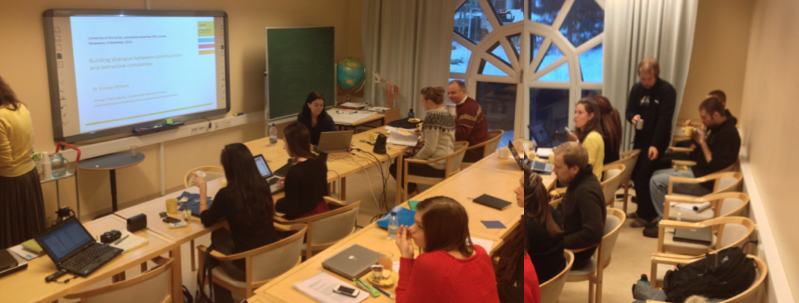
12/2: Okay, well. Here we begin at Rovaniemi, University Arctic Centre, just listening to Florian Stammler, introducing Lapland and everyone else introducing themselves.

 Amazing enough to say, sitting right next to me on my left is none other than Professor Mark Nuttall, U Alberta, and directly in front of me is IIED wonder, Emma Wilson, and then, sitting on the right is Piotr Graczyk, U Tromsø. Wow, the whole team of specialists right here, gathered to do what we gather to do.
Talk about energy stuff.
And students too. We are just now introducing everyone, and we will come to everyone during this entire week. Okay, up now we have Natalia Loukacheva, introducing us to the topic of resources in the Arctic. Nuclear power stations is now the topic, with several installations across Finland, Sweden, and Russia, the latter having now in mind a few floating nuclear stations. A peat power plant in use at Rovaniemi. Mining, uranium, rare earth minerals. Coffee. Not a rare earth mineral, but important at 9:40AM.
Conventional and unconventional distinctions — typically well, in this case, perhaps, the threshold becomes an economic factor (a generalized term versus a technical distinction).
 On shore/off shore issues. Natalia provides an instructive genealogy of events on pipeline projects across the Arctic. Moving from Mackenzie Delta developments (1970s-80s) across Barents Sea (1980s) Western Siberia (on land 2002) and upcoming Offshore Ru, Fr. No. Alaska, IS.
Okay. Here we have a Drivers-concerns-community considerations: Energy Endowment, future demand and price, environmental risk (oil spills, ecological impacts), access to resources (infrastructure, geopolitics, sea ice), technology (conventional and unconventional resources), role of communities.
That is Natalia’s list, but Emma points out that climate change is important and the campaigns against development, including considerations such as Al Gore’s Stranded Carbon Asset report.
 Now we turn to the topic of communities (health, economic opportunities, socio-economic wellness, implications for wildlife, participation in decision making, long term benefits, implications for future generations…).
General Discussion: What characteristics make these developments “Arctic specific”? That is a good question. And Natalia’s response is quite good too, responding in particular to how different communities respond, and how particular questions reflect particular regulatory conditions.
Depending on what types of categories invoked. Great comments by Florian and Emma, reminding us to not consider the Arctic as a self-enclosed box but to broaden our comparisons to other development zones.
 Chris Southcott is up now, from U Arctic, Yukon College, talking about resource development.
Canada village studies, looking at Northern Community development – taking on workshops developing a sense of what community needs might express what they understand as aspirations. Jobs, in fact, resource development in such a way that communities develop.

 “Simple research question”: Can resources be developed in a manner that help long term sustainability of communities and how can this happen? ReSDA (acronym for research project). Walking through the method of the proposal – very informative. Initial findings of the “Gap Analysis”: Communities have an increasing confidence in the their ability to control resource development to meet their needs (surprising confidence) but there is a difference between new treaties and historic treaties; They want to know the best ways to carry out development; They want to know what are the likely impacts of resource development, how these impacts can be best measured, and what is the best way of dealing with these impacts; They want to know how other communities have dealt with resource development to maximize benefits.

 Mark Nuttall! Up now talking about Greenland. Ah. interesting. The Arctic is becoming synonymous with Arctic Ocean, thereby emptying out the location of its indigenous occupancy. Nature as a space of contestation. Climate change is a key driver of climate change.


Read Full Post »
 12/10: Blew into Helsinki to work with Katariina Vainio-Mattila, U Helsinki, on a few proposal resubmissions, and feeling as I have never left, especially stopping through Fratello across from Sokos Helsinki, the former, where I spent most mornings some months earlier. A list of deadlines between here and getting off at SFO International on Thursday appear manageable under the spell of the writer’s grotto.











































 Paparazzi Ethnography