Feeds:
Posts
Comments

Archive for the ‘Paparazzi Ethnography’ Category

Reykjavik

21-25 April –

Nordic Conference

XIII Nordic-TAG

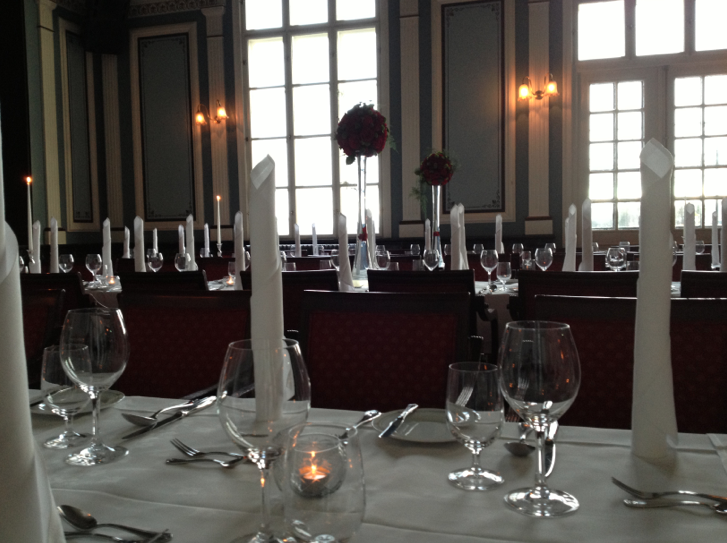
banquet
Screen Shot 2013-04-24 at 5.06.18 PM
town4/23: Starting up here now, second day, with Kathryn Lafrenz Samuels speaking about transboundary sites of scientific exploration on the Arctic scale. Struve Geodetic Arc. Points from a survey 1816-1865 — the survey helped determine the shape and size of earth, the nomination of the Struve Geodetic Arc as a world heritage site. Various attempts to commemorate sites through markers and postholes. Only in 1954 was its meridian measurements improved upon.
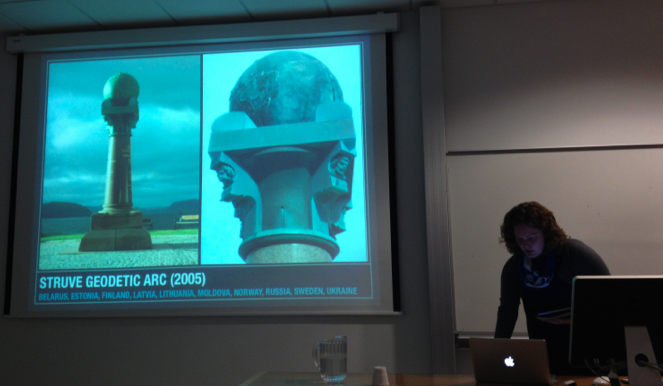
geoMid-Atlantic ridge, submerged underwater, UNESCO has no jurisdiction over the ocean, but can assign the ridge at the bottom as a site. Discovered in the 1950s, evidence of continental drift. Set in deep geological time. “Calibration of human experience with human and global terms” and linking that to policy and institutional frameworks for coping with transnational governance, for example, climate change. Elite and expert approaches. Science and technology as the lingua franca of international cooperation. Transnational governance: UNESCO World Heritage is one transnational solution to foster international cooperation around issues of resource management and conservation.

mapFrigga Kruse is up now talking about British involvement  in early industrialization of Spitsbergen. British mining, exploration, and geopolitics on Spitsbergen, 1904-1953.

Fascinating presentation by Genevieve LeMoine on Peary’s exploration and quest of the North Pole. She explores the sense of community Peary creates and interactions among Greenlanders, maritime laborers, and explorers, examining the techniques used in the contact situation of Peary’s 2-year occupancy of Floberg Beach.

Dr. LeMoine (and co-author Susan Kaplan) examine a variety of different sites, including Floberg, excavations of Lake Hazen occupied by Peary workers, and museum exhibitions. She examines a midden, a blight on the landscape in its own time. Proposed stove designs by Peary while on board the Roosevelt at Cape Sheridan, trained as an engineer and had the crew and families safety at heart (see image directly right-below).

Screen Shot 2013-04-23 at 12.02.17 PMSo, Dr. LeMoine identifies “tin stove pipes, making pails out of kerosine cans for Eskimo”. Why, as soon as they get there, where they making makeshift stoves [cups, bowls] from tin cans, to provide basic comforts?”

Some are skillfully finished and soldered, putting a lot of effort into making them. Repurposed tin cans are found all over the world, and there was an abundance of tin cans from the midden. Stoves play an important role in Inuit life, keeping a smoke free flame, light, and are strongly gendered artifacts, integral to women’s identity.

Screen Shot 2013-04-23 at 12.02.37 PMA traditional lamp burns seal, whale, walrus blubber, but Cape Sheridan was a bad location to hunt sources of fuel. Greenlanders did bring their own lamps, but could not bring enough fuel, and thus, probably these tin can stoves were makeshift possibilities to fit the new occasion. In fact, women were crucial for work, sewing, etc. but also “feminine companionship” not only for their partners but for the Peary’s non-Inuit crew. This created quite a bit of stress.

The stoves are, LeMoine argues, evidence to the stress and challenges to living at the Peary community as women who traveled to work on the exploration.
stoves
The entanglement of explorers and Inuit women, and the latter working with strangers far from home, under stress hand crafting stoves, etc. and to adapt and create what was important to them.
blurinside

lunch4/22: Starting up on the first full day of the conference. The first set of presentations, we chose to attend, falls under the general title: Foregrounding Things, forms and faults of representation. Sounds interesting!
icelandersÞóra Pétursdóttir is up, now making introductory remarks, reading from Bjørnar Olsen‘s prepared talk, who could not be here, referring to Bruno Latour‘s conception of how things manifest themselves and portray their essence  to “us”, a take on the Heideggerian principle of ontological character of objects that take on continued historical patinas of social and cultural order.

Sensory aspects and tacit skills in fieldwork, the materiality of things, fieldwork, attentiveness, an intellectual exercise focusing on the physicality of things that belie a certain latent Aggressive Hermeneutics (citing Susan Sontag), a conquest over the real, a dissatisfaction of what is there, to get beyond what is there, to read a significance that is more appealing and sexy that neglects otherness and turning ontology into a disciplinary brigade of useful things for “us”.
museumA plea to acknowledge also, largely forgotten in theoretical regimes, the immediate effect of things, how their very presence strongly affects us, and also the way we comprehend things. Concluding by citing social theorist of ideology, Terry Eagleton, affections and aversions, of that which takes roots in the gaze and guts, the aesthetic, the most gross and palpable, of the body’s long tyranny of the theoretical.

Okay. That was great. Now. We have Thingly Qualities and Tacit Properties of Nuclear Waste, Cornelius Holtorf. 300,000 tons of radioactive waste in the world, and 12,000 tons added every year, with half lives of 24,000 years (Pu-239) to 17 million years (1-129). Talking about Sweden’s nuclear waste disposal site. Swedish Nuclear Waste and Management Company, for which this speaker received some research funds, and for the purpose to communicating the real properties and thingly qualities of nuclear waste.

museumHow do we represent or mediate things without risking that their genuinely thingly qualities are lost in translation? Such as Nuclear Wastes. Answer:  a category of qualities (1) Scientific prose and formal style — but language is problematic, unless there is a Rossetta stone. Tsunami stone markers in Japan, several hundred years old, that indicate where not to build villages, but still, they still do not mediate; (2) Other, more poetic/prosaic ways — symbolic representations that communicate to future generations to avoid digging in nuclear waste areas, such as a symbol of a skull and crossbones; (3) visual media and art, landmarks that communicate that a place is a forbidden zone, through a wall or installation, which communicates to other beings, such as the holocaust memorial in Berlin, communicate an eerie-ness, a similar technique, but more difficult to steer the particular meaning taken from it. The Pyramids, for example, were there to protect burials, but in fact, did not even last several generations.

inside alsomuseumQuestions of how to communicate radioactive waste to future generations. Conclusions: (1) The need for non-standard forms of representations is obvious (writing an academic article and burying it in the waste area is not helpful); (2) The aim is not to represent “the way things are and articulate themselves” but to prevent harm from future human begins (or their descendants); (3) Representing “genuinely thingly qualities” is done by and for people. It reflects how they look at these things and the future — In particular — Effort and Intended Content. OECD level working with nuclear regulators in Europe, trying to figure out how to label “no-go places”.

meetingThus, a major hazard for future people, not a resource or minor issue like other waste. What he says here, quite interesting, is that the way we view waste today, is that it is waste, but it could be viewed by future generations who could potentially use these products, as energy, for example.

photosCiting Susan Sontag, all photographs are memento mori, Sigrún Alba Sigurðardóttir, now up, redexplaining the lived experience embodied in a photograph which Sigrún is talking about to explain who she is, voluntary and involuntary memory, citing Proust, that which resides in our minds, while other memories reside in our senses, memories in our bodies that we do not realize that we have, now citing Walter Benjamin, talking about about lived and non-conceptualized experience, facing reality absorbing it.


Speaking of Photography… after lunch, we decided to catch up with Kristinn Magnússon, professional ljómyndari (photographer) of architecture, food, and people. Today, we found him hanging around one of the top restaurants in Reykjavik.

at work

whenever

watching

light panel

focus

moving


We met in the elevator and sped up to the top floor, moseying around, looking at the sites.

Watching him prepare the gig, set up the scene, we asked a few questions about preparation and concentration.

Kristinn is pretty focused and feels confident about moving on once he feels he has got the number of soft and hard shots he is after.double checking

Enrolled at the Art Institute of Ft. Lauderdale, where he spent some additional time working with a few folks, but born here on the Island, he moved back home in 2006.

We followed along for the ride to observe his technique, asking few questions so as to not really get in his way.inside
He was carrying out a quick-shoot for one of the various Icelandic magazines that he works for. We will catch up with Kristinn again soon, to see the sights around Reykjavik from the eye of a professional.


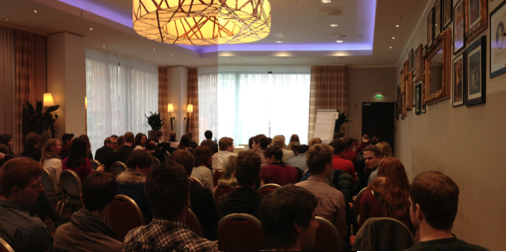
4/21: Here in beautiful Reykjavik at the 13th Nordic conference. What do we have? Up now, giving a few opening remarks from his recent trip to Washington DC, is the President of Iceland, Ólafur Ragnar Grímsson.

President
We are going to turn the Paparazzi Ethnographic microphonic blog over to the President himself:

Coming back from Washington DC, talking about the Arctic for one week, now here opening your conference talking about the old ways of the world. From your title, you are somewhat influenced from the past, talking about Fringes, Margins, and Edge. hands

I know it is not usually done in my profession to open a speech by saying the title is somewhat out of place [laughter] but I think it is important, that we realize that the western view and opinion is not really in focus, and we have been brought up with all these maps thinking that we are in the center, where Greenland is a little place up there, but that it is half the size of Europe, and never indicated to us that long before we wrote the literature on the Viking period, there were people for thousands of years who made this “remote” part their home.

handsyCertainly at the beginning of the 20th century, Icelandic explorer, Stefanson, by discovering the most northern parts of Canada, coming back to NY, explaining to the Explorer club that indeed there were people up there, and so famous he became that folks wanted to make him the first president [of Iceland].
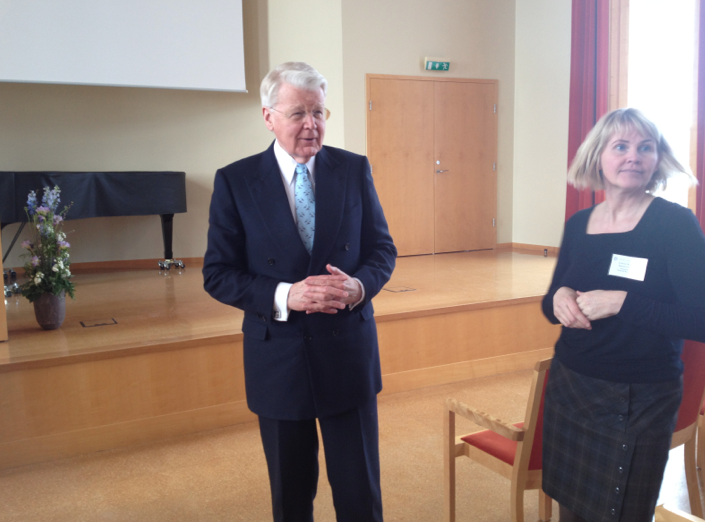
president looking greatLast week in Washington, the core of my discussions, with Senators, White House, Brookings Institute, and other pillars of policy dialogue, was that this Arctic neighborhood has become crowded. Last year every meeting I had with an Asian leader was their desire and right to have a seat at the Arctic table. This was the first topic, a month ago, in my meeting with the Prime Minister of India, was the future of the Arctic, during the first half hour of our meetings.

handsI said to both of them [China and India] because of our friendship, it is somewhat paradoxical that they did not want to talk about the ice covered areas of their world, Tibet, and didn’t want to talk about their people, but wanted to speak about my area of the world and my people.

If we now face a situation, where every national power wants to be a part of the Arctic, it is very important to bring to the attention the culture of the people who have lived here for thousands of years. We are recent arrivals.

shaking handsQuoting a Alaskan Elder, there was never any problems with nature and the people until the arrival of the White man. And I was reminded that there have been people in the Arctic much longer than [Icelanders] have. Quoting the elder again, there was so many negotiations with State of Alaska, federal government, oil companies, maybe he made a mistake, “Sitting Bull had been right after all” — Sitting Bull, who likely does not appear in any syllabus in your course readings, was the Indian Chief who refused to make any agreement with recent arrivals, “why should I make deals with those who want to take it over”.

And we enter into dialogue with the folks you decide to call “Fringes, Margins, and Edge” — this is their world, long before [the rest of us arrived].

friendsTo remind you and myself, that what we in Europe and the Western World, have looked at as a remote culture, as a people on the fringe and on the edges, is that their world is not on the edge, they are on the edge of our world, and that is a colonial view, but they are at the center of their world.

One of the most testing challenges, we face in the years to come, is whether we plan to respect the rights and culture, and that we are on the forefronts of human rights, but will we be up to the test of deciding on behalf of Northern Peoples when it conflicts with the interests of the state. So far, we have not been so successful.

presidentWhen we are [here] now, where the Arctic is the main global center of the political theater, where Asian leaders are requesting to be a part of the Arctic future, for those who have lived here for thousands of years, their lives are of utmost importance. Nowhere else will archaeology be so important than in the Arctic over the next several decades.

alsoWith these reflections, and reminder that maybe you should have chosen another title, I wanted to share this with you. I think it is utmost important that the scholarly work of Archaeology should not produce a colonial view that this part of the world is the edge, otherwise we will make fundamental challenges about the human rights and of how the world is composed.

[Applause]
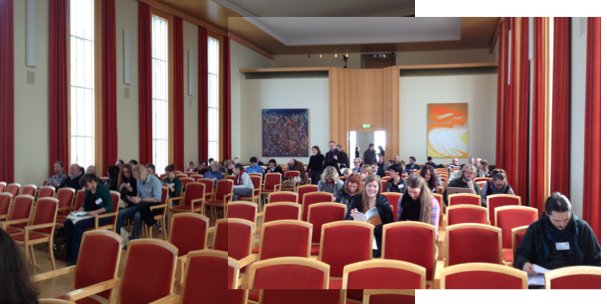
peopleUp now is Keynote SpeakerLynn Meskell, Stanford University, talking about UNESCO and World Heritage. Let us provide a summary as Lynn speaks forward. Official observer at UNESCO meetings, archaeology reaches world heritage recognition, but archaeologists are absent. Archaeology offers a powerful lens on Heritage.
invitationSo, this is a very interesting talk, clearly very complicated, about assigning UNESCO heritage sites based on nation-statehood, and thus Palestine, for example, was not able to register a world heritage site because of geopolitical contexts.

Global Indigenous Council of experts within UNESCO. Okay, that sound interesting. It was promoted initially by Australian government but, oops, quashed a year later. The decision to formalize the group was delayed. The scale of the French objections were excessive. Citing Wendy Brown, political philosopher.

Citing a journalist for the UN, “The truth is that the UN is too weak, not strong enough”.

Coffee Break

Great coffee break– as usual. We had a chance to catch up with the talented archaeologist hailing from U Tromsø, nearly PhD (submitting her dissertation in one month) Þóra Pétursdóttir, who will be speaking shortly on the role of photographic imagery in archaeology.

Alba
coffee
Here are few folks we know, Drs. Kathryn Lafrenze Samuels and Genevieve LeMoine, looking smart and well rested after the long flight from the United States, where Kathryn, coming form North Dakota State U. (NDSU), and Genevieve, from Bowdoin College in Maine.
ladies
Kathryn has brought with her a group of undergraduates, nearly graduate, and graduate students, funded through the National Science Foundation (NSF) — Good for NSF and also NDSU.

We had a chance to chat briefly with the students, several of whom are archaeologists and two cultural anthropologists working in heritage, and we would just add that we were impressed indeed, with the sophistication of conversation coming from residents of the newly oil rich state just south of the Canadian border.students etc.
entrance
> The session focuses on the heritage of science and technology in the Arctic.
> The conference is the XIII Nordic-TAG (http://www.nordictag2013.hi.is),
> which will take place at the University of Iceland in Reykjavik, April
> 21-25, 2013. While ostensibly the conference is an archaeology conference,
> it encompasses a broad view of any research on the past, temporality,
> heritage, etc. (“heritage” here being defined as: the study of how the past
> is used in present). I’m pasting below the session abstract, which includes
> a fuller description.
>
> Again, please accept my many apologies for the short notice on the
> symposium. I hope you’ll consider joining the session, as your work on
> energy development would be key for the aims of the session.
radissonhotel land

Banquet Scene

bankquet

Screen Shot 2013-04-24 at 5.08.01 PM

Screen Shot 2013-04-24 at 5.09.03 PM

Screen Shot 2013-04-24 at 5.10.03 PM

Screen Shot 2013-04-24 at 5.10.21 PM

Screen Shot 2013-04-24 at 5.10.52 PM

Screen Shot 2013-04-24 at 5.11.28 PM

Screen Shot 2013-04-24 at 5.12.05 PM

Read Full Post »

time
time

lobby

19 April –

Forum for Arctic

Climate Change and Security

Stockholm

Capstone Seminar
Royal Swedish Academy of Fine Art
speaking14:00 – 14:30  Opening Remarks
Arctic Forum workshop summaries: geoeconomics, geopolitics, and security cooperation
Dr. Jeffrey Mazo
Managing Editor, Survival, Research Fellow for Environmental Security and Science Policy, IISS

entranceGetting started here a little after 2PM, J. Mazo thanking folks for coming, thank yous to Carl Bildt, talking about his long affiliation at IISS, now talking about IISS’s long history on security and foundation’s focus initially on nuclear proliferation, but today on the Arctic.

Rapid climate change in the Arctic – studies, led by J. Mazo, and his colleague [??], and country expertise with IISS Russian and Eurasian departments alongside early career researcher participation, Shilo Fetzek [with whom I enjoyed a dinner yesterday at the Swedish ministry of foreign affairs, ed.], three expert level workshops, London, Brussels, Washington, brought together senior officials and experts from 19 countries, NGOs, Indigenous, etc., “conducted under Chattam House rules” so I can’t tell you who was involved but pamphlets on the projects are available [speaking of the other workshops].

fruitNow talking about the specifics of each workshop: first focused on impact on Asian emerging economies by opening up the Arctic sea route, and levels of inclusion in decision making processes – time scales of development are delayed than typically reported in the Arctic; second focused on military and search and rescue, consensus of risk of contention would be resolved diplomatically, but that knowledge sharing is essential; final workshop in December, in DC, future prospects for cooperation in the Arctic, safety and security needs-academic debates surrounding future conflict seems robust and lively, but cooperation and among state actors appears to hinge on highly useful forums like Arctic Council, and others, addressing sensitive issues as the Arctic opens.

filmingPotential cooperation rather than competition, but needs architecture of knowledge sharing and security, in the backdrop of environmental changes.

Scientific knowledge is incomplete esp. timing of events in relation to social and geopolitical developments. Despite an overall atmosphere of cooperation, there are areas of creeping military and antagonistic potential in the context of strategic developments.

Finally, there is a need for new formal security architectures and government structures.

So, in general, a background on these topics.

Swedish and Finnish Ministry of Foreign Affairs, Canadian and Japanese govt. funds sponsored today’s workshop.

Tweeting: Hash tag. IISS

14:30 – 15:30 Keynote Discussion
Policy directions for Arctic stability
Chair: Adam Ward, Director of Studies, IISS
Carl Bildt, Minister of Foreign Affairs, Sweden
Erkki Tuomioja, Minister of Foreign Affairs, Finland

Ward: Fabulous to be surrounded by such magnificent portraiture. Introducing the security tensions that could emerge, and neutralizing that potential. How is it possible to achieve stability needed and required against backdrop of great dynamism, globalization of the Arctic, climate change….

full shotBildt: Among the paintings and sculptures, celebrating IISS, we see rapid increase in Arctic developments, and the role of IISS in framing issues is very significant.

Sweden and Finland, lumping us together, we are not by the Arctic sea, but we are nations with an interest and intensive experience in Arctic regions, mentioning a navigator [?], Swede from Finland, a Russian subject but voyage financed through Sweden. We are the nations in the world with IceBreakers and Ice experience, because of our location in the Baltic, so we have a long tradition of Arctic experience, scientific work.

boarWe are now in a phase of the Arctic opening up, it is a scary story, climate change 2x as fast in the Arctic, things that we must and should do as Arctic Council, actively, but overall it is a global issue at the global level, we should have the same global regime operating in the Arctic, UNCLOS.

The possibility of the Trans-Polar, the northern passage, right across the top of the Arctic, which we should have in mind, not within the foreseeable future, as a trade route that directly competes with Suez, 40 percent shorter, but still colder, and container traffic, which requires timelines, maybe not, but for bulk shipping, mining etc. yes.

manOil and gas development will be somewhat slower than what we read about in the media, and in areas that are fairly accessible, Barents, Norway, Russia, but not in Alaska, for example, in Alaska, as seen in Shell’s recent problems. Probably faster than mining. On the environmental side, we also have to deal with retreat of permafrost, and methane release.

Arctic Council, 1996, Rovaneimi process, in the last few years, it has expanded, two years ago, the first legal binding issue on search and rescue among the 8 states, and on oil spills, we signed a legal binding agreement requesting best technologies. Opened permanent secretariat in Tromsø.

Arctic Council will be a model for other parts of the world: A firm basis in international legality, leaving a mark in global diplomacy, with open access.

Question by Ward: You mention global importance, do you think there should be a global framework?

Bildt: Sovereign rule with international legality…

mealTuomioja: Repetition is the mother of learning [referring to his plans to repeat what the Swedish Minister just stated]. Finland, we had access to the Arctic, but that is neither here nor there now [significant way to begin, noted by others during coffee break].

But we have a lot of know-how. Finnish Ice-breakers, whenever you need icebreakers just turn to us.

Nordic security point — the ice is melting, that is the key factor behind all the opportunities behind the discussions on the opening of the Arctic.

One degree elsewhere means 2 degree in the Arctic, and then we have melting of everything, but no one can tell what will be, so we have uncertainty.

My speech writers identified this seminar as a key meeting ahead of the Kirina meeting. A few words about the Arctic Council itself. Relatively young organization, 1996, foundations laid in 1991, a long way in a short period, focusing originally on the impact of pollutants from outside the Arctic, and now, focusing on globalization impacts in the arctic, and a very clear and human dimension, oil and gas, and one by one added to the agenda of the Arctic Council.

Screen Shot 2013-04-19 at 6.49.18 PMThe concept of Security was originally omitted from the foundational documents. Not necessarily a military issue, but hydrocarbon development, biodiversity, increased shipping, fish stocks, environmental capacity, not in any sense security issues in the Military sense, but are a real security issue for human livelihoods.

kingWe don’t need confrontation, but cooperation. Global issues not generated by the Arctic, but perhaps reflected in discussions on the Arctic. As with Carl [Bildt] I think the Arctic Council is a good model for other regional cooperation, the fact that 5 Nordic countries involved helps [joke]… Observers, have something of a bigger role, is important to have the European Union as an observer, bring knowledge and resources.

Ward: Taking questions

Q: The rise of the Arctic 5, what is your view on the recently launched Arctic Cyclone?
A: ?

yeahQ: How do you feel that Sweden and Finland are sidelined by the Arctic 5 (countries with access to the Ocean).
A: Non-littoral countries are appreciated, so there are no real threats to being left out. US has surprising rudimentary capabilities for maintaining Arctic presence. We have icebreakers.

Q: Will Arctic Council strengthen its institutional capacity with other organizations?
A: I doubt you will see the Arctic Council as much, I don’t see it developing as a foreign affairs council as such, like the European Union [Bildt].

Q: Swedish chairmanship — can you comment on the incoming chairmanship. Any specific questions you may have.
A: [Bildt] — They will emphasize economic and Indigenous issues, only look at a map, [so] continuity and augmentation. There’s more questions on what happens thereafter. Right now, Arctic is a low on the issues list in the US, so they will have to ramp up when they take over in 2 years, and John Kerry as Sect. of State has an active interest in this area [Ward: is it sufficient?] — America has an uncanny ability to turn itself around on issues.

Space assets, are key to understanding the Arctic, and coordinating all these space assets is crucial to developing an understanding of the Arctic.

bigQ: How about Greenland?
A: [Bildt] — a new government, democratic debate, and now has autonomy, exercising their right to make decisions. New Prime Minister in Copenhagen recently, and Denmark sort of accepts that decisions are going to be made by Greenland.

Q: If the story of the Antarctic treaty has any fundamental affects on the Arctic? Developing an authority. My other comment is that when you emphasize Finland and Sweden, there is also an expertise by countries on infrastructure, from countries in the south, Germany and China, which has icebreakers.

thereA: [Bildt]: There are no Arctic solutions for oil and gas development — but global solutions. Pace of development will be reduced by lower natural gas prices.

Q: If we are preparing even for 5% of development, but for the potential of development and the risks that ensue. Non development is a non-issue. Fairly certain that ice is melting, and of the iron ore prices and oil and gas prices. One way or the other, there is going to be development. There will be significantly more development in the Arctic no matter what.

break15:30 – 15:45 Coffee Break
Okay, great coffee break. I chatted with Pavel Baev and Katri Pynnöniemi, Researcher, Ulkopoliittinen Intituutti [Finnish Institute of International Affairs] — They enjoyed my comments about why we do not hear any presentations on steps to non-development. Oliver Truc, journalist and foreign correspondent for Paris’ Le Monde newspaper brought me aside and recorded a few of my off handed remarks, inside one of the art galleries nearby the coffee room.

15:45– 16:30 Responses I
Economics and development
Chair: Shiloh Fetzek, Research Analyst for Climate Change and Security, IISS

Pavel Baev, Research Professor, Peace Research Institute Oslo (PRIO)
Now we have Tamnes [see below]. Rapid increase in global interest in Arctic. Since the start of the new Putin administration, the Arctic has decreased in importance, now different issues occupy his attention. Russian politics there is a shift toward the Far East, caused by the rise and slow down of China, and Russia needs to relate to the United States pivoting there, that is why more money goes there. Yes the Arctic has some programs moving forward, that are delayed, and there is money promised, but the Arctic has slipped down, nothing that you would expect (because of the flag plotting, and Russia discovered its position of strength), but in the end, nothing much. And this relates another point, concerning oil and gas development — looks very different every day, not somewhat slower, but Hugely slower, not only Russia finds it difficult to relate to this, but EU common energy policy based on directives before the crisis, which is about robust arctic oil and gas development.

lightsArctic is primarily about gas, and Russia cannot deal with that, and therefore, slips into denial, with Gazprom remarking that shale gas is all Hollywood, smoke and mirrors, and just a couple years ago in Russian assessments completely inflated numbers about oil and gas, based on USGS 20% undiscovered, because in Russia, the real potential became just the real, and all this was building and then finally, Shtokman dropped last year, and Statoil wanted out, wondering what would happen, but then it did happen and nothing happened, and not only that there is no way to make it environmentally safe after all.

My last comment is about Arctic Council — What drives it on the Russian side. There is a huge project about expanding Russian continental shelf, and they are still working on it, Russian’s perfect understanding is never about evidence but about neighbors.

Generally, working with the 5 partners, they will carve up the Arctic and that will be that.

Dr. Bjørn Gunnarsson, Managing Director, Centre for High North Logistics
Now talking about economic development opportunities, no more realistic than ever before, interest from Russia and other countries and high commodity prices. But increasingly essential to establish infrastructure, design for operation on and off shore, the Arctic region lacks much of the infrastructure necessary to monitor these resource extraction industries, remoteness, bitter cold, and severe storms, icing, unpredictable ice flows, increased coastal erosion, permafrost thawing, have the potential of increasing cost of maintaining infrastructure for 10s to hundreds of billions of dollars.

two friendsculpture16 days to Shanghai in comparison to Suez, one saves up to 40% travel time, CO2 greenhouse gases, oil. But several deficiencies, if Arctic emerges as trade route, task at hand is to develop infrastructure necessary for meeting the safety and logistic needs of stakeholders. Requires pollution prevention, reliability…

First step in addressing challenges: Detailed assessment of existing infrastructure of the Arctic, available facilities, we need to know what is currently there, to identify state of affairs, and be necessary base line for projecting future activities. Recent effort to do that is Arctic Council’s Marine initiative. AMATI, will help policy makers with an inventory of what infrastructure is in place and what is needed. The effort and Arctic will generate an Arctic maritime data base and web-based map.

Second step — followed by a circumpolar modeling of infrastructure required for emergency response and development, with graphic component and GIS mapping, various components of the chain should be tied together, volumes and trade flows — the need to create off-shore hubs for travel — the harbors are all too shallow, floating units are cheaper to build than land base units. Loose infrastructure and mobile assets need to be created, interconnected with important roadways, river transport, rail, airports. If the Arctic is to be a competitive for Suez, it needs to be all year, and established with all of these infrastructure issues. But the Arctic ocean will refreeze during the winter months. This will require, high-ice class cargo ships with assistance in teams. And they should be connected to “Hubs” — with non strengthened feeder ships located in Aleutians and Barents on either side. Should be based on logics, science, and sensible (read: not politics). “Without any political implications.”

folksThird Step: international partnership for putting in Arctic international transport system would need to be put in place, some kind of funding mechanism needs to be put in place, a Transnational Arctic Bank or Arctic Bank — like World Bank, which can finance and open possibility of attracting sovereign wealth funds, for investment, and all the countries need to be involved . Without cost sharing, the upfront capital costs are prohibitive, infrastructure maintenance would be partly funded through user fees. Most of this transport activity will originate within the Barents and Kara seas, and east of the Urals, where oil and gas takes place, and large Russian rivers heading North, can provide commercial opportunities for facilitating development of Siberia. And then there is China, 90% of trade carried by sea, looking for Arctic trade routes and strengthening ties with Russia. “The potential possibility of trade through Arctic is too great to ignore” — requires capacity building (quoting from Director General of Shanghai Polar Research Institute)– Finally, as Arctic and non-Arctic countries pursue oil and gas development, minerals, tourism, an international region wide planning approach needs to be created and improved understanding of cumulative impacts.

Q: About arctic council and China, regarding Russia mainly.

A: [Baev] — the strategy of 2020 is approved earlier this year, which means 3 years too late, first targets to 2015 should be met, but have all been emptied out of purpose, as far as national security, in Russian strategic thinking, if US builds a strategic field, the Arctic must be there, deploying land assets in the Arctic zone, but since US is not serious about Strategic Field, the response is low. And spirit of cooperation perhaps will vanish?

A: [Gunnarsson] — Russian and China cooperation, but needs to include energy companies, commercial shipping industries, a joint effort to establish infrastructure, if indeed that is something that is wanted.

We need to look at the big picture, but not a little puzzle pieces. How does the infrastructure that is needed, how will that impact the migration of mammals, etc.

Website on Marine Infrastructure: http://arcticinfrastructure.org

sitting16:30 – 17:15  Responses II

Politics and security
Chair: Christian Le Mière, Senior Fellow for Naval Forces and Maritime Security, IISS

Rolf Tamnes, Professor, Norwegian Institute for Defense Studies (IFS)
Okay, last meeting of the day. Well I would like to start by drawing your attention to two very brief points: Transformation for the Arctic belongs to the distant future, related to oil and gas development and shipping, what we end up in the short and medium term perspective, is destinational traffic and mineral development. I would not exclude oil and gas development, but you know better than me the impact of unconventional oil and gas development and the extremely high costs of developing the Arctic. The second point is that the conflict potential in the North is very modest, and I think that it is rather fair assessment today and will be tomorrow.

bigThe crisis of today is not in the North and will not be in the North in the near future. There are many reasons for this assessment for low probability, but peace and stability serves the economic interests of the states, almost all resources are all in areas of undisputed areas of jurisdiction, most boundary issues are resolved, and that Russia will come back with a better application for the claiming the shelf. And second, migration of fish, yes we have some history of that in Iceland and UK, but the management of fish in the Barents is very well done. While our goal is not in any sense to disclude possibility, I don’t see any major conflicts and what then are the challenges.

windowPolitics: Institutions. Of course the littoral states have a greater stake, the role of the Arctic 5 in the Council, or the Council — to small to handle the real issues, to big to handle small issues. There is almost no difference between ad hoc status and [?]…

Security the society security — and here we have excellent cooperation, extensive cooperation with Russia, there is potential for developing these cooperations, the challenges that another dimension in the North, and that is the hard core security — Russia is a great power and it has strategic assets up in the North, where the North is less importancy than before, what is left is that the North is the basic region of sovereign status.

Concern in Norway to try to revitalize cooperation so that the Arctic 5 will get back its credibility.

table settinginsideinferno


Prof. Paul Berkman, Research Professor, University of California Santa Barbara
Talking about this meeting being a kick off for Kiruna, and that Arctic Council has something to offer. This meeting riffs off of Iceland two weeks ago — so two meetings on security and now Kiruna, first cycle of chairmanships of Arctic Council. We could never have talks about security in 1996. Urgency was to establish basic levels of cooperation. Sustainable development ultimately lies on stability, so the issue of security is a component of stability.

eyeIf I asked everyone in this room, each person would have a different definition of security. But I would argue that it means that city or state is dealing with risk of instability — and now we are dealing with an Arctic that has fundamentally changed. If we think of this room, inflow and outflow, the Arctic is no different from this room, inflow and outflow, and now we have a total difference, 50 percent sea ice is different, so if we lifted the ceiling of this room, we would have a different reaction to each other.

As a result, the Arctic is fundamentally changed, and that’s all there is too it, because the environmental change has happened, and as a result there is a situation of instability.

ayeSo if we think about this, let’s return to historical purpose, 1987, Murmansk, Gorbachev, scientific exploration in the Arctic is important for all of mankind, setting up a concept much like Antarctica, where science has lead to cooperation. And this led directly to Rovaniemi, concepts, effectively incorporated into the Arctic Council, except the word “Peace” excluded from the Ottawa declaration, in part, because Peace is linked to demilitarization. Peace does not equate with demilitarization.

imageNow we have a period of low tension. What better circumstance to reflect on peace during a period of low tension. The word Peace began to appear a few years ago, under the Norway Chairmanship.

They have a responsibility to consider issues that lead to conflict — strategies that lead to cooperation, strategies that avoid conflict.

Russia to be the largest beneficiary of the Arctic, but also, that dialogue among the Arctic states has matured, and I would ask the Arctic states whether they are too timid to deal with security and deal with tensions if they ever arrive.

II recently wrote an article to the OP-ED NYTimes, that the United States is really behind the times. So it is unreasonable. But it is disingenuous for Obama to talk about climate change without talking about the Arctic. Also Obama won the Nobel Prize prematurely, and he needs to earn that prize by creating greater dialogue about peace in the Arctic.

Submarines — know exactly how thick the Arctic ice is. The fact that the submarine data has not been declassified — we would have known that the ice was thinking decades before than we did. But we had submarines up and down the Arctic since the 1950s about thickness through upward looking sonar sets.

skulptursculptureA security architecture is far to rigid — and a process is required that focuses on balance. Sustainability is one aspect of balancing environment, social and economic welfare. Balancing the future and past is important. If we look at the Arctic as a law of the sea, identifies different zones in the ocean, territorial zone, continental zone, national interests. Then there are international interests, deep sea and high sea. Global challenge — balancing what exists within the boundary of states and outside the boundary of states. Among the issues of balance, are strategies that seek to balance national interests and common interests.

Q: Don’t you think NATOs involvement in the region will influence or spoil the situation?

A: [Tamnes] NATO has been in the North since 1959. So that’s the starting point. Second, in this time of economic austerity, there are limited resources in NATO for establishing authority in the north. Third point, conclusion, there is no interest by NATO countries for getting NATO involved in Arctic Council. No role to play in security of the Arctic. Will taken care of within other frameworks.

Berkman’s response — Military is not only used for force, and we see that in search and rescue, in effect the military is brought into discussion and NATO is a military alliance, and is brought into discussion, and Russia and NATO had a meeting/dialogue at Cambridge talking about search and rescue. All Arctic states have developed their own security dialogue. But there is no shared forum for bring together their shared perspectives to discuss what security means. And NATO had this forum in UK to work with Russians, to work with frameworks that are already in place, environmental protection, and environmental security, as a forum for discussion. NATO involves all Arctic coastal states with exception with Russia.

againI am still actively engaged with my Russian colleagues and my policy stakeholders in creating a dialogue to explore these risks that were discussed in isolation.

17:15 – 17:30  Wrap-up
Christian Le Mière, Senior Fellow for Naval Forces and Maritime Security, IISS

Their task was made more difficult by the fact that they are surrounded by naked pictures in the room, but they did a marvelous job.

mealsOn Mon, Mar 25, 2013 at 11:54 AM, Shiloh F wrote:
> Your RSVP has been noted and we look forward to meeting you on the 19th.
>
> Best regards,
> Shiloh
>
> Research Analyst for Climate Change and Security
> International Institute for Strategic Studies
>
> Arundel House
> 13-15 Arundel Street
> Temple Place
> London
> WC2R 3DX
> Phone (direct): +44 (0) 20 7395 9907
> Phone (switchboard): +44 (0) 20 7379 7676
> Website: http://www.iiss.org/programmes/arctic-security/

also yeah

windowsitting

Read Full Post »

arctic council

meals

18 April –

Conference

Sustainable Business

in the Arctic

Stockholm

sweden media


Conference on Sustainable Business in the Arctic

12.00 – 13.00 Light luncheon will be served for participants:
welcome
I was lucky to blow into Stockholm noontime, to make the start of the meeting.

Visitor reception at the Arlanda airport leaving baggage claim.

Everyone is reminded of the prominent role of Stockholm as capital of Scandinavia, expressed in a “Hall of Fame” — large photographs of stars, recent and old, ranging from the sciences to sports adorn the walls as we all debark on our destinations.

Hall of fame meeting
13.15 Start of conference 
Moderator: Johan Kuylenstierna
Sustainable business in the Arctic – 3rd workshop

Introduction by the Swedish Arctic Ambassador, Gustaf Lind

The challenges ahead – Lloyd’s report “Arctic Opening: Opportunity and Risk in the High North”
Erik Börjesson, Lloyds

Insurance markets needs to understand risk exposures in the Arctic, first was aviation — appraise the risk carefully – protect claims, environmental and financial risks at stake. In Lloyds – we have a team that produces these kinds of reports – cyber risk, nanotechnologies. Our Arctic report was produced with Chattham House, launched in Oslo 12 April 2011, Greenpeace forced themselves into the event and contributed extremely professional – a set of summaries.

Great opportunities and enormous risks.

casablanca“Met a senior guy from Arctic Risk” –

In Norway, you have to change your idea and not only mention risk but the word “opportunity” – extreme opportunity from the Norway point of view. No one really knows the “exact” exposures. Asking operators to tell the truth about exact exposures – What would happen if we have a Macondo incident just before the stop of the drilling season, and oil goes out for 3 months. No one knows, there is no answer, no one is asking questions about this.

Insurances classes.

Property damage can be figured out and expected cost, but liability (oil pollution) can not be numbered. Removable wreck liability is extremely important. Size of ships bigger and bigger more difficult to remove. Extremely high cost on removal. Seminar in Oslo in June – a lot of industry people at the event. Lloyds and arctic on drilling risks.

garbo Drilling in arctic conditions —

What happens if a rig becomes a wreck. Disasters push for new regulations and best practices [he goes through a variety of disasters and demonstrates how in each case – disasters first and then best practices afterward]. Their recommendation is establish best practices first — they want the same standard for the whole arctic.

They want one regulatory regime across the Arctic.

One regime in the whole of the Arctic. Insurance and banking industry needs to be involved. Our report was the first step to improve this situation. More industry involvement – requires a framework for knowledge sharing. Insurance industry is key to participate in knowledge sharing. Hopefully the Canadian chairmanship will take initiative. Industry led initiatives for best practices.

the manQuestion: Moderator Johan Kyulenstierna

What’s the balance between risk and opportunity?

A: Extremely complicated – if we compare with investments in pharmaceutical area. There are certain rules and traditions on taking investments, how they evaluate risk. Also, insurance market needs to play a serious role to demand how regulations will be done. Have to be extremely careful.

“Arctic council is not a regulatory body” – so that would be a big step even though we are taking small steps in regulation. It is a dynamic body, and can find wasy for operating.

inferno
The shipping sector – towards an Arctic shipping declaration?
Åke Rohlén, Arctic Marine Solutions

“Voluntary Arctic Marine Declaration”.

Arctic is pretty much about exploring new areas, and going into areas not known before. At the same time, it is not unknown how to work in the Arctic – icebreaking companies, who can tell you how to operate in the Arctic and do so safely.  A lot of knowledge exists, but you have to spread it. Arctic is a very cooperative area.

An image of Arctic cooperation – operators are industry and one is tourism. It is not a zone of conflict but one of cooperation.

drinksBackground to this declaration— long-term investments require stability.

Stability –Arctic –new projects, new practices. We see different efforts in industry. Follow IMO polar code.

arlandaBasically talking about different judgement decisions that can be made before doing work in the Arctic. Also, is there appropriate expertise within the company for making informed decisions? How do we make sure knowledge exists in your company and how do we share that knowledge. –How do we make sure we are not repeating mistakes.

photographerShare environmental data collected during operations – in support of environmental research. Support forums for sharing best practices. Make own resources available in case of accident. Do not use suppliers or use data from companies, that does not operate according to declaration. So buying data from best practices company.

A lot of money, effort involved in data collection and data analysis. Perhaps there can be a Forum – provide by the Arctic council for dealing with these developments? Influence by Industry—Oil companies already operate on ultra low sulpher diesel in Arctic—many other icebreakers still run on fuel oil (government). Oil companies operate with SCR and pay for fitting them (Many research icebreakers operate without SCR)

So Oil companies are part of the solution more than government. We would dare to say that companies have higher standards than researchers, because they live in a world where they are constantly criticized. Going out for support from folks. Around in the arctic –Voluntary, practical steps for good examples.

“We have no agenda, other than being concerned peoples”

Johan Kuylenstierna speaks: “hate to putting you on the spot but this is the role that I have”.

shotArctic Council role; not everything has to be run by governments, a good example of the good work of corporate social responsibility – but not only talk but to do something in practice. “Clarifying questions – but not going deep and we will have discussion later”. Who can ensure enforcement when someone signs up on this?

Response: The group of people working in the arctic is very small because it is so expensive. If you get people to sign up for this, they want to see consistent high level , not that many companies and drilling – no answer. No need for universal policemen, other regulation can take care of it,

How do you make folks commit to this process?

We are approaching other folks in the Arctic through ??? [personal connections?]. A collective document held by everyone? Owned and understood by all who signed.

Arctic mining – specific features of Arctic mining
Åsa Borssén, Research Analyst, Raw Materials Group

Mining focus. Mining is focused around the ring of fire – the Pacific. But not much in Arctic. Scandanavia has some mining. Resources and reserves found in the world, potential coming up. These are more of an economic definition than geological. As long as economics for prices are high.

morewatchingHarsh conditions and remote, not a lot of infrastructure, lower grades iron ore. Will mining be viable? Is it a new frontier? Is there room for high cost mines in the future? Extremely important matter of the environment, will it be sustainable.

Trends – world population growth, urbanization, will continue to keep mining prices high. How copper use is linked to GDP per capita. This will keep mining prices high. Leading to cooperation – licenses etc. Challenges, what happens when prices go down. Other suppliers, better grades, environmental sustainaiblities.

windowsWWF question – environmental problems today will be different that environmental problems 50 years from now. Also rehabilitation phase is very long term, as mining is itself a long term plan.

Arctic mining – specific features of Arctic mining
Frank Hojem, LKAB

Can a mining company be sustainable? That is the question we have been asking ourselves, some concrete and practical examples of challenges and opportunities of moving in a sustainable way. People are moving from poverty to middle class – 3 billion people will be moving from poverty to middle class – UN report. Trying to be sustainable – produces 90 percent of iron pellets for Europe – North Sweden – largest underground projects in the world on iron ore in upper north Sweden, somewhere up there.

coffee breakPerformance in iron making – bringing things to Norvik harbor. Visit Lulu Technological University – building a research cluster, have the world’s only glass furnace to lower the co2 emmissions.

Creating wealth and growth in the region through mining. 30 billion kroner, creating problems in fact, so much growth. Urban transformation. Kirina – slopes into the city – they need to “move the city” in order to take advantage of the city.

windowBuilding a new Kirina – nothing there 100 years ago, pay for a new city, in a sustainable way. Creating a lot of wealth and faith in the future. Hiring 1000 people within the next 2 years. Creating a more attractive community. Create Sweden’s best school in the north in Sweden; LKAB academy.

Working DEEP underground; Mining already has in place a regulatory situation. Not sure it always sure that government has in place the capacity to make decisions that industry needs. Labor is completely different when talking about mining from oil and gas. Mining is so long term that they have a material responsibility more than the oil and gas industry.

wallsWho should be allowed to be active in the Arctic? Anyone? Or should we have standards.
Supporting security – insurance –

[Kirnia – there is nothing there for 100 years—was caught by someone talking about Saami- -and so the speaker has to back track and talk about longer term dialogue “many of my workers come from Saami communities”] KLAB – europe’s biggest company in iron ore, that new business understands the specifics that they are coming into, Sweden has fabulous iron ore – the reaction from the local communities will be harsh.

[Oil and gas seems much more speculative endeavor than mining. Rates of return are different in terms of timing and profit, the requirements of labor itself seem completely different, 100 fish versus 100 human deaths are different, ed.].

listening15.00 – 15.30 Coffee break
Good discussion with Håkan Tarras-Wahlberg. He has apprehensions that government will allow industry to develop movement forward, when it should be society that determines how development moves forward.

New Panel: How to apply international frameworks for sustainability in the Arctic
Mari-Lou Dupont – OECD

How to apply international frameworks for sustainability in the Arctic. Human rights and social dimensions—environment – meeting in Paris in June.

Anita Househam – UN Global Compact

Global Compact clarified est. 13 years ago with 40 companies, today, 10k participants representing 145 companies. SMEs scaling up corporate sustainability. Caring for Climate – a group caring for climate.org

eatingLooking for solutions on climate change, working with governments at UN, ensuring that they engage in dialogue with stakeholders. The CEO water mandate: looking at sustainable water use. Ultimately the state has the responsibility to affect and make better human rights.

Leontien Plugge – Global Reporting Initiative

Disclosure and reporting. You cannot manage what you can not measure. What you cannot measure, you cannot manage. Sustainable reporting – insights into financial impact, but also environmental, social, governance. GRI guidelines give stakeholder what they want to know about their performance.

Quotes Al Gore on “when all you have is a hammer, every problem looks like a nail” – improving management practices. Network based organization, experts from all over the world, and create “responsibility”. GRI’s vision – Sustainable Reporting Framework — in 23 languages, guidelines. Specific sector guidance (Oil and gas)

KPMG conducting every three years – to see who reports a sustainability report. Sweden, Netherlands, China, – all state owned companies need to issue sustainability disclosures.

Cross Sector Business Coalition for Sustainable Development in the Arctic
Martha McConnell, International Union for Conservation of Nature(IUCN)

Sharing of knowledge, compliance, reporting.

dinnerOkay, now Questions:
Different and too many frameworks – is there a risk of too many frameworks? Bringing people into their framework. What do these people want. Futures require bringing people into their own network [period].

Panel discussion and Q&A’s
Tom Arnbom, WWF

Pre-coffee session – lack of social rights – risk assessment – connected to people needs to be discussed more, Risk perspective in a cumulative perspective. Lloyds is a brilliant talk – can’t talk risk assessment without the cumulative assessment. Second session – we could see a lot of discussion on human rights and Indigenous peoples. How do you measure Human rights? And how do you punish it if there is violations. You need capacity among indigenous people.

Anders Blom, Protect [?]
Reflections – future, and how the future will look like. The Arctic will look totally different in the future – and I wonder if business will look totally different tomorrow. If you are building infrastructure, that could be the hinder for animals to move in the future. Environmental risk assessment – Lloyd and military report about the future of what the risks are. A logical problem, business co2 neutral or friendly. But whose taking responsibility for shipping all these resources away from the Arctic. Oil business, exportation is not his business, someone else is taking care of that. Ecosystem based management – what people needs, what nature needs and business needs. 4 million people in the Arctic.

planning40-50 years are planning for different than what it will be today. What is Ecosystem based management? How do people fit into that? We have people living in the Arctic for thousands of years, very adopted to the ecosystem itself.

Tero Vauraste, Arctic Shipping
Gaps of the discussion – lack of business community, no one here representing business, need to improve dialogue between Arctic Council and business community, most of the operational issues whatever they will be done, will be done by the business communities. Discussion very important. Mentioned that we need companies to do sustainable development – what is that? Obeying the law or? Taking Talibara mine – a big spill, they did obey the law, but now there’s a huge spill, so we need companies to be willing to find the gaps, and ensure that things are right. In other cases, there is too much regulation, where nothing is happening. Insurance is not risk management.

Screen Shot 2013-04-19 at 10.34.41 PMLeontien Plugge, Global Reporting Initiative
A lot of the good points were already made. What about these multiple initiatives, frameworks, principles—all of this are ever evolving field.

Anders Backman – Arctic Marine Solutions
The confusion among professionals about the rules of regulations – I’m doing my best daily to try and sort it out. We can have rules and regulations but how translate that into actual ??? seems important. What is unique of the Arctic in comparison to other areas?

Next steps
The Arctic Council agenda, the Canadian chairmanship
Patrick Hébert, Counsellor, Canadian Embassy in Stockholm

lightsComments
Futures and development, is it necessary— Large scale and small scale development—sustainable development, having a fourth leg, Culture. Cultural aspect is not necessarily a social aspect. Greenland. Very expensive up into the Arctic – I don’t think we will go as an industry because we want to, but because there is a demand from society – we will because there is a demand.

Johan Kuylenstierna—politics is important – in May, Sweden hands over the Arctic Council gavel to Canada.

The Arctic business agenda
Patrick Herbert, Counselor, Canadian Embassy in Stockholm

Overall theme of Canada’s chairmanship – development for people of the North: 1-responsible arctic resource development; 2, safe arctic shipping, effective ocean governance; 3, sustainable circumpolar communities. Business community is increasingly looking to the circumpolar region to build ties. We Canada, propose that the council facilitate a circumpolar business forum – CBF – this proposal is now consultated with Arctic Council folks and business communities. Once established the CBF could take on a number of activities, a webpage for inclusion of community engagement, an expo on investment and indigenous involvement—creation of a task force under the arctic council as a mechanism for…

Screen Shot 2013-04-20 at 12.11.26 PMArctic policy and economic forum – 25 november – in Copenhagen, a yearly forum for economic and political stakeholders.

Conference conclusions
Mikael Anzén, Chair of the Sustainable Development Working Group of the Arctic Council, Swedish MFA.

Cocktail and dinner
Ministry for Foreign Affairs
Gustav Adolfs Torg 1

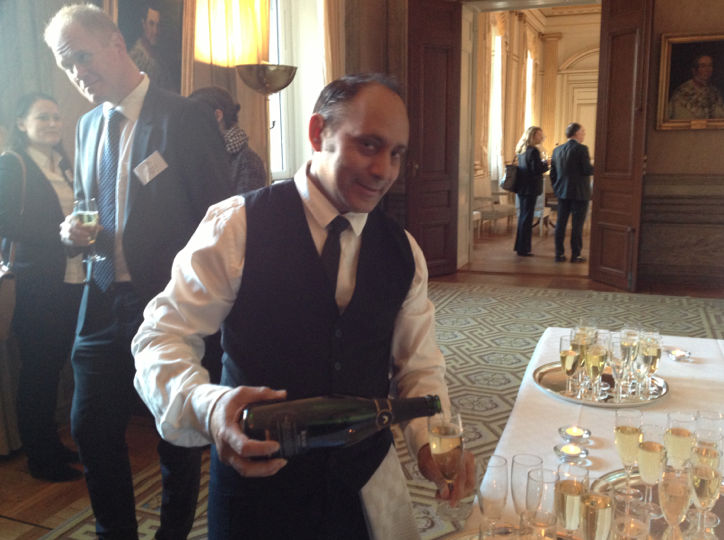
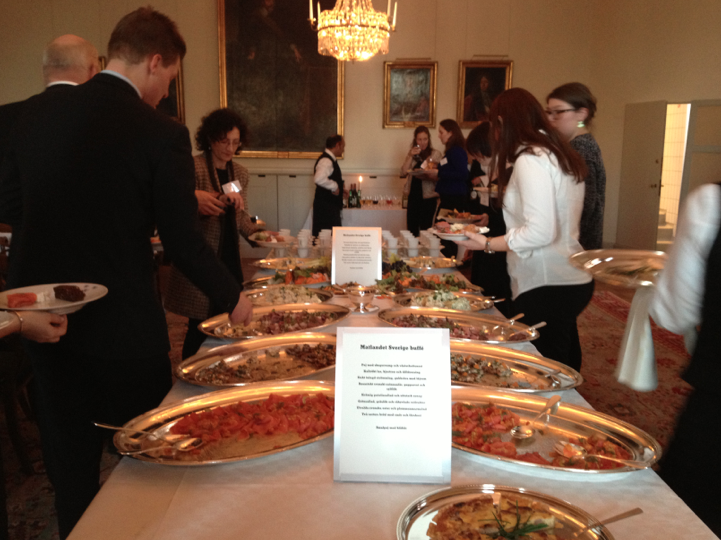
ed. note: Everyone was quite gracious, intellectually curious, and open about their interests. Of course, the Swedish Ministry provided a fabulous banquet which began with a few glasses of champagne and a speech by Mikael Anzén

dinnermarquis
Draft Program

On Thu, Apr 11, 2013 at 1:11 PM,  wrote:
> Dear all,
> It’s a pleasure to see so many participants to this conference. Since we are
> offering a light luncheon and a dinner in the evening I would kindly ask you
> to:
> 1. Inform me if you are NOT participating in the luncheon and the
> dinner.
> 2. Inform me about any allergies or other diet restrictions.
> Welcome on the 18th.
> With best regards,
>
> ———————————————————-
> Swedish chairmanship of the Arctic Council
> Department for Eastern Europe and Central Asia
> Ministry for Foreign Affairs
> 103 39 Stockholm
> Tfn: +46 8 405 32 47 Mob: +46 733 946 126
> www.regeringen.se

> www.sweden.gov.se

vision

Read Full Post »

Copenhagen

uc

April 9-10 STS Energy Workshop


IT U Copenhagen…Technologies of Practice

from the back
better
living

Wow. That was a whole heck of a lot of fun.

It was as if we were two energy teams meeting together in Copenhagen. On our end, there was Moi, Stefan Aykut, and Katherine Tveiterås, and on the IT U Copenhagen, Technologies in Practice, we had Brit Ross Winthereik and Laura Watts as speakers, alongside a gaggle of faculty, postdocs, and fellows, including Christopher Gad, Steffen Dalsgaard, Lea Schick, with James Maguire having helped in the set up.

Sofie Stenbøg was with us as well.

We did all kinds of stuff. Talked. Asked questions. Went for lunch. Talked more. Had coffee and cake. Went for a long walk (which ended up at the bar). Then we went for dinner somewhere (then to another bar).

It was true fun.

announcementMy talk was, what it was. But let us hear from the other folks.

First up, we had Stefan, talking about climate policy, energy experts, scenario making, how climate policy gets embedded into existing practices of energy scenarios – scenarios as one specific tool of government, that provides one aspect of policy – all kinds of stakeholders that will be important, power structures and how energy policy is organized.

All said, Stefan out did himself on this go. Great talk. Listen below:

foodFirst line of thought: path dependency and institutional change in the policy field. It is a political science question, which is especially strong in the energy field.

True for material reasons, large infrastructure that requires to be built, return on investment and lifespan is 10-15 years for wind, 100 years for dams. The material path dependency is only one side of the story.

A second side is the actor coalitions, very strong actor coalitions.

“Iron Pentagram” in German. In France it is so obvious that energy policy is centralized that there is no term for collusion between government and industry.
visions
“Trained to be pro-nuclear”. Traditional alliances between coal trade unions and political left gave coal a much longer and stronger place in Germany than when you look at it from an economic or material perspective.

Third dimension – cognitive dimension, or cultural commitment to certain organizations of development.

“American way of life is not negotiable” – American way of life linked to hydrocarbons and a special way of developing energy. Shale gas is a reaffirmation of thinking through the relationship of society and the US.
the locals

In France, reconstruction of the French state, modernity, identity, and commitment to nuclear power and the nuclear bomb. Tied to a certain kind of identity politics. Different for Germany who never had the bomb, so this could not emerge. German coal is the reconstruction of Germany after the war, it is what gave Germany its fueling economic boost that came out of the war and identity.

danishPath dependencies are many-fold or is it manifold. Global terrain in which identity politics that does not get weaker.

Second line of thought – social movements and social futures. How futures are embedded in our way of the present. Ulrich Beck: distinction between present futures and future futures.

Future futures are what happens tomorrow, and present futures that are those tomorrows that are embedded in today, how those tomorrows are becoming more and more important today. Unintended consequences of our risk society decision making today – Anthony Giddens, colonization about the future by the present.

How futures play out in social movements – futures are perhaps not that new, but more and more involved in the battlefields of what is at stake these days.

side viewFutures visions embedded in the way people talk, about controversies, what risks are, what certain visions are. Some controversies are defining the future and thereby controlling the present.

The present is very different if you have futures of peak oil or not. The present is very different if you have futures of climate catastrophe or not. The role of children – in environmental discourse. “Grips and the Future”

What are energy scenarios? As an instrument of government – they emerged in two different arenas, the circles around the RAND corporation in the US and the French planning both during the 1950s. French planning not about energy, but agriculture, business (like today’s China, 5-year plans) – giving some strategy to national priorities.

walkingScenario making – cognitive making, science of forecasts, what it means to have sciences of the future, because it emerged in the planning circles it has a strategic dimension, bringing together networks. First energy scenarios made in Germany and France are about (the) oil crisis, and the development of nuclear programs.

Nuclear requires huge investments, requiring large start up costs, and the rest is not that expensive. Very different from an investment point of view. Rate of Return over certain periods of time creates different kinds of strategies.

Nuclear program requires 50 years and thus means that the state has to bring together different team members.

the locationScenario is a tool of government, a centralized tool, technical discussions, certain actors only can be involved. Post 1970s – you see re-appropriation of scenarios by non-state actors. Amory Lovins, CERA, and in Germany and France. In Europe, reaction to development of Nuclear, emergence of a whole range of alternative scenarios, that contradict government, challenging government on a whole host of issues.

Taking the battle to the future in order to create alternatives in the present. This process leads to a high visibility of in parliamentary issues and in the 1990s, green discourses, notions and concepts of transitions.

descriptionIn France, there are transition scenarios, but that do not get the same attention in public discourse. How actors get legitimacy and bring attention to themselves. “The ambiguity of scenarios as a policy tool” – high entry barriers to discourse (technical knowledge) – but they can get re-appropriated by different groups.

sofieModeling Front: Scenarios are specific technologies in two ways. It is an economic modeling exercise – technical specificity, secondly, it is a governing technique.

On the modeling side, you have different groups, “different kinds of tribes”, economists, thinking mostly about stability, macro level, an economic system, energy is just one part of the system – a specific energy mix on the other end as a result.

Engineers, who are thinking mostly about technologies, about energy services, and make more bottom-up models.

These are more sensitive to technological change.

Government Front: How the organization of the state – the tradition of bringing together different actors guided by state engineers. Participatory techniques that grew up out of the 1990s and even from the 1970s. No longer about planning and bringing the most important stakeholders.

BritWrap up – scenarios as participatory expertise and participatory exercise (exclusion of actors, highering the entry barrios, or permeating by lower level folks).

How are power relations inscribed into scenarios – a future in which power relations are inscribed into the present? Circulation – how do alternative future visions circulate? How do they influence and irrigate and get built into official scenario building?

[they ] felt obliged to take into account simulations by energy consultants in order to counter energy firms. How do they look differently and what are their conditions of success? Consultancies in Germany and France are not as instrumental or have the same centrality as in the United States.

inside

foodKatherine just finished. She presented on our Intermediaries proposal and we were peppered with questions. It was remarkable to see her present the project, as if her talk should have been titled levitated mass.

Ok. Brit is now up and begins with –
A video. A short movie.

Alien energy project 2013-2015.

How do these renewable technologies on the edge impact on and are impacted by local communities? Community is not self evident (scientific community?), but in this proposal it has come to mean local peoples living in the area. Interested in how community emerges along side places where renewables is emerging. We are talking about wave energy here.

housingToolbox – Bringing new kinds of actors and problems into view.

Alienness means that they are not part of the energy infrastructure (like immigrants). Creating an exhibition. Mix characteristics from the classic ethnographic collection with new forms to create a mobile exhibition while doing fieldwork. Mobile because they need to be present in each of their field sites.

The ultimate stranger – Alien.

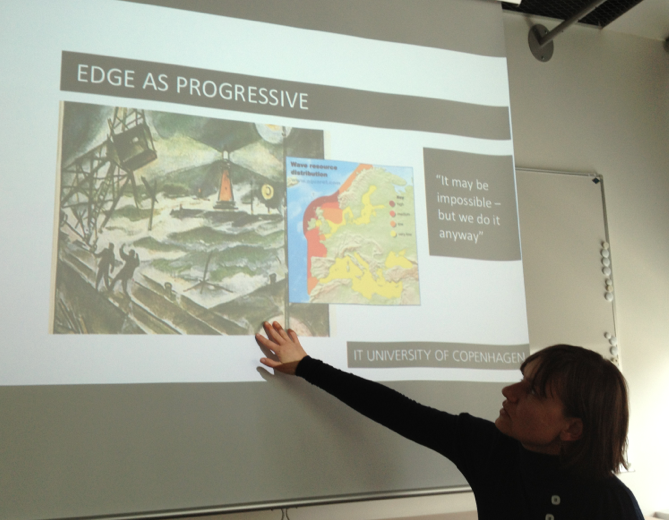
on siteConstituting difference which is not pure otherness. Aleins are life forms whose place in our forms of life is yet to be determined. Ownerships, managing the sea. Edge and World’s End – Location of test devices: “World’s end”. When we go to Hednstown. There are many physical qualities that represent edge. Which is an asset – taking fish out of the sea, but also somehow invisible, out of the way.

Indigenous cosmopolitics – How to take seriously the edge as a participant, and in what communities is the edge a political device? Frontier, an environment to conquer, tame and manage. Udkant – an environment to escape from. “Hinge or zone of transduction”. Wave developers to mobilize with local politicians – Innovation model.

The Innovation Model. What are the boundaries based on? What kinds of timelines are created? What are the timelines of the scenario?

Demonstration – from Andrew Barry. The ability of test devices to attract visitors, royal family, politicians. What is the ability of test devices to produce stories?

mainStories that do not circulate very easily.

Hockey stick is an image of enactment for investors. This industry does not exist as an industry. Technologies are pre BC in lots of cases.

Getting stories to physically move.
Innovation model image that helps promote the project – to be taken as a fact.

Two configurations as inventors: 1) one man + wife and garage. Spent all their money on it; (2) another version managed to mobilize a bit more, has a finance guy as a director, so that the inventor is not too visible. What is the legacy and what is the future that they can connect up to? Data is important, and what is created at the test site?

A feed in tariff supportive of the energy that is produced. They produce energy from waves and cannot transport it to the grid because it is too expensive. But they could present it, if they had government backing they could develop the industry. Recognition, but just a little bit.

more

floorLaura Watts is up now.

The Fanzine
Fan Magazine –

Objects we can produce that can travel.

Orkney – The sea as an object is not a singular thing but a multiple thing. Scotland is devolving from England. Linked deeply to oil development. Nationalistic project that comes from oil development, if oil was linked to Scotland (rather than London).

Waters around Orkney is the Saudi Arabia of marine power.
International regulations around Sea ownership are totally different than land regulations.

If you think about waves in England, they bump around a bit. Waves in Orkney that are 12 meters high. They stop things from happening – experience of waves may be different. “Unless you’ve been in Orkney, you don’t know”.

If you want people to understand, you have to put them on a plane, you have to bring them Orkney. Situated knowledge, the importance of differences in sea and their materiality.


edge
walkingA Map with Arctic at the center (referring to Katherine’s talk). It makes a difference where the edge is located. The place where you are is central when you are doing fieldwork.

Orkney is very way away. But if you live in Orkney, there are people there from all over the world. Every day people come from all parts of the world to visit Orkney for wave energy. So they have an understanding of themselves through this relationship to Orkney as a wave center, because it has conferences on wave energy.

Locations that are very fragile. Minor changes in fragile environments lead to big changes. Islands are living in the future, because of their fragility will change – edge places, where impacts matter, in a different way than the way Silicon Valley represents the future.

Electricity grid. Centralized. Centralized power stations.

Energy in the wrong place. Major issue, building national infrastructure to connect with energy on the edge.

“Server farm” – data, electricity. Google has a massive server farm near Oregon near large amounts of renewable energy, hydro.

folksyMarine energy devices get washed up on the beach. What do you do with that visible aspect of failure?

Sitting inside a consultancy in Orkney.

Building a wave energy industry will require large amounts of money to connect it to the government grid system. Who gets to move the knowledge, who gets to listen to the knowledge, who wants to listen to knowledge.

Spaces of science, where people should be able to make science, collective ownership.
Edge.

foodyNorthern Norway. Not as much economic development. “[Katherine] Been used as a rhetoric for years, they would use edge as a word to force government’s hand. After Snøvit, you’re no longer on the edge but in the center of development. The rhetoric used for years is now coming back on them”. Arctic on the edge, coming to be used differently by different actors, environmentalists, etc.

scatter plotEdge as having agency.
Stories that circulate vs. objects that travel

Telling stories. Embed themselves. What stories they tell about the future and how they mobilize the past as well. Windmills very important blah blah blah.. Century of the wind is coming back…

At least as important to tell stories that do not mention certain pasts. To organize forgetting. “[Stefan] One thing that you will never hear, about the electric vehicle, that we know how to construct them for 100 years. We never hear of its past. When you year the electric vehicle, ‘it’s now that the technology is right'” – might be helpful to state that it is an embryonic state.

foodyThey make the comparison to the flight industry. What was it [composed of] that it was so successful. Wright worked a whole lot on his environment. The Patent system, a wealthy friend that bought him an island. All things that have nothing to do with the technical development.

Purified accounts of how things progress (models of progress) versus what is actually happening. As far as the wave, a story about the device itself.

Utopian projects of scaling up. Grid system requires to be complete. Manifest destiny of completing the grid.

The pipeline in Alaska is part of a system to connect Alaska to modernity technologically, to connect its remoteness to the lower forty eight. More modernity. Energy system in the mind. A public service versus a commodity. Nuclear power.

Certain forms of infrastructure around energy where it leads to control.

dinner sign


3/10: 10-11.30 public lecture and discussion (Arthur Mason). Arthur, you might
> include Stefan and Katherine if you feel you would rather do it
> collaboratively. This part of the program will be open and public.
> 11.30-13.30 lunch and walk. Possibly Philippe Bonnet, head of the
> university’s Energy Future strategic initiative will join us.
> 13.30-16 workshop (we will think of a good format)
> Dinner in the evening


Read Full Post »

abc

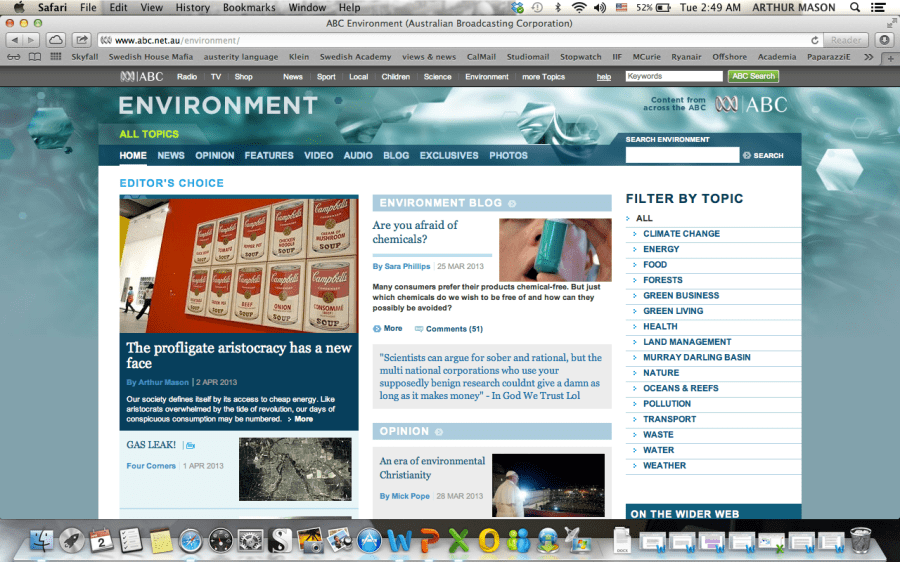
My ERL piece –
* re-written by australian media


image

Read Full Post »

artefactual data

villa pamphletmagazine
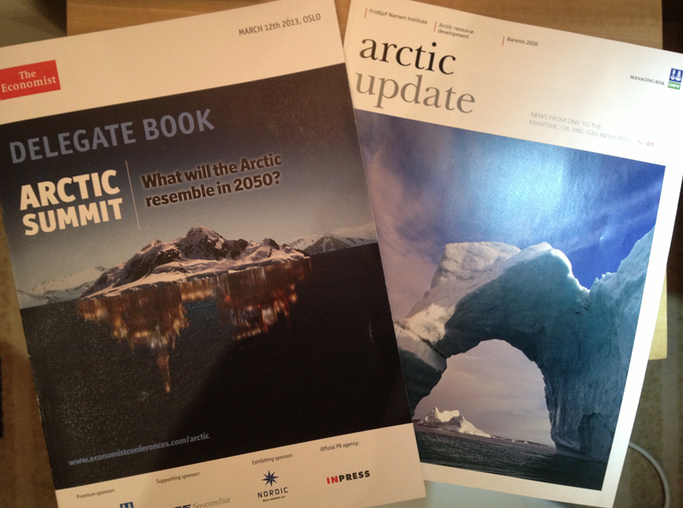
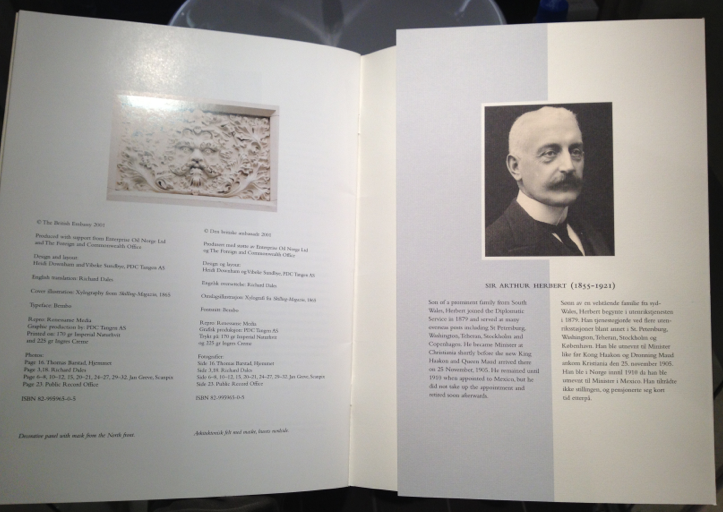
3/20: We nearly forgot to mention — of the Arctic Summit in Oslo’s Hotel Bristol last week sponsored by The Economist Events Group– some of wonderfully packaged reading materials, including a Delegate Book titled, Arctic Summit: What will the Arctic resemble in 2050? available online at economist conferences/arctic; the latest copy of Arctic Update from DNV to the Maritime, Oil and Gas Industries published by Det Norske Veritas (DNV) Maritime and Oil & Gas Market Communications, also available online at dnv/arcticupdate; and finally, a booklet written by Dr Stephan Tschudi-Madsen, formerly Norway’s Director of National Heritage titled, The British Ambassador’s Residence in Oslo, which is available on line, but should be noted, appears in a slightly different form than the actual booklet, at UK ambassador residence/Norway .

Oh. We should note in passing of the images that adorn the covers of these fine documents, that the booklet about the British Ambassador’s Residence was sponsored by an oil company, as was the Delegate Book from The Economist, and of course, the Arctic Update is a DNV company, a strategic knowledge firm for the energy industry, publication. Well. Before looking at these three visuals in detail, let us take a moment to acknowledge the circulation of this event’s primary documents.

First, let us examine the various locations of the banner image for the The Economist’s Arctic Summit. Here are a better set of images taken from the internet:

screen shot

internet

First of all, the image representing The Economist’s Arctic Summit was visible in various forms throughout the day appearing, for example, as a wall-sized backdrop behind speakers on stage.

on stage

Turning from the speakers and toward the rest of the room, this image is visible in the form of the delegate book cover, lying face-up on participant tables. Here, attendees come into contact with the image throughout the day, not only from holding it in their hands, but also by positioning their body in direct relation to the image, as when seated at a formal dining table.

on tables

handling

In this image, directly above, we see several ways that participants interact with the Delegate Book. On the far right, we see that flipping through the book is part of a dispersed attention to activities going on in the room, as well as the movement involved in those activities– from turning one’s head witnessing passersby, to the actual flipping of the pages, and the general occupation of having something to play with in one’s hands.

Also, notice how the image plays a role in the setting arrangement of the dining room table experience: a table with white linen, coasters for glasses and the Delegate Book table mat all within proximity to each other, and acknowledged as such by participants who position themselves in alignment to this setting. Notice, in fact, the intention in this image, with which the glass rests atop the coaster (if a glass appears on the table, it appears atop a coaster).

coaster Doily

In this way, the banner image for this event participates in a practice of formal dining etiquette, of encircling dish ware, a practice replicated during the breaks as evidenced by the doily between cup and saucer used for coffee.

The magazine and hotel names printed on locations associated with delicacy (the encircling of dish ware), is an assertion of title recognition in a particular way, calling attention to discovery (picking up the cup to reveal a message) but also to finger pointing (placing the glass directly on the coaster). Thus, the banner image by its association to this etiquette, participates in game of peek-a-boo, hide-and-seek, vanishing acts, and other games of visual apparition.

After the Arctic Summit meeting, participants were shuttled by bus to a networking event at the British Ambassador’s residence. As with the Delegate Book, attendees had the opportunity to mingle along side each other while handling copies of the Ambassador’s residence booklet (mentioned at the top of this post). You can see in this photograph, there is a general networking of persons, and each is taking on a different relationship to the booklet.

handling

What ties the Ambassador’s Residence booklet together with The Economist’s Banner image (and the DNV Arctic Update) is the appearance of the advertisement banner itself, whose two-dimentionality confronts the attendee as a conflation of images, both of The Economist’s banner and the Ambassador’s Residence Booklet images, as one visual instance.

embassy

Turning now to the images themselves, the Delegate Book on left depicts an uninhabited cold region, presumably somewhere in the Arctic where open water in conditions of relative darkness suggests that ocean surface ice has melted fully leaving the water a dark blue, thus decreasing its reflectivity from the sun or albedo effect.

Notice here that the book publishers have placed what appears to be a blurred vision of an off-shore oil and gas rig reflected on to the water, facing upside down, whose foundation is joined at the base of a land mass directly in the middle of the image.

Arctic update

The image is not a clear reflection by any means, but the shadow is recognizable as a multi-billion dollar industrial structure. What does this reflection portray? Is it a submersible installation representing subsea technology? Is it a fallen rig, barely perceptible under water, sinking into the depths of a pristine environment?

The title above is Arctic Summit, possibly an additional reference also to the actual physical summit of the rocky outcrop in the image. Perhaps the off-shore platform — as a reflection, represents the true nature of the rocky outcrop, and that the outcrop is a metaphor for the solidity with which the Arctic will soon be industrialized–  as a solid, common sensible and unassuming idea as the image of an rocky outcrop. Tomorrow’s sense will look nothing like today’s Arctic sense, but it will nonetheless be acceptable and accepted upon the same principles of sense making.

Another actuality, a version that cannot be discounted is that the rocky outcrop may be considered an Island of Inland Empire. That is correct, an Island of Inland Empire, where the rocky earth stands as an illusion that masks an assemblage of science, capital, regulation, development, entrepreneurial infrastructure built exactly into its core, much like, say, Crab Key Island in the James Bond movie Dr. No, sees the transformation of the equatorial island land mass, its core, into an internal technological wonder, much like Disney’s Magic Mountain and other sorts of diabolical resorts, distance the performance of industry from its mask of leisure. The blurred image, then, like the invisible under-belly of an ice berg is the foundational principle that keeps an Arctic Summit aloft.

But wait! Could not we also see image, its intended blurry quality, as a residue appearance, like an oil slick on the surface of water? In any event, we can state with confidence that The Economist’s image is by far, a deliberately elaborated, computer manipulated, thought provoking artefact. Its drama is elucidated strictly on the basis of its hand crafting through computer graphics in a work setting.

Okay, let us now turn to the image of nature on the right. Well let us take a look at this image for a moment, more closely.

internal image The first thing we can say about this image is that it is not a graphic designed image. That is, it is not intended to appear as a graphic design image but as a photograph, an image by the way, that shall be viewed on its own terms. We know this because the image, in addition to appearing on the cover of the magazine Arctic Update, also appears as an independent photo image on the PDF version of the magazine available on-line. Directly above is how the image appears as a PDF on the internet, within the context of the Arctic Update magazine.

What I mean to indicate here, is that this image –unlike The Economist’s banner image– can be witnessed as a photograph separated from the logo or title of its current affiliation. It does not only represent DNV, but represents itself as a product of artistic deliberation to be understood as such outside the promotion of the Strategic Knowledge firm. The copyright is Getty Images. Perhaps DNV did not hire someone in particular to take the photo, or if they did, they did not retain the copyright.

Thus, this image resides in proximity to the adulterated intention of The Economist‘s image, but stands apart from marketing, the dining etiquette experience and games of chance, all together.

image

Well, what can we say about the image itself. It is taken from the perspective of the bow of a ship and portrays a human dimension of scale.

Notice that we (I am assuming someone is driving the boat in addition to the photographer) are heading directly under this ice formation. The sea appears calm and the sky is without incident. The weather is fine and randy. But the ceiling of this lofty cavernous ice bridge is shadowed and dark, indicating a lack of viewing power to test its integrity to pass under the bridge without risk. Moreover, the viewer sees on the right hand side the cracks in the wall, and the precariousness of conjoining section on the left hand side, all suggesting even when the Arctic may appear safe, there are overlying risks associated with any safe passage through its locale.

Thus, while global climate change may be destabilizing the integrity of Arctic ice structure, nevertheless, confrontation of risk is personal in the Arctic and must be dealt with head on, no matter whatever the causes (anthropogenic, local, global). Thus, causality of change is not important and delay of policy is not important, only technical response in measuring the safe passage forward registers as a mature response.

Finally, turning briefly to the nature scene that adorns the cover of the British Ambassador’s Residence booklet, we see an image representing not the future or the present, but in fact, the past. It is an image of idyllic urban gardens at a time when Oslo was becoming more aware of a romantic-period style connection with the landscape, purchasing surrounding farms in the area and cultivating new estates with acres of adjoining woodland. Of course, the image is not a direct photographic reproduction and thus represents something similar to The Economist’s Banner image.

Before leaving, let us just add a few of the pages inside these publications:

delgate bookarcticanotherdelegate

Read Full Post »

berlin gathering

March 15-21, Fulbright affair


seen
“The future of Europe is inextricably tied to United States. Imagine dissolving national parliaments and replacing it with a trans-atlantic parliament composed of persons in the room, peace loving intellectuals, a fantastic potential to discuss the future”.
head

hands
scene
window

window Berlin nightnighty Berlin means so much to so many in Berlin, as if life itself begins and ends with tearing down Berlin Wall, an emotion like Check-Point Charlie, that is now a tourist attraction.
Read Full Post »

« Newer Posts - Older Posts »