That was a great week. I would have liked to comment more on all the activities as they were taking place. I captured below a partial representation of all the great work we went through together.
 In attendance this week were a lot of important folks from both sides of the Atlantic, Ambassadors, Ministers, Consular Generals, Arctic Chairs, the whole yard.
One of my favorite moments was heading up to an evening reception at the top of the Houston Hilton Hotel. We were waiting in the lobby when, as it turned out, one of the elevators was kaput. Hotel staff directed us to take the freight elevator.
Inside the elevator, packed to the gills so as to give the feeling we were in close quarters, Norwegian Minister of Health, Gahr Støre, was shaking everyone’s hands — that is, shaking the hands of those who knew of his importance in Norway. Minister Støre is expected to soon stand for the position of Prime Minister.
Minister Støre is charismatic, lean, handsome, tall, well dressed, articulate, sharply intelligent according to policy experts, with polished gestures, and a winning smile.
As serendipity would have it — I happened to have entered the freight elevator with American professor, John Tallis, (pseudonym) with whom I had a few beers just previously at the bar. Completely ignorant of Gahr Støre‘s identity, John was oblivious to the cultural moment taking place as we all headed vertically up to the rooftop terrace. From the casual look of things, the professor could not have interpreted the intensity of meaning associated with the ritual goings on now circling Minister Støre — all lined up and squeezed as we were into an inelegant freight elevator, yet in close proximity with a “political star”. The Minister was well aware of his star power in the midst of others, but when confronting both of us, the Americans, he provided a simple nod of his head, to acknowledge our ignorance of who he was.
I was, of course, caught up both in the star power moment — and the simultaneous recognition of the possibility of me being interpreted as a foreigner (we were two Americans in a Houston Hilton hotel).
I could not help myself, wanting to “shake the hand” of the power holder. I promptly introduced myself to the Minister, indicating that we had met the previous year, when he was Minister of Foreign Affairs, while attending the Oslo Energy Forum (OSE) in Holmenkollen on the outskirts of Oslo. He asked whether I had been back to the OSE, and I responded in the negative. On this point, our connection ended. But then, as if from a deep desire to maintain a lingering connection to the man, only to have a little more of his stardust cloud blow in my direction, I added having just met, several weeks before in Olso, with Johan Nic Vold, Managing Director of OSE.
This triggered an brief eureka moment regarding my existence, along with continued conversation as Minister Støre made his way to greet others with whom he is on politically intimate terms.
What a ride! Here is an image of Minister Støre from the Oslo Energy Forum, not too long previous to the Houston meeting:

11/15:Morning Day Four of TransAtlantic Science Week
Okay, now I am very far behind in my updates on what has happened throughout yesterday and in the evening. Nevertheless.
I am now attending the session: Fulbright Arctic Chairs and Beyond. I was able to meet Timothy Moore, from the Embassy of the United States in Norway and have a helpful chat about goings on in the Scandinavian political world. There was Petter Naess, who runs the Fulbright Office in Oslo, and up now at the podium is Pal Sørgaard, Deputy Director General, Norwegian Ministry of Education and Research. And even Paul Wassman is here, from Fram Centre, Tromsø.

11/14: Morning Day Three of TransAtlantic Science Week
Okay. I have to provide a wrap up for yesterday, but before we get to that, we are at the beginning of Day Three which begins with a Workshop on Petroleum Technology. But before that, I should mention briefly that this morning’s participants were mingling over (starbucks) coffee and chatting, and I had a chance to re-introduce myself to Kari (last name), with whom I traveled to Russia, along with workshop participants for the Teriberka workshop. And what do you know, Kari mentioned that there is a June workshop in Arkhangelsk (yay!).
Siri Helle Friedemann, Director Department of Petroleum, Research Council Norway is the chair for this daylong workshop. I met Siri as one of my first informants in Norway, but more about that later. For now, Siri is up on stage talking about RCN’r role as advisor to government, in networking and dissemination, and international cooperation. Wow. There is a Petromaks 2, a 10 year program supporting research, workshops.
Ove Flataker, Director General of Norwegian Ministry of Petroleum and Energy, gives a similar (same) talk as on the pre-conference day, see below.
Now up is theme, Drilling and Deepwater Technology. Satish Nagarajaiah Rice professor. Energy initiative on campus, is chair of this session. Okay, here we go.
IRIS. Center for Research Innovation, International Research Institute of Stavanger (IRIS), Sigmund Stokka, Research Director, 230 people, working on energy, marine environment and social science. Center for research based innovation. Describing a variety of partners, locations and test facilities, and numbers of MA and PhD students.
Very technical discussion.
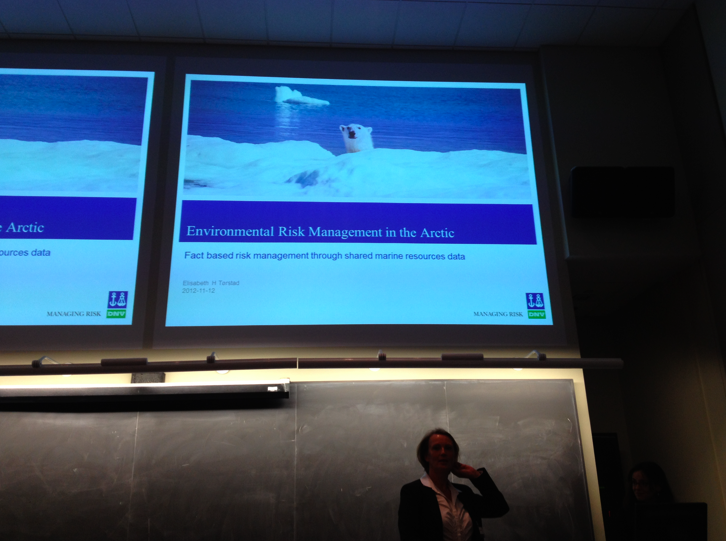
Elisabeth Tørstad VP DNV is up now taking about the kinds of risks involved in developing oil and gas. Several categories. Wow, a lot of information. External risks, Internal risks. (major overruns, major delays) — keeping an eye on risk picture and on barriers. Initial risk assessment and create “barriers” — e.g., a contract that has terminated or transferred. A company may be put up as responsible and then falls. Decisions are made on the basis of barriers that are set up and they are not.
One of the questions that comes up is “drift” — small changes that slide a project into disaster. Monitoring drift is important. A barrier is degrading.
11/13: Afternoon Day Two of TransAtlantic Science Week
A panel on Think Tanks.
 I always like to get in early, to get the lay of the land, and with 15 minutes to go on a topic that I am keenly interested in, a panel titled, Special Session: Think Tank Collaborations, I have already settled in. Look, there is another photographer besides myself, but with much more elaborate equipment for taking images.
Okay. we are underway.
Ambassador Edward Djerejian, Baker Institute Founding Director making opening comments: Talking about how private funding create opportunities that university institutions do not have. A distinction between university-based versus non-university based think tanks. There are, in fact, 1776 think tanks in the United States, there are 230 major think tanks.
Another thing to consider, is whether they are partisan and non-partisan. Baker Institute is non-partisan despite the Republican bias of James Baker himself. A final distinction, based on foreign policy and internal policy.
Thinking about collaborations. One the biggest challenges is translating ideas into viable policy programs that can influence government and academia. Baker has had enormous influence and had some failures. Presented their ideas to Obama on tax reform, which was not accepted, but ideas on G.W. were taken.
Emphasizes how only folks “inside” government decide.
Now, here we have Wegger Strømmen, Norway’s Ambassador in the United States, talking about think tanks. They actually created a report for the Norwegian government about think tanks and collaborations with them. The Peterson Institute for Economic Studies, is a firm the Norwegian government is very interested. International Institute for Strategic Studies in London was a location Strømmen spent time at.
Wow. This is interesting. Strømmen states that in America, “you have to look quickly for political affiliation and connections to industry“.
Peter Hartfel (?) professor economics at Rice U. and affiliated with Baker Institute. There is a deliberate attempt here to encourage collaborations with academia. The folks at Baker joint supervise graduate students, a very good example of how a vision of collaboration between university and think tanks work well.
Okay, energy security. An important part of the work is natural gas in global markets and geopolitical issues. Joint program on with Stanford and developed a World Gas Trade Model, which they have involved Harvard recently. Looking at long-term contracts to “market-based” price. Baker has worked with Institute for Energy Economics in Japan. A number of subscribers, “some of our best research topics come from industry”.
Edward Djerejian: No matter who finances the research, it is created without bias.
 Okay, up next, Kristian Berke Harpviken, Director of Peace Research Institute Oslo (PRIO).
Best practice of policy is based on sound academic research. Talking about the make up of PRIO now.
They publish no less than four peer-review “long standing” journals, highly ranked in international relations, that create a revenue. Twelve propositions for a good think tank. Into four groupings (1) People (2) Money (3) Outputs (4) Impact.
Now here, the conversation surrounds around actually making money off the journal, and Ambassador Djerejian would like to know “how can you make money?” — to which Harpviken replies in some detail how money is created, through primarily bundling and library distribution.
Baker Institute does not produce a journal and every time they go to consider it, it appears too daunting.
 A point about “images” and how they are interpreted differently by experts versus lay folks, bringing to mind my distinction in Empathy for the Graph.
Now up. Dean Eric Schwartz. Two elements relevant to the present conversation: (1) Integration of service, scholarship, and training; (2) Science, Technology and Environmental Policy (STEP) as a critical component for enhancing public discussion. Emphasizing policy literate scientists, and science literate policy makers.
Up now is Jon Pedersen, Head of Research, FAFO Institute of Applied International Studies.
11/13: Lunch Day Two of TransAtlantic Science Week
 We have all gone to a group lunch being held in the prestigious Baker Institute. I have not been here previously, but of course, I am familiar with its top notch reputation.
 At lunch, we heard again from Subra Suresh, Director of the National Science Foundation. The lunch is delicious and the surroundings prestigious. There were so many folks who wanted to attend the luncheon, the organizers created an overflow room where the good director could be seen on a screen.
Here below area few images of the luncheon in the Baker Institute itself:

 And here below, is an image of the overflow room, where folks could lunch as watch on the screen the happenings taking place a building away.

11/13: Morning Day Two of TransAtlantic Science Week


Okay, we are just getting started here. I always like to arrive early to see the setting, get a seat up front, and take a few photographs of the environment in which folks will be giving talks. Sometimes when the auditorium fills in, it becomes difficult to start taking photographs around the room.
Okay. All of the big whigs have stepped into the auditorium and are taking their seats in a reserved section near the podium. Wegger Strømmen, Norway’s Ambassador to the United States has just introduced Neal Lane, Senior Fellow in Science and Technology Policy, who is now introducing David Leebron, President, Rice University.
Neal Lane. Begins with a comment about the cool weather, and the new art work on campus, now giving directions to and discussions about the Tyrell Sky Space. In general, Dr. Lane refers to the importance of technology in energy development and promoting science, but also, relationships between our two countries and populations who share an entrepreneurial spirit.
Wegger takes the stage again to introduce Kristin Halvorsen, Norwegian Minister of Education and Research. Halvorsen is now up talking about innovation and higher education, new knowledge by research communities and its practical use. Managing the contradictions between petroleum wealth and climate change concerns, requires close cooperation with international research centers to achieve political goals. I should note that Ms. Halvorsen is wearing a very smart Navy blue pea coat-like dress over a skirt with white brocade.
Up now is Dr. Subra Suresh, Director of National Science Foundation (NSF). Summarizing thesis of the origin of the NSF. Innovation is necessary for the strength of the nation, and comes from research in science and engineering which should be carried out in the university and funded by NSF. First year’s budget in 1950 (?) was $200k and now it is $7 billion. NSF funded early research for the mathematics which ultimately became GPS and Google.
“Innovation comes in different ways: we put a man on the moon before we put wheels on a suitcase”. Seventy percent of all Nobel Prize winners have come from early NSF research. Actually, Subra is a superb speaker.
Okay well, Subra is a hard act to follow, but some one has to follow him. And up now is Arvid Hallen, Director General, Research Council of Norway. Arvid has some interesting slides, graphs that show performances of Norwegian science via publication indexes.


Above are a great set of slides indicating research centers. This is something that I am interested in, of course, for looking at the linkages of energy production and research innovation.
BREAK
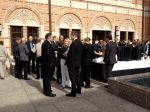


Okay, now we have Ambassador Edward Djerejian, Founding Director of James Baker Institute for Public Policy, Rice University, whose presentation title is Geopolitics of Oil and Gas. Strait of Hormuz. Transportation of oil — can be easily shut down, if only temporarily, spooking the energy industry with a spike of prices. Promises that the Western Hemisphere will be come “energy secure” within the next decade, and thus the geopolitical map will change. Second “Arab awakening” — a “tectonic shift” in the political landscape — the “true end” of the colonial era.
What is necessary is “political and economic reforms in our bilateral relationships”.
Great question: How do think tanks learn? How do they see themselves as doing things better? Do they learn from each other, do they collaborate with each other? How do they work with each other, is this meeting one way they learn from each other?
11/12: Day One of TransAtlantic Science Week
Wrap up for the day: After the last session, conference attendees made their way to the Consular General’s residence in Houston.
Perhaps one of the most remarkably casual instances of this trip is the number of informants that I know based on my research of the Norwegian energy knowledge industry. This list includes Siri Helle Friedemann, of Research Council Norway (RCN), with whom I met when I first began my project in 2010, and at that time attended her RCN funded Norwegian-Russian energy workshop in Murmansk and Teriberka, Russia. I also bumped into Petter Naess, who heads up the US Norway Fulbright Foundation, in Oslo, and with whom I met at the orientation meeting in August.
Crazily, as it would seem, I also bumped into Ole østein Aspholm, Senior Principal Consultant, Det Norske Veritas (DNV), who attended my talk at DNV last month in Høvit, at the corporate offices outside of Oslo. These folks are in addition to those mentioned below.
Most of the evening was spent in the backyard patio, around a Texas shaped pool, where we dined on indian food buffet style. Consular General Jostein Mykletun provided a warm reception over a microphone to everyone, stressing the theme of the conference, to bridge partnerships between Norway and the United States across academia, government, and industry.
The typical manner of entering a consular’s home is to line up and greet first his wife (sonia) and then the consular general, of course, with a handshake and brief introduction. This occasion was no exception. Among the party I had arrived with, a group of recent PhD’s or nearly there, Katherine Hedegaard was engaged in rock science, and we spoke together at length about our respective projects, she speaking about the problems of oil recovery in North Sea chalk basins which collapse inexplicably and I about my recent National Science Foundation proposal, that I am writing at this moment, attempting to put together a revision that makes sense.
Panel: Sharing Environmental Data Across Boundaries in the Arctic Part II: Now up. Jon Staerkebye, Senior Vice President, Kongsberg Oil and Gas Technologies. Showing movies that depict the advance communication strategies for envisioning environmental monitoring on the sea floor.
 Okay, now speaking is Dr. Larry Hinzman, Director of Arctic Research Center, U. Fairbanks, talking about the best of international partnerships for understanding the Arctic.
International sea ice prediction network. Ice-ocean model run by ACCESS working group to provide guidance on how to target observations.
Streaming thoughts in my head: I woke up today deciding to chance it that most folks would be wearing a suit without a tie. I was correct. Now where on earth did I learn that? It was in Holmenkollen, at the Oslo Energy Forum (OSE), when Johan Nic Vold, managing director for the Norwegian Energy Foundation, organizer of the OSE, instructed participants on the first day, in a collective manner, that wearing a tie is limited only for dinner gatherings.
Coffee break: I just bumped into DNV’s Elisabeth Tørstad (Exec. VP and Chief Operating Officer, Division Americas and Sub-Saharan Africa), who joked that she sees me everywhere — to which I responded that I request her travel itinerary from DNV. We laughed. I first met Ms. Tørstad at the Berkeley CO2 sequestration meeting, where we exchanged stories about the Oslo Energy Forum. Then, some months later, we bumped into each other in Tromsø, at the Arctic Frontiers conference this past January.

Sharing Environmental Data Across Boundaries in the Arctic Part I: Jarle Aarbakke, Rector, U. Tromsø. former Chair of Norwegian Government appointed High North/Arctic Committee.
Wow. This turns out to be an interesting panel. Climate “regime shifts” in Marine environments. I barely got my tail over here, thinking the meeting room was close by, but turns out a 10 minute walk, so I missed some of Dr. Hepsø’s (Statoil anthropologist) opening. But Dr. Aarbakke is stirring things up already by jumping directly into Norwegian-Russian data sharing on climate change, marine environments in the Barents Sea area, which requires cooperation by all Arctic countries. “Key Message”.

A “next generation” environmental monitoring system. That it is harder to find financing for data management. Sharing requires (a) recognition of ownership (its traceability) (b) standardized and readable formats (c) known data sources (d) known quality of data.
I wish he would go into more detail about these points, traceability of ownership, for example, seems to be a curious rabbit role to chase down.
End of presentation, stressing the need for the Arctic Council to step in to create a major presence in data sharing. Of course, during Q and A, I made my few comments, always interested in having my voice circulate around the room, though not even sure what I referred to, just enjoying the fleetingness of exchange (yay).
Okay. Up now is Dr. Robert Detrick, NOAA Office of Oceanic and Atmospheric Research. Again, partnerships with industry, government, academia, to create expertise on data sharing. This is interesting: Observation network should include Operational Forecasting and Anticipation of changes in Ecosystem Structure. Point out the combination of technologies, traditional (ships, drifters) and emerging (unmanned aerial systems, cable observatories).
Data management. Tremendous volumes. NOAA has MOA’s with ConocoP, Statoil, and (?) on environmental data sharing partnerships.
Now up is Svenn Ferry Utengen, VP Statoil Research Development Innovation. “As my son told me, I am a ‘Fairly Good Representation of the Fossil Industry'”.
Using the best available technology requires sharing, in this particular field. Actually, that is a good question, what types of knowledge require sharing (e.g., arctic technology and development, including environmental) and what kinds of knowledge are proprietary (e.g., intellectual property).
Okay, now concrete technologies. Svenn puts up a slide that defines five areas where uncertainty surrounds how to move forward with technological developments. His activities refer to in house expertise on, well, just a whole number of issues, including oil spill response technology, Arctic drilling units, Seismic technologies — I will post a few slides in a moment.
David Womak, IBM, Director, Worldwide Chemicals and Petroleum, began his career with Exxon, BA, MBA holder. paper titled, Bridging Partnerships. “Smarter Responsibility” — successfully, safely, productively. A series of partners who come together to explore “collaborative development activities”, things IMB thinks are going to impact the industry “going forward”.
Market research on chief ideas on the minds of global companies. Amazing. He distinguishes between global companies and petroleum companies. Cycle time, is 7 years for an engineer to become productive straight out of college, and looking to reduce it to 3 years. Environmental issues number one.
Wow. Oil and gas acknowledging the nature of complexity it needs to solve and will be outsourcing problem solving. Several threads if you will toward moving to solving data issues, environmental/sustainable issues.
Lunch: Tuna sandwich with potato chips. I learned that Vidar Hepsø, anthropologist at Statoil will be delivering a talk on Arctic energy at 2PM. Also, Amy Jaffe has since moved from Rice University to UC Davis to become Ex Dir. of Energy and Sustainability, and replaced by Kenneth Medlock, who I plan to look for tomorrow morning after the plenary taking place at the Baker Institute.
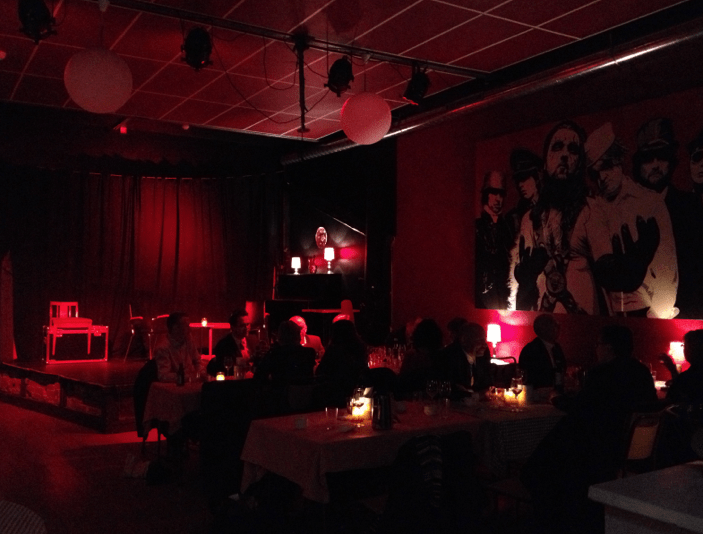
I am a push over for colored lights. I love dazzling colors. Whether used to depict complex capillary formations in oil deposits or as spot lights for jazzing up science posters, or even just mosaics on ceilings and pharaonic design patterns for architectural motif, the sight catches me my tracks.


Up next, a session on sharing environmental data across boundaries in the Arctic.

Ove Flataker
10AM: Just settling in and immediately began chatting with Ove Flataker, “Ekspedisjonnsjef” (Director General) of Norwegian Ministry of Petroleum and Energy, who just up, gave us a well rounded story about the history and future of Norwegian petroleum, respectfully referring to American titans of oil and gas development for establishing the industry in Norway beginning late 1960s.
I always like images that depict the Arctic, from different perspectives and highlighting resources in different ways.
Here are two such images that Ove employed in his talk:

 “The best way of collaborating is physically, to meet each other”, says Prof. Arne Graue, Chairman of the Executive Board Petroleum Research, Norway, mentioning the value of networking.
Oops, we just heard from Dr. Graue that the dinner at the Consular’s residence tonight is restricted by invitation only, so hold on to your tickets everyone! Here is an image of the invite:

PhD student from NTNU, Trondheim, Elena Parmiggiani, just gave a great talk on environmental knowledge management. Good grief, some folks have great projects. I am in the midst of revising a proposal for research funding on quite a similar topic, and found her talk inspiring.
One aspect that caught my attention is how knowledge is gathered — referring to (1) what is “new” versus what is “traditional” knowledge (2) what is local represented versus standardized knowledge and (3) what is top-down versus bottom up (e.g., folksonomies) knowledge.
11/11: I blew into Houston this afternoon to attend the Norwegian-Texas TransAtlantic Science Week via invitation of Dr. Jostein Mykletun, Norwegian Consular General to the United States, and former Ambassador of the High North.

This is a view of Houston from inside the taxi.
Some of you may remember that just over one year ago I had the opportunity to present a key note discussion of my research in Houston at the Arctic Oil and Gas Workshop.
At that event I got to mingle with folks in the technical part of Arctic oil and gas industry. It was at this workshop also that I first met Jostein, if I may take such liberties to refer to him by his first name.
I should mention that it was then also, at a reception at the Consular General’s home, that Sonia Mykletun invited me to apply for the Fulbright Research Chair position. This was an especially generous gesture. In fact, my visit here this week includes extending a warm thanks for support as I was awarded US-Norway Fulbright this year. 
It is just about dinner time and I will head over to the Hilton now to see what other pre-conference activities are taking place.
Read Full Post »


 The security experience is rough, as you might imagine, and entering the building provides a self-enclosed experience on its own. Security came out and disciplined me for not having read the sign and standing behind the painted yellow line. When speaking with the guard though the gate, he inquired whether I was some kind of special agent, probably something to do with my academic tone, a combination of defiance and leisure.




 I cannot recall now when it was, perhaps the second day, but by 2PM, I had intended to travel over to

 We also had a lively discussion about virtual and seminar networks and the IFEG membership. In fact, now that I recall, I joined one of the break out groups for having a seminar on “Energy Blogging”. So we shall see where that takes us and I plan to report back soon on the IFEG members.
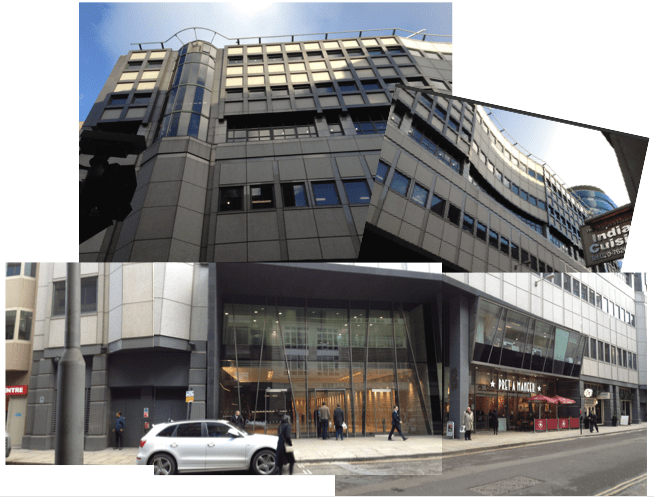

 It looks like I will have to get up and get on an airplane for Norway. Well, that was London. I expect to return shortly, for a number of visits that could not happen this time, including a scheduled meeting with a Statoil higher up, through a connection in Norway. But what a great town!


 Earlier this year, in April, I had the opportunity to visit an energy consulting firm, UGR (pseudonym). Upon entering the building, my attention was arrested by the personal image of the front desk person, dressed as she was in a smart hair-bun, posturepedic grace, and so on. But evidently, I was mistaken.
 Here is a map of how to get there from the tube station:

 Arriving at Heathrow could not have been simpler. I usually take the tube, but at the bottom of the escalator, after passport control and just before baggage claim, salespersons were calling out tickets to Paddington aboard the direct train connection, for ₤ 52 first class round trip, + another ₤ 5 for taxi from Paddington to the hotel — 25 minutes later– and here I am with a latte, already getting together a final draft of the National Science revision proposal sent back to






















 Paparazzi Ethnography