Feeds:
Posts
Comments

Archive for the ‘Paparazzi Ethnography’ Category

10/23: European Research Council (ERC) proposal workshop, Consolidator Grant:


YR_Leaflet_ERC_Consolidator_Grant_OSLO.

Binder ERC StG chapter 5 and 6 incl 2012.


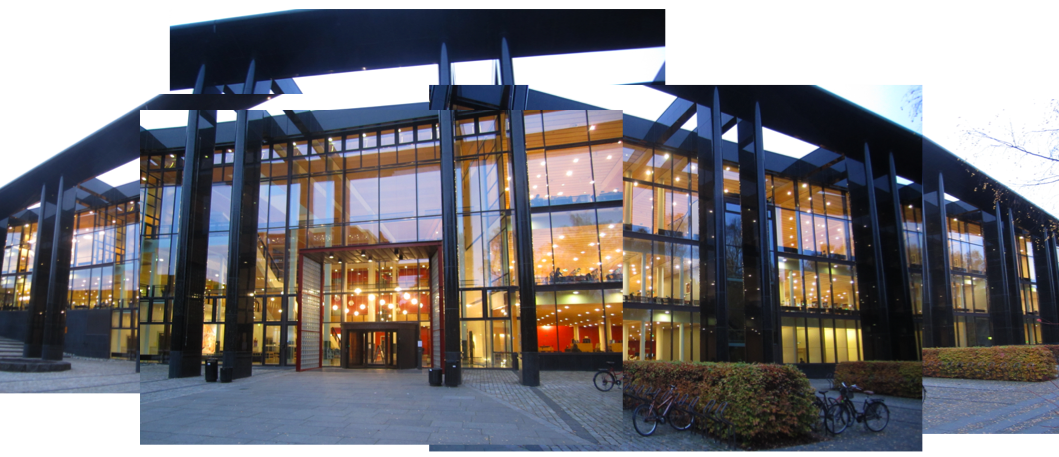
Here I am, sitting in Auditorium 2, Georg Sverdrups Building, University of Oslo, attending a workshop to prepare a European Research Council (ERC) proposal.

Workshop begins:

Mette Skraastad. A great workshop convenor.


The workshop begins with C. H. commenting on his successful proposal on emergence and decline of constructive memory:

Proposal needs to be enthusiastic, stand out from the crowd. Imagine a friendly reviewer and write a proposal. Success rate is 10 percent. Do not make it complicated. Follow the guide application closely. High gain but low risk. Point to possible challenges but point to solutions. Identify novelty. Why is it ground breaking? Demonstrate how it can happen. Discuss the proposal with previous panel reviewers. A substantial proportion of “luck or unluck”.
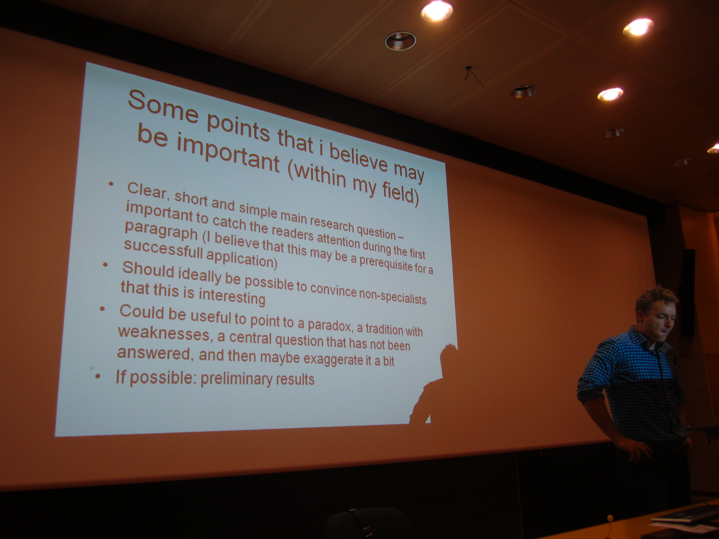

Find a paradox in the field in order to create novelty.
How can we unite different aspects of a field?


Per: Have the proposal ready before Christmas.

Mette Skraastad: Look for great research questions. All about being original. That is why you need time. What will the panel find that is interesting?

Wow! This person is tough.

An entire university is behind these projects. Plenty of time to edit and review. Write the project, discuss it with ERC members, previous reviewers, etc. Put the effort into each project proposal and get it on paper as soon as possible. Must be consistent — all throughout. Everything throughout the proposal should be consistent.

The entire point of the ERC is to select European Scientific leaders.

There were 4800 project proposals on the last call. For this reason they split the Starting proposal from the Consolidating proposal. FP7 Activities and Themes. A lot of proposals will be submitted for the Consolidator.

High risk research is best. But demonstrate that it is low risk by providing preliminary results — there must be high risk research elements. They assume that you have a team, because it is a consolidating. Explain how this will contribute to your career. Independent: you need to have several publications without your advisor.

It is 10:15AM and my brain hurts. A need to create new knowledge.

If I have a team, I need to justify all activities of members. What is their specific value added activity. Clarify what kind of people I need and why (for what kinds of specific tasks). Look at my strengths and weaknesses. How do I deal with my weaknesses, clarify how I plan to deal with it.


There are two steps. If I get lucky and get past the first step, then there is an actual interview process in Brussels for the second part.

Template is available Nov. 7.


Now, Mette is mentioning the importance of “Keywords” — what keywords you choose will determine how referees will be selected. Keywords based on research field.

Select potential external referees. Go to their website and identify key words about their research. Identify potential external referees for the ERC, help them out.

Mette is going through the process of review. Nothing new here. I know this process. Basically a fight over who is getting what.

This is the EGG of the proposal. Where is the novelty. In the approach?
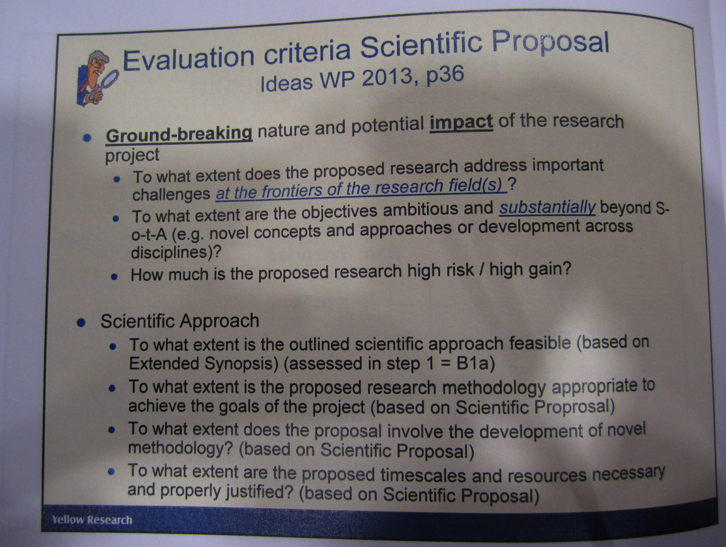

If it is incremental, it is not ground breaking.


There needs to be an analysis of why it is high risk, and an analysis of why it is high gain.
There needs to be a description of methods. High quality methods, high quality results.


“To my knowledge, this is novel, and for these reasons”. Then, I need to identify where others are around the world when talking about this research.

Need objectives. Each part of the project is mandatory to achieve the overall mission of the project. Explain how I will achieve objectives. Objectives + Hypothesis must lead to Insight. Wow. Page 21, make note of the “focused project” over “open project”, the latter disregarded.


There must be a clear indication of what I can create as objectives. And there must be time to obtain data.

Do I have access to data? Where will it be coming from? What is the larger integration of activities and approaches that make it reasonable to go after the ERC, and that it is the human mind that is selecting the empirical evidence.

Wow.

I just had an insightful lunch conversation with the workshop convener, Mette.

She says that I need to use the North American case study as an example of why my project is Feasible in Europe, and to show the exciting findings of the previous project etc. And then, use that work to show that I am the ONLY person who can do this work in Europe. That is something I have not yet done, lead off with my previous research, how I did it, the findings, and then describe what the differences are in Europe, the different languages, culture, etc. And how I plan to go about it.

It was quite funny. When I told her “I’m the only person who can do this”, I actually raised on tippy toes with my nose in the air, to which she immediately responded, “And that is how you have to present it to the ERC!”

Okay, we are now dealing with Methodology in Detail, with Key Intermediary Goals (to measure whether we are progressing toward the objectives at intermediary stages).

In overall activities, explain generally and give the feeling as well as provide back up plans, when you are not achieving the specific goal (p. 23).

Everything novel has high gain, what is the risk, is it feasible, yes or no.

Break the project down into WPs/ Strands/ streams/ subprojects with activities/tasks, milestones and a Gantt chart (what is a Gantt chart?). Good grief, how could I get so far in my funded research without ever using a Gantt chart?

Show that I have experience in handling data., etc, to explain to the panel members that I know what I am doing. Also, present thoroughly that I have access to specific data. Provide actual names, and justify why I am selecting certain houses. Is the institute the right environment to carry out the research.

They do not like to see collaborators. They want to see experts who can help out [This is really important]. Clear about the well defined objectives — AND come up with a hypothesis. what am I expecting?


On team members: “Mr. Smith with one paper is out. Mr. Jones with a lot of publications is in”. Make sure you include people who are worthy in your project. You have to select specialists.

There is one panel member that is going through all the references. As soon as there is one that is not there – they know that the project cannot be trusted.

Make sure that I am using an appropriate template, what is more convincing, a table, or what- Page 25. What is up and running at my institute that demonstrates that I am carrying out top quality research.

Well that just tops all. Mette is amazing. She has been talking for over 4 hours, and everyone in the room is exhausted, but she continues, and will continue for another 3 hours.
Must have citations to my own work.


I have to select the panel for whom this work will make the biggest impact.
How much data am I generation, and am I creating results.
Create a table, on B2b – Example of Challenge Analysis (page 27). Create a table for the grant. What are the milestones/outcomes, what are the risks, where are they located, what is the backup plan(s)?

Last year would be used to write a monograph. Year 5. Make sure they can assess what is novel, what is interesting, where the cutting edge is. What do I have that I bring into the project and what am I asking for from the ERC. Mostly salaries.

Explain why I want a workshop and who I plan to invite. I need to explain why I need a certain amount of money.



Read Full Post »


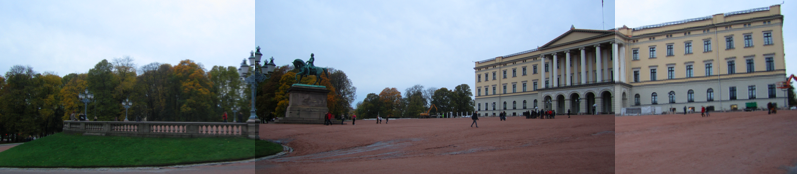
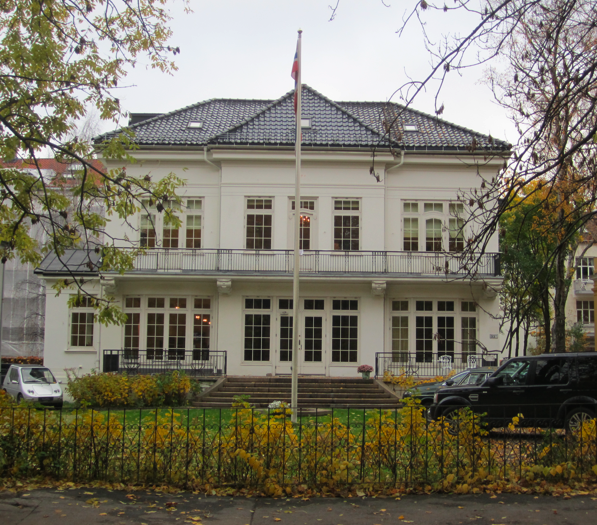
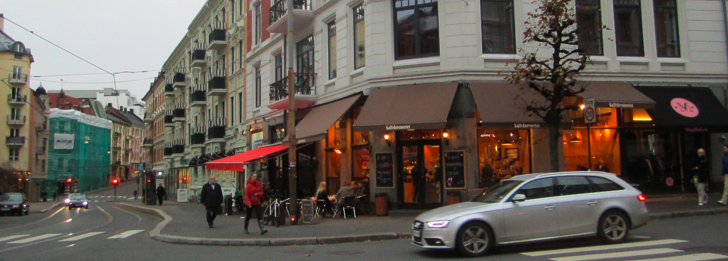
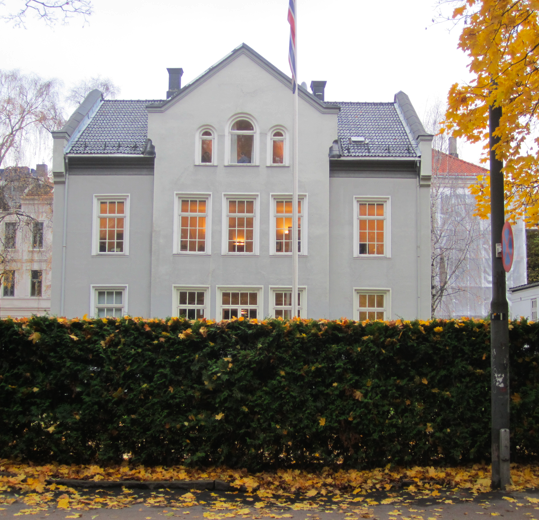
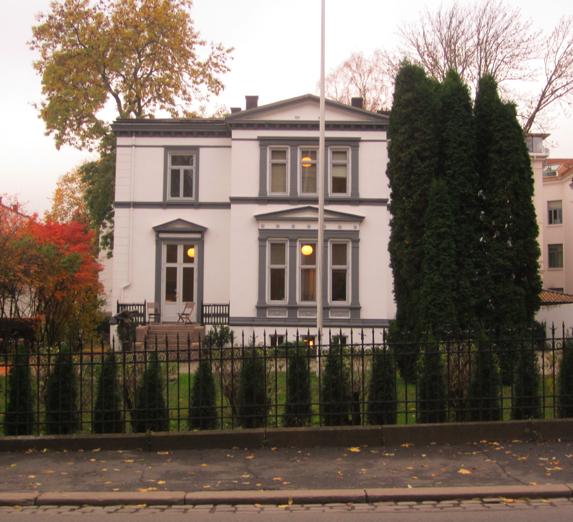
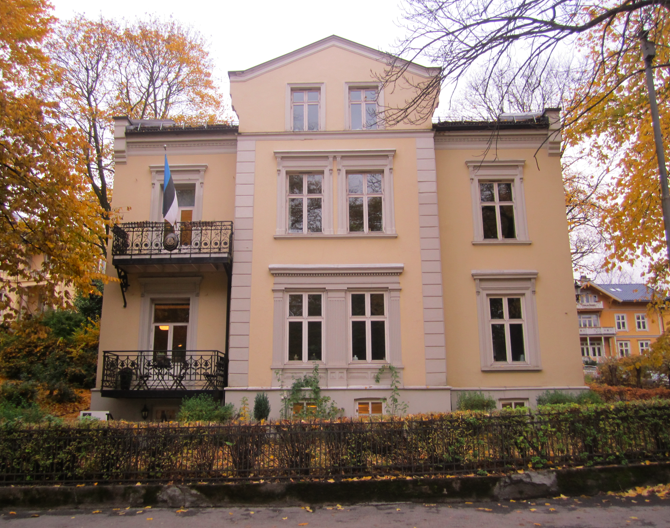
10/22: I headed back to Kafe Oslo to complete these notes, taking stock of the estate sized homes along Embassy Row, directly behind the King’s Palace.

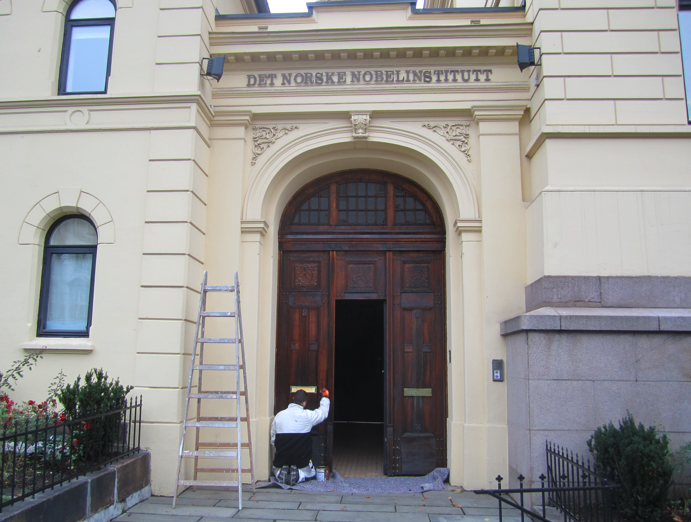
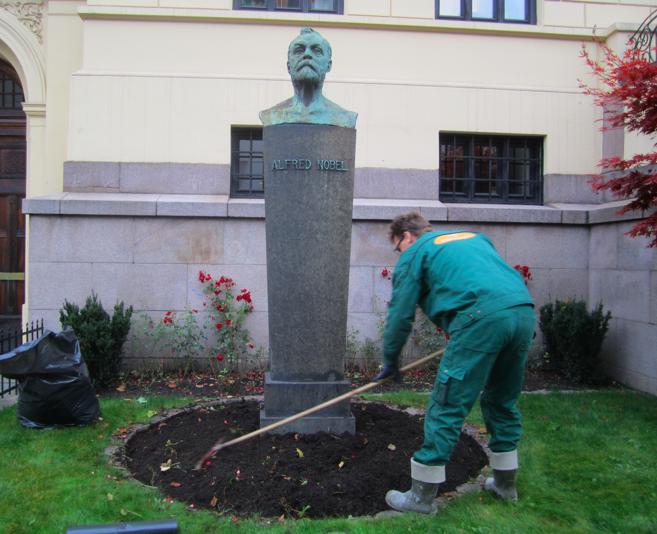
I could not help thinking in detail about my exchange this morning with Tom von Nikolaus, having just taken place in a cafe near the American Embassy, a section of Oslo I am familiar with from my August visit to the Fulbright orientation at the Nobel Institute.

My assistant Annamots, refers to him as “The Oil and Gas Man“.


To me, Tom von Nikolaus is the Dick Cavett of Norway’s Oil and Gas Industry, thoroughly networked, and at the same time, standing as front man for its high-end ritualized appointments.

For the reader, I call him Tomvon.

Tomvon was my first informant on Norwegian oil and gas issues, having first met him summer 2010. Agreeing to meet over coffee, I introduced my conception of knowledge flows and actors on Barents Sea Shtokman development.

With maturity, humor, and thoughtfulness — Tomvon instructed me on several research aspects.

In particular, there is a need to consider the role of oil and gas majors in employing independent experts to justify developments that might prove delicate if presented as in-house social relations campaigns.


During our next meeting, I accepted his invitation to attend the prestigious Scandinavian Energy Forum (another pseudonym), wherein I mingled with heavies of Western European industry and finance.

With several I have established agreeable relations, in London for example, with former CEO of Amerada Hess, philosopher-capitalist, Francis Gugen.


Tomvon —


alongside several others from Norwegian social life who straddle the higher lattices of government and industry —


including Norway’s Consular General in Houston, Jostein Mykletun


— provided a letter of support for my US Norwegian Fulbright Award 2012-2013. I thanked him in person over a handshake this morning.

Let me set the stage further:

I had enlisted Annamots to create a thank you letter for the Fulbright award to acknowledge persons providing strong support. It was on the basis of this support — as told to me by Fulbright Officers, in addition to my proposal — that my application entered into the winning circle.

The bar on my application was high. 5 years previously, I received a Fulbright for Canada. Having completed the mandatory hiatus period for re-applying, receiving a second award so close to the first (given there are only two opportunities per career), seemed unlikely.


There is a longer story.

But I learned years ago the importance of a well crafted thank you letter.


As part of my ethnography on Alaska politics serving as volunteer for the Gretchen Guess State House election campaign, we crafted a letter of appreciation to acknowledge financial contributors.

At the time, it seemed to me ridiculous that one letter, replicated to all donors, but signed in the hand of the candidate, could be viewed as anything more than a cynical gesture. And yet, evidence revealed to me the exact contrary, that it remains to be said, when crafted with earnestness — an acknowledgement of thanks is a signature of sincerity.


A final set of points:


I had spent considerable time preparing to meet with Tomvon —

I knew it would be brief — 30 minutes between his travels between Stavanger and Moscow.

I began by noting that U. Tromsø had invited me to establish a research presence in Norway, including support for the Fulbright; an appointment to apply for national and European grants (having submitted four); a teaching course on methods; and establishing partnerships with other academics, e.g., a recent workshop to consider High North futures.

I wanted to follow a step further, to build long term capacity for the University on topics around leadership, decision-making, and expertise related to High North energy, based upon personal connections between academia, industry, government, and experts, but also, stressing the importance of valuing the proprietary nature of exchanges.


My meetings at U. Tromsø last week, taking place with Vice President for Research, Curt Rice (avid supporter also of my Fulbright), and in-house High North Oil and Gas Guru, Peter Arbo, was focused on an Institute for Social Science research, of which I will write more in the future.

Thus, at issue was a request of Tomvon to keep me in the loop of Energy Forums and other meetings; establish introductions with key persons with whom we could create a baseline social network for learning about Norwegian energy development;  and hold internship possibilities in energy knowledge firms.

And this was the context of our discussion as we sat down over two lattes and warm bread buns filled with blue cheese.


Our conversation began with Tomvon’s present trip to Moscow —

on behalf of the Norwegian Ministry of Foreign Affairs, to be accompanied by a small core of academics in order to engage with government and industry leaders of both Norway and Russia.

“The opening of a new ocean”, as the topic of the Arctic was put to Tomvon by the US State Department this past September, when he visited the United States, along with meetings with the Marine Corp. and other significant US government attachés on this topic.

It came as something of a surprise to me, that he mentioned the names Gunnar Sander and Arild Moe, the former — a professor with whom I had participated in a workshop last week at U. Tromsø, on the topic of High North Futures; the latter — who also provided a support letter for my Fulbright and current Deputy Director of the Fridtjof Nansen Institute — both of whom would accompany Tomvon en route to Moscow today.

After discussion of aims of the trip, and touching on more names, mentioning my visit to China this past March, in response to a point he made about India’s interest in the Arctic, a reminder to a presentation by Shyam Saran, Former Indian Foreign Secretary and Special Envoy for the Indian Prime Minister on Climate Change, from whom we both heard a speech on India’s emerging role in the Arctic at the 2011 Scandinavian Energy Forum, mentioned above


— Tomvon asked what were my intentions?


I responded with the request, “to be included in discussions over The Opening of a New Ocean”.


Read Full Post »

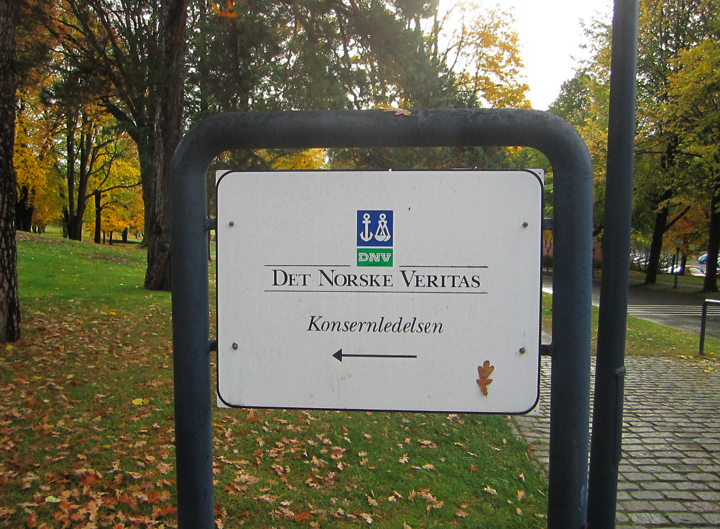
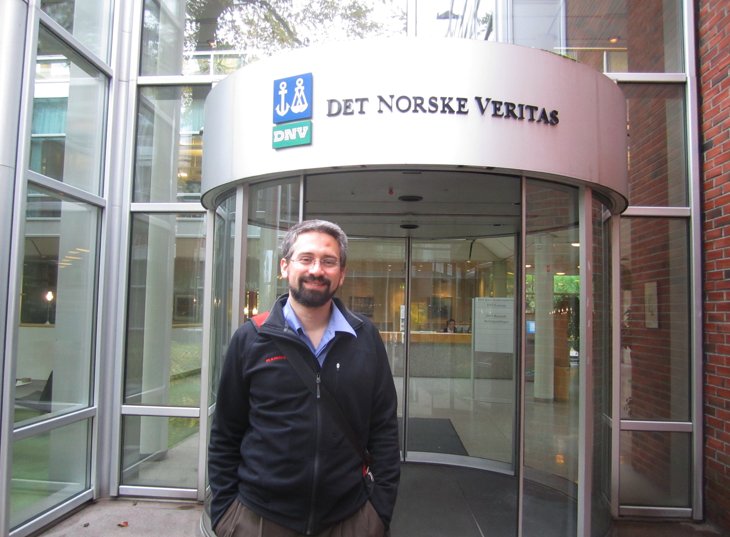
I gave a talk at Det Norske Veritas (DNV) about my research on energy consulting, by invitation of Bradd Libby who works in an Arctic research section of the organization.

Bradd and I met in January at the Arctic Frontiers conference in Tromsø.

It was then that I first heard him mention DNV’s interest in Arctic specific research, from climate change impacts to practical experiments for determining the quantity of ice build up on ocean vessels in Arctic conditions.

In 2011, at the Oslo Energy Forum in Holmenkollen, I met DNV chief executive officer Henrik O. Madsen, PhD, businessman and engineer. Henrik, for several nights, was emcee to the delight of attendees. Here is a photograph of Henrik on stage delivering a summary of the days events.

DNV is a “classification society” serving as a foundation for “Safeguarding life, property, and the environment”. The organization evaluates technical conditions of merchant vessels and provides services for managing risk. The company was retained by the US government for investigating the Deepwater Horizon oil spill. 300 offices in 100 countries, 10,000 employees focusing on transport, energy, health care — its reach is comprehensive.

I had planned a talk on Historical Change in Visualization, when, over drinks the evening prior, Torild Nissen Lie, also of DNV, mentioned that my observations on how firms communicate would be of interest.

It was advice from a fortune cookie.

After drinks, I went back to the hotel and re-wrote my presentation to focus on how consulting firms create Communities of Interpretation.

A similar occurrence happened last week.

On the evening prior to my presentation before U. Tromsø faculty, Sidsel Saugestad, over a whisky, pointed out that I should drop the Visualization topic and lead with an ethnographic presentation.

Traipsing back to the computer keyboard, I reworked everything hours before presenting.

Thankfully, the two outcomes were the same. Both presentations turned out to be crowd pleasers. Phew!

But that is getting ahead of myself. On the morning of my DNV presentation, with travel directions from Bradd, I hopped a cab to Oslo central station suddenly realizing that I left my camera in the hotel room.

I hopped out and told the driver to circle the hotel and meet me at the entrance. Typically, I use the I-Phone camera, but had forgotten the charging cord in Tromsø, and would now rely on a point-and-shoot.

Lucky that I remembered.

There were so many interesting interior images I wanted to capture, including Bradd’s bricoleur constructions for carrying out experiments, which included assembling locally bought hardware store items (funnel, duct tape, screws, plastic pipe) into a capturing device for measuring sea spray — for placement on a research vessel.

But I refrained from taking photos as it was the first time we had all gotten together more formally.

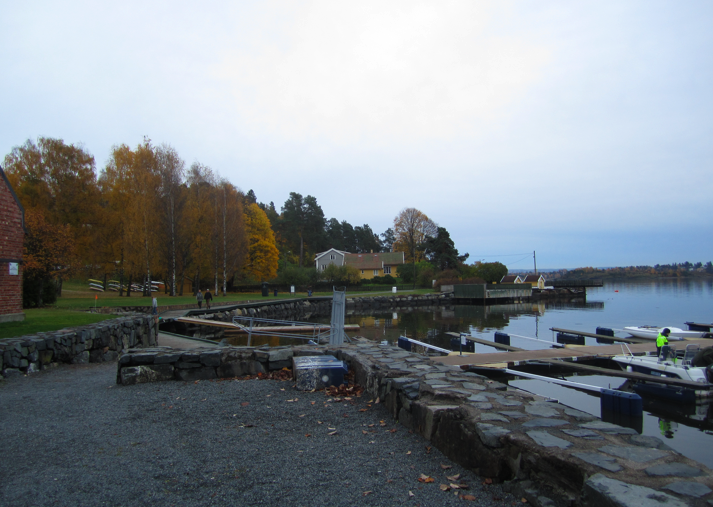
The DNV “campus” — as folks including myself refer to the layout of buildings, is located on a knoll, that slides down into a cove located on the Oslo Fjord.

It is the site of an old glass factory, with the buildings now refurbished serving different purposes. The town is Høvik, a suburban center, west end of Oslo, in the municipality of Bærum, the latter noted for having the highest income per capita in Norway, highest proportion of university-educated individuals, and most fashionable residential areas.

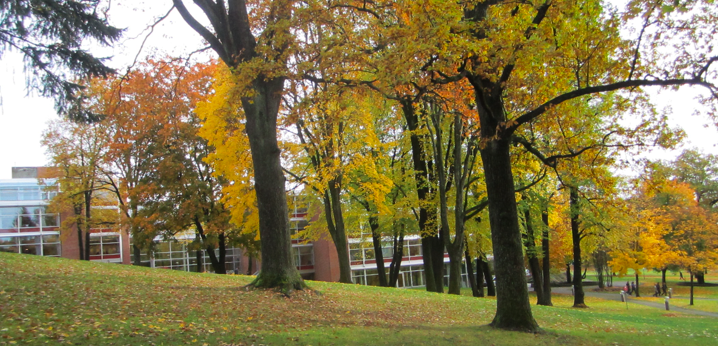
During this time of year, autumn, the DNV campus is beautiful and reminded me of two other places, Belvedere Island, Tiburon, California, where I grew up, and Cold Spring Harbor, Long Island, New York, where I visited friends while an undergraduate at Columbia University. These towns are located on inlets, surrounded by deciduous trees, and whose forms of artificiality and enlightenment contrast that of the university form.

One of the first persons with whom I was introduced was T. K., who among other duties, served as one of the lead authors of the Barents 2020, a 300-page report assessing international standards for safe exploration, production, and transportation of oil and gas in the Barents Sea.

Five years in the making, the report creates knowledge from a working relationship with Russian counterparts and Western European specialists.


Efforts such as the Barents 2020 impress.

It is a reference document for the sciences, as evidenced last week at U. Tromsø, where scientists submitting proposals to the Research Council Norway Polar Program, cited the report in requests for further study on oil and gas development, a point I conveyed to T.K.

But discussion of the report also offered an opportunity to discuss DNV’s working relationship with VNIIGAZ, the scientific research institute of Russian natural gas giant GAZPROM.

T.K. acknowledged that there is generally an issue over the lack of knowledge sharing with Russian counterparts. Yet, he also stated that the knowledge issue is not so difficult as long as you maintain continual contact over the long term and settle in and familiarize yourself with the data on-site.

I had a chance to meet with Bradd’s team members all of whom held science and engineering backgrounds and are for the most part in their 30s and early 40s.

Present at my talk were about 18 persons. That we had been discussing the techno-science role of DNV, I decided to begin my talk by paraphrasing a passage from Norbert Elias in which he points out that 18th century court society developed an extraordinarily sensitive feeling for the status and importance that should be attributed to persons on the basis of speech, manner or appearance.

My work deals with appearances, which serve as an instrument of self-assertion and social differentiation, the display of rank through outward form. As such, I wanted to prepare folks for what was coming.

Bradd was funny. He introduced me by giving his own stereotype of what cultural anthropologists do, describing us as wearing wide rimmed hats and hanging out in tropical villages (“but in this case Arthur studies people like us!”).

So we laughed and that was a good beginning.

I presented a combination of works, referring to recent manuscripts which can be accessed on my StudioPolar.com site.

A unique occurrence that took place, or at least I thought it was indicative of the general interest in my talk: at 2PM Fridays, the group typically meets for a wine bottle lottery and candy share. Whomever wins the wine bottle, brings candy the next week, or something of that design. At any rate, we began at 1PM and I was advised that nearer to 2PM — I could expect folks departing for the friday mini-celebration.

To my surprise — and I had hoped only to speak 40 minutes but actually ended at 1:55PM — most folks stayed and asked questions until about 2:20PM, which I found gratifying.

The questions were good. One question concerned whether I was making too many generalizations, based upon a case study of natural gas restructuring in North America. Or rather, whether my entire presentation was too general.

And this was an accurate critique, in the sense that I was introducing, ambitiously, at least 7 points in my talk, referring to a historical shift in visualization toward more abstract forms of interpretation; the role of energy consultants in creating consensus among competing parties; the role of government after the OPEC embargo in creating institutions that could collect data that would provide independent firms to thrive; the general point about a semantic collapse in national energy systems during the 1980s; and the overall collapse of 3 historical autonomous forms of Knowledge and Human Interests, as once laid out by Jurgen Habermas but which now represents, under environmental sciences, a combination of prediction, vision, and ethics — Really, quite a lot to cover in less than one hour.

Looking back, I should have stated that what I do is a combination of Historical Constructivism and Philosophical Empiricism and that a statement of such at the beginning would probably have cleared up things.

But instead, I responded by appealing to empirical grounds, stating yes, the European condition is quite different (regulation, technical aspects of pipes, marketing), but that in general, the Western European and American case can — as a general form, be considered unique, in comparison to, say, the Middle Eastern form, which still regards visuals as truthful when shown in an immediacy of the recognizable image, which, for those in the room at any rate, can only be grasped as falsity.

But it was a good point.

Another set of issues surrounded the performativity of visuals, whether consultants can do more than justify an independent stance over development or whether they can perform certain futures. Here, I demurred and provided a 3-point answer: all of the above.

There was a question over whether emancipation of the earth was simply anthropomorphizing the planet. Again, to speak otherwise would bring us back into a Weberian conception of science as a vocation (a separation of the current collapse of knowledge and human interests). That was my response at any rate.

Finally, there was a funny question about the Kantian aesthetic, and whether we would ever go back to the anti-Kantian aesthetic, in terms of visuals. I responded by pointing to Norbert EliasHistory of Manners, suggesting that we have been moving steadily across history toward an aesthetics of increased refinement and delicacy.

That likely, the shift from an anti-Kantian to a Kantian aesthetic reflects this trend, where today, instead of seeing the violence perpetrated upon the earth by reference to images of “pollution” (or such immediately recognizable images of environmental insult), we now prefer to look upon images of graphs– the relationship of surface temperature to the amount of CO2 in the atmosphere, as one example — as if prediction is now the only form of determining environmental remediation.

Overall, I thought the presentation went well.

Afterward, I had a final opportunity to convene with Bradd and his section leader M.W. We talked on a variety of issues, including unique areas of Bradd’s research on potentially disruptive (innovative) technologies for the Arctic.

Our discussion resulted in follow up themes that I am hoping to collaborate on with Bradd for developing a stronger relationship between my own research and the DNV Arctic research team. These include, communication and conveyance of risk; the formal system of networks in the Arctic; a social science exploration of identifying contours of proprietary knowledge; a topic I suggested, geoengineering, because I felt that once we identify ourselves as the purveyors of climate change, while it may result in political action, as Al Gore states in Inconvenient Truth, it most likely will result in, well, more scientific progress! (testing on the earth, knowing that we can now manage it).

Finally, it was time  to go home. Bradd and I walked down to the shuttle that would carry us to the train heading for Oslo.

Bradd lives in Norway with his family, but I told him, and not without some laughter, that he was still very much of the American Risk Taker ilk — placing me, as he did, a cultural anthropologist in front of his colleagues to see what happens, an experimental gesture to be sure, and I was grateful for the opportunity. We shook hands at Oslo central station and proceeded to our respective destinations.


Read Full Post »

♣ Oslo

10/22: Dinner at Bjørnsletta.

I left the city briefly, at least out of downtown, taking the subway to dine at the home of Alan Tiecher, IT consultant for SEKKK Corp., a consulting firm with 300 employees here in Oslo.

We had met in Berkeley, at a Carbon Sequestration workshop last year and kept in contact over email. Alan invited me to dinner, to meet his wife and family and to provide tips on Norwegian interpersonal relationships as I begin my Fulbright research. We discussed my upcoming meeting the following morning with Tomvon, see later post.

Over several beers and a traditional Norwegian meal (cutlet, potatoes, lingonberry sauce), we discussed our different career paths. Alan and his wife, Christina, along with two small children, had travel extensively, having lived in Berkeley, in Chile, visiting South Africa frequently. Alan had spent four years in the United Kingdom, at university near the city of Bath.

Christina holds an IT senior position as analyst with a firm in downtown Oslo but was considering a change in careers.

As Alan walked me back to the elevated subway stop, I seem to have surprised him by pointing out that a change in careers is difficult, especially successful ones as in cases such as his wife. Only through great conviction, I said, is it possible to remain relevant thereby neutralizing the power of currency. My surprise came when he responded that I indeed thought money was relevant.


10/19: I gave a talk at DNV today and will post my impressions shortly.


The Guard House outside of Det Norske Veritas (DNV), an architectural blend of panopticon security and kiosk disney.


10/18: I swooped into Oslo last night, arriving late from Tromsø and taking the train into town. The entirety of University of Tromsø it seemed, was working over night to complete proposals for the Research Council Norway, myself no exception, and was exhausted on the flight over.


It was a fury of efforts. I was the North American in town at that moment and thus, was thrown on to proposals other than mine, to meet the international requirements of the call, subsequently finding myself competing against myself.

I awoke in a different climate entirely, Oslo far south from Tromsø, and began putting together my talk for DNV, invited by Brad Libby, for friday. Early evening, I met up with Torild Nissen Lie, also of DNV, with whom I shared a few drinks and spoked about work and life in general. Torild has a fascinating career at DNV, a huge company involved in oil and gas development. She hired 20 folks over the past 2 years, and it was interesting to hear about employment practices of high end professionals.

Without going into details, we had a good laugh over the differences between academic and entrepreneurial affiliations.

Here is a quick video of Torild and Bradd, along side Emma Wilson on the left, when we were all together not too long ago at the Arctic Frontiers conference in Tromsø.

I had Torild laughing over a point about the importance we place on the body in relation to knowledge. In my paper tomorrow, for example, I point out that posture and thinking are linked to either magical causality or rational techo-economic causality — that, when giving thought to multi billion dollar West African offshore oil and gas development, kneeling with palms held tightly together in the form of prayer would unlikely be considered an appropriate form for contemplating success.

Read Full Post »

→ U. Tromsø

10/16: Visions and Transformation of the Arctic – workshop.
We met today, mostly to talk about the technocratic impulse of modernity and its future vision. As such, I could not help reflecting on what was missing, and indeed, that which was on display as part of the past, yesterday when I went to the Tromsø museum.
Here then, are some unbridled comments from a techno cosmopolitan workshop on futures, alongside a few unbridled images of captured heritage, actual lifeways as lived yesterday well into the future, on the ground.

Up now is Dag Avango from Sweden talking about involvement in a Swedish national MISTRA funded project utilizing Actor Network Theory for denaturalizing the deterministic language of climate change as an environmental response for development.

Resources (not something given but constructed defined by actors in order to function within actor networks); Voices, (resources require voices to articulate them) Governance (historically specific contexts). So, these are some of the new analytical tools for evaluating competing visions. One of his main questions: how do actors construct visions and why? Which actors visions gain influence in different time periods and why? Why do some futures become realities and others unheard?

Dag approaches his work through archival research.

Okay. Now up, we have Stian Bones. Norwegian Polar Politics 1870-2014. Ah. a Book project. Interesting. Building on an already published historical account. Using cultural and political economic approach in contrast with a “realist” theory, which focuses on state interests and power in the international system. Okay, what else. The role played by individual actors is important. So, a polar politics in a culture of anarchy, Hobbsian (antagonists in an international political system), Lockean (rivals negotiate and compromise), Kantian (friends for common common good).

Okay, well, now it is my turn to start talking bah. blah blah blah.

Wow. That was good. I actually got as far as “the shift from the anti-Kantian to the Kantian aesthetic”.

So up now is Astrid Ogilvie. Norsaga Locations. Looking at transportation flows of the Ole Norse. Reconstruction of a temperature record for southern Norway for the period 1758-2007. Looking at diaries for when ice break up took place and transforming that to numbers. No surprise, today is warmer.

There is Annika Nilsson up now from Stockholm Environmental Institute. Great communicator, talking about a paradox of climate change in the Arctic and further extraction, and therefore, the faulty science-policy interface. “It is not the climate that is making the Arctic, but the people with their interests who are creating the Arctic, and institutionalizing an image of the Arctic”.

Kari Aga Myklebost. Now up talking about Norwegian and Russian relations sharing a common border since 1826. A historian, with a great new publication Caution and Compliance, Norwegian-Russian Diplomatic Relations 1812-2014, establishing new arenas between Russ and Norway on vulnerable resources in the North. Part of the Barents Region created by Norway government was to deal with the welfare gap existing in this transnational region between the two states.

Another thing: Russian is a big actor in an asymmetric relationship to Norway, great power- small power relations, in contrast to say, Swedish- or Danish- Russian relations. Moving from bilateral state relations to civil society it would be the other way around, Norway has a much more strong civil society with a sharp social welfare contrast in the Border areas, which was discussed both today, but also during the mid 19th century. And finally, how do you explain the stable border relations given this double asymmetry — where is the will to cooperate coming from.

Peder Roberts: Historical construction of Arctic resources. Whaling — particularly blue whales were not harvested until the exploding harpoon, and until that development, were not brought into relations of markets and commodities. So they resisted the market for some time, much like my natural gas discussion of the Arctic. Resources as political power versus economic exchange. Under the context of whaling, for example, when Indigenous groups seek to have access to whaling, they become boundaried by the regulations by whaling commissions which limit them as a discrete group with certain rights.

I was asking — why utilize a new Latourian language or could this story be told without a Latourian language? I had to do so. The language of networks and structures provides some durability — that is a good response, but would there be a loss in contingency. And then Dag responds also, that path determinacy can be unraveled by network theory.

Okay. Now Gunhild Hoogensen is up, talking about extractive industries in the Arctic. Talking about notions of security, moving from Cold War to the present, from the political to the extractive industries, protecting environmental security, placing values on the environment, and the definition of the state. That is, preserving those which we find valuable given climate change, and prioritizing resources. Looking at the ways one understands security and the dominant forms and non-dominant forms of knowledge that are and are not part of the security debate, and how do debates proceed with different voices, for example, how do Indigenous groups view oil and gas industries.

Gunnar Sander: Prospects of Arctic Shipping. Wow, what an interesting talk. There are three routes. The North East passage (and a subsection of the North East Passage), the wide open ocean passage and the North West passage. Canada does not want traffic for political reasons because of a threat of sovereignty and environmental risks. But also, there is no infrastructure. While in the North East passage, Russia does want traffic. Nevertheless, there needs to be a re-build up and upgrading of ports, navigational systems, and search and rescue and icebreakers. There are only 25 of 50 ports that are operational.

Well. This guy knows everything, about oil and gas also. A fine balance between how much money the state is willing to invest into the system versus asking the fleet to pay, but then high tariffs would lead to alternative routes.

So, what he says is that “we hear about transits” but that is not the case. And yet again, there are transits. So for example, by comparison, there are 18000 ships moving through the Suez canal in 2011, while only 33 ships across the northern route.

Drivers of shipping. There are transit traffic (container and bulk) going from Asia to Western Europe and Destinational Traffic. In sum, it is not direction of change (we know that), and ultimately where the Arctic is going (we know that) – but it is a matter of when, the exact time that the Arctic will be open ocean in summer.

Tore Henriksen: Arctic shipping through challenging waters.

Peter Arbo, has the final word, discussing refreshing perspectives brought by STS, systems theory, Luhmann, institutional theory, governance, a mix of various approaches applied — both the empirical and theoretical level.

Annika now discussing collaborative potentials: PhD programs as collaborations. How can we develop courses that share expertise and resources to increase the quality of PhD education in Arctic social sciences. Another possibility is guest exchanges. What could we actually gain from each others networks in a systematic manner.

okay well…


10/13: Postcard for Nadia Filimonova (!):
From the Norwegian Museum of Northern Art (Nordnorsk Kunstmuseum), probably a depiction of Lofoton, titled Malstrømmen, 1929, by artist Per Krohg (1889-1965), from the permanent collection in the third floor gallery.

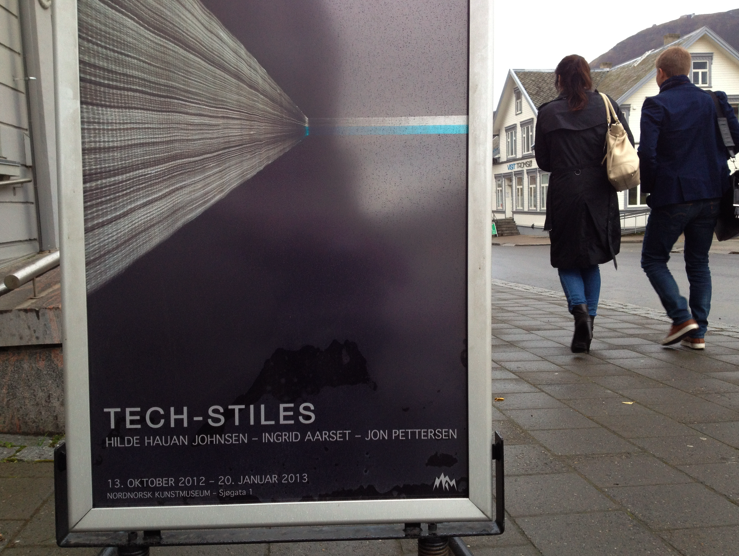
We took a break from writing proposals and decided to take Peter Arbo up on his offer to visit his wife’s art opening downtown, at the Norwegian Museum of Northern Art. The program was focused on textiles.

By this time, my lecture to the anthropology department the day before on consultant expertise in creating arctic oil and gas futures was long past. At some point toward the middle of my talk, Sidsel Saugestad suggested I speak more slowly, and so realized I was nervous– having previously presented mainly to energy audiences.

Thanks Sidsel! for always looking out for me. I appreciated the gesture.


Another faculty, Bjørn Bjerkli talked about onshore-offshore differences, suggesting onshore creates a qualified claim in the context of indigenous rights, by which by definitions are temporalized with reference to the past. Well, I almost cut him off right then and there, because he was absolutely correct, in that both indigenous and experts signify two poles of temporality the latter concerned with the future. Elsewhere, I even discuss the gesture and gaze of a future perspective.

Jorun Ramstad, another faculty asked about issues of proprietary nature, and whether it was difficult to gather data.

This was a great question, because it allowed me to present Paparazzi Ethnography as my method for getting around such problems. In fact, I was able to pull up this very site right then and there, and go through methods I use for capturing fleeting phenomena. Other good questions came up, for example, the issue of optimism and certainty.

And it is true, that consultants are much more optimistic and speak with certainty than researchers working at a university who feel more comfortable with uncertainty. As part of my response, I suggested that the future can serve as a surrogate for progress and thus gloss over issues having to do with a present defined by risk society.

We all then went upstairs for coffee. To a plate of fabulous homemade blueberry cheesecake, we began delving into aspects of my talk in the context of developing a PhD seminar for spring 2013. Semiotics and the political economy of the sign was a major theme in our discussion. I was delighted. Seldom in interdisciplinary meetings does semiotics arise. It was then, afterward, I had the opportunity to meet up with Curt Rice, Vice President of Research, and Peter Arbo, Political Science professor who works on Arctic Futures. It was good to see Curt. He is such a polished academic and administrator, a role model to be sure. That is when Peter suggested we go down to the opening.
Relatively newly minted PhD in anthropology, and CICERO maximus genius, Marius Næass, of whom I write in my Tromsø post below, came along and we bumped into UiT postdoctoral fellow, Maaike Knol. We were lucky to be able to fit two art openings in during the day, the second, about portraiture and photography in the context of desires to be beautiful and the sacrifices made along the way.

10/12:
A lecture given by myself today. Right now actually. I will be back…

10/10: Arrived in Tromsø this morning…
…via an airplane all to myself.

Gørill Nilsen, Professor and Head of the Dept. of Archaeology and Social Anthropology was kind enough to offer me her computer upon my arrival so I could provide this little blog update. Marete Johansen, Administrative Honcho for the department was hospitable. She gave me an office, scrambled around for a flash stick, provided me keys to the place, and even set me up with an email account for the duration of my Fulbright stay, and beyond.

So there you have it.

Now it is time for me to do some heavy lifting. I have to complete my presentation for Friday. There are also several sections for two proposals I have to draft before my meeting with Marius Næss tomorrow morning. That much, alongside whatever else I have to complete (articles, applications, etc). Wait a minute, maybe it is time to get some coffee and heavy lifting later. But come to think on it, before signing off, I like these Norwegian computer keyboards. At the touch of my finger, there is the æ (where the ” typically is) and oops, here is an ø where the ; is typically found. Ah, now here is something you donæt see often, the å where the brackets usually are located. Okay. Away we go for coffee…


10/8: Inflection points enroute…


9/27: We just received a draft agenda for the workshop, Visions and Transformations of the Arctic, taking place at U. Tromsø on Oct. 16. It looks exciting! We will post here the final copy.

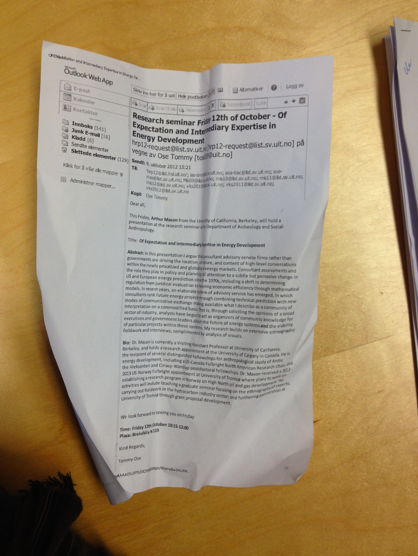
Seminar Lecture: Department of Anthropology, U. Tromsø (October 12).

Title: Of Expectation and Intermediary Expertise in Energy Development

 Abstract: I will talk about consultant advisory service firms driving the location, structure, and content of high-level conversations within the newly globalized energy markets and the role that consultant assessments play in policy and planning — calling attention to a subtle but pervasive change in US and European energy prediction since the 1970s, including a shift in determining regulation from juridical evaluation to favoring economic efficiency through mathematical models.


Workshop: Visions and Transformations of the Arctic (October 16).

Title: PanArcticon — Providing Insight into Arctic development

Peter Arbo and Gunhild Gjøv Hoogensen of U. Tromsø, along with Annika Nilsson, Peder Roberts, and Dag Avango, coming in from Sweden, Environmental Research Institute. We plan to present our Arctic oil and gas proposals, looking for synergies of approaches moving forward.

Read Full Post »

9/23: We are developing a Pan-Arctic research program called PanArcticon: Providing Insight into Arctic Development (website soon).

PanArcticon introduces new approaches to the study of experts, institutions, and forms of knowledge that guide arctic energy development. Current support includes two multi-year NSF awards; Norwegian Fulbright award; Aleksanteri Fellowship; Ciriacy-Wantrup Fellowship; and grants from the Canadian government.

We developed a few main themes including what we call: Anywhere That is Not Now, in which we refer to our project as one of documenting the slide of the unconventional into the conventional, that is, examining the cumulative symbolic impacts that provide capacity for enshrining Arctic oil and gas development as conventional. As such, PanArcticon is in the business of creating thick descriptions about Arctic energy. Stay tuned.

Read Full Post »

ArcSEES

9/13: We submitted a proposal to the National Science Foundation (NSF), titled Pan-Arctic Visions of Sustainability among Indigenous Peoples and the Hydrocarbon Industry (yay!).

The project calls for collaboration of American, Western European, and Russian scholars to study differences between individually and collectively constituted visions of sustainability. Such a fabulous drafting effort! I decided to create a post for the proposal. If funded, we need to document the entire project right here on Paparazzi Ethnography.


The Participants:

We plan for workshops in Norway and northwest Russia focusing on the folks affected by hydrocarbon development, including study of local investment schemes. The idea of workshops came from the “evil genius” — as I refer to my faithful assistant Annamots, seen here in our lair at Sutardja Dai Hall, UC Berkeley — Voilà:

Participants at workshops include folks living out on the land where pipelines and oil rigs cross pastures, hunting and fishing grounds, including Indigenous peoples and the oil industry laborers working on infrastructure alongside.

Florian Stammler, of Arctic Centre at Rovaniemi, suggested this approach, providing the relevant expertise on networks with reindeer herding communities in Russia, as seen here (r), asking critical questions at the Aleksanteri conference in Helsinki, Finland.

As to workshop structure, we will elevate the importance of local voices, assigning key leadership positions to local Indigenous members. Also, Norwegian-Russian cross border engagement through workshop participant exchanges will provide opportunities for communities in Russia to learn about Norwegian human rights in the context of oil and gas.

These ideas stem from Maria Stoilkova, Eastern European expert, as seen here left in New Orleans, Louisiana, attending the Anthropological Association Meeting. The workshops will be held in conjunction with quantitative research for mix methods comparative approaches to individual and collective visions of sustainability.

And this development comes from our collaboration with a Norwegian Research Foundation funded project, directed by Dr. Ilan Kelman, who is seen here in his office at the research institute CICERO in Oslo, Norway.

 Carly Dokis has a fabulously completed Ph.D. dissertation from which we constructed the intellectual merit of the proposal, which examines workshops as a Euro-American forum of consultation wrought with potential and hazards, as Carly is shown here, dining with us in Svolvaer, Norway, at a candle making shop.


Our project mentors, Bjørn Berkli, seen below in his office in Tromsø, Norway, this past August, and Nina Poussenkova, shown in the main conference room of IMEMO in Moscow, where we had the opportunity of taking a tour of the building, provide important in-country expertise.


And we know who these two early career scholars are.

You guessed it.

None other than San Francisco’s own Samantha Catalyst, Photographist and International Travelry Specialist, and Octavia Shadowz, Cocktail Waitress and Faschion Designer, both uniquely involved in the project, working at what capacity, only they know best.

Well, that’s the participants. We will return in the coming months, when we begin to hear back from the National Science Foundation Cognizants!!

Read Full Post »

« Newer Posts - Older Posts »