Feeds:
Posts
Comments

Archive for the ‘Paparazzi Ethnography’ Category

CSTM&S

UC Berkeley’s Center for Science, Technology, Medicine, and Society (CSTMS).

Recently, David Winickoff spoke on Geo-Engineering. Cooling down the earth by controlling the sky — a type of science spear-headed by David Keith, previously of University of Calgary and my former sponsor of the Canada-US Fulbright when I was there some years ago. David K. is ultra smart and ultra famous, and now resides at Harvard University.

It was yesterday, at David’s talk, through an introduction from Chris Jones, that I met Ozzie Zehner, a Visiting Scholar at UC Berkeley with a newly minted book coming on the shelves about the pitfalls of green energy — in your book store this May 2012.

His book, titled Green Illusions, by all the looks of things, will be popular. Look for Ozzie on television soon, or NPR if you listen to the radio. We all got a chance to catch up over coffee. After our little chat, about all those et ceteras and so ons, we headed over to CSTMS’s launch of the undergraduate component, titled, Science of Society’s Course Thread.

The thread launch included food.


Read Full Post »

Dustin Mulvaney


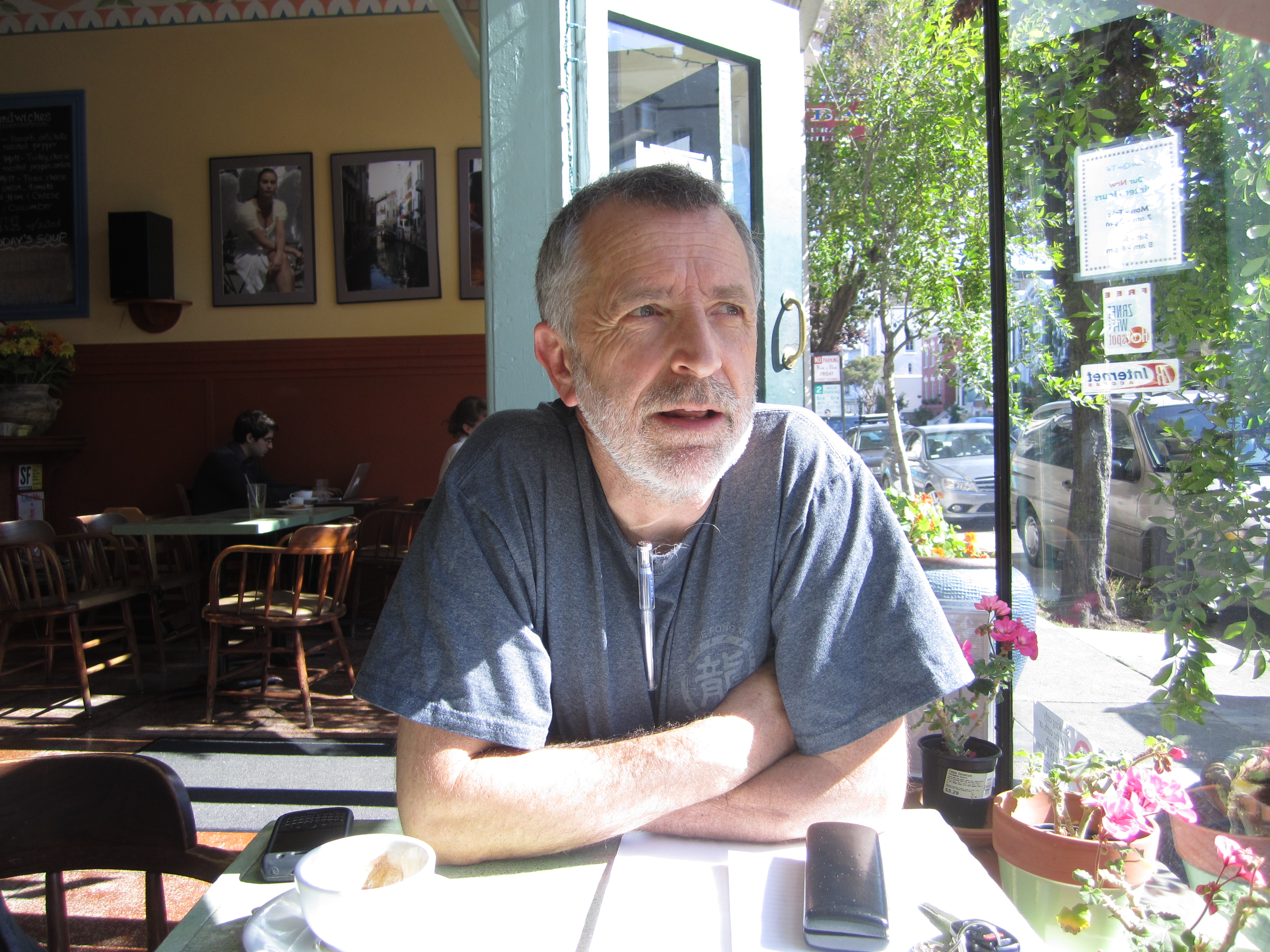
10/14: Friday, I had a chance to catch up with Dustin Mulvaney for coffee.

We both were heading over to the Environmental Politics workshop to discuss Matt Hubert‘s chapter on neoliberalism and the 1970s in the wake of the oil crisis. The workshop consists of about 20 persons sitting around a table. Matt introduced his piece, which everyone had read before hand. Then we discussed the work while Matt remained silent.

Chris Jones was there, who is working on energy transportation at the middle of the 19th century, so I had a chance to introduce him to Dustin.
Department. of Geography’s Michael Watts turned up, providing a few comments, as did Nancy Peluso. The evening before, I tagged along with Matt and members of the Department of Geography, Nathan Sayre, and Richard Walker, for dinner at Gather, a Berkeley locale, for steak and margaritas. I had a chance to talk with PhD student Teo Ballve about his work in Latin America on drug cartels and territorial governance.

10/07: I met with Dustin for coffee to discuss among other things his interest in carrying out a GHG Inventory/Life Cycle Analysis of Exxon-Mobil’s Shale Gas production.

He suggests that natural gas produced from hydraulic fracturing operations produces methane emissions that make the Greenhouse Gas (GHG) intensity of natural gas higher than coal. There is also significant uncertainty around the GHG intensity of Tar Sands extraction and Synthetic Fuel production. So what he aims to do is to conduct a peer-reviewed life cycle assessment of hydraulic fracturing operations (in collaboration with Exxon-Mobil).

The other major resource impact from hydraulic fracturing operations is water. Water footprinting includes more than water quantities consumed and quality of wastewater, but also factors such as geographic content of water extraction. Here, he proposes to evaluate the water footprints of hydraulic fracturing and tar sands operations in the context of the geographic areas of water impacts. For hydraulic fracturing, he would contextualize the water footprint in areas of high and low controversy (comparing Pennsylvania operations to those in New York). For tar sands he would evaluate water impacts at sites of extraction and along potentially vulnerable water supplies.

3/31: I met up with Dustin Mulvaney, post-doc at Berkeley, who received his PhD at UC Santa Cruz. Dustin works on solar energy and has been traveling around lately looking at various ways government, through the Department of Energy, lavishly funds speculative deals in solar electricity. In particular, he is concerned with the environmental aspects of desert clearing when installing solar power. Such activity begins when a company files an environmental impact report with government. The report demonstrates what will happen to nature when constructing and operating solar power installations. Often, these reports are called Life Cycle Analysis (LCA) documents. These LCAs are supposed to describe the entire impact of a technology on the environment, from its initial assembly, operation, all the way to when the product is dismantled.

What Dustin has been discovering in his research, however, is that the metrics for determining LCAs, that is, the actual methods used for identifying impacts in these reports, actually do not include many of the ways in which a technology impacts the environment. He mentions for example, that the desert turns out to be an environment that sequesters carbon, and that clearing the desert would release more carbon into the atmosphere. Well, this feature is glossed over in the environmental impact report. In the end, he points out that metrics used to create these increasingly popular LCA reports, are quite political, and often conceal many aspects of how solar power impacts the life cycle.

Our conversation began with a walk over to the north side of Berkeley campus to the Thai restaurant on Euclid, next to a coffee bar that we were eyeing. We settled in, ordering the same thing, which happens a lot with me, actually, as if I am interested in tasting what the other person feels about their food. Dustin had some fascinating things to reveal about solar power industry, government give-a-ways, land give-a-ways, and fabulous taxpaying dollars being spent all under the name of innovation and cleantech. One Israeli company, BrightSource Energy, for example, has managed to obtain nearly 2 billion dollars from the US government, for which the company has used to fund military contractors to build gearboxes, and traditional engineering firms (Bechtel) to construct tubes– not necessarily companies on the innovative edge.

After finishing off plates of rice, green beans, and tofu, we skipped out to the coffee shop and ordered mochas. Sitting on the street, we began our conversation again. Dustin knows a lot of people in his field who are working at multiple scales — not only knowledge and information in Washington, D.C. (at the high level of creating abstract laws), but also what is happening in the field offices of, say, the Bureau Land Management in New Mexico, who map and lease out land. In a sense, he is examining the entire commodity chain of solar power.

We have both been fascinated by the concept of clean in phrases like clean coal, cleantech, or what ever to which clean can be attached. But what does clean actually mean in these contexts? It refers of course, to energy technologies that release less carbon, and thus reduce chances of climate change. But is clean coal actually clean? Will mountain tops no longer be destroyed? Will streams no longer be polluted by the word clean in clean coal? In a word, no.

Actually, Dustin had a come up with a phrase to capture this mode of thinking, which he calls — The Reductionist Epistemology of Carbon.

Read Full Post »


We arrived in Arkhangelsk some time during the summer of 2010 in the midst of a WWII victory celebration.  Our entire visit was focused on connecting with friends at the newly established Northern (Arctic) Federal University or NArFU. Our exploratory research included the goal of setting up networks of with Russian universities so that we could pursue long term research on Arctic energy development in the Barents Sea area.


Marina S. was our contact, and in fact, I bumped into her again not too long ago in Tromsø, at the Arctic Frontiers Conference this past January 2012, nearly 18 months after I first met her and initially discussed plans for a follow up project. It was then, in January, that she introduced me to Elana Kudryashova, Rector of NArFu. During fall 2011, when I began drafting the new request for research funds, Marina and I had several long conversations about what kind of support letter I could obtain from NArFU to include with the main grant proposal. In the end, she bifurcated the workshop and research aims from the capacity building and networking.

It is just incredible to me how much effort we put into reaching out to folks, then following up and asking them to write elaborate letters of support. Here is the letter that we received from NArFU, and we are grateful to them for putting this together.

Arkhangelsk is a one-hour, 40-minute flight from Moscow’s Sheremetyevo Airport. Traveling through Moscow on that particular day was tough. In addition to the hot weather, our driver was terribly late, and I practically had a melt down over the possibility of not arriving on time, since we had very specific arrangements to meet with representatives of the university.


That is Alex K., enjoying the ride out of the tarmac.

Upon arrival, we could not help mingling among the throng of revelers, as we made our way past the closed off streets to our hotel, Pur-Navolok, located on the embankment of the Northern Dvina river.

Upon reflection, there was not really that much for us to do. We had a few meetings with university representatives and a tour of the university grounds. In sum, the meetings took the better part of one-half day. But we arrived the afternoon prior and gave ourselves a half day after the meeting before returning to Moscow.

With the down time and worsening weather, we made our way through the city, noticing with what high admiration town dwellers revere the statue of Vladimir Ilyich Lenin, who stands at the middle square starring down the tallest building in the city.


From the center, we passed into the side streets and small fairs where local painters have developed a particular fascination for their skyscraper.


I am a big fan of ice in my soda pop, not a standard issue service provision in restaurants. After being discouraged by having only one or two cubes, I began to request as much ice as they could bring out, and it came in bowls.

The story behind the Arctic city of Arkhangelsk is well told. Its founding dates to the 1500s, established on order of Ivan the Terrible to be a commercial port. It is increasingly referred to as the Gateway to the Arctic, hence, one of the reasons why we wanted to check in. As Russian arctic oil and gas development begins in earnest, it will be from this Gateway.

One of the activities that I do during down time, and especially when it rains, is to dart into a movie theater. Hanging out in a restaurant, as in the case of the below photograph is another activity. Here, we visited the Argentinean Del Fuego located on the city’s promenade.


Nevertheless, on this particular occasion, we decided to travel to the nearby and well-preserved wooden architectured city, Maliye Karely, now a Museum about 25 minutes drive from the center of town. It is an open-air city of wooden mansions, churches, windmills and barns and built between 16th and 20th centuries.


As a footnote and of course, with due respect, while returning from our walk, Alex led us down the wrong path, thinking it was a short cut. We arrived at the doorstep of some unhappy shack. But we were able to retrace our steps.

From there, returning to Moscow was easy.

Read Full Post »

The Blue Carpet


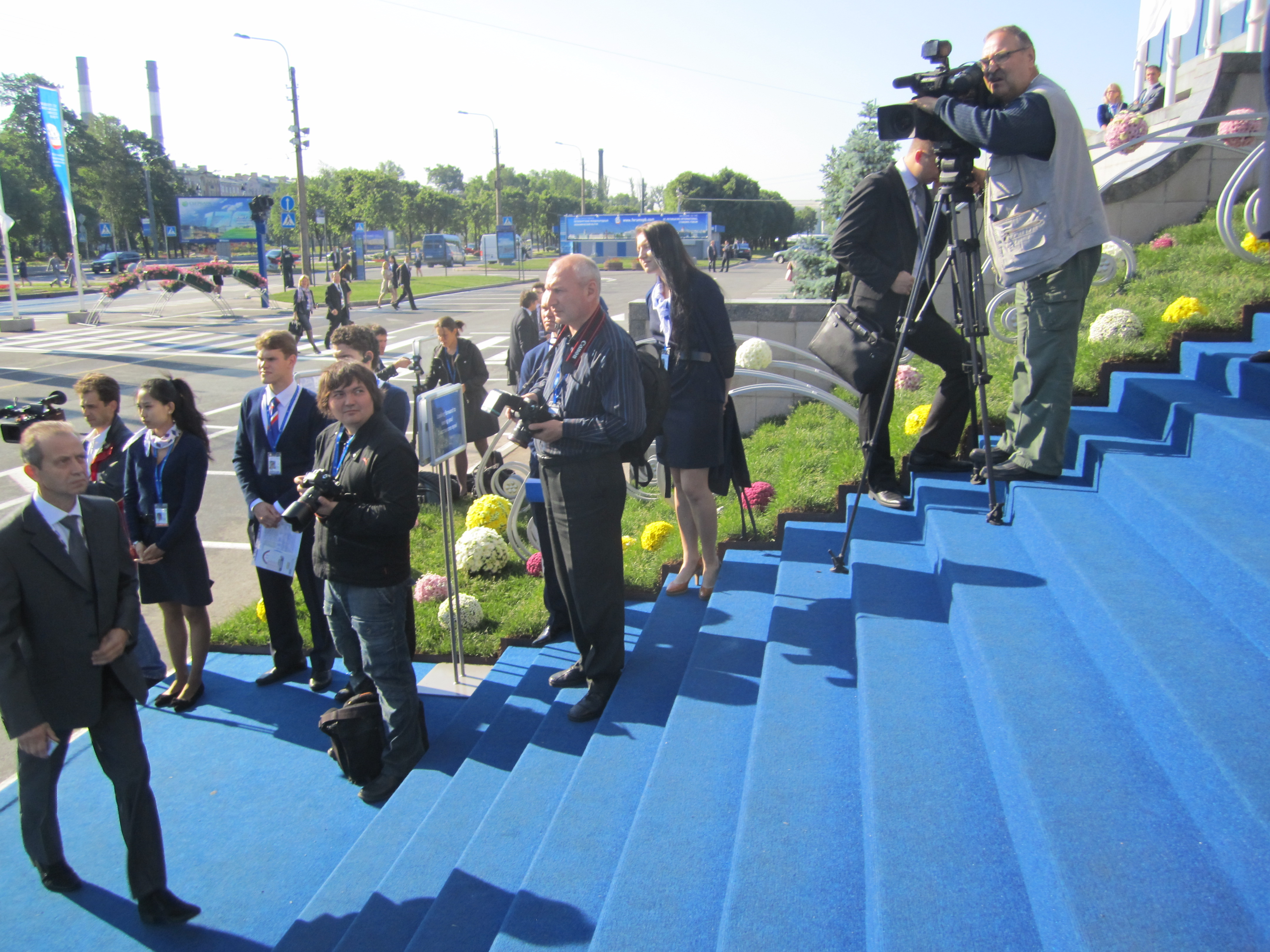
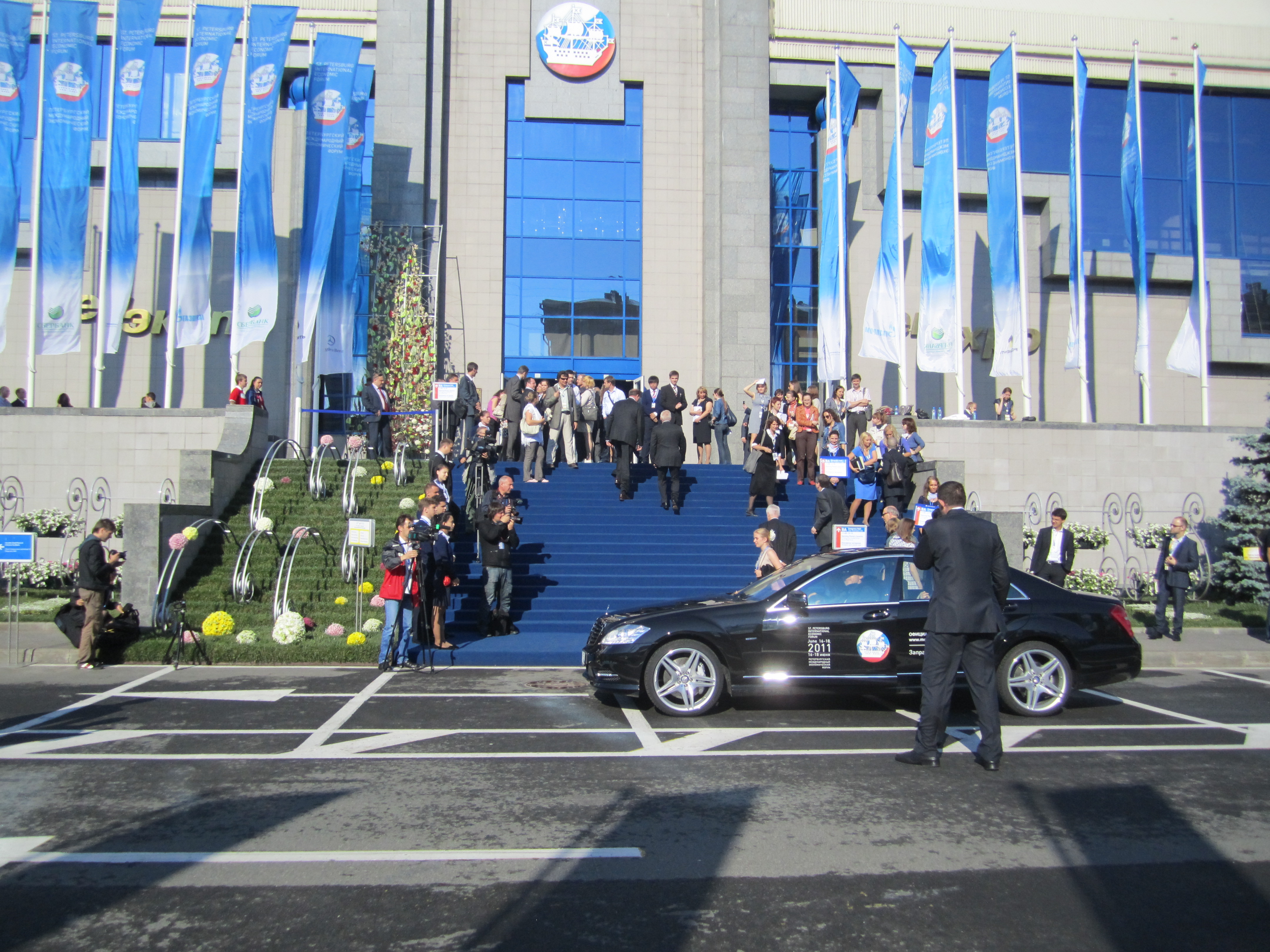
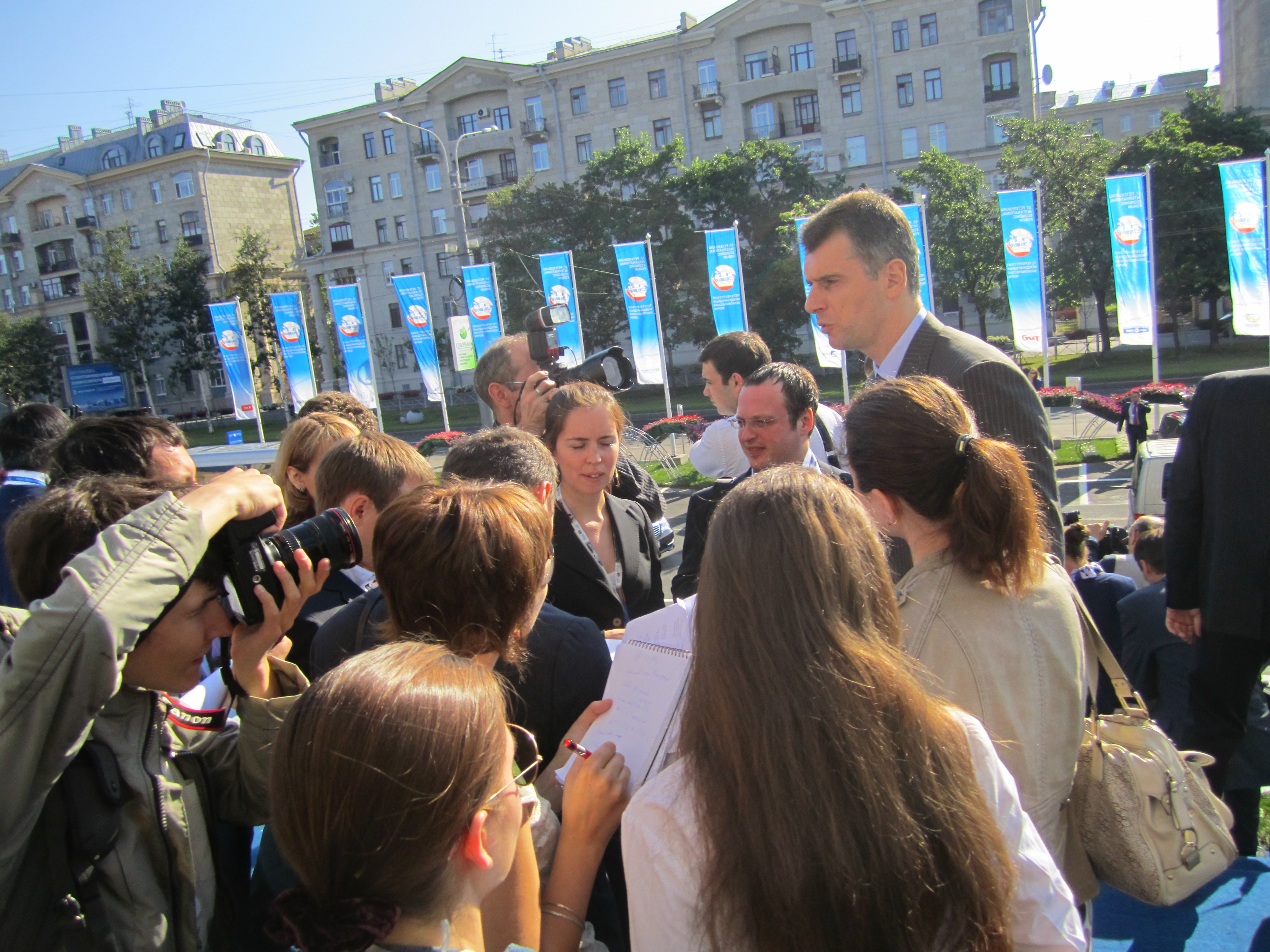
The Blue Carpet at this year’s St. Petersburg International Economic Forum (“Russia’s Davos”) framed the Entrance Steps for a variety of glamorous performances. Business men, photographers, journalists, conference personnel, an anthropologist, politicians, within a moments pass through this space igniting a sensory experience and thus, a sensible experience.

The steps set a colored fabric (blue carpet) — to an entrance of a conference — placing on display a fleeting phenomena of images that portray Russian political and economic power — ostentatious self-representation, fashion and elites.


Read Full Post »

The Factory of the Sensible …

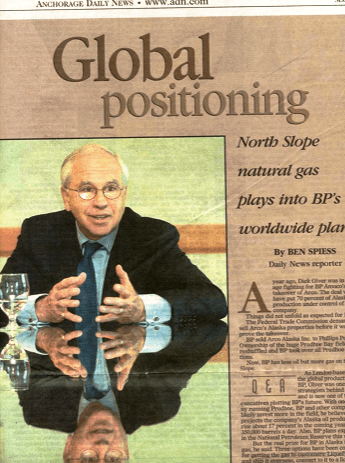
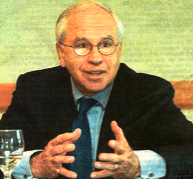
Quite some time ago now, Dick Olver, London-based head of global production for British Petroleum (BP), flew to Anchorage, Alaska to promote construction of an Alaska natural gas pipeline to deliver Arctic gas from Alaska’s North Slope of Alaska to markets in mid-continent. After his address, the Anchorage Daily News published a photograph of Olver. The man appears seated at a glass table with his hands reaching forward in a cupped-like manner. He grasps at an imaginary globe. The article headline is, “Global Positioning: North Slope Natural Gas Plays into BP’s Worldwide Plans.”

The last part of the headline — “plays into BP’s worldwide plans” — rhymes with the colloquial expression “plays into one’s hands.” It is a play on words stating that development of Alaska energy reserves is at the manipulative whim of BP.

World in the Palm

The photograph is striking. On the one hand, there is a clear image of Olver’s face and upper body attired in jacket and tie. Olver casts an excited grimacing smile. But in a curious display of editing, the full bottom-half of the photograph depicts the mirror image of Olver as he appears on the glass table, upside down. His head appears in Janus-faced expression and blurred by the reflection. Directly at the center of the photograph are four hands. Two of the hands belong to Olver, while the other two hands are those that appear reflected on the table. In a perversion of appearances, Olver has four hands and twenty fingers.

A glass half-filled with water or depending on perspective, half-empty, stands near Olver’s wrist, beside his gold cufflinks. The mirrored reflection from the table gives the water glass the appearance of an hour-glass. The water appears like the sand of time half-poured out. The news article begins by reminding Alaskans about Olver’s last appearance in Alaska the year before. Then, he was fighting for BP’s takeover of ARCO (Atlantic Richfield Company). The merger deal would have placed 70 percent of Alaska oil production under the control of one company.

Images of energy industry speak volumes. But it was at this same time, when the entire energy industry was uncertain with how to deal with uncertainty and risk — price volatility, wars, financial meltdowns.

Cambridge Energy Research Associates or CERA, a leading global energy consulting firm, took the opportunity to deal with these crises by framing their CERAWEEK conference through the visuals of a key symbol — the Chess Game.
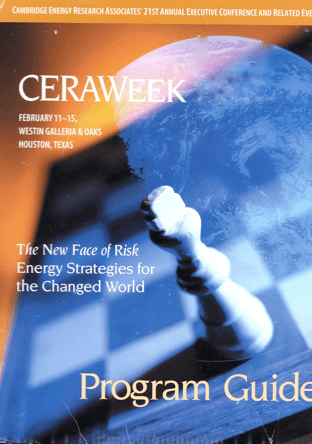

One Move at a Time

In fact, not only the energy industry was concerned. Everyone required a new symbol — the same symbol — to deal with the times. Thus, the image of the chess game — this Very image — became a symbol circulating more widely across society. I found the image when I returned to San Francisco, in an advertisement for a symposium for Bay Area managers to learn the challenges of leadership in uncertainty.
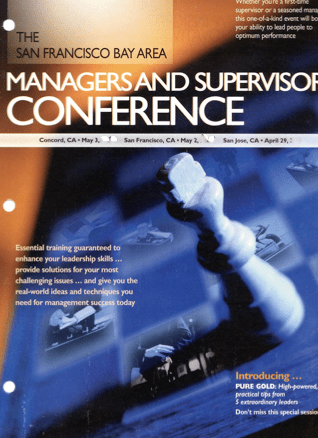

Returning from the CERA Week conference in Houston, Texas, and I found this credit card application in my mail.



The two identical images are different. The CERA Week image focuses on strategic energy challenges for a changed world. But you can see in the background of the CERA image — there is clearly, an image of the globe.

Reproducible Images For Risk Management

The emphasis on the chess board, the vulnerable one-move wonder signified by the King, as well as the globe was apparent in other sites at the conference, including on one side of an internet smart card available to CERA conference participants.


The other side of this card has more. Here, the transparent globe has moved from the background to become the central attraction and is resting delicately in the hands of a child. In this image, the globe and strategic energy choices about the world’s future — are imagined as belonging to a next generation of leaders, presumably living in Asia, where strong economic growth is linked to increased energy capture, particularly in China. All of this — symbolized through the physiognomy of a child’s eyes…


A transparent globe cradled in the hands — through which to envision the future — taps also into the symbolism of the crystal ball, the fortune teller and practices of anticipatory knowledge, found during this period in advertisements on global communications.


The idea of hands propping up a transparent globe, returns us to Dick Olver — with his reference to Global Positioning. In this instance, strategic moves and foresight are linked to corporate power– that energy companies like BP literally have the world in the palm of their hands.


Worlds in the Palms of Hands


Contrast the above images to that used to symbolize the nation-state’s relationship to global modernity. In this image, the concept of Government emphasizes a lack of transparency — that is, lacking foresight, as seen in this figure of old Uncle Sam. Notice the different hand positioning, no longer in the supportive position, but resting on top of the world, invoking the Dead Hand of Regulation.

There is no mystery here, just aesthetics of the sense-making. Images from the factory of the sensible.

Energy consultants, like those at Cambridge Energy, always argue for global expansion in the industry and that natural gas energy flows through liquefied Natural Gas transport or LNG are suitable. Most natural gas travels by pipe. But LNG is always on the cusp of transforming from a niche regional business into a global industry. Global Gas Development is the watch word.

In short, natural gas can become a globally traded commodity. The U.S. market would become dependent upon these global energy flows. Thus, in these conversations, future U.S. dependence on global reserves of gas energy characterizes an entirely different world society than U.S. reliance on foreign sources of oil. Such things like natural gas imports, creating new economic value, and future global security, are all brought closer together through the reorganization of natural gas market knowledge, under the banner of reaching for the frontiers.

The symbol of this global gas modernity is found in a multi-faceted globe.

Shell Game


Read Full Post »


A Day in the Life of an Energy Consultant:
A Study in Productive Calm


Read Full Post »


Energy journalists are key players in Arctic natural gas development. We began noticing the influence of journalists when observing the Alaska Governors. Members of the Governor’s cabinet were highly concerned with the reporting of news events.

In fact, within the Alaska Governor Tony Knowles administration (where we began our paparazzi ethnography) we noticed a few journalists highly placed within the administration. They were word-crafters and public spokespersons for the Governor. Persons like David Ramseur, whose career began as an Alaska journalist, but in the final years of the Knowles administration, he became Chief-of-Staff. David recently is serving as Chief-of-Staff for Alaska U.S. Senator Mark Begich. Ramseur kept his cards close to his breast. He often wrote policy speeches for the Governor and kept an eye on daily press releases that we turned out for the Alaska media.

Journalist, L. Persily as Federal Coordinator

Another journalist who flittered between political appointments and freelancing for the Anchorage Daily News is Larry Persily. Larry is a master wordsmith. Under Knowles, he was Deputy Commissioner of Revenue and coined the term now famously delivered by the Governor, “My Way is the Highway” — which was in response to a policy favoring the Alaska-Canada Highway as the best route for an Alaska natural gas pipeline (should it ever be built).


Larry was hired also by Alaska Governor Sarah Palin in order so that he would not work as a journalist. We met up with Larry in Washington, D.C. recently, to see his new digs, as reflected in this photograph above. He is the Congressionally appointed Federal Coordinator on the Alaska Natural Gas Pipeline Project.

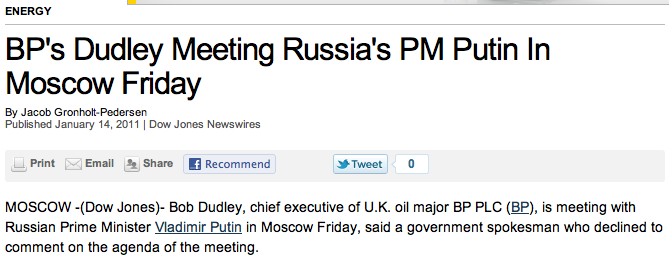
Moving on, in Moscow, we were lucky to meet with the quiet, humble, and high-in-demand journalist for The Wall Street JournalJacob Grønholt-Pedersen. Jacob is from Copenhagen. He speaks perfect English, Russian, and Danish. We initially saw Jacob’s writings when he was reporting on the Barents Sea Shtokman natural gas project. We contacted him by email. Here is an image from an internet search of his name.


We met Jacob for lunch on the pedestrian-only Kamergersky Pereulok – a sidestreet and popular hangout in Moscow. In fact, the street abuts the Cambridge Energy Consulting office where we met energy consultant Vitaly Yermakov. Here is a photo of Alex standing next to the Cambridge Energy bronze plaque.


Here is an example of headline by Jacob:


Energy Journalists on the Timing of Events

  • The issue of expertise surrounding development of the Barents Sea Shtokman natural gas field is reported upon in the press differently depending on the any one event, meeting or issue taking place. For ecological organizations, it is a chance to inquire into how potential industrial wastes and hazards will be handled. For representatives of Shtokman Development AG (the energy partnership) it is an opportunity to promote how information produced by environmental consultants will be made available. For trade organizations (builders, tenders) in Norway, they consider anxiously how they will be involved in the project.
  • Main tag line: “Russia’s priority project, the massive Shtokman offshore field in the Barents Sea north of Murmansk—a joint project with France’s Total S.A. and Norway’s StatoilHydro”.
  • In this article, Jacob demonstrates his access to expert analysts in the field. He quotes Vitaly Yermakov — Director of Moscow branch of Cambridge Energy; an “analyst” (unnamed source) from UniCredit and Ron Smith — Chief Strategist at Moscow-based Alfa Bank.
  • This main issue discussed concerns when the project will move forward at all. And we find printed here various statements by independent consultants or finance organizations who presumably are located somewhere in Moscow and whose comments are specifically limited to timing. Everyone wants to know about the timing of events. These statements on timing (2013, 2015, 2025, never) encapsulate an entirety of expectations surrounding regulatory and economic conditions.
  • If you google Moscow Cambridge Energy director, Vitaly Yermakov, his name appears in relation to Cambridge Energy Director in the Washington D.C. office, Matthew J. Sagers, who is author of an academic reaction paper to Milov et. al (2006), (the latter article appearing in the syllabus of Yale anthropologist Doug Rogers on energy in Russia). In addition to working with Yermakov, Sagers also cites in his bibliography an article collaboration with Russian gas economist Valeriy Kryukov, who we had dinner with in Oslo along with Oxford Energy Institute’s Jonathan Stern, at the Petromaks Workshop sponsored by the Norwegian Research Council — the same group who sponsored the Norwegian-Russian Arctic Gas Workshop in Murmansk, titled Petrosam (see below). Both Stern and Kryukov have been publishing for decades on Russian gas developments, together with Arild Moe of Norway’s Fridtjof Nansen Institute (see the post on Moe and Stern below).
  • In the article we refer to, Sager responds to the “nature of Russia’s official energy policy” (“ad hoc” rather than “systemic”). He comments primarily on whether Milov et. al are correct in their empirical assessments of oil exports, pricing developments, price deregulation, gas supply, export flows.
  • Essentially — what we draw attention to here is that there are various levels of detail entrenched in different spaces (academic journals, dinners, workshops), that bubble up to the surface through the work of journalists and often times in the form of statements about the timing of events.
  • The social function of the work of Pedersen, is to write stories in the form of news articles that serve as a hieroglyph, a consecrated form of expert interaction, a condensation of information flow, whose depth is flattened out by publication in the press, but that retains its hold as a source of knowledge because of its lineage, as represented by the various actors cited in text. We suppose the apt metaphor would be a tip of the ice berg. Articles by Pedersen, are like the tip of an ice berg — whose actual dimensions of depth — everyone in the know can recognize by its appearance on the surface of things.
In the event we are awarded our beloved National Science Foundation proposal, we plan to follow up with Jacob in the nearest future….

Read Full Post »

« Newer Posts - Older Posts »