Feeds:
Posts
Comments

Archive for the ‘Paparazzi Ethnography’ Category

James Clifford

11/20: I could not help feeling something– Enlightened? Scolded? Emboldened? Lonely? – as I made my way back home from Santa Cruz across the treacherous hwy 17 mountain pass, foregoing the picturesque hwy 1, recommended because of its coastal sunset. I sought the heavy traffic as a taste of the bigger and blunter, and perhaps to drown out moments of incompleteness. By the time I passed the summit, barreling into Silicon Valley at madcap speeds, I felt fleshy and weighty all over again, whistling theme songs of westerns.
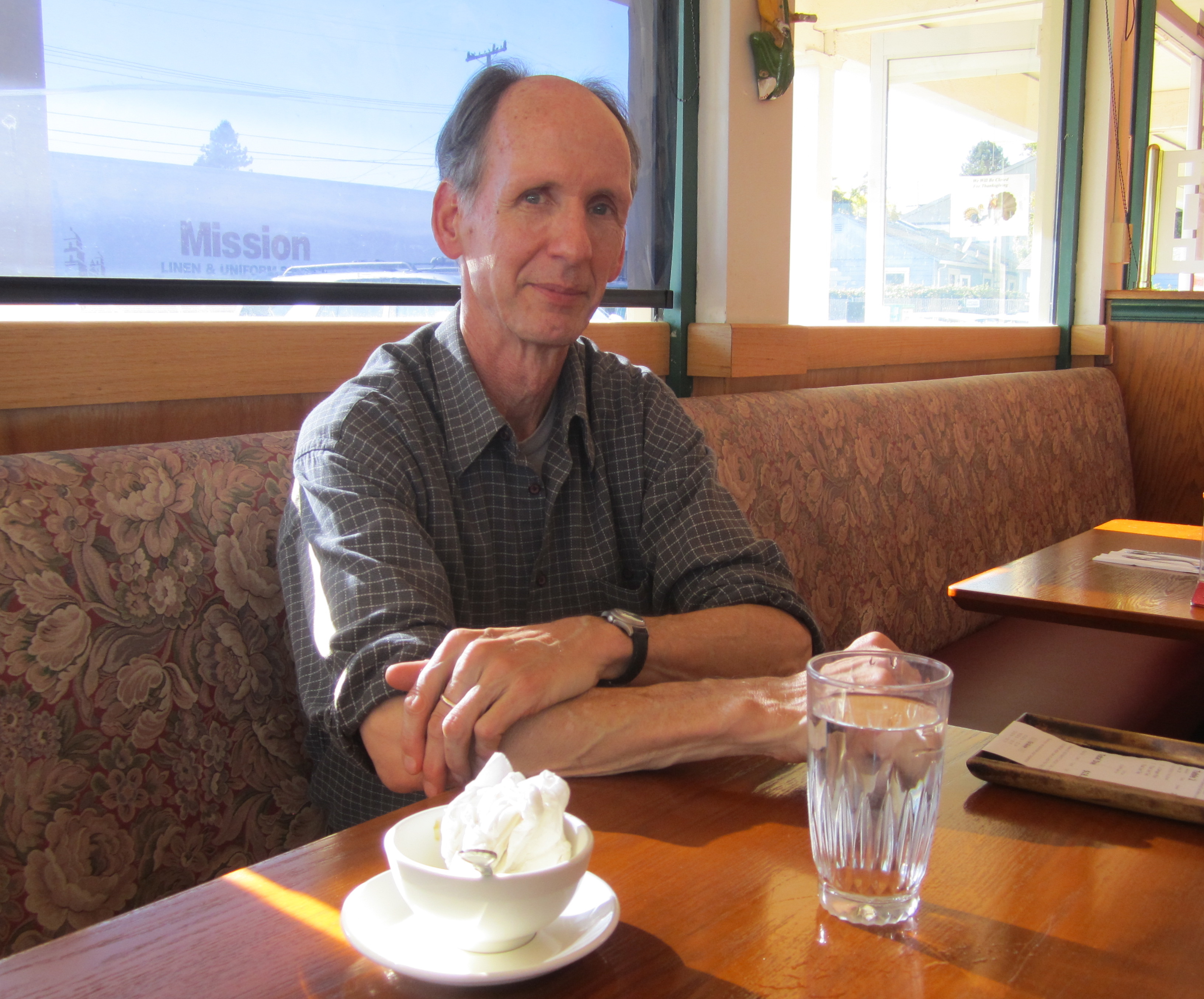
James (Jim) Clifford

Who is Jim Clifford? Or better, who is he anyway? as academics who have not published enough put it. Recently, for the past 10 years, Jim has been considering the predicament of heritage and culture along the North West Coast, in fact, in our very own backyard, on Kodiak Island, Alaska.

I pulled into Jim’s round about 1PM, and we headed to a Thai restaurant ordering the same meal all around (pork curry with colored tea) so I could feel what he was tasting. From there, we got off to a good start, explaining StudioPolar‘s new affiliation with Energy and Resources Group (ERG), an academic unit at UC Berkeley founded through current science advisor to President Obama, John Holdren, who was picked off by Harvard after winning the Nobel Peace Prize. Since then, we have been expecting the next Harvard draft-pick to be recent co-Nobel Prize winner Daniel Kammen. I explained to Jim that if you google the following words: Energy Czar Kammen — you get recent media on Dan’s appointment to the World Bank, where he was made Energy Czar on renewables.

We both had a laugh, with Jim asking “where’s the Interpretation Czar?” Jim is the Interpretation Czar.

With the ice broken, riffing in various directions, speculating whether Weber’s world view turns out to be only partly right and yes, partly wrong, I could not go further without taking notes, selecting an abandoned envelop, as it turns out, and starting to scribble for good measure.

Note-Taking on Abandoned Envelope

One phrase in particular, which I got a kick out of, was what Jim called Casually Aggressive Generosity, in memory of my working back East among K Street lobbyists, and their soft-graft. And in connection with this, Jim had sent me previously a hilarious excerpt from Samuel Beckett‘s Molloy, about one such miss-fire of interpellation for which we have placed a link here: Beckett_Molloy .

We talked on topics of globalization and considered Neoliberalism as a bigger system than {simply} policy of the 1980s and 90s, rethinking the limits of interpellation and domination, by taking into account the incorporation of new power regimes or (collective) bodies that matter: the U.S. system creating niches that empowers smaller power-bases which the system subsequently must work around (both bad news and good news).

We carried on our discussion on to complex engagements, social roles and particular histories while walking through the University of California, Santa Cruz (UCSC) campus, mentioning Immanuel Wallerstein‘s recent article in the New Left Review with a link here: Wallerstein-Structural Crises.

UCSC campus walkway

Colloquium at 261 Social Sciences Building

We ended up at the social sciences building sitting in on professor of anthropology at Universidad de Granada, Spain, Juan Gamella, speaking at length on demographic change among the Romany, named Gitanos or Cale, of Spain.

11/15
: noon. Descent into Steinbeck country, hwy 1 down the California coast, is nothing less than a wash-up on the shore of the subconscious. Come to think on it, I remember reading John Steinbeck, along with John Muir, in the context of their views on American Indians and Mexicans as humans of fatigue and lacking energy.

Energy and power are practically interchangeable. We speak of horsepower as a technical measure of energy, but also of the power of the state. This conflation of energy and power in language, is partially metaphorical, but arises because both meanings involve the ability to do work, to command labor. To be powerful then is to accomplish things, to turn energy and work of nature and humans toward physical and political purposes. Our classic example is Muir’s flippant encounter with locals in the Yosemite Valley in Mountains of California, and Steinbeck’s greeting with the locals while traveling with Ed Rickets through the Sea of Cortez. At any rate, I had flights of fancy under the Golden Gate Bridge, followed hwy 1 down devils slide, encountered unconfounded traveling symbols and et ceteras along the shoreline. Let us go check in with James Clifford

11/15: 7:35 AM. I have a theory for everything as I hit wide across the bay, heading from Berkeley to Marin, spending Sunday on the Tiburon side of Richardson’s Bay near the Audubon’s Lyford House. Early Monday, coffee from the Bus Depot Cafe in Mill Valley where we noticed something new: clamping down on electricity use of patrons (computer and cellphone recharging), with a lock-box on electricity outlets. We have been interested in how much accessible wattage is provided to consumers in the public sphere and are willing to say off the cuff that accessible electricity for the upper-middle income earners is socialized energy (airports, coffee shops, museums), while for workers, energy use is privatized by commutes and residential usage.

My father, electrical engineer Peter Mason, designing lighting for transportation systems when working for Bechtel in the 1960s/70s explained his unconscious assumptions about how much candlepower (unit of light produced by pure spermaceti candle) to build-in for travelers of public systems. He was annoyed with the Metro system in Washington, D.C., for example, when they decided on reflected lighting –the stations are so dark you can hardly read. This was the basis of decisions he had made on lighting — the candlepower enough to read morning newspapers or novels. His travelers are a literate audience (versus, well-lit public areas are less dangerous). What then, about the rest of us, using Iphones no longer needing extra energy?

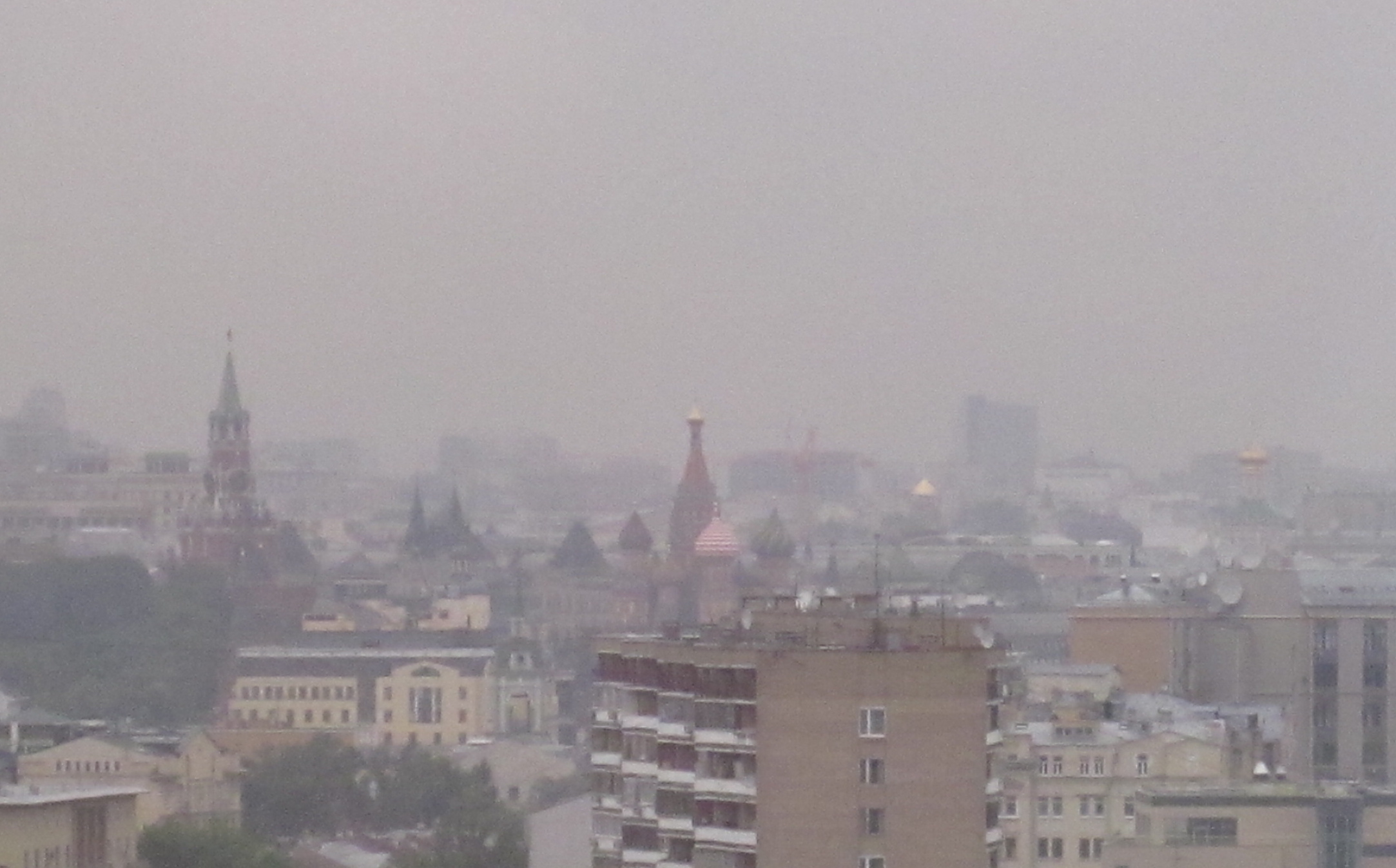
We were in Moscow over summer and I could not help but take notice of the lighting systems in their subways, perhaps with designs of a comparative study on candlepowers available to users of different public systems.

11/11: Heading down to Santa Cruz on the 15th to ask a few questions of anthropologist James Clifford. Re-starting the book and thinking it would be a good time to check in with Jim, since he has written oodles…
Read Full Post »

St. Petersburg Economic Forum

At that event in Houston, I met the former speech writer for Robert Dudley. As many of you know, Dudley was CEO for the TNK-BP. Of course, BP stands for British Petroleum and TNK stands for Tyumen Oil Company. Robert Dudley is now the chief executive for BP. And in fact, he was just at the March 2011 CERA Week. In any event, the speech writer argued that we must attend the St. Petersburg Forum if we want to know the intersection of elites, consultants, and experts on Russian arctic gas development. In fact, as we discovered when attending the Petersburg Forum, energy Guru Daniel Yergin of Cambridge Energy was in attendance and presided over a fabulous forum on energy development.

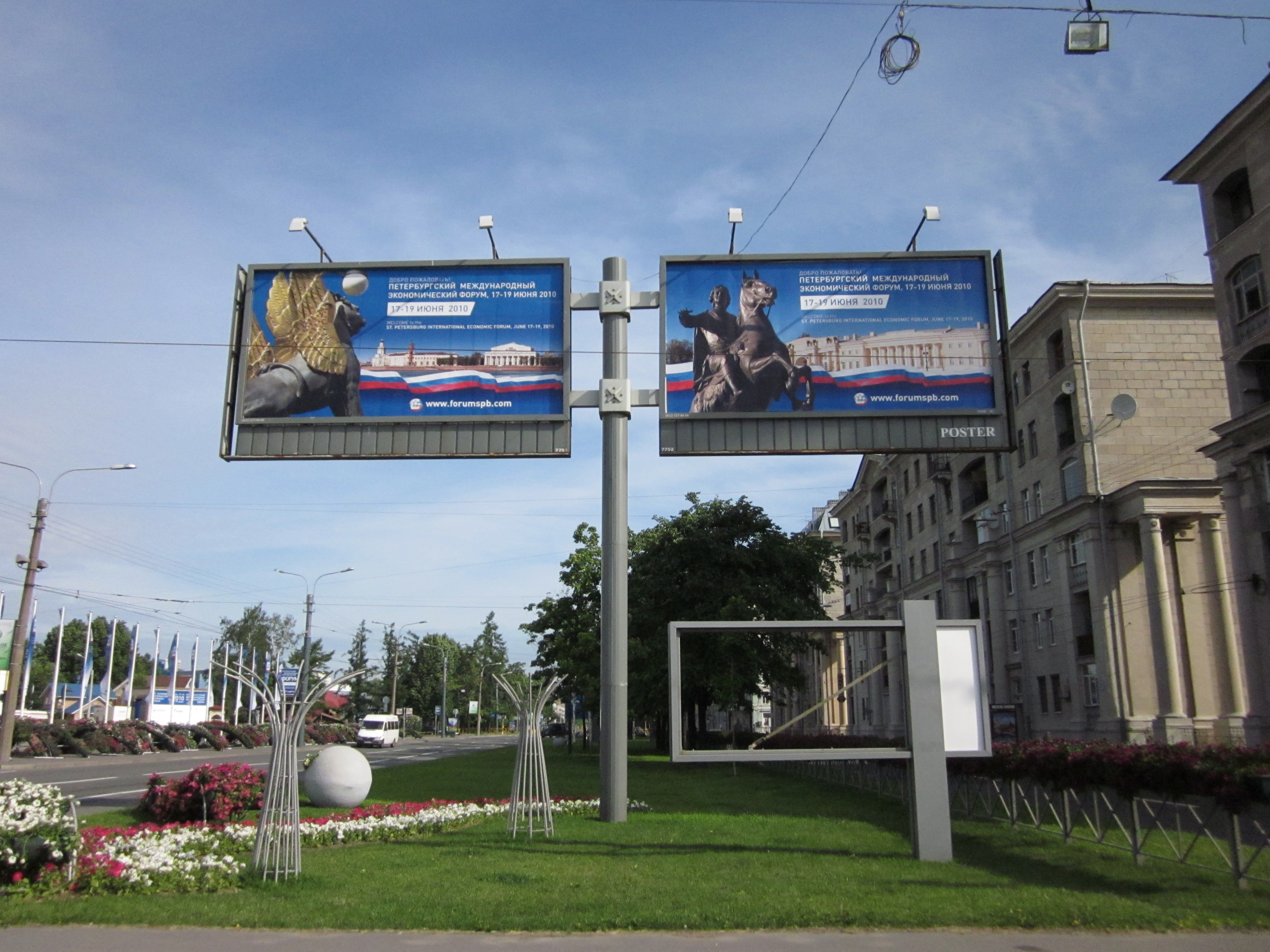
Upon arriving to St. Petersburg, we noticed publicity for the Forum throughout the city. In the photo on the upper right, you see the poster we encountered along the boulevard heading into town from the airport. In fact, we were able to obtain our passes and identification cards right there in the airport. It was a big deal as it turned out, so in the end we were lucky we had it all sorted out. An entire part of the city, where the Forum was taking place, Vasilevsky Ostrov, was practically cordoned by police and impossible to get around– impossible to enter, in fact, without security identification. We strolled right through.

Security

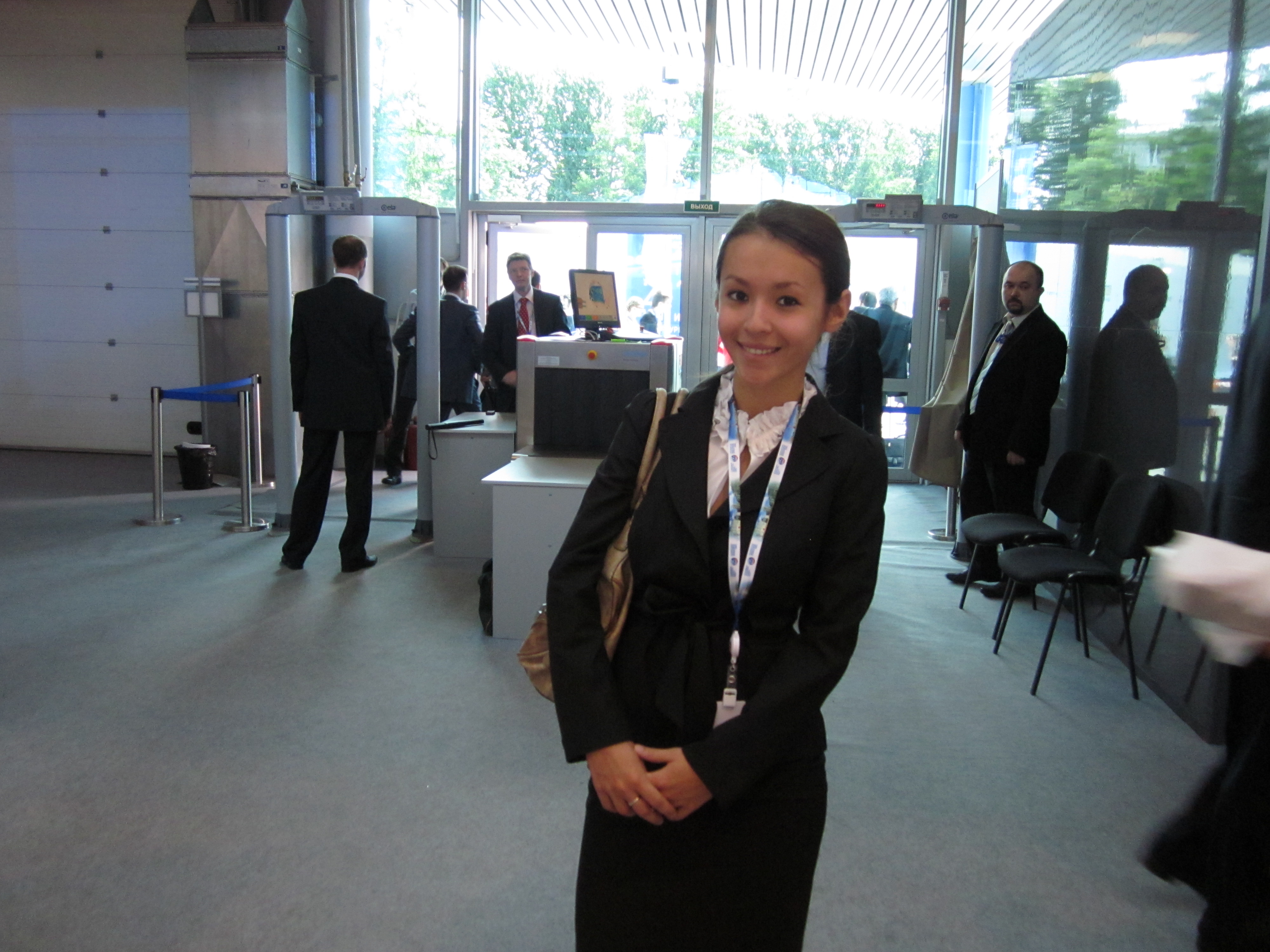
Security was ubiquitous at the Forum. Our attempts to take photos of security personnel were thwarted at every turn, with guards hitting the delete button on the camera. I was nervous about taking photos after several failed attempts.

security

We changed our strategy and started using ourselves as decoys, as the photo on right depicts. I had Alex Karamanova, my then assistant, stand in front of security throughout our trip. Notice that there in background is security personnel observing.

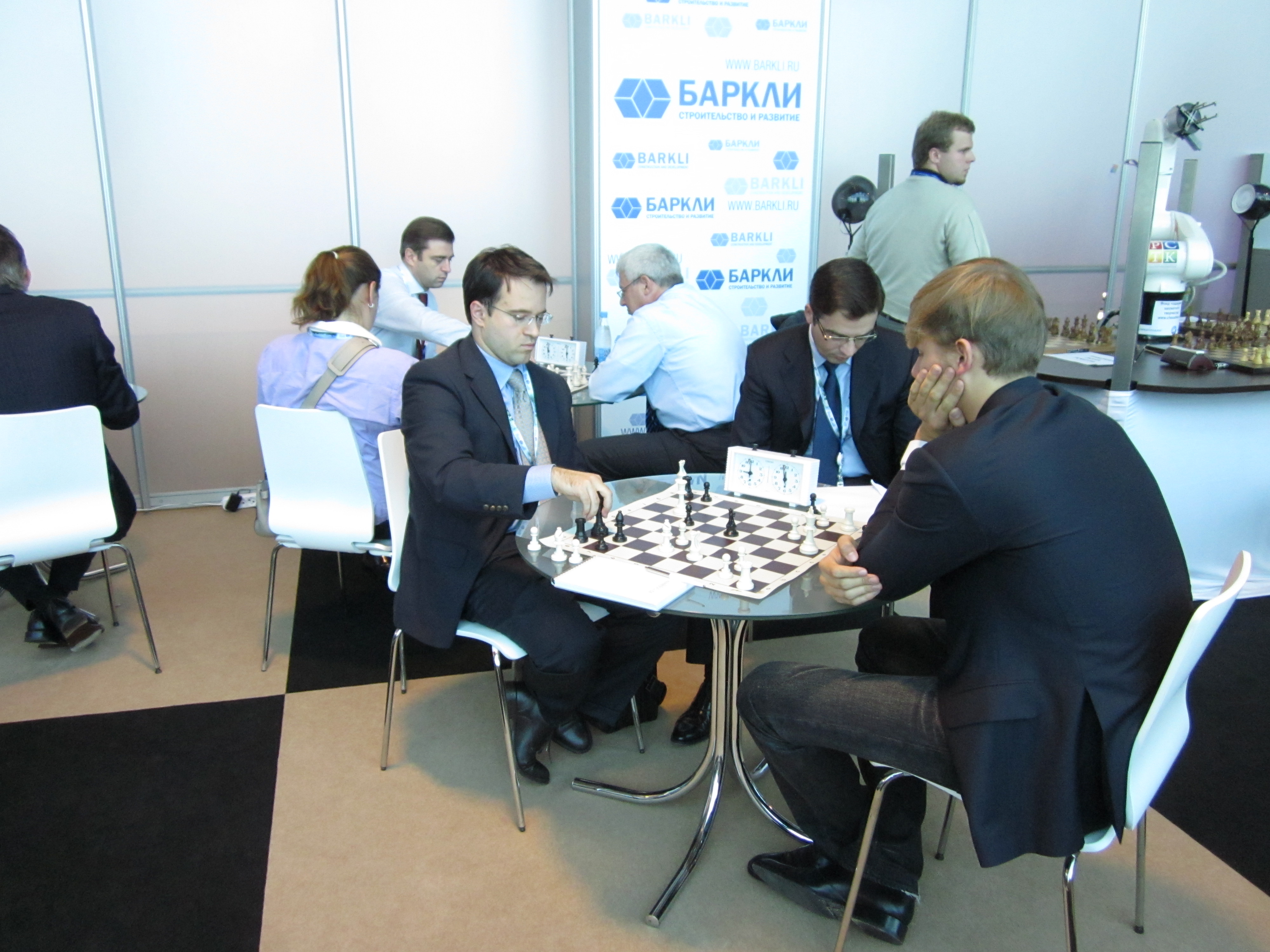
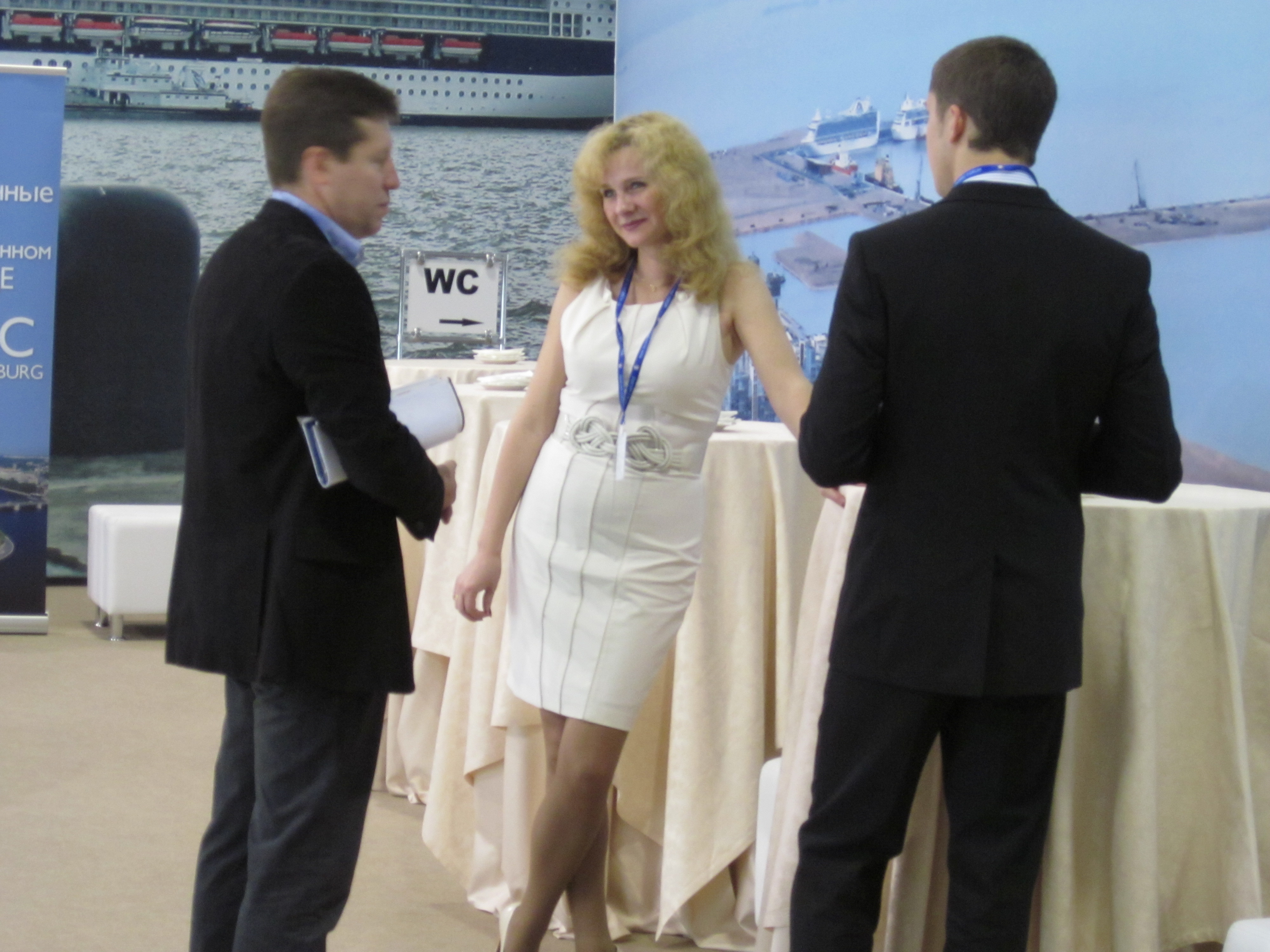
There was a lot of lounging going on at the Forum. People were immaculately dressed, entertaining themselves everywhere. We hung tight to the energy pavilion where there were fabulous exhibits from Gazprom, and other concerns seeking energy development in Russia. We were after, and wanted to see a younger generation of experts and their emerging role in Russian energy development.

lounging

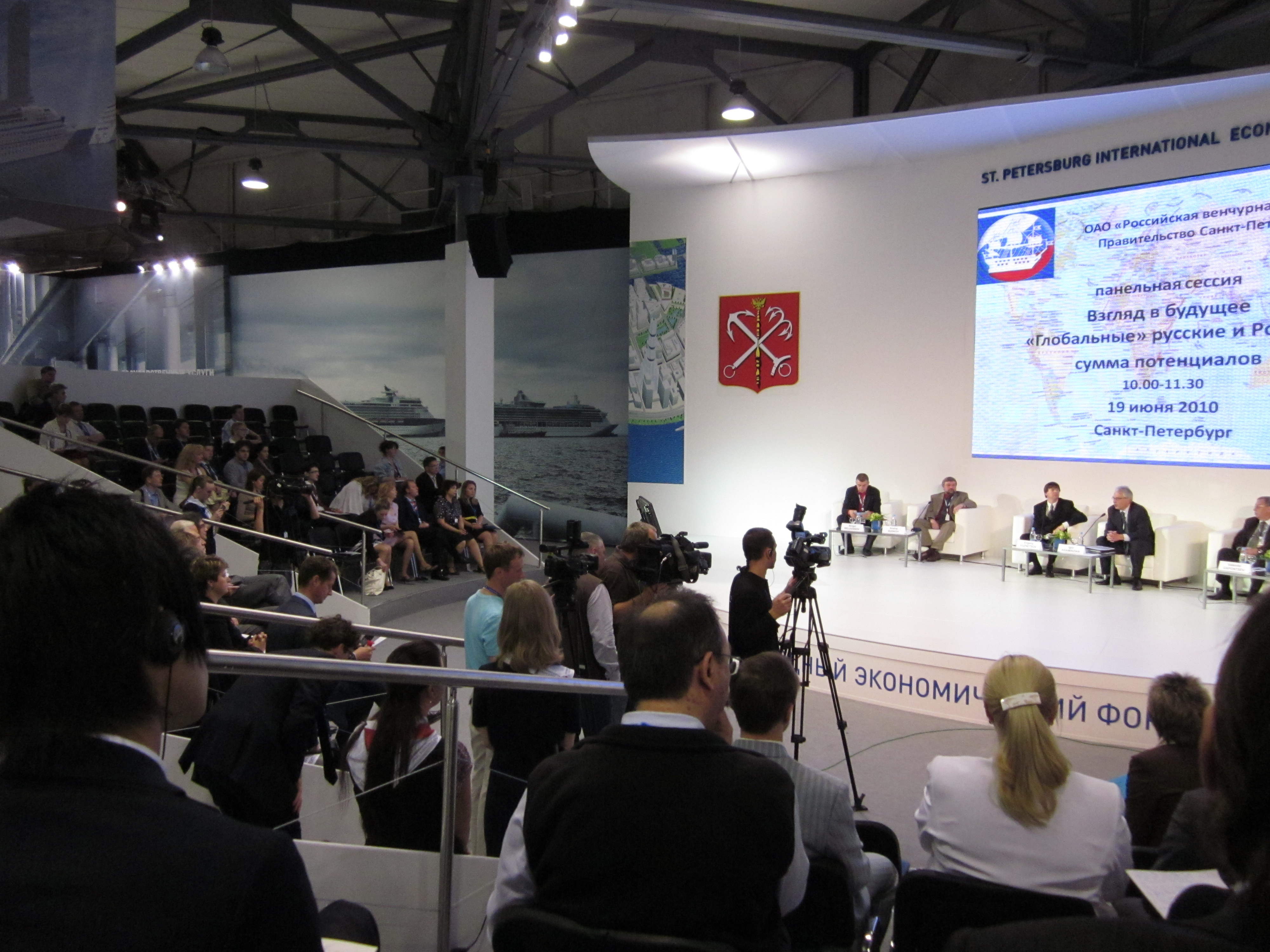
And here we got lucky: There was an panel titled Global Russians, where in attendance and asked to speak were Russians who received degrees from abroad, in western Europe and the United States. Even a former UC Berkeley graduate was invited to speak. From this experience, we identified two communities within Russia, made up of contrasting social positions having investments in shaping arctic gas development.

The first group we call rear-guard, made up of older specialists whose structural position as managers of organizations such as Gazprom and the government ministries is based on their accumulated political capital– their built-up personal connections throughout their career. The second group we call vanguard or alternatively labeled Global Russians (Globalnye Ruskie) – a phrase adopted right there, at the St. Petersburg Forum, to identify a younger generation of Russians educated in the West and who are now serving as experts in Moscow in the capacity as energy analysts, journalists, etc. for western firms (e.g., Citibank), or for newly created government entrepreneurial incubation parks.

lounging

The vanguard is further characterized by their reliance upon American economic discourses concerning relationships between capital expenditures, transparent reporting, and returns on investment.

By the way, I should mention, that after this event, we began using this model to inquire into the status of Global Russians within Moscow. And we had some success when speaking with financial analysts now working for Citigroup and the like.

The entire Forum lasted about 3 days. Unfortunately, we missed the first day because we were in Murmansk, at the Petromax workshop, checking out Norwegian and Russian contacts in the context of developing the Shtokman field. What a total difference between these two events.

global russians

Gabbing

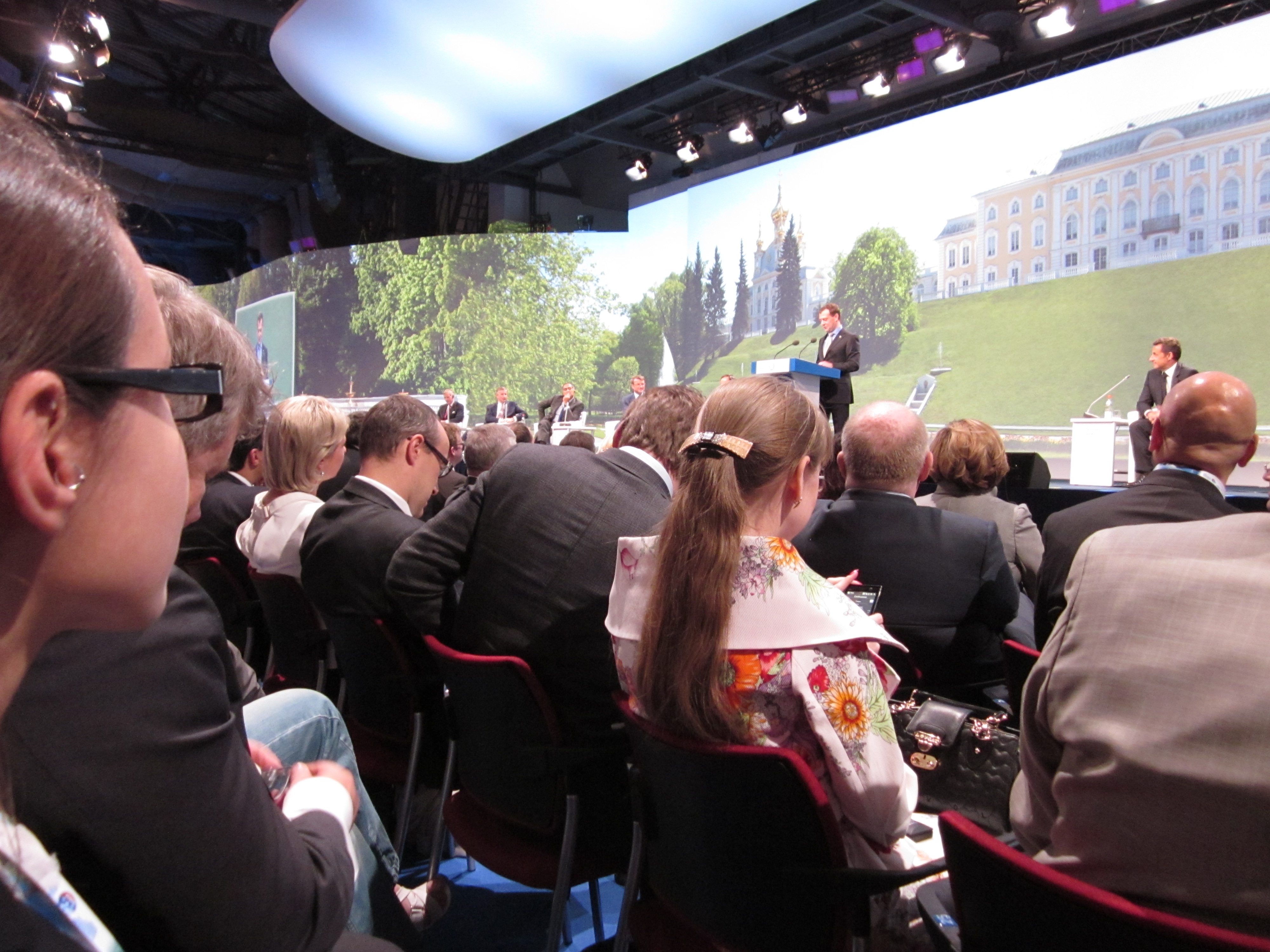
Finally, we attended the closing ceremony with speeches given by Russian President Dmitry Medvedev and French President Nicolas Sarkozy, as seen here on the left. There is much more to say about the Petersburg Forum, and so we will return to this fantastic event.

presidential speeches

Read Full Post »


Clusters
Coming immediately to our minds with the data we collected summer 2010 is how information tends to cluster around themes. In Lysaker, we met with energy consultant Ivar Tangen, childhood friend of Bengt Hansen, president of Statoil in Moscow. Statoil is a Norwegian oil company and one of three companies that formed Shtokman AG, the partnership group with plans to develop the Barents Sea off-shore natural gas field called Shtokman. The other two companies are Russia’s Gazprom, owning majority stake (just over 50%), and France’s Total S.A. The connection of Ivar Tangen to Bengt Hansen was close so that we established with Statoil Moscow on one phone call, our meeting, upon arriving to Russia. It is a question: what type of connection creates the meeting with one phone call?

Statoil conference room

When I worked for Alaska Governor Tony Knowles, in his D.C. Office– Knowles was regal indeed, enjoying all forms of formality paid to him in his person –we thought about the access issue–who had it and who didn’t. In D.C., we always took note upon seeing a memo addressed to the power-holder (governor) that was written, “Dear Tony,…” — who could write that instead of “Dear Governor”? These guys are typically so formal– it is rare to see them addressed at the office in any other manner than their sociological title. Moving on. We arrived to the Statoil office in Moscow, and had our meeting with Hansen (Norwegian) + two deputies (Russian), in the conference room.

This photo above on the left, is the conference room a few minutes before the meeting. Here, the angle of view is one corner of the office, but revealing indeed. This is the entrance side, and directly you confront two images: first, the wall map of oil and gas production in Russia (on the left), and second, a high-rise window perspective of the Moscow landscape. You should be able to increase the size of all the images by clicking on them. Both perspectives, the map and the city landscape, represent their own particular form of cadastral map– a miniature resource map– of Russia’s hydrocarbons, and of the city scape.

Kremlin from Statoil watchtower

In fact, looking out this window, as seen in this image on the left, (walking closely as if to the map to see where resources are), you see the Kremlin in center. Admittedly, not much to see. We’re not Muscovites, and not even looking for it, but it was easy to spot gazing out. You get a sense, pretty quickly, when looking out the window, that you’re gazing out of a particular kind of watch tower — a tower of power-holding, and gazing off, on to another tower of power-holding. When we finally arrived at the Kremlin, we looked for the Statoil office building and found it easily. It’s there in the below photo to the left, the watchtower building standing in the middle…

Returning to the image above, the conference room, what you see then, upon entering, are two framed windows looking out upon the Russian landscape: the first, a cartographic landscape of resources presented in miniature or model scale and brought into the interior of  decision-making (e.g., Scott’s Seeing Like a State) and the other is the miniature image of the city-scape, where the power of the state is brought into the conference room, again, at the level of decision-making. Many times, we were reminded of the power of the Russian state, especially at the St. Petersburg Economic Forum, by way of metaphor, in which attendees refer to “kissing the ring” as a form of deference among western businesses paying tribute to Putin and friends.

Statoil Moscow reception

There’s other things we will refer to, for example, the first image of Hansen above, where it was taken, at the Petroleum Oil and Gas Congress in Moscow on the eve of his retirement, and how everyone in the room gave him a standing ovation, and really, you could see that he was an endearing figure to many in the Russian oil and gas industry, and this would be in contrast to descriptions of other western operators, which we won’t get to at the moment. But finally, this image here on the left, taken of the reception table of Statoil Moscow, which has the Herald Tribune newspaper, and a few glossy Statoil brochures in English. All materials here are in English, and we know for certain that the Statoil brochures are also printed in Russian (a Russian copy sits below in the photo on the left, which we obtained at the Oil and Gas Congress).

Statoil’s Russian Brochure

So for us, it is indication, that whoever comes through the door and sits down (that is, whoever is made to wait and not immediately brought through to Hansen), the person(s) are likely to be English speakers. You could read it in different ways. Maybe non-English speakers are not made to wait, which could be another reason the oil/gas community respected Hansen– Or again, maybe all business was at that level, instructed by the very beginning, to be in English, after all, Statoil is a Norwegian company.

To wrap up, in these photos, we see examples of what we call clusters. A set of information particles, that are now and have since become arranged in a certain form, as an image. What you see is a discursive effect on the landscape of meanings regarding the encounter (that is, when one is lucky enough to pass through a set of images regarding the power-holder of a major oil company). And here, again, we’re referring to an aesthetics and factory of the sensible (J. Rancier), the surfacial features which provide the sense making that work to position the common sense of decision making on Shtokman natural gas development.

Read Full Post »

Joe Kantenbacher

11/10: I met for coffee today with Joe Kantenbacher, whose seminar lecture I had the good fortune of attending last week. Joe ably provided data on how scholars have talked about the topic of behavior modification, as it relates to energy and climate change. The presentation was provocative indeed. Joe began by pointing out that if climate change is anthropogenic (human induced), then, instead of looking for financial or technical solutions to green house gas emission reductions, we should orient ourselves toward identifying a climate policy that can shape the aggregate set of human activities to reduce our carbon footprint. After all, as Joe points out, last year, residential households in the United States were responsible for producing thirty-nine percent of the nation’s green house gas (GHG) inducing carbon dioxide.

Joe Kantenbacher

Joe’s presentation was a trial run for a paper he plans to deliver in a few weeks at the Behavior, Energy and Climate Change (BECC) conference taking place in Sacramento, California. According to the their website (link here), BECC is focused on understanding the nature of individual behavior in order to accelerate our transition to an energy-efficient and low carbon economy. One aspect of the conference — whose attendance anticipates policy makers, social scientists and media —  is to “achieve viable solutions” for reducing greenhouse gas emissions by efforts as design, effectiveness of policies, and individual actions.

With these preoccupations, Joe decided to cull from bodies of scientific literature the kinds of stimuli or technique that researchers had concluded would result in behavior modification. If this last sentence sounds a little complicated, well, it is, in part, because the topic is a little complicated. But the point was so interesting, that I began to think about it in discursive and historical perspective. And before I go there, I want to provide a little more description about Joe’s presentation which captured my interest, while fully acknowledging that I cannot unpack his full intellectual vision.

At the beginning of his talk, Joe casually reminded us of the various models used in different academic fields for interpreting behavior modification – such as prices (economics), culture (anthropology), and normative values (sociology). Second, he pointed out that each of these fields identifies society as the appropriate scale for examining behavior modification (I add a footnote of dissent on this point as anthropology has abandoned society altogether in favor of the subject and rationalities that govern the individual). Third, while society may be the scale for investigating behavior among different disciplines, each approach suggests a specific rate-of-change. Economists, for example, believe change can occur overnight (e.g., triggered by a spike in prices) while sociologists believe that rates of change follow longer patterns of structural shift, such as, for example, from feudalism-to-capitalism, or from modernism-to-post-modernism.

I enjoyed the review. It was a reminder of the need to keep a sharp look out for what we are calling: scale of object, temporality of dynamics, and form of registering events.

Well, here is where Joe’s talk became even more curious. After culling through the record of 1970s-1980s science literature, and pulling articles that crossed over topics of behavior, energy and climate change, he then created a visual networking image to elucidate the spatial relations of different disciplinary authors who were publishing topics akin to each other.

VOSviewer program

At first, upon seeing the image, I must admit that I thought his discussion had shifted toward the epidemiological. But as he explained to us, he was using VOSviewer, a program that can help you construct maps based on network data using a clustering technique. Toward the end of his talk, which I don’t quite recall, my visual attraction so distracted by the VOSviewer image, Joe suggested that researchers had and could identify a variety of forms, by which modification of behavior takes place, and these forms include: public commitment, invoking norms, tailored information, feedback, modeling, goal setting, and a few others. Some of these techniques for influencing behavior could be considered antecedent (before-hand), such as goal-setting, while other could be considered consequential, or what might be called carrot-and-stick (e.g., rewards, feedback).

I think Joe is on to something, in that he has identified a suite of practices, aimed toward governing the body, around the issue of energy and climate change. The lecture struck me profoundly because of the possibility of a history of future unintended consequences that may derive from the inception of a certain idea-force:

Climate change is a scientific fact. But what will it mean to us, that it is now a social fact? Stated differently, in addition to an empirically changing world that we register by science-based instrumentation, what does it mean for us, as a group of persons, to call attention to ourselves as responsible and capable of changing the global climate? What possibly can it mean, to begin living under an idea-force  — a regime of life, in which we identify ourselves, collectively, as the Sun King?

Read Full Post »

Karlene Roberts


Catastrophic Events and High-Reliability Systems

11/9: One of our emerging projects at StudioPolar plans to explore the reliability of electricity grids in the Arctic. We can not help but notice that across the Arctic, from Fairbanks, Alaska, to Nuuk, Greenland, everyone lives in homes that are heated solely by electricity. No one knows the names or biographies of the technicians who run the local power plants and upon whose lives these communities depend. Even so, community members appear confident in the reliability of these ghost machines, so much so, that few residents consider back-up plans for an emergency situation (God forbid), in the case that power-stations shut down.

Karlene Roberts

We find two things remarkable about this condition: (1) someone, or some group of persons, working in the government housing and planning office decided one day, that there was enough reliability in electricity systems to approve building homes, in areas where temperatures range from 32 to -40 degrees fahrenheit for months on end, without any traditional mode of back-up heating, such as fuel-oil or wood stoves, and; (2) these really are reliable systems, and technicians in arctic communities do get up every morning and produce electricity, despite the fact that these regions are often talked about as high-risk for many occupations and lifestyles.

We also wonder, as an aside, and this is something we must resolve, why these technicians are not celebrated, and emerge as political and economic leaders of these communities, given the crucial role they perform in these societies. We became particularly aware of this in Nuuk, Greenland, where politicians garner quite a bit of local celebrity, including the premiums of vanity that are associated with their rule.

With these issues in mind, I was grateful to lunch today at the faculty club with Karlene Roberts, whose research over the past several decades concerns the evolution of large-scale technologies with high levels of operating reliability performance that are crucial to political legitimacy. Karlene received her PhD in Psychology from UC Berkeley, and after working at Stanford, became the first woman ever appointed to the Hass School of Business here at UC Berkeley. In fact, she has been a frequent collaborator with ERG’s Gene Rochlin and Todd LaPorte, a political scientist also at UC Berkeley.

There are so many research fields Karelene is working in at the moment, and which overlap with our own interests at StudioPolar, that the conversation was dizzying. Just to mention a few: she is actively engaged in UC Berkeley’s Center for Catastrophic Risk Management with which we plan to participate; also, she is working with members of Statoil, the Norwegian oil company, through their collaboration with UC Berkeley’s Center for Executive Education, and which is titled the Statoil Project Executive Program, or, in Statoil language, according to the company website, Project Academy. We plan to follow up on all of these links and will report back in updates on our NSF EAGER research.

Read Full Post »

New Orleans

Several of us headed to New Orleans for the American Anthropological Association annual meeting. The trip was the food.

Read Full Post »

10/29: 8:50 PM. The conference is over. Our path toward understanding, for which we traveled across far-flung places, has once again left us individually standing in the dark. Still, we depart alone, but also stay united. It is our zeal for an idea, a belief in what remains enlightened.

6:56 PM. “Closing ceremony: looking back, moving forward: trajectories for continuing research on the Russian energy sector” — this is the title as it appears in the program to call attention to the end of the three-day conference (with the one exception, that we have decided to not capitalize each letter, as the organizers have done so in the conference program). Recently PhD minted and conference organizer David Dusseault is on stage in the Small Hall auditorium at this very moment, a charismatic political scientist whose nor’easter accent provides a welcomed staccato of punctuation to the boxes and tables that appear in his power point images. We are now very close to applauding ourselves for the past three days of intense, informative and friendly discussion and awaiting who will have the last word…

5 PM. Inside the University of Helsinki’s Main Hall, where the conference is taking place, we find ourselves spending time among statues of the classical world. There they stand, the men and women of the ancients, on the steps between the panel rooms, located across the balcony halls, we come face to face with these early ancestors. The very contrast by standing among these prior cosmopolitans and our discussions of the politics and policies of modern energy systems, reminds us of the contrasts between today’s energy requirements and those of the early world. As Vaclav Smil poses the issue in his 2000 article available in the Annual Review of Energy: the amount of power available to today’s affluent American household was only possible (but without the convenience and convertibility) for an owner of a Roman latifundia of 6000 slaves. Can you imagine.

3:00 PM. Time now for a networking break, as everyone heads out to the caffein bar for more BTUs in order to get through the final half of the day. We should mention here that — as we were leaving the auditorium, and pausing for a photo op to include, in addition to Dr. Cui and Master’s student of diplomacy Scott Milgroom, the very intriguing British ex pat in Moscow Ian Pryde, who is founder and chairman of Eurasia Strategy and Communication — the importance  of empires in decline, which as Ian reminded us, that it was not so long ago, that Britain faced its own loss of national self-esteem after World War II, and that in Russia, in the context of a comment that we had made yesterday about global Russians returning to Moscow, there is today, in cosmopolitan Russia, attempts to recapture that earlier pride through establishment of incubation parks to woo the newly educated Russians arriving home from the West.

And this was, in fact, the very topic of the well presented talk by Dr. Nikita Lomagin of St. Petersburg State University, Russia, who suggested that perception of self in today’s Russia is quite important, and that the willingness to be viewed positively, or rather, the question of how to demonstrate that you are important revolves around energy. The importance of energy security, and more clearly, defining ones strength as a petro-state, was created in Russia through a state programatic developing out of the 1990s that would focus on strengthening position of strategic markets in Europe, diversification of these markets, investments in Russian infrastructure, stimulating local consumption, and access to new technologies in all stages of the production chain. And this, according to Dr. Lomagin, defines energy security in Russia today– security that is as much a part of development and protection of economy as it is promoting and protecting imperial consciousness.

1:30 PM. One point Dr. Sherr made during his key note speech this morning, which we found interesting, was that, in energy as in most other spheres, it is remarkable, that Russia is able to compartmentalize its relationship with China. And moreover, the ideas that dominate Russia’s concern are primarily those dealing with the relationship of Russia to EU and the United States. And with these thoughts in our minds, so it was, that we also found interesting the key note provided by Professor Shoujun Cui of Renmin National University, Beijing, China, who delivered quite a few common sense understandings about pipeline politics in the context of Russian, Chinese, and central Asian pipeline transport systems. Dr. Cui posed the question of whether natural gas pipelines should head West from the Caspian basin, including from Russia, toward Europe which will experience low economic growth rates in the future — (of which two are already proposed and referred to as the Nabucco project from Turkmenistan and South Stream from Russia, but in fact are in zero sum competition westward) or, would it not be best for pipes from, say Turkmenistan, to flow eastward to connect up with the China Central Asia pipeline.

Let us interject, from our own humble perspective, that there must be incredibly confident forecasts for economic growth and demand of natural gas existing in China to continue to build and connect the long distance pipes westward of which Dr. Cui speaks. From our point of view, in the North American context, where the incremental gas demand market in many cases would prefer to destroy demand rather than plop down the multibillion dollar figures necessary for connecting Arctic gas to the pipeline grid structure (and even where announcement to build would destroy the price for natural gas), there must really be something going on in the East Pacific. It may be time to enroll in those Chinese language classes we always find ourselves joking about. Dr. Cui suggested to us, as a partial answer, that the authoritarian government allows for making long-term energy decisions, whereas a U.S. legislator’s horizon is only as far as the next election.

9:45 AM. Key note speaker, James Sherr, Senior Fellow, Russia and Eurasia Programme, Chatham House (“funded by the foreign office and the Rothschild’s, and set up in the 1930s” according to a conference attendant who wants to remain anonymous), London, began speaking this morning to a largely empty auditorium. Apparently, revelers of the conference last night kept him up at the bars until the wee hours, and could themselves, not make his 8:30 AM talk. Nevertheless, even by his own admission, of having to operate today on two-and-a-half hours sleep, he gave a provocative speech on Russian energy policy internally and abroad over the coming decades. Even Alexey Gromov, Deputy Director-General of the Institute for Energy Strategy in Russia, who has taken the lead in pointing out fundamental misperceptions students of Russian energy policy often make, gave Sherr his enthusiastic approval (photo on the right, Sherr in middle and energy expert, Vladimir Paramonov on left).

If we can distill his lecture, and my apologies to Dr. Sherr in advance, into several dense points: (1) vertical power under Putin is misperceptive –and while there has been a fundamental change since the 1990s in relations between the Russian government and energy sector, moving from a situation in which money effectively bought power and privatized parts of the state, toward a reversal since 2003, where power buys money in the sense that the state simply takes property– in fact, real power is concentrated not solely in Putin himself, but in a small number of persons who derive their profits from the energy sector – while being linked closely to security services of the federation (i.e., no unitary actor in Russia); (2) there is a struggle taking place, within this circle, and which will mean much more than classical policy discussions as they take place in the EU, in the sense that the struggle over policy outcomes—answers to questions such as will the energy market become more flexible, more market driven, liberalized, etc.—will depend upon the protagonists engaged in their own struggle, and for those actors these tribulations will take precedent over the debate of modernization itself; (3) yes, modernization itself, what about modernity in the energy sector? It will be inhibited by specific structural features that are beyond the struggles of individuals—infirmity of property rights, lack of entrepreneurship acting independently from the state, strengths of personalities and weakness of state institutions, weakness of judicial order and rule of law – and these conditions will likely lead and strengthen conservatism (in addition, Russia’s likely recovery from the financial crisis), and even intensify the meaning of these struggles to which Sherr so passionately refers. Finally, when it comes to Europe in any event, Russia is proving to be effective at integrating its commercial aspects of its energy policy with its geopolitics, and this is especially the case in those instances, such as Ukraine, where Russian banks are further integrating that country toward becoming, what Alexey Gromov quipped during the Q and A period, a Russian domestic market.

Read Full Post »

« Newer Posts - Older Posts »