University of the Arctic:
Extractive Industries Workshop !!!





U Arctic extractive industries workshop:
The Arctic as extractive industries resource frontier: legal and political economy developments, November 9-14, 2014
Neryungri Technical Institute, [southern] Yakutia, Russia.
DAY FIVE (!!!):
Irina Zhilina is now up talking about her upcoming PhD program at College of Fisheries working under Peter Arbo on Barents Sea oil and gas development, looking at integrated developments. For example, the Norwegian/Russian boundary treaty is taken in western Europe as a success, while in Russia, generally, there were several serious disagreements which upended the process of its full ratification.
Primary drivers of Arctic oil/gas exploration: scope and pace of climate change, economic conditions and global markets, advances in offshore technology and maritime transport, policy developments. As such, international cooperation through “integrated” development could potentially respond to these various sectorial developments, and the process of this development, frameworks, centralization, distributed authorities, all make a difference in characterizing the fragmentation/integration of Barents developments. Irina is pointing out that most of her research will be focused on oil companies and suppliers, collaborative projects (the Norwegian Russian ship reporting systems, Barents rescue, Joint Norwegian Russian environmental commission); but also on frameworks and Arctic strategies.
 Up now we have Vitaly Kornilov (above) talking about labor markets in Northern Russia, Republic of Sakha (Yakutia), from the perspective of “decent work” concepts within international labor organization (social partnerships, protections, fundamental principles associated with rights of employment, issues of child labor). The Russian North has several specific issues that distinguish labor conditions from other parts of the country as well as the international context.
 Henri Wallen is now talking about cumulative social impacts of predevelopment mining projects, looking at the Finnish mine project in Sokli.
 It turns out that the mine is in various stages of development, and Henri is examining its futures. There is a speculative (discursive) mining boom in Finland, in part, because of a change of law in 2011 opening up vast tracts of land for exploration by mining firms, thereby, liberalizing the playing field for prospects of development.
Sokli has both uranium and phosphorous deposits, yet obtaining the phosphorous license appears possible with far less regulatory hurdles that uranium, opening the possibility for developing the latter in a step-wise process.
 According to pro-development groups (municipality, Regional Council of Lapland, Labor unions), the cost benefit analysis for the project favors employment, whereas the those against development (nature activists, reindeer herders, tourism industry) have raised contamination issues to the region and possibly outside the area through the affect on rivers.
One of the contributions here consists of looking at the context of “social impacts” itself, finding out the principles in which social “Impacts” accumulate over time. In the end, for example, assessments by social authorities may or may not assess the actual event-impacts.
We had a rather lively discussion over the object itself, wanting to know more about the genealogy of the “cumulative impact assessment”.
So finally, for the last speaker of the workshop, we have Nikolai Vakhtin, skyped in from St. Petersburg European University, speaking on extractive industries (EI) and local population, beginning with “deconstruction” of terms indigenous, newcomers [sic], moving to soviet-time industrial geography and heritage, and the future of EI in the Arctic. Dr. Vakhtin explains that it takes perhaps 50 years for any one “group” to “feel” as an indigenous peoples, which he interchanges with the word “local” population [sic]. But in fact, indigenous is a “legal” term, strictly speaking [the opinions expressed here are of Dr. Vakhtin’s, ed.].
Dr. Vakhtin cites Andrei Parshev, Why Russia Isn’t America? (1999) — suggesting that Russia’s geography is entirely located in a cold space, and thus, should shield itself from the global market, given the competitive costs of development. Fiona Hill and Clifford Gaddy, authors of The Siberian Curse (2003), likewise examine the consequences of operating under the past seven decades of Soviet governance in the modern global system of competition, leaving the country with a continued non-market system, in part, attempting to master and develop the Northern region (planners, creating pools of labor lured to the North to distribute populations across the state).
 As such, Russia’s 1/3 of the population live and work in almost impossibly cold climate regions in Siberia, responsible on central elements of distribution, four times as high expenses as more temperate areas, and living without adequate transportation networks, road infrastructure, badly built housing, district heating systems always on the verge of failure. In fact, Temperature Per Capita (TPC) distribution: USA (1930) +1.1 c; Sweden -3.9; Canada -9.9; Russia (1926) -11.6. But in fact, by 1989, Canada’s TPC was about -8, versus Russia which has gone higher than -9.9 to about -12. In fact, Russia pays a “cold tax” in the neighborhood of 2.25-3.0 percent a year, because its “misallocation” of populations in the north.
Russia’s population density in the North is 40-50 times greater than in Canada (Russia has 9 of the 10 largest cities in the far North). Since 1989, Chukotka lost over 60% of its population, Magadan region lost 40%, Kamchatka lost 18%, Sakha lost 10%.




DAY FOUR (!):
Up now, we have Mikhail Prissyaznyy talking about differences between metropolitan capitals and northern regions emphasizing government and company supports of extractive industry cities.
Jonathan Parsons is now up talking about resistance to extractive industries in Newfoundland and Labrador, referring to the Petroculture of the St. Johns, on Canada’s eastern seaboard. Jonathan is exploring the context of resistance in the region, identifying various public and media displays by which residents frame their own ambivalence to the risks and rewards to mining and shale gas development.


Now a general planning discussion about the thematic network and phd program (which is an activity of the thematic network) and the funding, which is from Norway to create North American-Norwegian cooperation. Gunhild Hoogensen-Gjørv is the Principal Investigator, now going over the previous trips in Canada (St. Johns), Norway (Tromsø), Russia (Neryungri).




DAY THREE: Jon Skinner speaking about his PhD research underway at U Alaska Fairbanks, working on Kara Sea, looking at political science perspectives on oil and gas development with attention to international oil company development decision making, political leadership in Russia, Arctic governmental and international environmental policy.
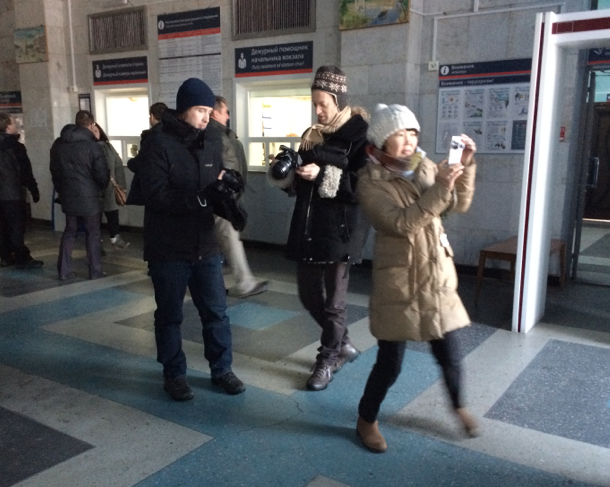
Oh, and of course, we had my humble contribution, conversing over ninety-minutes on the such topics as the paparazzi ethnographic form.
 Up now we have, Asya Lazareva, talking about the richest resource republic in Russia, the Sakha Republic. Economic profits and the role of the northern resources in global development, prospectus of mining, and economic activity in the North.
The scale of economic activity in the North places Russia in the top spot. Northern regions produce about 11% of GDP with 5% of population. Yakutia has about 1 million people, but rands first in the Russian Federation by total reserves of natural resources development, an economy built primarily on exportation (diamond, gold, tin, coal, oil and gas production, electric power production).
Capital investments are increasing, including construction of pipelines for natural gas export (China). Oil: Surgutnefetgaz, YaTek, Gazprom, Tuymaada-Neft, Sakhaneftegazsbut; and Gas: Gazprom (external market), YaTEK (internal market).
 Prospects are increasing every day for resource production. Arctic environment is rapidly changing as well. So the ecological aspects are extremely important, especially regarding permafrost in Yakutia, which poses traditional difficulties for resource extraction.
At any rate, some of the most important processes (for development and human living) is interaction between agitation and permafrost, carbon emissions, and global temperature change.
The Arctic part of Yakutia/Sakha is less well developed, with communities living under conditions not as modernized as the southern part of the republic. Pollution of the environment, deforestation, nearly 200 million tons of waste, 92 million tons of untreated sewage, 1982 tons of harmful emissions produced each year.
 Most significant area of disturbed lands are concentrated in the areas of mining development: Mirny, Neryungri and Aldan districts.
Big industrial machinery, blowout of pipelines, accidents, catastrophic events that can last for decades. “Megaprojects” such as Eastern Siberia – Pacific Ocean and “The Power of Siberia”. The vastness of the region itself is mirrored within the future visions itself.
 How are [industrial] plants decommissioned? Well, that is a good question, to which Asya points out that industry has expressed quite a bit of ambivalence on this topic, not necessarily seeing any economic motivation whatsoever in reclamation processes, and dumping the responsibility on the state and civilian structures.
Of course, now we are having a general discussion about analytical and methodological considerations, for example, when constructing the PhD dissertation, how does Asya plan to frame so many macro-to-micro concerns, to which she points out, that her concerns primarily focus on development futures, how particular discourses impinge on aspects of Arctic development.
Lunch
Yuka Oishi, PhD Candidate from Tokyo Metropolitan University, Cultural Anthropology, is now up, talking about environmental use in the Khanty, specifically, the Num-to lake area in the Yamal-Nenets region. Yuko provides an instructive background on developments in the area, the first gas/oil fields established in the mid 1950s, with industrialization of oil in the mid 1960s, and by the 1980s, with pasture destruction, the forced migration of Khanty. So, as Yuko points out, land in the area has been redefined over the years, mainly into three categories of the modern condition, before soviet collectivization, the soviet period, and post oil development period.
Here we go. Yuko provides a chapter-by-chapter discussion of her dissertation on cultural articulations in post socialist indigenous people’s communities, backgrounds, changes of livelihood and environmental use (in political-economic transformation), nomadism, and other such interesting objects of inquiry.


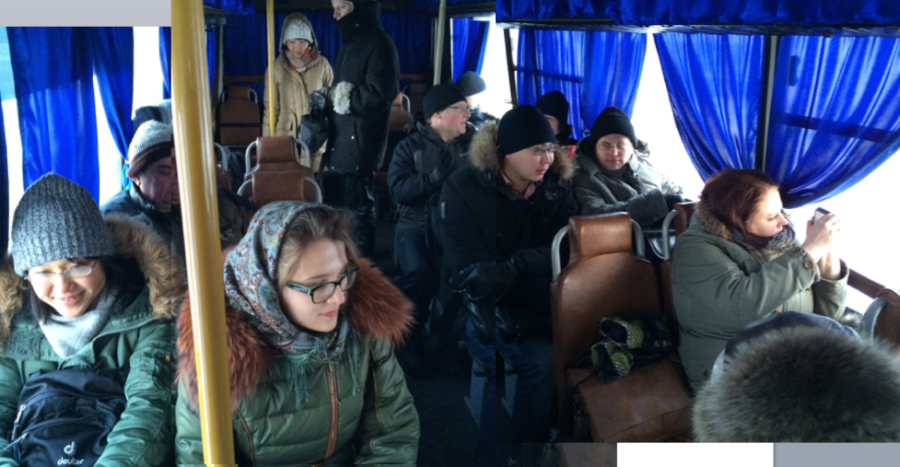

DAY TWO: Beginning with Gunhild Hoogensen Gjørv, talking about tensions between environmental, economic and energy security, providing a working definition about the concept of security, emphasizing the relationship between individuals, livelihoods and governance, that is, creating a space of provisioning, remarking also on the historical context of security in the Arctic, which was primarily a military concern among states.
In the Arctic, climate change debate is a threat to economic and energy security, and increasingly part of policy debate — while at the same time, many discussions about resource development are not taking place within the same time-space experiences as sustainability and climate concerns. Gunhild points out the example of Arctic Circle event last week in Reykjavik, in which separate sessions dealt individually with issues that likely should be talked about openly within the same space, for full debate on the enormity of the stakes involved in the climate change – energy consumption nexus.

Q & A: Debates about Norwegian oil development within the Norwegian public discourse. Well, in fact, there is quite a bit of discussion about oil development, for example, a moratorium on oil extraction in the Lofoten region, and here, the discussion is not about climate change (as a global issue) but instead local fishing industry and local identity (as a national concern).
Newly accepted PhD student to College of Fisheries, U Tromsø, Irina Zhilina, and Florian Stammler, Professor at U Lapland, Arctic Centre, brought up several comparative questions regarding how the federal state identifies oil wealth through exports to security and sustainability, prompting Gunhild to point out that renewable and non-renewable resources, while rising in the public debate, are not critical to the provisioning of the modern state.
Up now, we have Dr. Travor Brown, professor at Memorial University in New Foundland, Canada, talking about “strategic HR [human resource] planning” — and the merit of “building versus buying model” – whether it makes sense to bring in trained labor or train the local talent to the skill of the current requirements of industrial development.
 Pros and cons to both. The cost of buying skill is expensive, paying dearly for certain skills (although, the training time is truncated). Bringing in *stars* that do not necessarily perform as well when taken out of the environment that created them as A-listers.
Community reaction is also a consideration, because labor contracts oppose outside expertise.
Training locally, for example, creates flexibility and consistency, though there is a ceiling in the case of, say, situations where there is a short term need for a certain skill set, bringing in workers with multiple years of expertise (or even semi-retired and senior persons) can create efficiencies unavailable at the local level.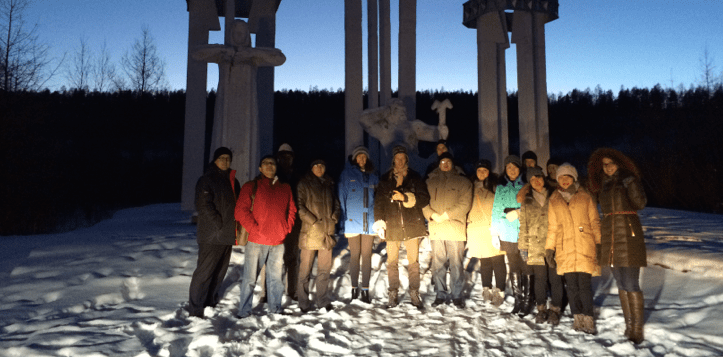
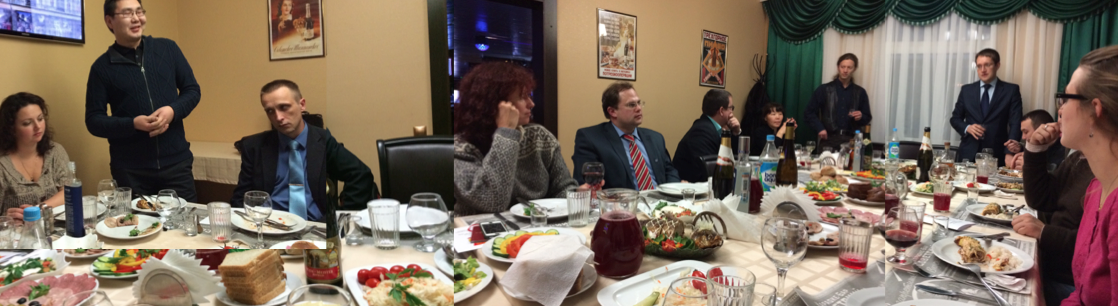
 “What’s required for the job?”, an important question when regarding a hire-training program. In mining towns of the North, the “personal level” — a strategic phrase to describe the evaluatory assessment of personal worth in the context of productivity to the company. By the way, that is Travor in the photo above, sitting to the right, just about to start a yummy lunch at the local cafe, a karaoke bar on the theme of Soviet society. We greatly appreciated their cabbage salad, which was devilishly spicy.
Techniques of training (lecturing, visual aids, critical incidents and cases, role play, simulations) as Off-the-Job instructional format. Technology. Behavioral Modelling — preview the principle, observe a trainer perform the task, trainees perform a task, trainees receive feedback.



Governing the body…. through technology.
Cognitive modeling — “Do things quietly in your head” — of course more than that, but the affect of discourse can never be underestimated. That is, creating a habitus toward productivity and safety. Simulation and identical elements. Doing things that work, requires replication off-site, to bring back on-site guiding principles, habitually established in the body (and, of course, in your head). The role of task confidence in transfer, an issue that links the concept of training to a concept of effectiveness.
Conclusion: what is the status of a “trained work force” in the North, for making development happen? Developing your own skills is a better return on investment, but for short term productivity, bringing in the experts is the more efficient purposeful approach to efficient return.
Talk of the Town




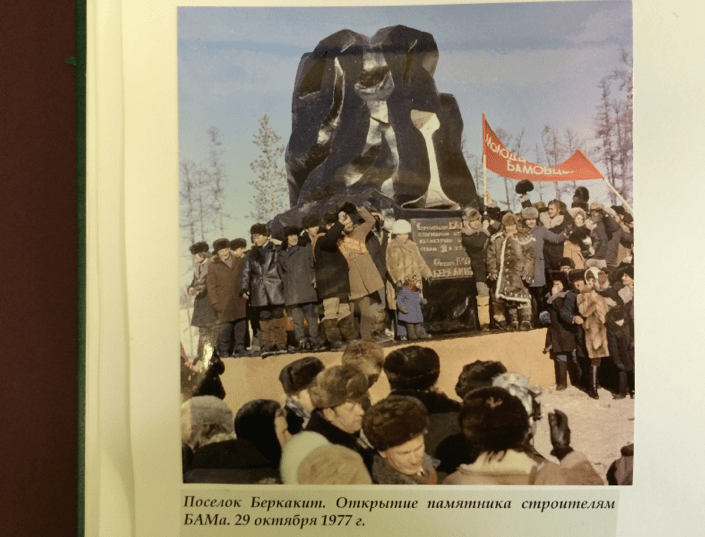

DAY ONE: Opening of the course with comments from Serguei Pavlov, Director, NEFU Technical Institute; Mikhail Prissyanznyy, NEFU Vice-Rector, U Arctic Board of Governance Member; and Florian Stammler, Head of Thematic network, Professor Arctic Centre, talking about the importance of networking and exchanges across the Arctic and the role of СВФУ (NEFU) in the extractive industries network from the very beginning, also with some discussion last year at the Arctic Circle among guests in Reykjavik. Michael up speaking first, thanking Florian for his hard work in establishing and sustaining the extractive industry network and even providing Florian with a plaque from the region, celebrating the U Arctic activity in Neryungri for the first time as a host. Michael also provides a plaque to Serguei Pavlov, for his important role in hosting this event [applause all around].

Florian providing greetings and thanks to the thematic network, especially taking place in a mining town where extractive industries is taking place.
First talk by Florian Stammler and Aitalina Ivanova – Confrontation, coexistence or co-ignorance – Indigenous resource rights and implementation negotiation in two Russian extractive industries regions. Utilitarian logic and negotiation logic. Resource: something extracted for the use of people (renewable and non renewable) – extractive industries: large scale processes related to resource (subsurface, hydrocarbon, mining, fishing, forestry). Determining a logic in which humans own and control the land, conquer, master, make useful versus a partnerships logic, in which people are a part of the land, in which people are part of the land itself and do not envision resource as added-value. These two logics are regulated by law, best practices guidelines, and different kinds of commitments.
Aitalina is up now talking about Case 1, confrontation – the Itelmen fishermen of Petropavlosvsk and West Kamachatcka living on the shore of highly productive fishing grounds. The main conflict is about restricting indigenous resource use rights. The state wants to diminish the niche of fisherman traditional livelihood following a partnership logic in relation with their resource. The state regulates following an utilitarian logic where all land rights and fishing rights belong to development to maximize industry profits.

 That is, the State has in interest in eliminating indigenous livelihood and resource — because it the latter represents a non-commercial use of a commercially valuable resource. in Contrast, the State wants to create best possible conditions for big industry to extract most profit of the resource (fish). According to one indigenous elder, “[we have] fifteen minutes are left to practice traditional life” [because of restriction of quota and fishing time or direct harassment of state structures]. Industry eliminates competitors by transferring the job of pushing indigenous partnership approach out to the state.


 Case-study #2 -coexistence: consideration of mutual interests among various resource users. The fishermen of the Lena Delta live on the shore of the Laptev Sea. The State assigns a niche for them in a protected area and allows indigenous people to live in partnership with resources on their own terms, by granting them access to riverbanks and fishing grounds and quotas for one special indigenous enterprise — in doing so, the state accepts that indigenous have their own rules, but on the other hand, indigenous accepts their niche under the state rule. Another example of process of co-existence — Kolkohz artel “Arktika” (Sakha Republic) founded in the 1920s, produced the only Arctic enterprise that did not change its name or legal form with the members as shareholders.

Case three: co-ignorance, where the state and companies avoid detailed regulations of resource use practices. Co-ignorance works as long as the stakes are low and industry production is small. The state reserves the right to express the superiority of its utilitarian logic for the future, in case more subsurface resource extraction rights should be given to industrial companies. The Evenky herders of Kamchatka live with their reindeer between a mining area and a national park in a situation the presenters call co-ignorance of delating with other land users.
 Co-ignorance appears stable as long as industrial stakes are low.
Q&A: How does the quote system operate? A: allocated by regional authorities, typically by scientific justification, but typically, the issue is a local/regional issue (versus federal) with indigenous folks.
 There is a lot of interesting discussion about the role of the state in Russia, e.g., in the past, in the field, that there is a Soviet nostalgia, that in Soviet times, Indigenous persons received a lot of support, embraced by the State patron which granted them possibilities to subsist, and that has indeed changed a lot.
Lunch
After Lunch
Yulia Zaika is up now, talking about her extensive background in International Polar Year and Polar Early Career activities and her latest research on quality of life indicators in Russian Arctic cities as well as her dissertation overview, focusing on urbanization in northern Russia and specifically, the Murmansk region as an industrialized city and its transformation into a sustainable form.





Read Full Post »




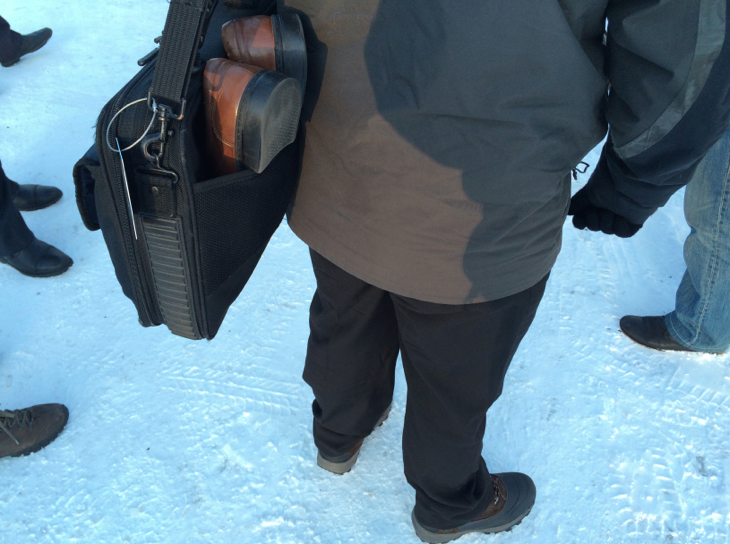
 Notice in this image the celebration of things marking various relations of intimacy as a lived experience: a mattress moving through the front door, a leather brief case that lies on top of other items, and the metallic/plastic suit case (to the right of the leather brief) that sits on the earth, thrown there off the truck, making an indent in the snow.
 Among these paintings, one artist’s rendition below of the “elevated cabin” stands out as a prototype of the Neryungrian departure from its proto-developmental form, reaching, that is, toward an articulation of a high-energy civilization. Behold:
 In the collage directly above, I have attempted to capture the import of cosmopolitan resource through the tableau of men-at-work — gazing out before them (toward an object of labor). In the case of the Neryungrian, his object of labor are other paintings inside of the museum exhibit itself, and as such, artistic labor becomes a manner of intense reflection.

































 Paparazzi Ethnography