

This year’s theme, Arctic: Societies, Sustainability, and Safety, focuses on: (1) Arctic Climate Science, (2) Arctic Safety and Cross-Border Knowledge Needs, and (3) Arctic Research-Based Industrial Development and Resource Management.

This year’s theme, Arctic: Societies, Sustainability, and Safety, focuses on: (1) Arctic Climate Science, (2) Arctic Safety and Cross-Border Knowledge Needs, and (3) Arctic Research-Based Industrial Development and Resource Management.
Posted in Paparazzi Ethnography | Tagged Toronto | Leave a Comment »
[I plan to come back and re-work this blog- give me a few days, ed.]
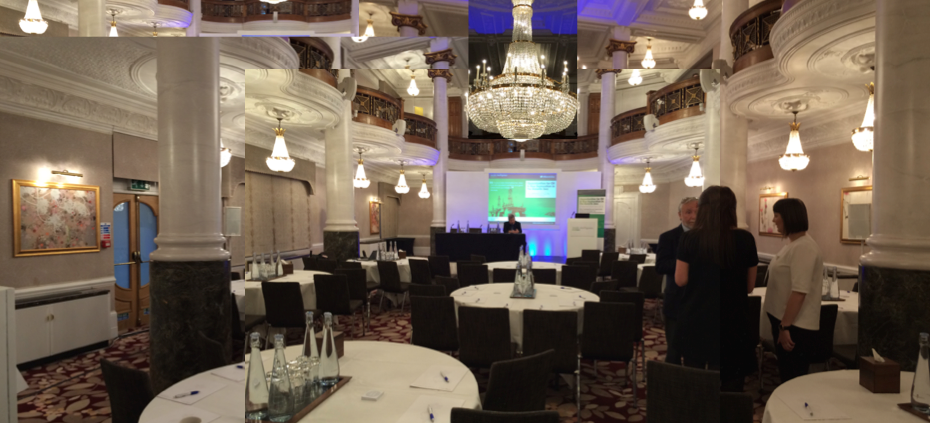
Oil and Gas Exploration in the Barents Sea, October 6-7, St. Ermin’s Hotel, Caxton Street, London, SW1H 0QW

October 7: Day Two
Chair’s Opening Remarks
Hans-Christen Rønnevik, Vice President Exploration, Lundin Norway AS
Lundin’s Story: How Do We Unfold Reality In A Mature Area? Lundin’s exploration activities based on 42 years of experience in the Barents sea; The Gohta oil discovery; The petroleum habitat of the Loppa High

Begins quite philosophically, about the role of knowledge. “Visions are achieved by action, not by thinking”. Fact and experience based operational knowledging (conceptual procedures). [I will have to return to post up some of Hans’s slides, which are made up of declarations which he states in a clear punctuated manner – mainly, modeling is not a method of thinking, but certainly a necessary skill] — continuously unfold reality as you interact with it – to explain broadband 3D for deterministic mapping as input to models. Gohta discovery in the Loppa high, 2013: recoverable resources 10-23 Sm3 oil/ 8-15 billion sm3 gas; 2014: Gohta 2 Environmental mapping in Barents Norway since 2007, working with NGU and FFI.
Key Note: Denis Francois, Geoscience Director, TOTAL E&P Norge AS and Dominique Roy, Western Europe New Ventures Manager¸ TOTAL E&P Norge AS: Weighing up economic implications of operating in the Barents Sea; Facing technological challenges – experiences from Novarg and Snøhvit; Managing operations in an unfavourable climate condition. Total/Fina/Elf – Yet to Find. West Barents 4.8 boe and East Barents NO 2 boe. Novarg – new venture stage: 2008 to license award 2009. Looking to set up an LNG ii train to Snøhvit.
Artem Rabey, Exploration Manager, LUKOIL Overseas North Shelf: Tectonic development, depositional environment and sedimentation; Analogies with Timan-Pechora basin; Hydrocarbon potential — two licenses in Norway.
Knut Gunnar Amaliksen, Senior Geophysical Advisor, Wintershall Norge: Predicting the good reservoir; The Importance of field work; Be brave and the rewards will come. Pre-Jurassic reservoirs. PL611 – Kvalross Analogue (Edgeøya, Svalbard).
Hot Topics discussion: Hans-Christian presents the problems — How do we form strategic alliances in rig sharing; should there be tax breaks in Barents Sea; Cost issue where 500 million barrels is appropriate development; Will Statoil’s step program build efficiency; Can the French take more Snøhvit gas to France; what about oil spill issues and environmental concerns; and local community impact on development in the region; Have we solved the problem of oil and gas, and can it be done without more exploration and what is the role of tax relief.
Cost issue: Terje Flaten, Statoil, takes the stage to present the issue — what kind of single oil pool accumulations can you have for commercial development given oil price scenarios and current cost regimes – I didn’t quite say 500 million barrels, could be distance to market, technics etc. e.g., Golath is 175 million barrels – Johan C. field, two accumulations, had they been in one single accumulation we would have been happier. Further into the Barents need to find +300 million barrels oil. Industry self inflicted upon itself a cost regime that 3 times larger than previously, and now the cost profile is [through the roof] – attempting to standardize at the High North – lower scale of cost, pushing back on prices for development because of differences in Barents versus North Sea (e.g., depth);
Gas strategy for transportation: ? from the back of the room — delivering gas to Western Europe is a political issue, that could create security in the region.
Environment: Stig-Morten Knutsen, talking about lenses and in-situ burning for oil spills. Several issues that need to be working as an industry as an issue. Other speakers focus effort on well-blow out prevention instead of on spill. When you talk about oil spill, its about optics. Also safeguarding — evacuation, getting people in and out — waiting for initiative to expand base on Bear Island or does the industry invest into creating better preparedness.
Rig alliances – [what can be created among oil companies and a rig fleet on continuous activities and a coordinated rationalized plan] – The longest lead item to carry this out is the Rig – “have an adult conversation about our needs and then approach the rig owners”. Looking for a group rig share for the 23rd license. Tax relief — 78% investment return.
Ove Tobias Gudmestad, Professor of Marine Technology, University of Stavanger; Emergency Operations, Evacuation And Rescue In The Barents Sea; The physical environmental conditions in the Barents Sea; Emergency and evacuation operations in the cold arctic seas; The geography of the Barents Sea and rescue operations – Arctic versus cold climate region (Barents region). Referring to Barents 2020 map created by DNV with step wise development into Barents area.
Stein Sandven, Vice Director, Nansen Environmental and Remote Sensing Centre
Breaking the Ice: Managing Operations in Icy Environments; Understanding different structures of ice and how to incorporate this knowledge into operations; Predicting and detecting ice to optimise exploration operations; Identifying technology to ease operations in ice; Learning from past operations in remote, ice ridden regions: case study of other Arctic regions — How do we predict and how do we detect.

October 6: Day One
Chair’s Opening Remarks
Hans-Christen Rønnevik, Vice President Exploration, Lundin Norway AS
8:58AM – Just getting started here – a hush has taken over the group of about 50 industry players and now it looks like Anna Townsend, Program Manager, is going to get us started with a quick announcement, including a welcome to Dolphin Physical, a company sponsor, and a few Russian presentations were cancelled because of visa issues, and a few other persons who may or may not be coming, and now Hans-Christen.
“Welcome to a Norwegian conference, the same hotel where Philby delivered his secrets to Russian agents, and here we are years later and with the same situation with Russians not able to obtain visas”.
Tax relief giving a new life to the Norwegian Continental Shelf (NCS). More diversity and many more companies now involved in NCS development. Amended tax regime as on the UK shelf in the 1980s led to more players. Barents opening began in the 1960s with hypothesis looking for inverted Volgian highs.
Latest – Active concession policy and new players from 2002: Johan Castberg, Wisting and Gotha results of 3D seismic and the geologists belief in the possibilities. 33 companies are cooperating on 4 broadband 3D seismic surveys for 23rd round. The truth is not determined by majority voting. Renewed interred due to oil success and large structures available.
Opening Address: The Barents Sea, A New Era
Wenche Tjelta Johansen, Head of G&G, Norwegian Petroleum Directorate
Exploration history of the Barents Sea
Undiscovered resources yet to find
Requirements for the Norwegian Continental Shelf and Barents Sea
Updates on the 23rd licensing round
78 fields in production, 60 in North Sea, 17 NCS, 1 in Barents; 13 fields being developed. Prolonging production requires enhanced recovery, opening new areas. 480 wells drilled on NCS (12 drilled 2005, lowest ever, has increased because of high prices, last year second highest exploration wells ever).
Key inputs to assessment: number of possible prospects, size distribution, probability of success, hydrocarbon phase. Statistical methods: calculated stochastically (Monte Carlo simulation), results for individual plays are aggregated to give a total quantity, presented as a probability distribution.
Creaming curve Barents Sea, based on 90 wildcat wells, last three years considerable resource growth. Optimism is back in the Barents sea and explorations wells highest in the last two years.
Barents Sea South East: NPD data aquired spring and summer for most prospective areas.Barents Sea North 2012-2014. Licensing rounds held every second year. 23rd Licensing round – January – 160 blocs nominated, 140 in the Barents Sea. 61 proposed blocks on public hearing.
Goliath production this year. Only one producing in Barents, Snovit, gas bearing. Unit costs can be reduced through cross licenses.
Q & A: How do you include in your yet to find, recent good news and bad news.
Yet to find, is updated every 2 years.
What percentage of wells drilled in the Barents are based on hydrocarbon indicators?
Where Do Real Opportunities Lie? Investment Conditions In The Northern And Southern Barents Sea
Haakon Haaland, Executive Vice President Business Development & Exploration, E.ON E&P
Distinguishing the key players and possible future players in the Barents Sea
Understanding the status of developments in the Southern and Northern Barents Sea
Evaluating the most recent Barents Sea discoveries
Venturing into the former grey zone
Political/Commercial aspects of industry. Mix between state/private is key to what will happen in the Barents going forward. Before continuing a few facts about E.ON E&P. Current focus areas, UK, Norway, Russia, Algeria and Brazil. 14 production fields, 5 producing fields as operator, 60 exploration licenses, staff of 220 employees and 200 contractors.
Crossing the 62 median line (not so much the “Barents Area”) — was the industry ready. No secret that the Barents was Gas, not a big prospect, always looking for oil. A decisive energetic ministry combined with competent NPD – creating the right policy of exploration. Barents initiative during the 1990s, wanting something to happen, and taking decisive action to encourage exploration. In terms of a global scene, it is a well organized efficient development process (data organized and released timely, modestly costed). Goliat, Goliate-Kobbe, Johan Castberg – drilling boom.
Barent Players – Statoil still major player in Barents Sea exploration; Majors not active anymore: Exxon, Shell – Companies left the area: Mobil, Saga, Hydro; New important entrants: ENOI, Lundin, OMV Other newcomers: DF, DONG, Noreco, Repsol.
ENI, Statoil, Lundin, continues to have stamina. Barents: After more than 30 years still a frontier area. Not the North Sea, Key discoveries (Snohvit, Castberg, Havis, Goliat) conventional exploration models; Late Neogene uplift and erosion, huge area, limited data; South Barents south east total frontier zone.
Cost levels, lack of infrastructure, and too much bad news at the same time. Gas discoveries create dry spells in continued exploration. One clear risk/opportunity: Norway will reach production maturity in mid 2020s, need for new gas that will utilized this infrastructure, especially liquid gas. Connecting Barents with the Norwegian infrastructure system. Infrastructure key to value creation. In the past, private investors always had interest in constructing infrastructure, in the North sea, large anchor fields created an interest. Today, commercial entities not interested in investing 5-6% returns on pipelines to create the infrastructure required to move forward on Barents. One of the difficulties in Norway, is that politics is difficult to step out in front of projects, to be a front runner on investments, there is the debate on social distribution. Debate over whether the State and Ministry step up to create the infrastructure to unleash activity and value creation from Barents area. Another discussion on special incentives such as Snohvit, special production allowances.
Q&A How decisions can be made with several degrees of uncertainty: Priorities, driven by the ambition to replenish – but there are forces against (cash flow, investor sentiments — the most moving audience of all, because if you fail to deliver on the quarterly the CEO gets fired).
Unique cost drivers in Norway, nothing to be proud of, operating drilling more expensive than anywhere else, a need to get productivity up, no way it should take 50 percent more time to an engineering design for a semi than required. Mobilize as an industry.
To early to have the discussion about how to connect the Barents. Looking to have more exploration before any kind of determination can take place.
Keynote Session:
Will Commercial Success Follow Exploration Success In The Barents Sea?
Terje Flaten, 23R Project Manager, Statoil
Statoil’s approach to Barents Sea exploration from play validation to exploration focus
Barents Sea Southeast 3D seismic cooperation project
Development challenges and commercial hurdles
Will commercial success follow exploration success. Myths or Facts: Developing Barents Sea discoveries commercially requires — much bigger discoveries than anywhere elsewhere; massive development of new technologies; completely different methods for oi spill handling; new solutions for escape, evacuation and rescue, management of ice totally unique.
First oil production will be at Goliat. Exploration conventional seismic and mapping early discoveries. Periodic and underexplored
Steps to commercial success in the NCS/BS — (1) Big discoveries (high resolution seismic acquisition solution; triassic reservoir presence and quality): How big is big — 150-300 million barrels represents the threshold; key issues is how to build out hubs and field centers. (2)Political acceptance and license to operate: Trust, transparency (distance and temperature, people in extreme cold; robust oil spill contingency – barriers to recover spilled oil and barriers in the well to prevent oil spill) (3) new technology: Horizontal drilling in shallow reservoirs (time and cost, overburden stability, happening in Hoop, Bjarmeland, BSSE); handling of produced water (clean water discharge, everywhere); new sub-sea solutions (incremental development needed. Away from North Sea Standards where they are not needed) (4)industry cost level: Positive oil price development – however more expensive reserves erode returns. Cost per barrel increasing. Restoring the returns: Standard solutions adapted to sub-surface and surface conditions: drilling costs and efficiency, leaner facility concepts, replicated and standard packages, wider industry co-operation, reuse. Last decade – oil price tripled, development costs doubled.
Cooperation: BSSE 3D Group Shoot: Authority guidance;encouragement, attractive business model, equal and low costs (no volume disc out, fair price differentiation between EP and LP, room for different company strategies and prioritization); Involvement in decision making and survey design.
“Business Card Exchange”
“Take advantage of this networking opportunity to introduce yourself and exchange business cards with other conference delegates. Start with the people closest to you and then move around the room to learn more about other attendees and their companies and projects.”
The Role of Structural Geology In Success-Failure Analysis – Examples From the Barents Sea
David Jackson, Global Manager Multi-Client New Ventures, Dolphin Geophysical
Understanding the present day architecture of the petroleum system
How has the petroleum system developed through time
Understanding the role of key tectonic events in changing the petroleum system
The communication of geological understanding and rationale to non-geologists
Understanding the Barents Sea’s Unique Petroleum System: Source Rocks
Tommy Samuelsberg, Exploration Manager Barents Sea, North Energy
Understanding the unique petroleum system in the Barents Sea
Exploring which source rocks exist in the Barents Sea
Underlining the quality and nature of source rocks in the Barents Sea
Play models in the Barents Sea
Exploration history of South-Western Barents Sea; Play models in the Barents Sea (Permian, Triassic, Jurassic, Late Cretaceous/Paleocene); Petroleum systems. First discoveries 1981 (Alke South, askeladden); Albatross (1982) and Snøhvit (1984) – 8th rounds..
Networking lunch break
Ice, Erosion and Broken Plates: Unravelling the Tectonothermal Effects on the Barents Sea’s Petroleum System
Ebbe Hartz, Chief Geologist, Det Norske
Late Cenozoic uplift and erosion in Barents Sea’s petroleum models
The geodynamic challenges of deposition, uplift and erosion of the assumed overburden
The different petroleum models that result from reducing erosion estimates by considering the effect of glaciation and continental break-up. Hans introduces Ebbe as a ski champion – “I will speak without using the microphone, and will do so until they fix the computer [PPT – there was some issues with PPT earlier on during the day]…. using Heriksen and friends from Statoil’s Slides to make the presentation.
Ice probably caused significant compaction, thus erosion estimate stop high; Paleo heat suggest less erosion, and may partially have come from break up. Break up hear probably uplifted Svalbard, erosion enhanced this process; Thus, implementing ice loading highly effects petroleum models for the Barents Sea.
Unleashing the Untapped Potential: Reserve Estimates for the Barents Sea
David Poole, VP Exploration & Deputy CEO, Spike Exploration
How can we use resource estimates as a predictive tool in the Barents Sea?
What are the lessons learnt from more mature areas on the Norwegian Continental Shelf and how can these be applied in the Barents Sea?
Applying resource estimations to future strategies and ensuring return on investment, from a Spike perspective
“Back to strategy” – Focus on using historical data in mature basins as predictive tools in the Barents Sea; Analyses of historic exploration performance in UK and Norway used to highlight trends in exploration and yet to find for the different basins; Sources of information includes: exploration wells and NPD.
Early entrance action.
[ed. space of humor- geologist sparring with statistician]
Where Does The Technology Gap Begin In The Barents Sea?
Stig-Morten Knutsen, Head, Roald Amundsen Petroleum Research
Addressing the unknowns of the subsurface and the surface
Knowing how to detect and handle ice
Overcoming environmental and technological risk and uncertainty
What’s with the Barents Sea”
Circum-Arctic setting
Challenges
Data and subsurface
Technology: The application of scientific knowledge for practical purposes especially in industry. Five Norwegian Partners in Roald Amundsen: U Tromsø, U Stavanger, IRIS, Norut, Akvaplan-niva.
Proven plus probable discovered Arctic resources (2P) – Barents – A far north area without some of the extreme far north issues. Barents: as a step stone to the circum Arctic (offshore).
Subsea challenges – Temperature. Hydrates and flow assurance. Topside challenges (drilling rigs are more expensive due to winterization features).
Seismic affect on mammals in Greenland – Big discussion when you get to ice affected waters how marine mammals are affected by seismic acquisition AND who oil spill will be looked at; emergency evacuation.
Contemporary 3rd and 4th wave of Barents development having to do with knowledge and information. First wave, Snøvit; Second wave during the 1990s up to 2000 discovery of Goliath.
Referring to Nansen — sometimes the model is important, sometimes the data is important.
Roundtable Discussions
Moderated roundtable discussions to allow in depth discussion and debate around a variety of topics. Delegates will choose one roundtable and use this opportunity to ask questions and discuss the key exploration challenges of operating in the Barents Sea.
1. Exploring for gas and the lack of infrastructure in the Barents Sea. A catch 22?
Led By: David Poole, VP Exploration & Deputy CEO, Spike Exploration
2. What are the key technological obstacles the industry needs to overcome to make developments in the Barents Sea?
Led By: Stig-Morten Knutsen, Head, Roald Amundsen Petroleum Research
3. How does exploration in the Barents Sea differ to exploration in other regions?
Led By: Denis Francois, Director Geosciences, TOTAL
Closing Remarks from the Chair
Close of Conference Day One and Networking Drinks
Posted in Paparazzi Ethnography | Tagged London | Leave a Comment »
9/30: Arriving early to get a lay of the land catching a glimpse of workers taking a breath before the launch while exploring spaces first-hand without admonition associated with overstepping boundaries during ritualized activity.

Center for Integrated Operation Conference, September 30- October 1
The event begins with a few introductory comments from Arild Nystad, Chair IO Center/NTNU and a short video depicting graphic design innovations in knowledge communication in the oil and gas industry.

Up now is Unni Steinsmo, President of SINTEF, largest research concern in Norway, talking about technology, generic developments that have daily impacts on oil/gas development and society more generally. Unni points out the diversity of the IO Center as measured by the various academic and industry partners involved, including the number of partners, publications, MA and PhD degrees. Sustainability framed in terms of carbon capture and sequestration but also in terms of IO capacity for introduction organizational and technical innovations.
Plenary I: Intelligent Petroleum Fields and future technology challenges in Oil and Gas
Session chairs: Frans van den Berg, Shell and Arild Nystad, IO Center
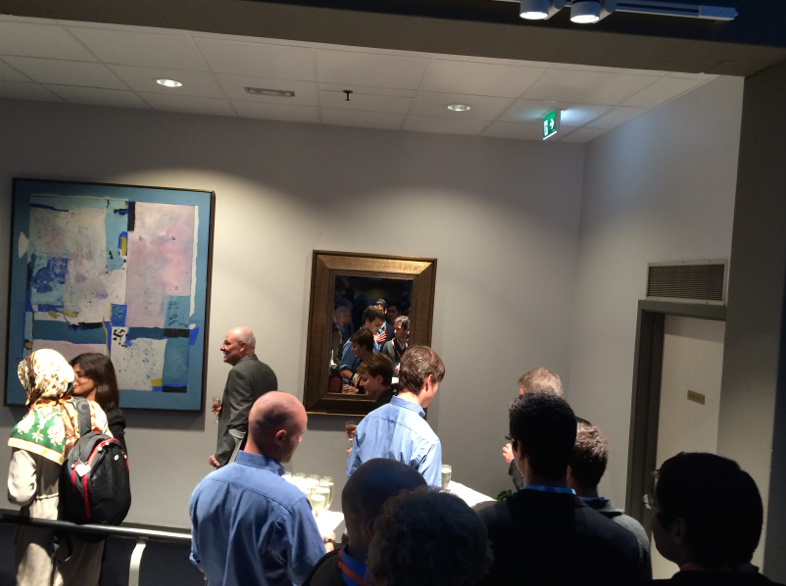 Tord Lien, Norwegian Minister of Petroleum and Energy. Introduced as having taken an MA degree in history at NTNU, 2003.
He begins, “I’m happy that you mentioned my MA degree at NTNU even though it isn’t in energy [audience chuckles]”. The future of the Norwegian continental shelf.
Opening of Ekofisk [petroleum well] in 1969, a dramatic event. Today, nevertheless, projects today on hold, rising development costs and declines in production taking place raise concern.
General tendency is that Barents sea will be developed. Goliath [production] opening up next year, licensing rounds increasing, maturity in Nowegian continental shelf being revisited through enhanced production and new licensing.
The Subsea Factory: Solving complex technical challenges. Industry must be initiator of handling developments in industrial sector and government needs to take a back seat or provide funding. Government’s role is to create frameworks of innovation through public funding support, as an example, RCN’s Petromaks and Petrosams research and development.
 Helge Lund, CEO, Statoil, speaking now on technology enablers for increased efficiency. “Thank you for the opportunity to address this expert audience [Last week in Trondheim addressing 500 students on how to address challenges of development] – contributing with some reflections on oil and gas environment. Last few months have illustrated how volatile the world is these days, instability in Middle East (Iraq, Syria), Russia and Ukraine, Africa (Nigeria), almost got a new country in Europe (Scotland) which would impact oil and gas companies.”
 Three issues that industry needs to deal with communities, climate and competitiveness. Community: Industry needs access to reservoirs, but also dealing with new areas closer to communities, and there are higher expectations than not creating harm, but also to share the benefits of development which is much more than royalty and tax share. Tanzania, last month during a gas discovery, you could grasp the sense of expectation.
Climate: Last week at the UN attending climate meeting, an urgent fight, and could feel the personal pressure to be a part of the solution as a representative of the industry. We need to provide these resources with less CO2 emissions, requiring new policies to stimulate innovation and new innovation, and society should put forth a sufficiently high price on CO2 in order to address the issue. Carbon intensity is an integrated part of how Statoil addresses moving forward, integrating what those figures might be in decision making. [US Dakotas] Bakken off-gassing, has been converted to CNG dramatically reducing flaring and halted field composition on gas; Peregrino, looking for transport solutions and reducing energy consumption.

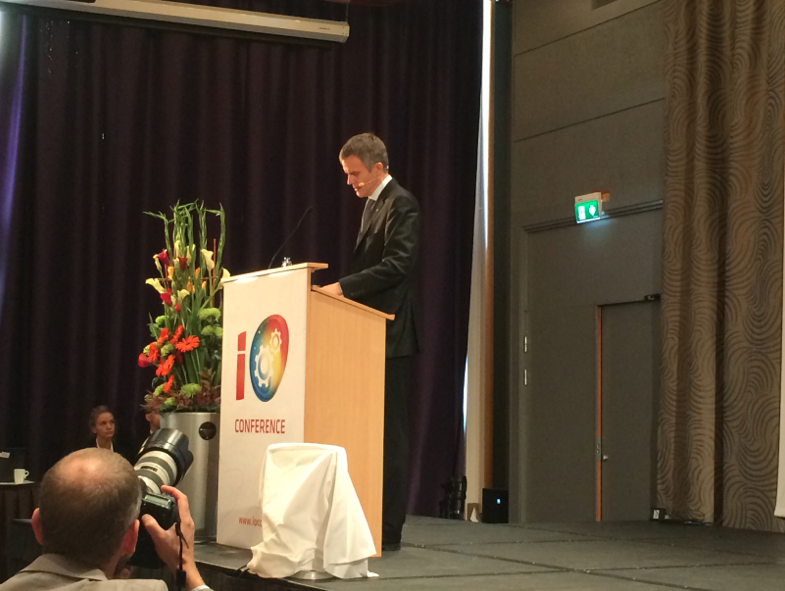
Competition: build in more production, reduce complexity through innovation (industrial standardization across operators and suppliers, fast-track projects, lower costs) – providing huge potentials through simplifications — achieving plug-in play rationality. Integrated operation “as I see it” is an enabler. A broad set of centralized centers, saving cost and improving possibility of efficient operations and decision making. Technology can make companies, make industries and transform societies. No doubt, technologies will continue to change oil/gas development in the same way geopolitical conditions influence the context.
[Questions by participants] Expectations of a CO2 price of $50-$75 per ton. By 2020, reconfiguring $50 per ton (which is low), in order to keep licenses to operate and continue to move gas to replace coal.
Cristina Pinho, E&P Executive manager, Petrobras commenting on upstream services and its enormous scale. The most challenging aspects of development is the human capital issues, but the most rewarding also is the team implementation.
 Chon Fui Chai, General Manger Smart Fields, Shell, sharing a journey to smart fields, stressing Organizational capability through structure, behavior, sustainability; Dealing with big data, collecting and using the right data, algorithms that convert sensing to sense making utilizing industry standards and predictive analytics; Consistent screening and technology deployment in projects through project screening and follow up…
General discussion with the speakers at the panel stage: investment costs up by 75-80 percent, with development profits up only by 4-5 percent. What is going on with this, asks Arild Nystad. Responses: Differentiating where we need standardization and industrialization versus innovation and creativity.
 Lunch
Lunch
Plenary II: Proactive Operations
Session chairs: Jon Staekebye, Kongsberg OGT and Prof. Bjarne Foss, IO Center/NTNU
Up now is TNO’s Ruud van der Linden, talking about mature fields. TNO runs contract applications somewhere between industry and academia, founded by government with industry application, “similar to Norway’s Sintef”. Modeling of flow phenomena which they use for optimization of well extraction.


[Note to self – with Vidar Hepsø, STS scholar and petroleum anthropologist, sitting as my neighbor at the table, I am reminded of one of his articles where he points out how geological mapping of reservoir knowledge does not rely on photography (realism) as a form of truthful knowledge.
Instead, for example, the body of a geologist to determine scale.
I noticed Ruud van der Linden use photographic image of a well-bore to depict reality, versus a previous image on gas extraction represented in the form of a graph which I communicated to Vidar as a data point.]
Prof. Bjarne Foss, Dept. of Engineering Cybernetics, IO Center/NTNU: Transforming mechanical artifacts into intelligence. Downstream increasingly automating complex operational decisions by merging: real-time process data, with mathematical models and mathematical optimization.
Moving this process upstream — capitalizing on shrinking margins (downstream has always attempted to get by on capitalizing on small margins, and market affect that is now moving to the upstream). Looking for a system over time that can assure highly continued optimization.
 “party”
 “no-party”
Plenary III: R&D and Innovation
Paulo Viana, IO Coordinator, PETROBRAS — A project has to end, because it is a project, but the structure has to provide model for facing the future in an effective way, a transformative layer, so that each function sees the other function and collaborates and integrates.
Up now is Jon Kvalem, Director, IO Center/Institute for Energy Technology, talking about collaborative environments in the oil and gas industry. Thinking about what IO Center has achieved in collaboration and Innovation – utilizing new IO technologies, SOFIO. Structured Observations with Feedback of IO Interaction (SOFIO). There is the IO Map (Risk visualization prototype) and the scenario visualizer. Referring now to Statoil’s Logistics and Emergence of Response Center and ENI capability development and organization development — challenges in the Barents Sea.
 “impression management – recognizable logo seen at a distance“
Senior Vice President, Statoil, Lars Høier, speaking on standardization is the new innovation. Moving into an area of cost cutting – we just have to think differently and define the next generation standards. A lot of opportunities if you attack it in the way of standardizing the industry context. The relationship between research and industry in standardization: More complex projects; capital costs increased; high oil price but lower margins (is seen consistently); Research and technology is part of the solution.
Using examples from Norwegian continental shelf. (1) Fast model update first in use 2010 (Grane Snorre, Sverdrup, Peregrino, 8 other committed); Pin Point first use in 2010 – better well placements for well drilling (Asgard, Njord Hyme, Snorre); AICD Valve and iRips (Barents Sea, 8 wells on Troll = 2400 valves).
Fast track, 40% less time to production; US onshore lowering drilling cost; Cat rigs, higher operational efficiency; Floating storage units; Stadardized equipment and modules; Vertical x-mss trees; Standard production weeks; Subsea on slim legs — A lot of innovation to success [uses the word “attack” repeatedly to talk about lowering costs in the context of standardization].
Technology of deep dive — subsea factory. Subsea Factories – Brown field factories — that we plan to tie in. technology elements as simplification



Second day
Torstein Sanness, Managing Director, Lundin Norway, focused on organic growth strategy and exploration. Replacing reserves. Around since 2004. New Norway – High North, same size as the Norwegian sector on the continental shelf. Keeping the company focused looking at oil liquids with 60 licenses. If you want to be at the edge and try technology before anyone else, and be in a major discovery every third year, you need innovation. Open culture meeting with workers every week demonstrating growth.
Dinner comments Torstein Sanness
Pieter Kapteijn, Director, Fossil Future – Norway’s capability cluster (government, business, academia). Quotes John Lennon, “Life is what happens to you when you’re making other plans”. Sierra Oil and Gas. Presented the idea of “Smartness”. Fascinated by Helge Lund, what do leaders of IOCs worry about, what IO (innovative operation) really is and what it offers, what we have achieved, the role of leadership in IO. The true belief in leadership that technology can make a difference. Worrying about higher costs that eat into the margins. Not confidence that they will find the resource, moving into more difficult areas, the resources discovered are more challenging, expensive EOR, Arctic, there are new competitors.
Disintermediation– Service companies are becoming exploration and production companies; A defining debate for oil industries is climate change – creating pressures.
Becoming an increasingly competitive company, looking at complexity and wanting to find simplicity — when faced with such challenges what do you do? In the past, simple, low risk –defer projects and investments; quick results –laying off staff, tried and tested; chase cost reduction–sell assets; minimum disruption–no changes to business model. But what if these changes are more fundamental? At what point do you make structural changes to business? Invest in new capabilities: Create new partnerships- creating new ecologies to allow business to move faster; rethinking and redesigning business.
At the core: cybernetics. Looking at systems thinking to look at the organization of your business.
 Creating an enabling organization. Creating an environment that works. Business value of IO [smart wells] has been proved in the field: and we have only scratched the surface. Creating a better risk profile. How do we make something that is integrated across disciplines and make it work.
Are you trying to control or enable; are you standardized or organic; do you want hierarchical or flat; is it a tight or loose organization; address all these issues. Bent-Ove Jamtli begins with an anecdote of his early experience in the army with Helge Lund, working in a small Saami town in the High Arctic, and talking about search and rescue.
Vegard Evjen Hovstein, CEO of Maritime Robotics AS. [cybernetics in certain ways became the surprise word over the past two days with a few folks paying homage to its meaning in the context of IO, ed.]
 Vegard referred to this interesting automatic versus autonomous systems, referring to the Center for autonomous marine operations and systems in the Arctic.
Up now is Eldor, remote operations in the context of IO presented by Ove Heitmann Hansen, Managing Director, Eldor AS. Moving remote operations to even more remote. Why should pilots be sitting at the front of the plane with the best view? Why not move them back with a computer screen, or off the plane altogether. Similarly, using information technology to change work processes to achieve better decisions – technology enables remote control of equipment and processes. Functions and personnel can be moved from offshore to onshore.
Generation 1 case – BP Valhall, offshore and onshore control room with shared control responsibilities. Level 2 Partial Onshore Control – shared control from a remote location – at Valhall this means offshore & onshore control room with shared responsibilities for operations and surveillance between offshore and onshore.  Generation 2 case – Total’s Martin Linge – One control center with four control suites —
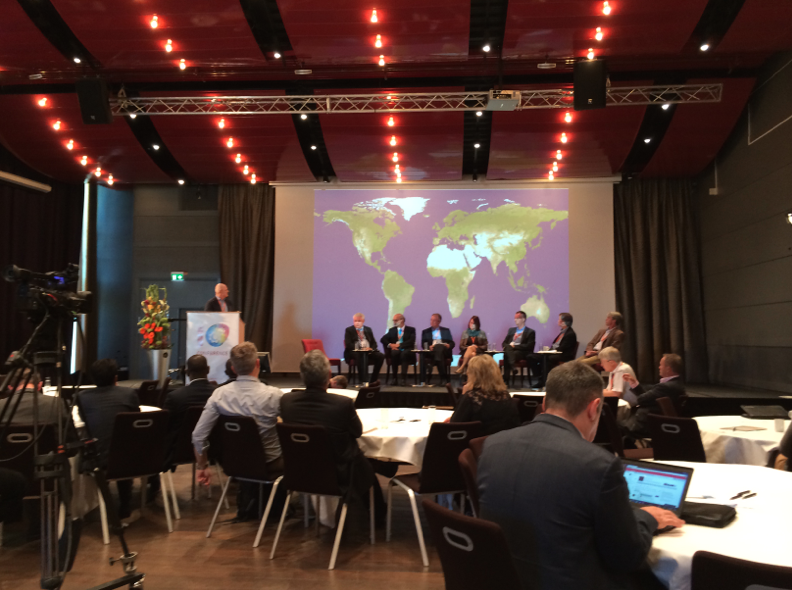
Final panel: Trond Lilleng, Statoil; Tony Edwards, StepChange Global; Kaare Finback, Knogsberg; Pieter Kapteijn, CEO Sierra; Arne Holhjeim, Norwegian Petroleum Directorate.
Lilleng: IO steps, production to projects, moving gradually stepwise expert stepwise establishments.
Edwards: Managing inherent complexity; value chain integration.
Finback:
Kapteijn: Pervasive sensing, unlimited computing power, plug and play modeling, unlimited data capture, unlimited bandwidth, molecular/nano scale engineering
Holhjeim: Norwegian Petroleum Directorate — good management, efficient, as much resource out of the ground as possible, minimize environmental impact.


Posted in Paparazzi Ethnography | Tagged Subsea Factory, Trondheim | Leave a Comment »


 I attended presentations at U Tromsø, Norway’s Arctic University. The energy law conference this week provided discussion onHigh North oil and gas developments and challenges from a juridical perspective.
 Else Berit Eikeland, Member of Arctic Council, Senior Arctic Official, Norwegian Ministry of Foreign Affairs, keynoted on sustainable development in the Arctic and circumpolar cooperation at the Arctic Council.
She emphasized that opening new areas of petroleum development in Norway is a democratic process and that peace and stability, even in these demanding times of embargoes on Russia is the focus of Norwegian representation at the Arctic Council.
The Law of the Sea is the legal framework for this area and in her presentation, she refers to Det Norske Veritas (DNV), the Norwegian shipping concern, using an image created by DNV, for which she credits the firm in her discussion about areas of increased marine traffic in the Arctic.
Ms. Eikeland also refers to climate change as the “most important [issue] to the Arctic Council”. Here, she utilizes and image produced by US tax-payer funded National Snow and Ice Data Center, which she does not credit.
Canadians are fond of telling Ms. Eikeland that living next to the United States is like “sleeping with an elephant”, a description she finds apt to describe Norway’s relationship to neighboring Russia.
But she points out that Norway and Russia are working hard to establish science relationships in fisheries (15 years) with successful stock management as a result.
Also, there is close dialogue in energy arenas and on and oil spill regulation for maritime shipping and offshore oil and gas development. Russia is a key to understanding development for Norway, and there is ongoing work on bilateral agreements with Arctic Council. Russia is “much more important to Norway than [is] Sweden and Finland – [because of the access to the Arctic Ocean, and the people located across the northern Norwegian area]”.
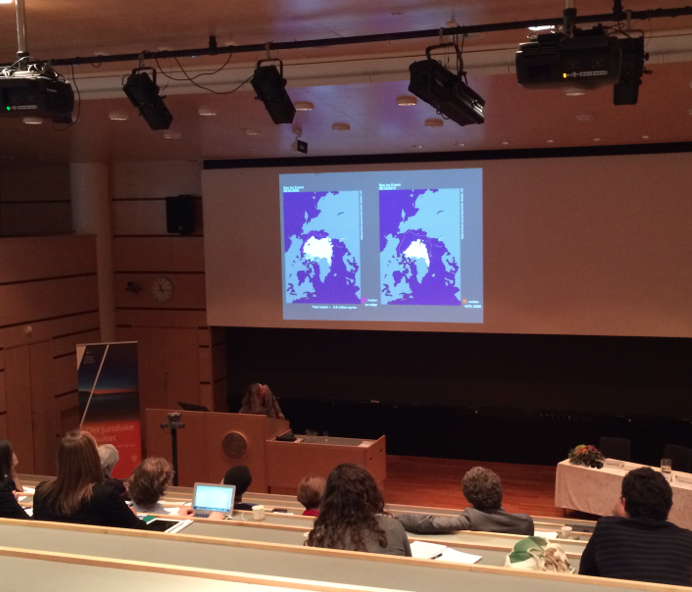
Nothing is binding in the Arctic Council (8 Arctic member states, 6 permanent observers and “a lot of outside specialists”), e.g., there is “no East/West division in the Arctic Council [and] interest is much more defined by geography, coastal states and economic interests in the North”. She describes the group as the “most successful multilateral political institution” [but what is the impact of decisions that are non-binding, ed.].
Tromsø as Arctic capital of the world.
Günther Handl, Tulane University School of Law and Kristoffer Svendsen, KGJ Centre, University of Tromsø, spoke of managing the risk of offshore oil and gas activities, identifying the key issues regarding compensation of transboundary pollution damage.
 This was an interesting talk about international legal instruments that govern or address oil spills. When there is environmental damage, there is a cost to restoring and replacing natural resources; there is diminuation of value of those resources prior to bringing them back through reinstatement and restoration of environment; whenever such restoration is not feasible, it introduces components for proper compensation for all loses.
“Problem lies in the fact that for all ESS [ecosystem services] – we don’t have a market, or market-based mechanism – and cannot calculate in monetary terms – and [some argue that] nature restores itself and no need for compensation”. But [in fact] in domestic law, we do have a number of statues that provide compensation for ecosystem services. There are environmental liability directives in Europe. In America there is […]. And in China, there are regulatory programs under development.
So there needs to be proper methods for [determining] eco-system losses – of non-use values. Habitant equivalency analysis. Address impacts on systems and create an equivalent on another area. Service to service approach, creating important domestically. BP aggressively undermining claims on Macondo [oil spill] – conversely federal governments will argue aggressively for compensation.


Nengye Liu, Marie Curie Fellow, School of Law, University of Dundee, discussed the European Union in the context of enhanced governance of offshore oil/gas operations in changing Arctic conditions.
To envision EU as an Arctic player (observer of Arctic policy) – The EU competent to act. There is no specific Arctic mandate. Does the EU really need an Arctic Mandate? Of course not. EU should initiate a “common reporting standard for accident and activities” and outline what measures will take place if companies fail to report. Offshore oil and gas: require common standards to facilitate business.
How to enhance EU enforcement – EU has no teeth. Article 10 – what is their task to ensure safety in oil and gas. “To assist… only on request… assess [but not enforce]”.
As a matter of course, Norway should export standards as a product – working with EU oil and gas –promote Arctic legally binding regional agreements
 Nigel Bankes, U Tromsø and U Calgary came up to the podium to compared unitization provisions of Norway and Russia on agreements in the Barents Sea and those of other framework unionization agreements.
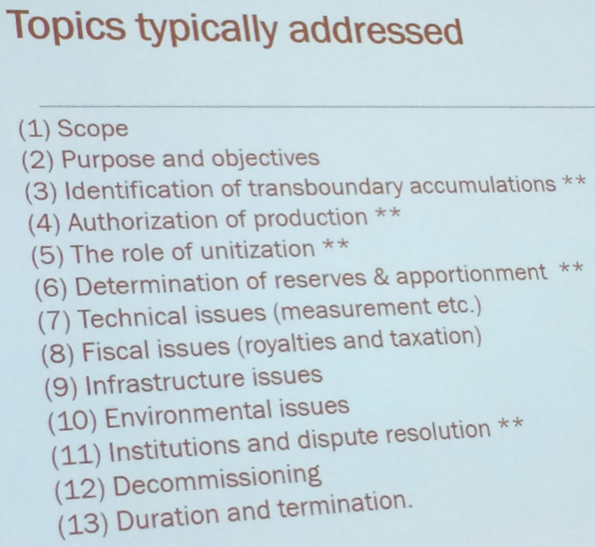 First step was the unity of deposit clause in delimination agreement between UK and Norway; Second step is the framework agreement on TB – transboundary reservoirs — Unitization are party agreements versus dispute resolution at the level of the state.
Tina Hunter, U Queensland, gave an insightful talk on harmonisation of oil spill prevention and response in the Barents Sea, questioning if this is at all possible.
There are soft laws or legal regimes, but they should be binding and not simply guidelines.
Standards and best practices (Norway, UK, Canada, Norway) are now migrating to the safety case regime: proving to the regulator that the facility is as safe as possible (safe as reasonably possible), and based on nuclear reactor models. Those who create the risk should be best able to mitigate risk.
 Deepwater Horizon/Montara – well integrity. No inspections – with the presumption that the operator is doing what it should do. Well integrity and well inspection is at the heart of protecting the Arctic. Read for example, Anthony Hopkins‘ Dangerous decisions. (In the rest of the world) there is well blow out Prevention versus ONLY oil spill response at present in the Arctic.
Thinking about regulation within its context – instead of simply extending North Sea to the Barents area. Barents 2020 (DNV) uses baseline from north sea development – a whole range of responses for well control – where are your nearest responders. How long does it take to mobilize your human responses, etc.
 Catherine Banet, U Oslo, Scandinavian Institute of Maritime Law, Petroleum and Energy Department, talking about third-party access regimes to LNG terminals in the Arctic region and asking whether it is possible to put Arctic LNG terminals into competition. Export terimals and import terminals. Three cases for considering third party access. She refers to the Snøvit, which is currently up and running, and to the Yamal project, which is in the process of development, and the Alaska project, which likely will take some time because of economics.
Nevertheless, each a has different regulatory situation despite their present state of development and success.
 Finally, there was Maria Madalena das Neves, KGJ Centre, U Tromsø, who considered the protection of energy investments in two Arctic territories, Svalbard and Greenland — in Greenland – increased energy demand requires increased grids and electricity – and there is a desire to develop a more integrated grid system across the continent as well as substituting diesel for more environmental friendly alternatives. They are looking for experts from outside to help opening the market. There is some criticism that they are rushing in [to Arctic oil and gas developments] to quickly.


Posted in Paparazzi Ethnography | Tagged Tromsø | Leave a Comment »

9/21: The day following the end of the LNG Global Congress, I met over lunch with interfax energy reporter Tom Washington. At the journalist’s suggestion we met near the Thames river, at Brasserie Blanc. The day prior, we had chatted briefly over lunch at the LNG gc Congress and I had so many questions that I implored him to meet with me for lunch the very next day.
As Tom explained, journalists play a role in determining prestige among firms and spokespersons. Energy journalists are  interested primarily in numbers. Through numbers (annual production, forecasts on production, revenue) they aim to tell a story about the fortunes of industry.
Since they are reporting and not editorializing, they specifically employ a quote by an expert in order to fashion a particular interpretation.
That is, a quote gives surface legitimacy to their interpretation of the story based on what they understand the numbers to convey.
As an example, consider Tom’s reporting on the Yamal discussion at the LNG gc event in his article that came out several hours after our lunch titled Yamal LNG affirms its faith in China for financing.
We talked for some time of Tatiana Mitrova, who I met at Skolkovo in the outskirts of Moscow, just prior to her ascendance at Russian Academy of Sciences.
Her presentation at LNG gc was instructive as always, discussing the evolution of Russian gas policy, describing the industry’s shift from traditional contract (subsidizing economy and low taxes for production – protection from the state, monopolistic structure of market without question) to New Deal, where prices are reaching Henry Hub level for industrial consumers, while taxes are increasing, and more players, Novatec/Rosneft are “hungry to reduce Gazprom’s share”.
I should just mention that other persons of note in attendance at the LNG gc included Ralf Dickel, who I first met in Moscow during his deliver to the oil and gas congress when he was director of European Energy Charter, and then last year at the Energetics Conference in St. Petersburg.

9/18: Just off the coffee break and now listening to Takao Kasumi, Deputy General Manager, Paris representative of Tokyo Gas. In the post Fukushima landscape, LNG (liquified natural gas imports) are a big issue in Japan. What is perhaps more unexpected is the high expectations of shale gas imports from the United Sates.
I asked earlier, actually, of Senior Analyst Javier Diaz, Bentek Energy, a unit of PLATTS, whether all this US gas would potentially come from Alaskan efforts to commercialize North Slope natural gas. His response provided before everyone and sundry was that the project (announced recently in Alaska news as going forward) was totally uneconomic, without even a projected time horizon of delivery. The 45-60 billion dollar project no longer is talked about in terms of 10 to 20 year time frames rolling into the future.
Anyway, back to Takao who just finished, and we are moving on to Jose Ramon Arango, Leader of Liquid Bulk Segment, Panama Canal Authority, who will be speaking of everything [except the tariff rates].
LNG [liquefied natural gas] Global Congress, London
Global LNG Pamphlet
Panama. The transshipment center for the Americas since the 1600s. A lot of impressive photos presented both on current development in widening the canal, but also computer graphic imagery depicting how it will appear when completed.
Andrew Clifton, General Manager, SIGTTO — talking about achieving a level of reliability that makes LNG shipping “almost invisible”. US, UK, France, were the three main developers of LNG vessels, and responding on the French achievement is Jean-Francois Castel, Manager Business Development, Gazocean GDF Suez.
US LNG vs. Russian Pipe Gas: who wins. Will Russia remain the lowest cost producer in Europe? by Theirry Bros, European Gas & LNG, Global Research & Strategy, Societe Generale. A lower overall European gas price will make Chinese extract low cost gas from Russia. But Russian production costs are very low. Apparently, Russia is observing US export of LNG, watching the potential terminal buildup for exporting to Europe, wanting to keep a threshold beyond which would destroy price stability.
Yamal LNG Update, Will Yamal LNG be cost effective for European Supply? Christophe Malet, Deputy Director Marketing & Shipping, Yamal LNG. Multiple candidates of super giant natural gas fields across the northern peninsula of Yamal. Production company moving toward production and trade entity.
Envisioning utilizing Northern Sea Route during the Arctic Summer (June through September) — within two weeks distance to eastern markets making it comparable distance to middle east. During winter, Yamal would go west to Europe across Norway to transfer gas onto conventional vessels that would then provide shipments to the East.
Total investment cost of project, 27 billion dollars for the three trains. Requirements of an Arctic fleet + a conventional fleet to transport from lower latitudes + condensation infrastructure. Arctic vessels around 2015.
Port of Sabetta, Yamal. Malet shows actual photos of the development of the location, indicating 3000 persons at the site, a commercial air strip being constructed, “it’s beautiful”. [fabulous photographs, ed.]
 “As Tatiana [Mitrova] highlighted this morning, sanctions have created uncertainty in Russia these days”…”Yamal has significant momentum to date because its shareholders had a pre-committment and show continued support for handling the new uncertainties, whether over technology transfers or access to financial markets”. The fundamentals of the Yamal are very strong and valuable proposition – for asian markets, and European markets. A project that will bring a constant flow besides Europe, which is ideally located to access additional production.
Now up: John la Rue, Executive Director Port of Corpus Christi providing update on the US LNG Exports. Shows the US gas transmission lines. Talking about various projects with an opportunity to “see 10-12 billion dollars going into the ground” per project.
An interesting discussion about flaring – burning natural gas – and the attempts to cut back on flaring from days to hours.
 In one of my favorite books, Ancient City, Fustel de Coulanges builds lifeworlds around the smallest bits of data. I always think of it when looking at photographs, especially poor images like the one above that I took with the photobooth camera on macbook.
If we take just one fragment from this image, we can see quite a bit about the nature of what constitutes the staging of verification in energy knowledge at this particular event.
In this case, the “pleated” blue cloth-like folds that conspicuously hang down from the elevated “stage” onto the carpet, indicating excess and heightened sensation of a location titled floor or ground, where people walk, and the elaborated distance from which people speak or address those on the ground floor.
Posted in Paparazzi Ethnography | Tagged London | Leave a Comment »


Day 5: Final day, printing and wrap-up.


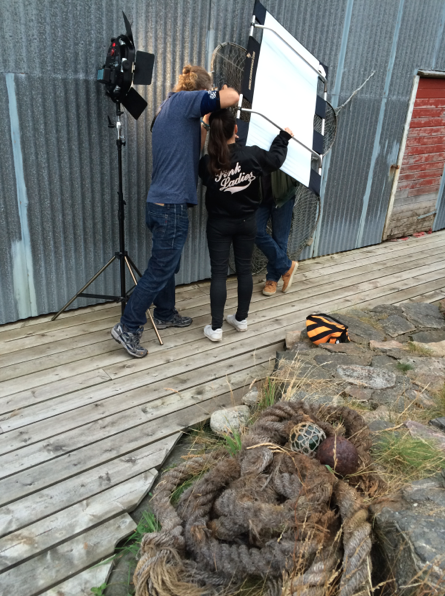

Day 4: critique morning. Talking about the nature of light and being conscious of where portrait light exists, especially using screens, and ensuring handlers watching the light as they hold the panels.

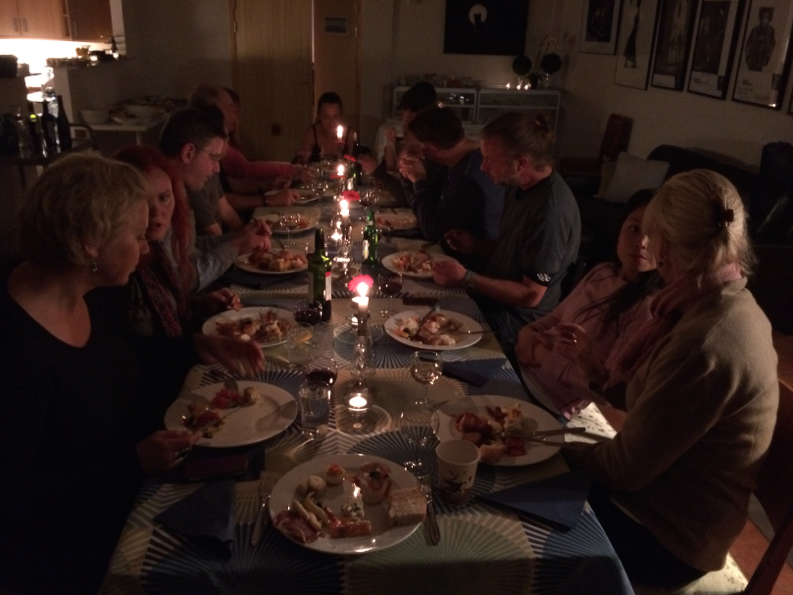 Lunching and Dining @ Nordic Light


Day three 9/5 – Beginning of Critique discussion: Bringing out the subject. Really getting in and taking control. I asked to what extent celebrities are knowledgeable about the photographic process, and whether it makes sense to describe that activity. But Greg points out, from plenty of experience, that the celebrity form creates certain conditions on a continuum that stretches toward insecurity or solitude especially since celebrity folks do have experience in front of the camera.
Greg is one of the few persons I do not bother arguing with because the presence of his empiricism is so full and broad, it is simply good knowledge.
Using Lightroom in moderation. Clarity –

Day two 9/4 – End of Critique discussion: A general discussion about what constitutes photography versus graphic design, and where the line is in determining the differences. What I find interesting is the emphasis Greg places on photographers and high-concept artists, for example, and little discussion of magazine editors, art gallery owners, and all what constitutes the industry decision makers (similar to academic worlds of peer reviewers determining disciplinary boundary).
Critique: Finding areas of interesting light – tips and techniques. Talking about portraits. Introduction to Light Room and beginning to see some differences between Leicas, Canons, Nikons.
Greg Gorman reads a long quote written by Rob Carr, professional retoucher: “We can split an atom to light a city or destroy a city” – as a quote is applied to discuss photographic Light Room retouching, in a refractal kind of way, in attempt to make the image meet the human experience. Retouching influences the viewer on where to look, and does not affect an artificiality of the logic of the camera [paraphrase of the quote]. “Does Placido Dominigo’s clenched fist underscoring a [musical point represent an artificial contribution]?”.


Day One.


9/3: Greg Gorman. Need to spend time, break down the barriers and building a relationship with the subjects you shoot, working as a team. Taking 15 to 20 minutes to take the shot. Spend 15 minutes setting up the shot, lighting, getting things calm, and then have your 5 minutes to take your shot. Single point light source in most cases, and additive, higher ISOs with LCDs.
 An introductory treatise on the courage to take risks in the role of creativity and to withhold the commercial response so strongly present in our lives, e.g., 20 years ago, Greg would shoot Tom Waits over a 10 hour period, whereas, last year for the London Times, he was given 30 minutes (in a Chinese restaurant in L.A.). Talking about his covers for Interview Magazine. The power of celebrity and familiarity (showing images of Bet Midler, Tom Cruise, Schwarzenegger, Jagger, Basinger, Coster). Shooting motion picture campaigns, Tootsie, Big Chill, Meet Joe Black, Pearl Harbor (a couple hundred movie posters).
Never listen to whatever anyone has to say about the person your taking photos of, just use your own judgment and you have no idea about what anyone is going through at any one time, e.g., Al Pacino on the set of Scarface. Finding models that are exceptional for style (e.g., Bruce Weber). Finding personal subject matter versus the commercial drive. Taking a lot of work when you young, because it is available. Commercial assignments maintaining the integrity of personal style.
 As Gorman shows us, his career spans back to the late 1960s, and has included photographing Everyone. When you are doing your work, the layout, design, you have to maintain control. You have to direct the project to the final form. When shooting, walk 360 degrees around the subject to see what starts to make sense. Greg also presented images taken on streets in South Asia which represent quite a contrast to the familiarity of his celebrity photos.
Critiques of images coming up now, with professional comments by Greg on images we have given him for initial assessment. Soon to breaking out in two groups, lighting, models, infrastructure.
Critique #1: tonality matching skin tone, bringing more edge in the picture. Stressing not centering images. Moving images out of center. What is in the image that does not add anything to the photograph. Cropping: crop the images for the images, don’t compromise the integrity. Move more closely into the subjects. Getting rid of as much excess as you can. The more you can move (draw) the person into the image the better (vs. Mary Ellen Marc who privileges surrounding). Strengthening the image.
Critique #2: my photographs. Good composition. Balance of frame is fine. Filling the frame with information. Look for horizon lines.
Critique #3: Kicking light up into the eyes; squaring off eyes; shaving light off bald heads tops to cut down attention.
Critique #4: Push your black points to retain depth, because losing three-dimensions is common when moving to a two-dimensional world. Look for cropping and shifting to black and white.
Critique #5: You don’t want to give up information but if it is distracting from the subject you need to crop it.
Critique #6: When you’re the photographer, you know the subject, the context, the situation – and the work is to make the photograph create the context after being truncated from its historical condition. When there is an abrupt lack of information our eye dismisses it, so you have to bring things into view.
How to see light – never be able to do better, than to understand single point light (natural) – pay attention to how light drifts off, and how much is available, and hitting the subject. Watch ratio of lighting.


Posted in Paparazzi Ethnography | Tagged Averoy, Kristiansund | Leave a Comment »










 Paparazzi Ethnography