Feeds:
Posts
Comments

Slow Kлуб ▼.Г.


▼.Г.


▼.Г.


Still holding on to keys of romance


8/10: US-Norway Fulbright Orientation….

Where Does One Begin?


Perhaps with Fulbright maven, Ragnhild Sohlberg, Ph.D., of former Norsk Hydro management and Rand specialist to whom, alongside Sonia Mykletun (see bottom), can be attributed the recently established Arctic Research Chair position?

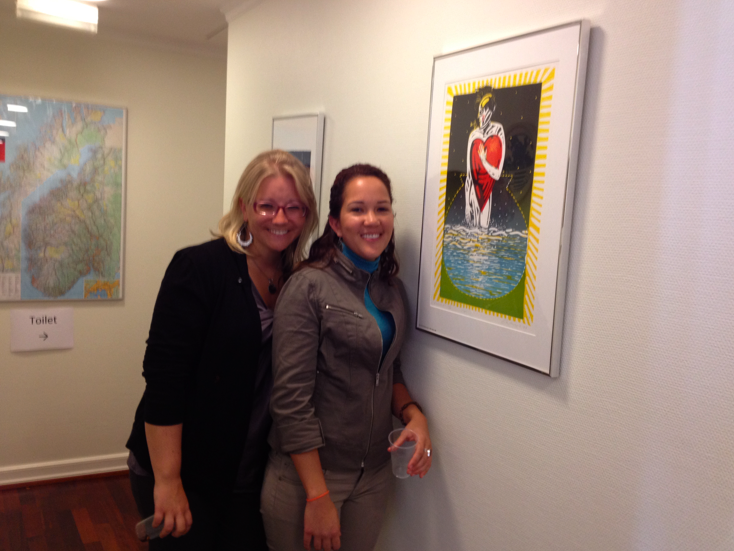
With newly minted Fulbrighters musing on Art and Love in the Oslo Fulbright Office?


We back up and return to our visit at Nobel Institute?


To our roof-top reception following our Award Ceremony?


With where Prez B. Obama received his Nobel Peace Prize?


To imagine ourselves at Norwegian Ministry of Foreign Affairs?


After introductions to begin a series of discussions about life in Norway?
Chatting, down the steps, onward toward ceremony and reception?


Let’s walk alongside past the King’s Royal gardens?


To begin under the celebrated chandeliers?


The paparazzi search beams, yes, for stars of my left and my right?


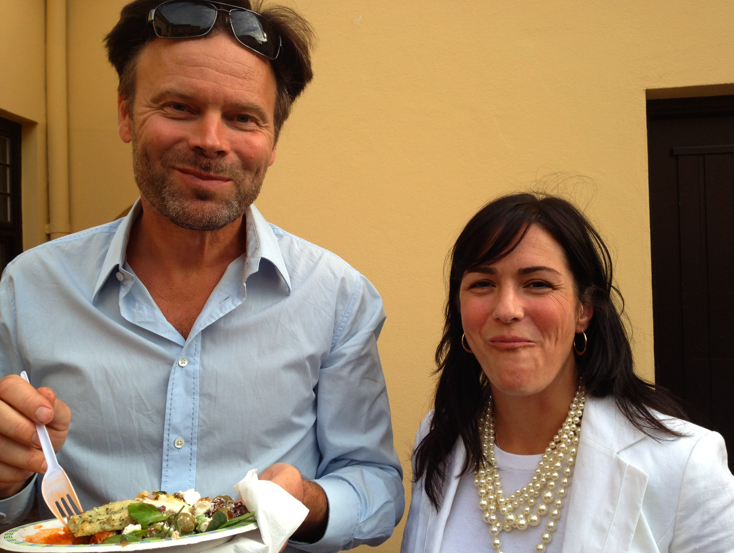
With the gendered children’s spam (pâté for the sensitive)?


There indeed are so many places to begin, as if to say, how can any one paparazzi ethnographer capture all the fleetings of such ritualized settings?


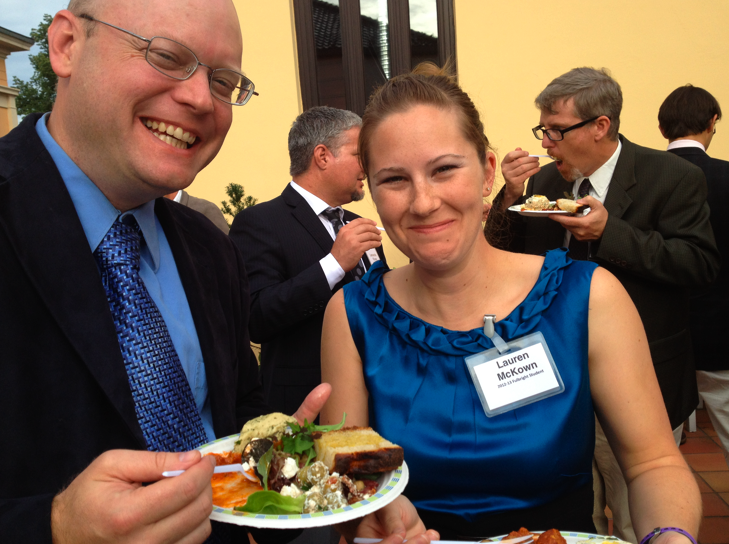
8/9: Entering into the Fulbright reception:


6/23/2012: I was awarded the US-Norway Fulbright Research Chair 2012-2013 at University of Tromsø (yay!). Reading my previous blog, see below, seems like a long time ago that I began the application. And it was! One year ago. I want register here and now that I plan to attend the Fulbright Orientation upcoming in August and to capture that event in paparazzi ethnographic style… 🙂

I recounted the entire saga of the award application to Svetlana L., with whom I had several wonderful conversations in April at Cambridge U. while attending the BASEES conference. Afterward, we met up in London over drinks at the Lanesborough where I poured out the entire story. She confessed to me that my tale was indeed, interesting. Here is Svetlana chatting on Hyde Corner:

To provide one example, I received news of the Fulbright award while in a hotel room in Jinan, China. I was visiting folks at the Department of Anthropology at Shandong U., with the generous offer to take the position as Associate Professor. For several days, I wandered around Jinan wondering how in world I would fit into that city scape, with all its unique food items, such as sea slugs, rose petals, and lettuce, as shown in the image below, taken at a high-end delicacy restaurant.


On the third day of my visit, returning to the hotel from a preview of the apartment that the university offered me as part of the hiring package and after walking out of the shower — a blast furnace of a water faucet, thank the lord — I noticed a new email in my inbox, from the Fulbright Foundation in Washington DC.

It was an eye spot. I paused for a few moments before reading the word: “congratulations”. And I plan to provide some updates right here, especially as I get news of the orientation.


6/23/2011: Last month, in Houston, I had dinner at the residence of Sonia Mykletun, recently Executive Director of the US-Norway Fulbright Program. Toward the end of the evening, she graciously invited me to apply for the newly created US-Norway Fulbright Arctic Chair, launched during her tenure. Sonia’s husband is the Royal Norwegian Consul General, Dr. Jostein Mykletun.

Both Jostein and I attended the Arctic Oil and Gas North America Conference that week where we were invited as keynote speakers.

Jostein presented the Norwegian Government’s High North Strategy, since he was Foreign Ministry Ambassador for the High North.

I decided to take Sonia up on her offer to apply for the Arctic Chair and have created here a post to document the process of putting together the Fulbright proposal.

What I find interesting, in fact, are all the threads that come together to make an application happen. In advance of my discussion with Sonia, I had discussed this opportunity with anthropologist Sidsel Saugestad of University of Tromsø (UiT). Initially, I was short listed for assistant professor in her department, though the job went to David Anderson, formerly of U. Aberdeen.

Some months followed and Sidsel and I chatted in SFO at the Anthropological Meetings about my spending time in Norway. And now, we are coordinating on the application.

Nezune Menka and the Band

The artist community of Svolvær in mid-winter

Another connection at UiT is Dr. Paul Wassmann of the Marine Biology Department who also has joined the Fulbright application effort on my behalf.

Not too long ago, Paul invited me along with early career scholars to Svolvær, Norway, in winter, on a cruise ship traveling the Norwegian inside passage from Tromsø, so that we could talk shop on oil and gas development in the Arctic. The conversations were intense. To cool off, we were provided with our own entertainment, in the form of a salsa band flown in from Barcelona, Spain.

That was an amazing voyage and Svolvær is so beautiful, especially in winter. In fact, there were artists in residence and we attended gallery showings. One of my favorite set of paintings was from Maud Brood, who, a bit of a recluse, became quite animated when talking about her work.

Hill Side by Maud Brood

Anthropologist Carly Dokis

pausing to catch a breath

During that trip I came to know quite well anthropologist Carly Dokis, who is wonderfully witty.

We spent all our time just hashing out ideas, intellectualizing our emotional lives, recounting our individual experiences through the language of anthropological texts. It is impossible not to do so when you have spent so much of your life sitting around reading. Having an interlocutor of that caliber, like Carly, made the trip.

Najune

heading south

But I should not forget the wonderfully clever anthropologist Najune Menka, also in attendance and who originates from Alaska. Najune works at the intersection of science, environmental politics and identity.

What is funny, Carly was living in Calgary, Alberta, where I was also living at the time, having been awarded the US-Canada Fulbright Scholar, North American Research Chair, at the University of Calgary.

The project I am proposing to carry out now extends my research into energy analysts in Norway. For this, many persons I have met so far as part of the US National Science Foundation research, including Arild Moe, Kaare Hauge, Elana Wilson Rowe, will be part of the project.

I have just completed what is nearly a first draft, and I am quite excited about it, and perhaps for this reason, I decided to create this post.

Enroute to Tromsø


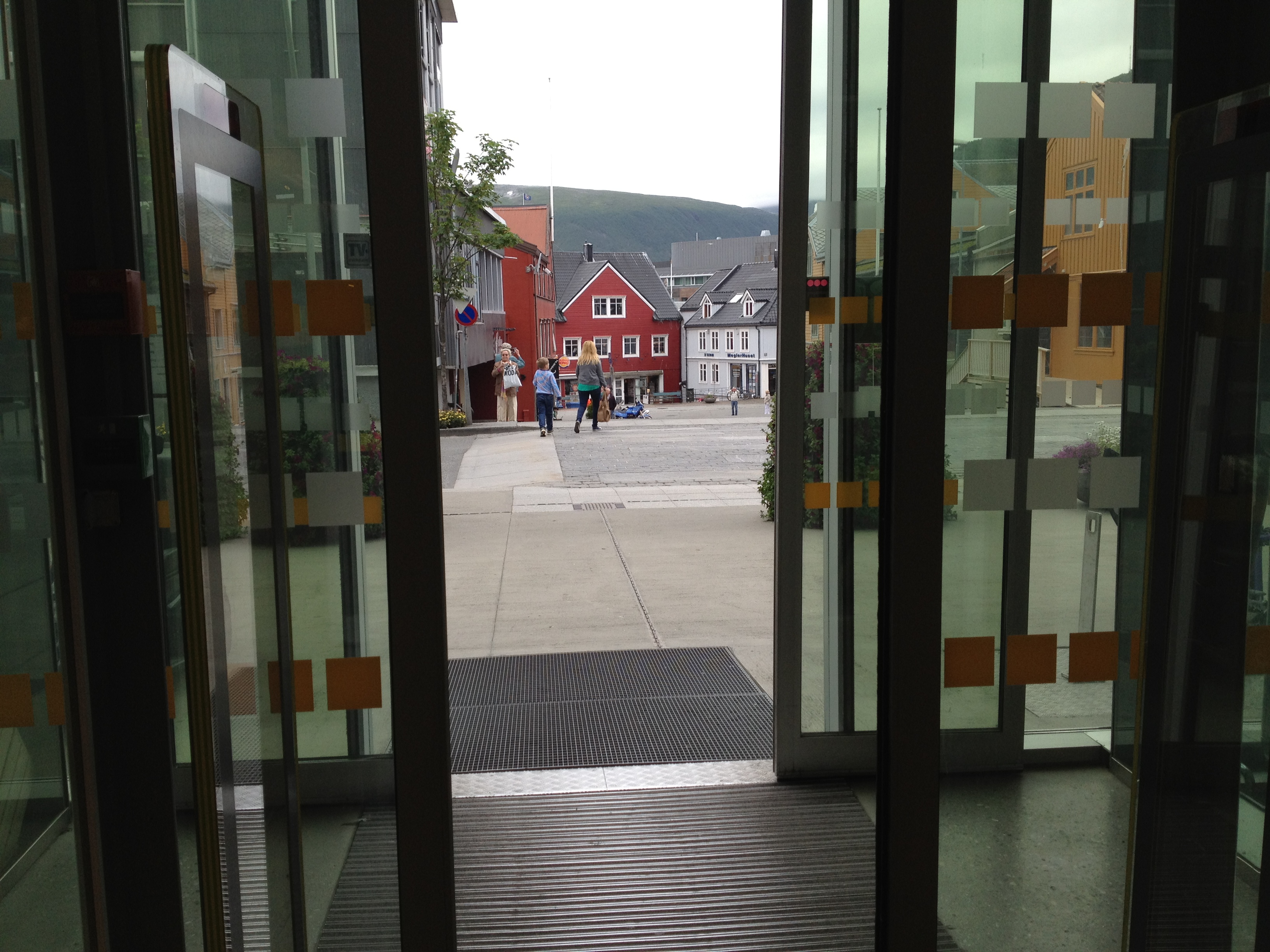
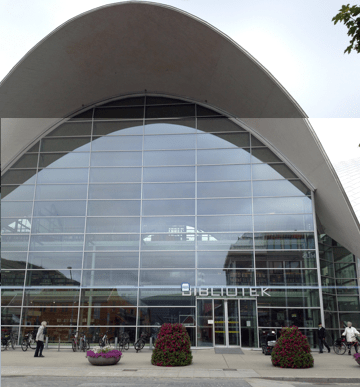
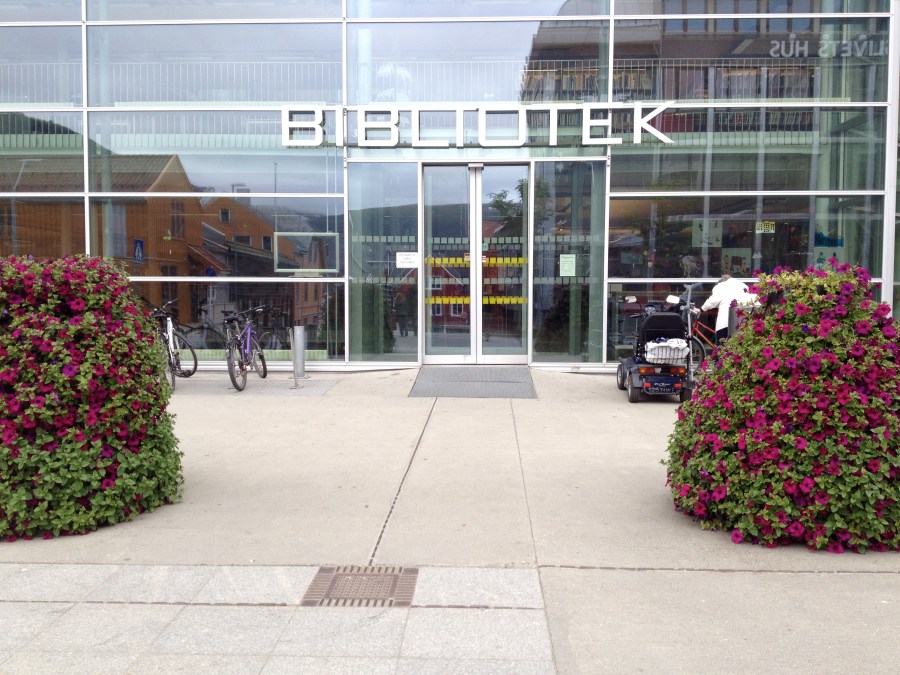
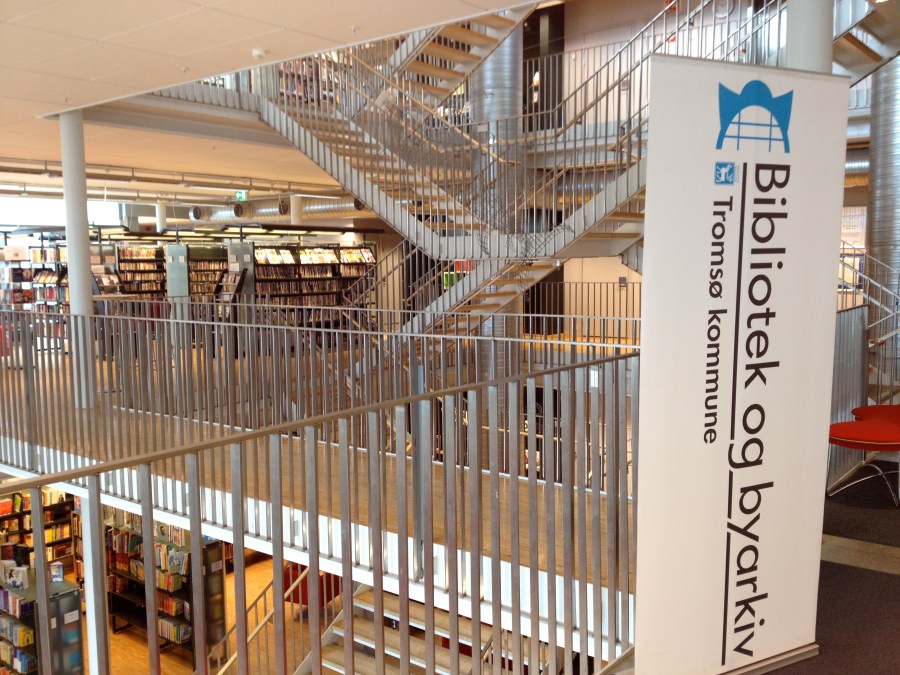
8/8: The Tromsø town library — where I decided to work today, is located downtown. There is (relative) quiet, great light, plenty of workspace, electricity, and internet.


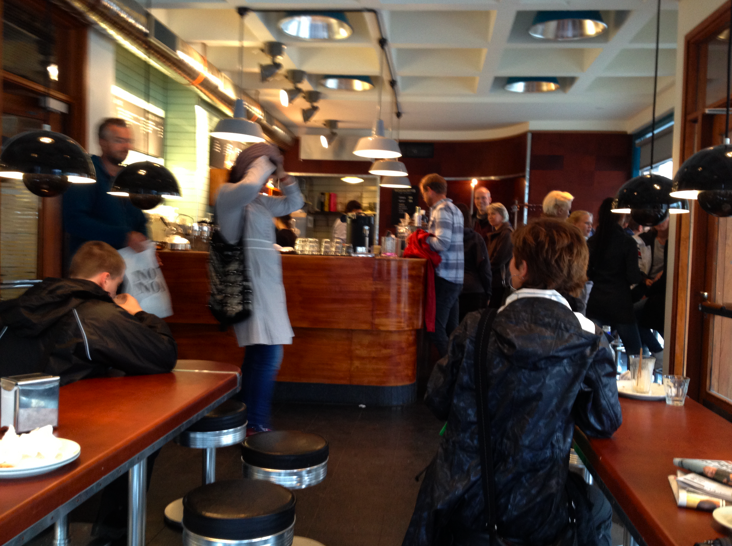
But yesterday, meeting at noon on Campus, Sidsel S., Peter A., and I, at the canteen of the medical faculty, where Peter brought his lunch, Sidsel collected an open sandwich, and I chose salad from the bar, my trip began to take on dimension.

At the salad bar, I had made the discovery of placing all of my selected items on a porcelain plate, after which Peter instructed me to find a way to scrape the collection of lettuce, beans, corn, egg, and pasta, into a plastic cup that was available, which is the proper container for weighing salad at the register.
Immediately, I thought to myself, “well, I will pay for the the extra weight provided by the porcelain plate.” Or a better thought intervened, “I will bring an extra porcelain plate to the register so that the cashier can weigh and deduct the weight of this extra plate from my plate of salad”.

In fact, I managed to transfer the salad into the plastic container. I then moved on without too much more thinking on the subject.
We did not gather simply to lunch, but instead, Peter and Sidsel were kind enough to meet for a discussion on the possibility of re-formulating a proposal for submission to the European Research Council (ERC).

Having brought my computer with me, I began typing out alternative approaches suggested by Peter and Sidsel. One issue I had mentioned, there were several actually, was that the proposal, a study of consultants working on arctic natural gas development, had been quite successful, up to a point.

But that this point, was receding from view.

In return, Peter suggested that we reframe the approach to focus more on consultancies, while using the Arctic as a case study to illustrate the role of intermediaries, a field imbued with insecurities, and thus, we could look at how consultants work in this context.

On the other side, he suggested, we begin from the energy perspective, with the issue focused on the opening up of new petroleum provinces, and how these activities become legitimated, but then downplay the consultancies, because they are but one actor.

Both agreed that the core the of the project focuses on what is going on inside the companies, how are they collecting, transmitting, using knowledge, as discursive agents – and that one neglected aspect I have not yet considered is indeed – who pays?

These are business organizations, and so who is paying them and for what purpose (aspect of payments and linkages to retainers).

They operate in the interstices between academia, government, and companies, and through knowledge production, new modes of production, consultancies are serving as boundary expanding organizations.

Well, in fact, “you could take any region of the world,” but of course these companies that I am interested in are involved with money — and oil and gas is a monied economy.

“We need to narrow the project”, say from a Russian decision making process, “to make a comparative situation, or can we talk about this as a transnational community, or that they are change agents for the same logic of decision making and policy.”

Well, the proposed application, how it is structured, is in fact completely open. The ERC proposal. For this, then, we agreed to investigate the role of consultancy companies, wherein, we will use arctic oil and gas illustrating this role.


The Glamour of Uncertainty

This was my favorite phrase used by Sidsel for the afternoon. Though in truth, she had stated the role of uncertainty.

I misunderstood her, but simply agreed that The Glamour of Uncertainty is certainly a great title. Well, in fact, there is an extreme level of uncertainty on arctic oil/gas development which raises the question of how to perceive the empirical area.

But in truth, we did spend considerable time approaching the topic from the other vantage point, from the perspective of oil and gas in the Arctic.

And we subsequently agreed, that if we start from that angle, with oil and gas, there are deficiencies in my descriptions so far. Arctic as a region of extreme uncertainty, how is risk reduced, how is operation made manageable, and here it is the oil companies and the sub-actors who are the main agents. Thus, the methodological part, ethnographic part, from the inside, the ethnography of expertise, bringing in the arctic and uncharacteristic character of creating images of the future would fall by the wayside.


And thus, we decided to settle on a project that examines the consultancies.

Of course, and here Sidsel suggested steps to avoid certain concerns, over secrecy, over how much companies would be willing to tell me. To present the project in a way that does not look threatening, and looking into the secrets of the trade, the logic of operation.

The logic of the Ethnographic – my contacts are an advantage, and that various companies seem to be willing to let me in and give admission to this work. I would need to work this as a privilege. Fortune tellers. Secrets of the trade.


Well, we were through. Our discussion was complete. We were pleased indeed.

But then, briefly, we turned to the topic of a PhD seminar that I was invited to teach next year at U. Tromsø, with a specific methodology of Ethnography of Expertise. Of course, I had absolutely no idea how they teach seminars in Norway, having taught only in the States (and Canada). This was an enlightening moment. The course structure takes place over three days. Three full days.

There is a budget to invite 2-3 persons, experts in my field who would also provide instruction with about 12 hours overall of lecture combined with discussion of readings and presentations by “successful applicants to the course” who would provide an overview of their own projects. The course could stand with only 3-4 students with an upper limit of 20 students. I would include a reading list included with the invitation, some of the readings are compulsory, with additional readings, selecting some 500 pages.

After the seminar, the students would have about one month to submit a paper (10 pages) demonstrating competency of the materials.
I was intrigued. How could I refuse? If only all PhD courses were the same.

Without further ado, we parted with me following Sidsel back to the Department of Anthropology to go over some more of the details of the PhD seminar, and to debrief on how to move forward.

Based on our conversations, I had agreed to return to Tromsø in October, to begin working for a few weeks on the proposal with team members from Peter’s group, perhaps working in some kind of seminar.

There are other details. These are large projects, with postdocs, fieldwork, a certain percentage of time at U. Tromsø and so on and so forth, which we discussed in some detail.


8/6: Plugs, outlets, and nature.

I met with Dr. Marius Næss at CICERO, which stands for Center for International Climate and Environmental Research – Oslo. But if you Google CICERO without adding “Norway” next to the word, you hit a Wikipedia entry titled Marcus Tullius Cicero, born January 3, 106 BC, died December 7, 43 BC, “Roman philosopher, statesman, lawyer, orator, political theorist, Roman consul and constitutionalist. He came from a wealthy municipal family of the equestrian order, and is widely considered one of Rome’s greatest orators and prose stylists”.

It is a heavy title to be laboring under. Luckily, Marius is as genial a scientist as they come, filled with knowledge about all the workings of Norway, and enlightening indeed. He tuned me into the successful NRC proposal, a similar topic that I am proposing for the ERC, submitted by Dr. Ilan Kelman, in the Oslo office of CICERO, Marius’ office being physically located at the Fram Centre in downtown Tromsø.

This bit of news was quite remarkable. Indeed. As I sat facing Marius, and the project outline he provided me with, indicating that Ilan had shortly thereafter given him a phone call based on an email Marius sent to him describing our similar approach — in a stupefied manner, glancing back and forth between the sheets of paper and Marius, over a cup of joe, I announced, “well, we should send Ilan an email or rather, call him now”.

And that is how we were able to organize a meeting with Ilan in Oslo on Saturday at CICERO, with many thanks to Marius. The Genius.
From there, and without too much irreverence, we headed into town to munch lunch and gossip about our respective careers. I dropped on his every word, so interested I found myself in the operations of Norwegian science communities. In fairness, there was not much Marius could tell without peaking my interest, so it is perhaps over stating the case that Marius revealed state secrets. And it was the obvious that captured my interest.

We soon returned to his office for a last debriefing, where I found myself distracted by what seemed to be Venetian Blinds installed on the outside of the window at the Fram Centre. In this, I found something unique, akin in my mind to placing socks over shoes, and I had to capture an image of that which fascinates me, as seen here:


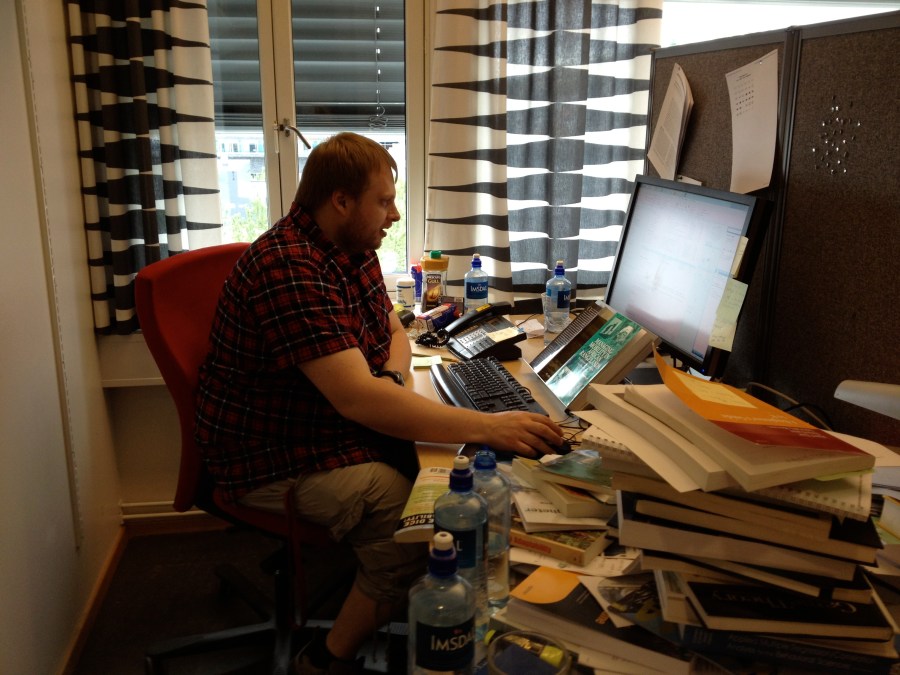
After lunch, I headed up to the Anthropology Department, where I had the opportunity to have my afternoon coffee with a one, Dr. Bjørn Berkli, who is written recently on the intersection of law and indigenous representation, discussing the different modes of communication and means and ends implications. Here is Bjørn in his office, with a Dr. of Philosophy’s wall of books.

Here too, I was fascinated with all that Bjørn could instruct me in the ways of academia in Norway, for which I have no idea why. Perhaps it is the case that he was on the committee that mulled over my own application several years ago, when I applied to the U. Tromsø department of anthropology, and all the epistemological glue that he could recommend which holds career steps in place.

At any rate, it was good to get caught up, and I explained that the proposal I had come to discuss was much in the inchoate-stage, and that, as with Marius, I would look forward to his participation, particularly given his long-term experience working with indigenous communities in the Northern Europe.

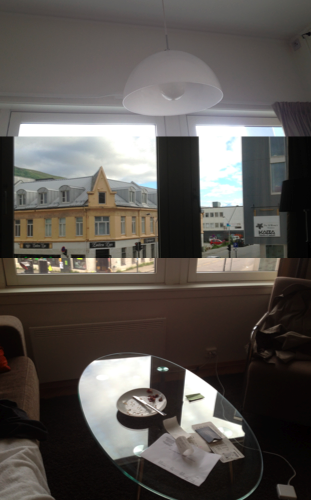
8/3: Yesterday, I blew into Tromsø around noon, a little rain notwithstanding, managed to get through the day in my flip-flops.

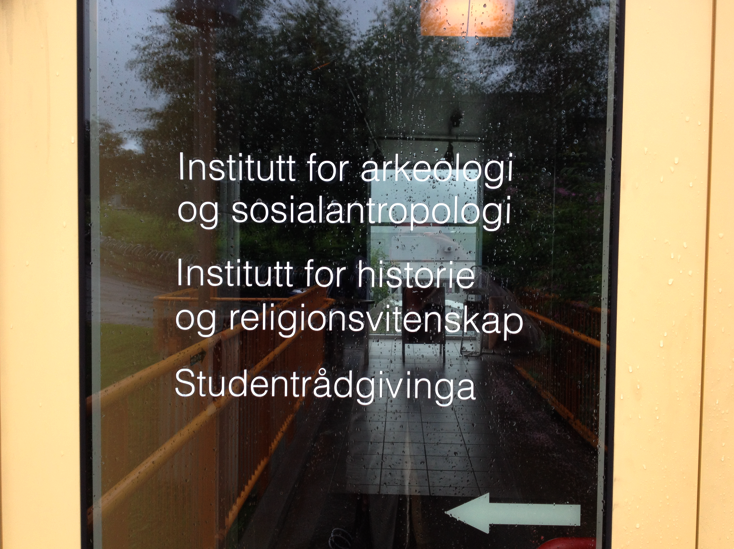
I showed up at the anthropology department, got keys to my office and mulled around before meeting up with Thorbjørg H. and Bjørg M. about the European Research Council (ERC) proposal.

We discussed timing of events and expectations in developing the proposal. It was a good meeting overall, though I was a bit hung over from jet lag. They mentioned several issues that later that afternoon I formulated as two questions: (a) why is this proposal being done here at U. Tromsø?; (b) why is the project innovative?


I picked up some vegetables, little things around town that remind me of Berkeley and headed back to my apartment to catch some shut eye and write a few emails before dinner.
At dinner several hours later, I sought to address questions brought up earlier in the day.

I met with UiT professor Peter A., who represents persons on Campus working on oil/gas, futures, and discourse. I sought him out because of a talk he gave in at Arctic Frontiers in January, here in Tromsø, from which he provided valuable intellectual contributions.

At dinner, Peter discussed what his group had been doing on Arctic oil/gas, which is similar to my proposed direction. I told him that working together, we could lay out the broad collaborative design, from which we would then form an alignment here at UiT, and then move outward to other folks across Norway, and then to Europe and Russia.


Once we have that alignment, we could then easily move to other universities and institutes in Norway, letting them know we plan to do this proposal, the folks at Bodø for example, who do oil/gas work, or the institutes in Oslo (nupi, econ pory, fni) and sprinkle them into the proposal. The same for UK and Russia partners.

And that was yesterday.

I left Berkeley several days ago. I had not slept on the flight over to Amsterdam, and realized upon arrival the lay over was quite long. In Oslo, I managed to not sleep either, but sat at the usual bar over the usual dinner. And finally, today, sleep caught up with me, not at first however, but only later on in the day, when I came home.

Something more? About a dinner conversation in which I recalled Bjørg stating she grew up in the same town as Peter? I do not recall.


7/31: Walking blithely through…

6/30: Visiting U. Tromsø August 1-9, on a proposal for the European Research Council (ERC) Consolidator Grant. Quite a few collaborators including Sidsel S., Thorbjørg H., Bjørn B., Bjørg M.Yulian K., Marius W. N.

Putting together the draft with reviews received from the US National Science Foundation (NSF) and the Norwegian Research Council (NRC).

Ciriacy-Wantrup

6/28: On the heels of the Fulbright Award, I was offered the Ciriacy-Wantrup Fellowship at UC Berkeley, 2012-2013 (deferred to 2013-2014). While not publicly as well known as the Fulbright, the Ciriacy-Wantrup is unique among academic circles, because of its emphasis on qualitative economic knowledge. I was happy to receive the Fulbright, since there are 2 awards per life time, and my first award came 5 years ago, exactly the hiatus period (5 years) to apply for another award. But I really was taken aback by Ciriacy-Wantrup. Everyone I know who has had the award is a heavy hitter in social sciences and while I consider my work innovative on the planning side, I am never quite sure what it looks like on the operational side. The Fellowship dates conflict with the Fulbright so I requested a deferral for one year.

The project involves completing a manuscript that gathers perspectives on my North American (Canada, Alaska) and European (Russia, Norway) observations of energy development.

On face of things I want to create a typology of experience that contrasts corporeality of expertise (immediacy, inspiration, face-to-face) — to the deliberative, contemplative and isolated activity of reading intermediary reports. I have been thinking already over how the two modes of experience (corporeal and textual) may be contrasted by reference to Peter Sloterdijk’s two types of knowledge, ancient kynicism (corporeal, anecdotal) and modern cynicism (distanced reflection through textual familiarity) but also, by reference to Pierre Bourdieu’s Kantian and anti-Kantian aesthetic, the former tending toward a rejection of representations of the obvious in favor of principles of the esoteric, and the latter, a preference for the sensual, immediate and obvious. The discussion could be linked also to Norbert Elias‘ the civilizing process, what Max Weber called “progressiveness”, and what Georg Simmel referred to as “the blasé attitude”.

For anthropologists like myself, the textual and corporeal is a division marking a threshold of modernity. Literacy, for example, emphasizes abstraction, universalization and depersonalization and thus, makes it possible to dispense with spectacle and demonstration in securing the belief and obedience of others. By contrast, for pre-capitalist modes of obedience, relations of power are made, unmade and remade through personal interactions that rely on visible (conspicuous) expenditures of time and performance of the body. This is necessary to secure symbolic recognition, as shown in example after example, in that wonderful book The Gift, by Marcel Mauss. So, in a sense, corporeality raises the possibility that the legitimacy of expertise in a post-capitalist society is based not solely upon theoretical knowledge but instead, upon pre-capitalist modes of spectacle, charisma and enchantment – what Alfred Whitehead called the “staging of verification” in scientific experiments or Bruno Latour refers to as “inscription”.

There are other areas, but that is the general picture of this particular project.

Nelson G.

4/28 9AM: I caught up with my PhD advisor, Nelson Graburn, UC Berkeley’s Chair of the Canadian Studies Department and Professor Emeritus in the Department of Anthropology, who organized a conference for this weekend, titled Aboriginal Self-Governance in Canada, taking place in the Gifford Room, Kroeber Hall.

The event kicked off last night at 6PM sharp, with a duck dinner and familiar faces including Amanda Giles and Alexis Bunten, the latter, a Bristol Bay Alaska Native and Ph.D. in Anthropology.

Alexis just completed a superb article in the recent issue of Journal of Marxism and Interdisciplinary Inquiry, titled, A Call for Attention to Indigenous Capitalisms. She even cites my work, which is kind.

Over dinner, Alexis and I discovered that we had developed different views over what Alaska Native Corporations are going to get as a take-away from their re-election efforts on behalf of US Senator Lisa Murkowski (R). As everyone up in Alaska knows, Native corporations funded a write-in campaign for Murkowski after she lost the primary.

Alexis and I were able to to get reacquainted with Alaska heavies, Yup’ik leader Roy Huhndorf and his daughter, Dr. Shari Huhndorf, the latter now a UC Berkeley professor in the Department of Ethnic Studies, seen in the photo on the right.

At some point in the evening Nelson Graburn took to the bullypit providing an overview of the conference as well as reminding us all that government funds for research are an important part of keeping academic activities moving forward, and that we all need to take special note of who supports such funding when we vote in the next election.


I am going to refer to Nelson here and with all respect, as Daddy Cool, in memory of Boney M.‘s lead singer Bobby Farrell, that twist-master who every one adored from the 1980’s songs Rasputin and Daddy Cool.

In fact, the connection between the two men could not be more close —  both have lust for life and have a way of stirring excitement among those enviables who are lucky enough to grace their presence. Here is a poster for the day’s events, and shot of Bobby.


Curiously. I had not thought about Boney M. for ages until, one late evening, last summer in Akureyri, Iceland, while hanging out with Hjördís Guðmundsdottir, from the Akureyri Institute, at her house party, she broke out the Boney M. records. We started out earlier that evening as a group of revelers in a pub purchasing beer buckets. Here are a few photos:

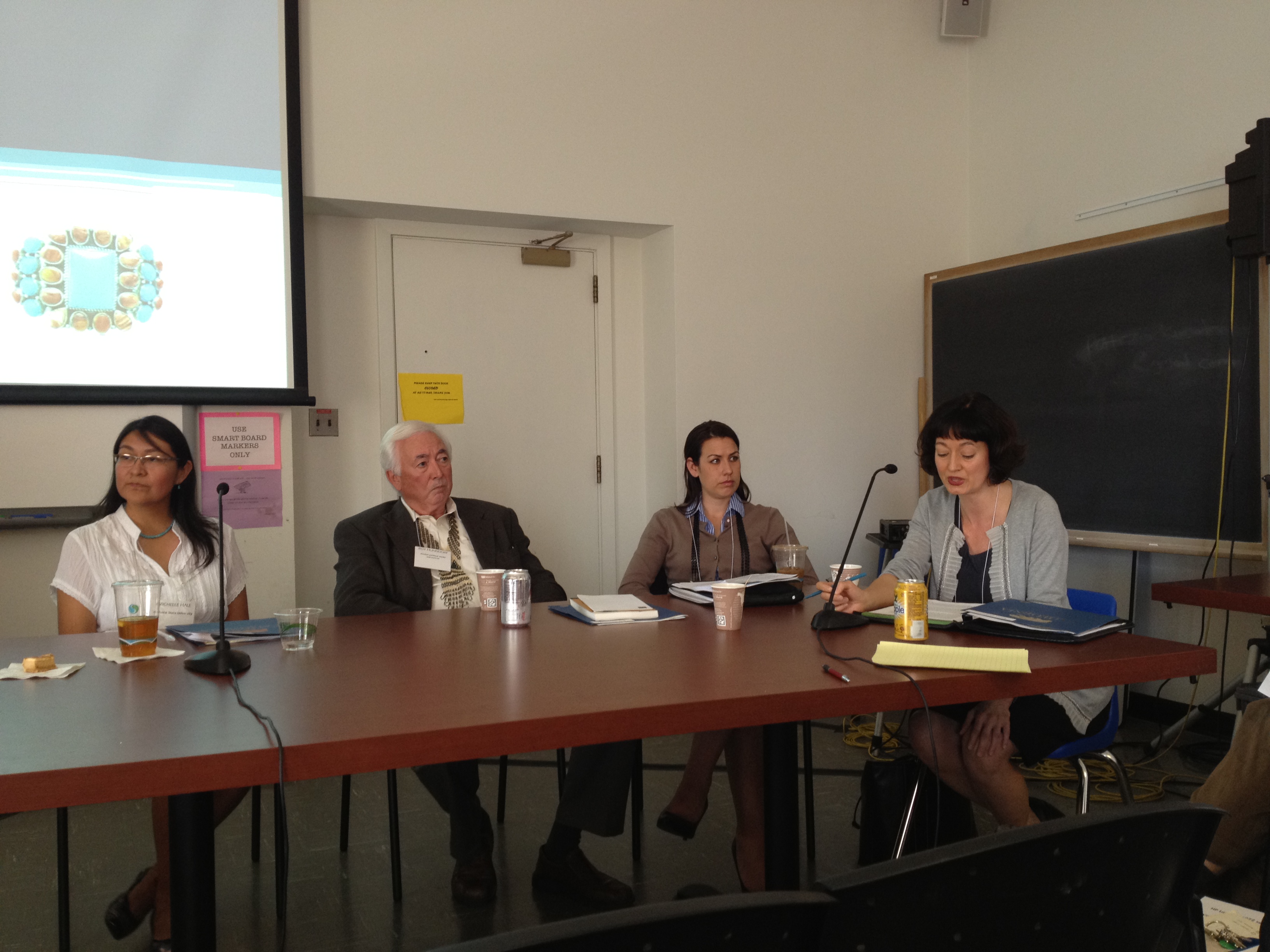
Returning to Berkeley, Michele Hale, Arizona State U, Center for Indian Studies, is now talking, in the last session of the day about Navajo governance and self-determination during the 1970s, how that has led to what she calls devolution, an increase of active participation by the Navajo over what was previously federal control. This has lead to a large Navajo bureaucracy of 6000 employees with plenty levels of administration, now looking for reform because of ineffective services to communities.

And here, she refers to even greater devolution, from the central Navajo government to the even more local, whatever that is– and so I am waiting with bated breath on what the local-local looks like. This is because of lapses in ethics by leaders involved at higher levels. The phrase in play is Local Empowerment, (allows chapters to put the self in self-government), emphasizing participatory governance and citizen decision making.

Here they are, M. Hale, R. Huhndorf, A. Bunten, S. Hunhdorf:

Roy Huhndorf is now up talking about Alaska Native governance after the Alaska Statehood, when Alaska Federation of Natives was set up to counter land transfers by the federal government to the state, when at that moment, oil was discovered at Prudhoe Bay, which opened up aboriginal title rights and halted the development of pipeline construction, which then led oil companies to lobby Congress to establish the Alaska Native Land Claims Settlement Act of 1971.

Alexis Bunten opens now talking about comparative legal frameworks on indigenous governance and so on.

It was good to check in with the folks from my old stomping ground, Kroeber Hall. We will see them again next time!

Traveling Ice Cube

4/26: Energy Event #34


4/15 Epilogue: I recall sitting at Frida’s Cafe on 78th Street and Columbus, yesterday, Manhattan’s upper west side, working on my third margarita, chatting, reaching over Suzana Sawyer, Leigh Johnson, and Octavia Shadowz to get at the guacamole and chips. Then, I awoke in Berkeley, as if I have never left this big leafy town.

My ears are ringing. My throat is sore, probably from yelling in the bar. We covered every topic, anthropology rivals, who is working on what. Things I can think of and more. It was the end of a furious several days. We walked through all the book chapters, giving each author 3 minutes to have their say, turning to a designated critic to provide 10 minutes of rigorous discussion, then opening it up for group discussion. 16 papers in all.

Everyone, we said, would receive a memorandum of comments with the aim of having a second version of chapters ready by end of summer deadline. September 1.

One of my favorite photographs. On the first day, Hannah Appel, Michael Watts, and I planned to meet at Joe’s coffee, on the corner of 120th street to strategize before getting underway. So fun to see those two folks after such a long time. I came in, immediately recognized Hannah, and before we could hug, I had to take a photograph.

I love this shot.

I had not seen Hannah in 8 months. Can you imagine? The last time we were hanging out was in August in Berkeley, writing to NSF program officers about a new project we had in mind to examine off-shore drilling in Ghana.

I am an absolute nutter for keeping notes, and I have started collecting images of folks who keep notes, where they keep them, with what special pens they write, et cetera. For this reason, I had to distract Peter Hitchcock to get a view of his note taking procedures.

Peter–provided me with fabulous comments on my chapter, gentle genius that he is. There were so many facets we went over:

Transparency and secrecy. Nature of oil archive, assemblage, boundary lines between corporations, states, et cetera. A critical ethnography of infrastructure. The question of expertise, science, security and securitization. Multi levels of time, and temporality.

NEW-YORKERS EAT WELL.

We left with a feeling that we were bringing together something important, and that we probably need to turn up the temperature on each of our chapters. Maybe go through one more version.


4/14: Gosh, I meant to blog yesterday, but we did not have internet access. Writing a few notes and need to transfer them and will do that soon enough, but right now I am in the lobby of our hotel, The Lucerne, sitting with Saulesh Yessenova, waiting for Octavia Shadowz to hop a cab to Columbia U. for the second day.

Everyone had a good time yesterday. Of course, we talked, talked, and talked, which is what academics do, but it was good to see old friends as well, like Mani Limbert.


Yesterday


Actually, I have a confession to make. In fact, I know some of the attendees for quite some years. Let us start with Suzana Sawyer. Well, she and I attended a weekend retreat as part of another workshop that took place “decades ago” as she put it when we greet each other yesterday with a hug and a laugh over that period. On that previous ocassion, David Zanton, who has since retired, invited us to work on our proposals at a retreat in Sonoma County. It was when I was completing my comprehensive exams as a PhD student at UC Berkeley, and when Suzana was just hired as Assistant Professor at UC Davis, Department of Anthropology.

But-then there is some history with Mani Limbert. Some years after I completed fieldwork and was writing my dissertation at UC Berkeley, Mani came to town on a postdoc fellowship, having just completed her PhD at Michigan Department of Anthropology.

Boy. Those were some grad student evenings. That is all I can remember. But we had fun.


What can I say about Saulesh Yessenova. Good Grief. Well, for starters, Saulesh works as Assistant Professor at University of Calgary. And I happen to have spent a year at U Calgary, as a US-Canada Fulbright Fellow!

I have since gone to Calgary a few times, and Saulesh has proven to be an immaculate host, taking me out for a steak dinner and whatever kinds of side dishes they have in that town, the Houston of the North as they all refer to it up there.

4/13: New York City. 7AM, just starting the day, heading over to Columbia University soon, to chat with Michael Watts and Hannah Appel about the workshop which begins at 9AM. I plan to blog away today, catching the fleeting conversations and photos of folks.


4/6: Okay. At this moment, I am pretty much holed up in a Norwegian hotel room going over these book chapters. I do not think I am going to be doing much more in the next couple days, other than revise a chapter for another edited volume, attempt to write an article revision for a journal, and re-write a grant for the Norwegian Research Council. But all of this tomorrow, hopefully.

3/7: A workshop organized by Hannah Appel, for a co-edited volume by Michael Watts and myself, fifteen contributors, all gathering at Columbia U, to chew the fat.

We put up materials for contributors on a designated website, restricted at this point, but with screen shots of the participants and titles of the chapters below.

I had the opportunity to share a coffee with Mona Damluji, who studies in the architecture department and is contributing to the volume. We met at Babette, a coffee house in the Berkeley museum. We talked about the discipline of anthropology.

Actually, Michael Watts and I have been working on this project for exactly one year (Yay!) so it is a good feeling to see that things are coming together…

Apparently, David Hughes, another contributor, received his PhD from UC Berkeley at around the same time that I was coming into the program. We talked briefly about his tenure there and some of his advisors.

Matt Huber is someone that I came to meet recently. He is very knowledgeable about energy development in the United States, and knows much of the separate histories of the fuel arenas, in addition to specializing on oil.

Mona is excited about reading the papers for the upcoming workshop.


I plan to post all the news of the event here on StudioPolar‘s paparazzi ethnographic site.

Here are the participants in Oil Talk. Yay!