Feeds:
Posts
Comments

→ Tromsø

1/27: I had the opportunity of joining the University of Tromsø, Department of Anthropology colloquium this afternoon, hearing a presentation on Murmansk Saami ideological distance between indigenous culture and pragmatic life. Last night was a lot of fun. I joined up with my forum playmate Torild Nissen-Lie and co-keynote speaking wonder Emma Wilson, hanging out at the Rica for drinks and dinner. We bumped into another DNV heavy, Bradd Libby, who of all things is working on nearly the same project that I am, but from an industry perspective, assessing how individual leaders influence the debate on arctic energy development.

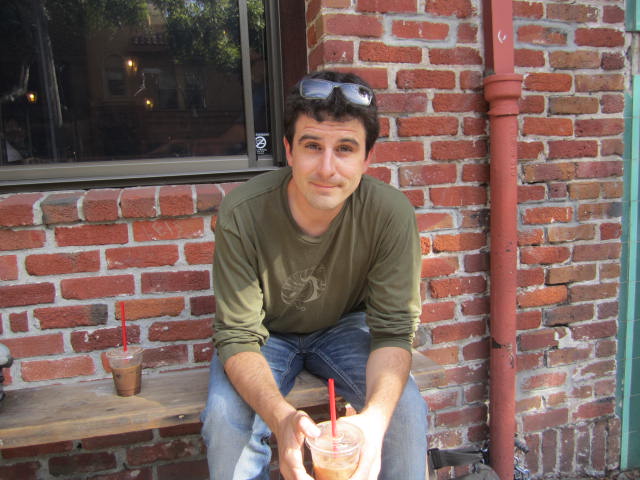
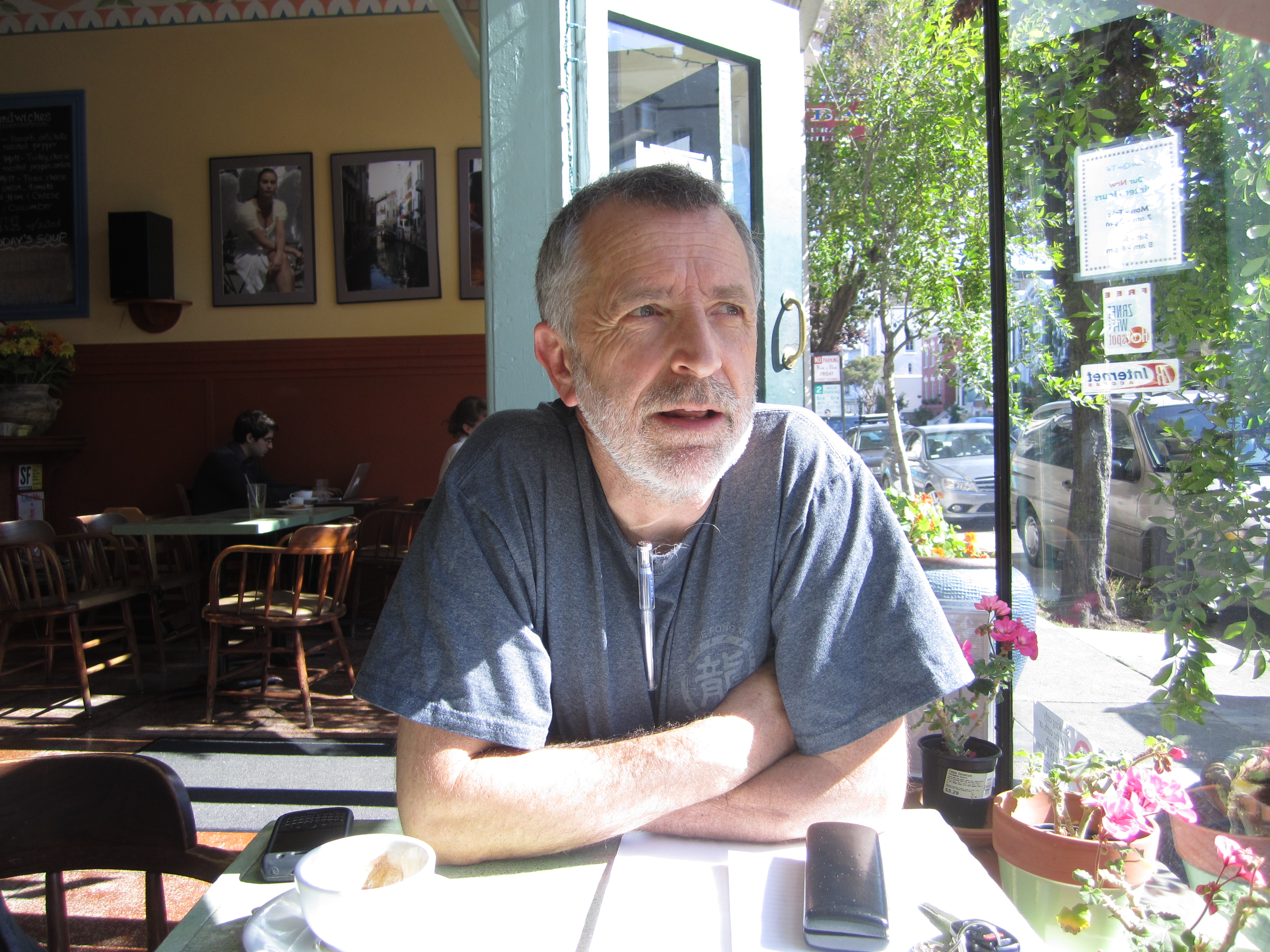
Here is Bradd approaching his crab while Torild has one hand on a drink ticket at the Rica. After all said and done, Torild and I scrambled up to the second floor for a final few drinks and chat before waving a fond farewell to each other.

1/26: Thursday. Political economy of oil and gas development in the North. Peter Abo‘s talk was perhaps the most relevant, discussing the limited approaches management to oil and gas development in the North.

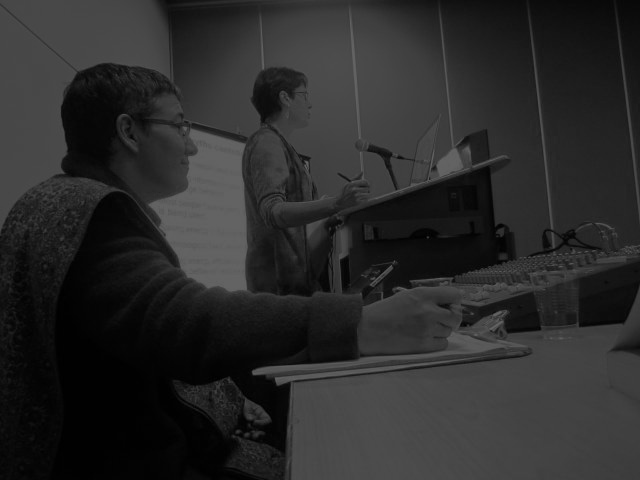
Now here is Emma Wilson, on stage looking fabulous, giving a talk on the limits of dialogue in arctic energy development stakeholder engagements. The evening before, we had dinner at the theater, where I caught up with Nora Hveding Bergseth, ENI Norge Research and Development Coordinator. Nora was previously on the board of Directors for the Barents 2020 grant fund, where U. Tromsø recently submitted a grant on my behalf, so I chatted up, promoting the proposal. We stayed till closing.

Here is a photo of Torild interested in a poster session, holding a glass of vino.


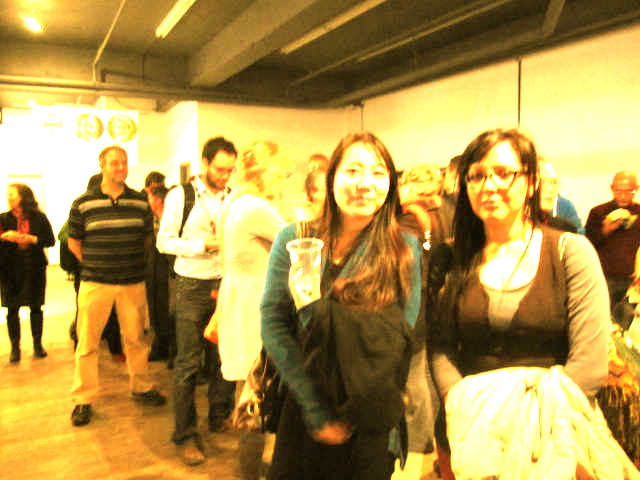
And of course, the conference is all about networking and mingling. I met gobs of people, some I knew from the not too distant past, like Jen Baesman, Director of Association of Polar Early Career Scientists (APECS), and other persons entirely new acquaintances, such as Torild Nissen-Lie, Head of Environmental Risk Assessment of DNV (Det Norske Veritas).


Attended the reception last night at the ConocoPhillips suite in the Radisson. A good way to start the evening. They have been doing the reception for a while, as part of the ARCTOS network, ushering in the beginning of the Svolvær Young Scientists Forum.

1/24: Here we go. Second day at the Arctic Frontiers. And the chair is Elena Kudryashova, Rector of Northern Arctic Federal University in Arkhangelsk, who provided me with a support letter for the NSF project, via Marina Kalinina, who I just bumped into in the hallway.

Oh my lord! There is Elisabeth Harstad, Managing Director, DNV Research and Innovation, who I met at UC Berkeley as part of the CO2 workshop last year. She is talking about combining Norwegian Off-Shore and Russian On-Shore experience and create synergies.

I must get involved in these workshops that Elisabeth is talking about:

Yesterday evening, we all headed over to dinner at the Radisson BLU for dinner.


1/23: At the opening of the conference Jarle Aarbakke, Rector of University of Tromsø & Salve Dahle, Chairman of Steering committee of Arctic Frontiers just completed welcoming everyone here, talking about oil and gas development and how important U. Tromsø has been over the past 40 years since its inception to critical understandings in Norway.

Now here comes Laila Susanne Vars, Vice President in The Norwegian Saami Parliament is speaking now, giving an address to Arctic Frontiers, speaking in Norwegian, without English translation, so I am tuned into the Russian translation. Talking about the development of resources and the partners between industry and government.

Thomas B. Johansson, Co-Chair, Global Energy Assessment and prof. at Lund. He is up now setting the scene on global energy outlook and the Arctic. Pretty good stuff really, talking about the erosion of the natural capital, and the continued dearth of providing energy to the 7 to 9 billions by 2050 who are looking for modern forms of energy, affordable, healthy, and somehow avoiding continued climate change requiring major energy system change. And thinking about how to do this timely and without disruption.

Such changes bring lesser values to private investments. How to create conditions for private industry that are good for the world. Talking now about global emission pathways could be in compliance with 2 percent but only 67 percent probability. Okay — finally, we are talking about energy consumption. The PassivHaus, to create lower space heating demands.

Mike Entenza, Minnesota Governor’s aide, talking about global warming. We had a productive chat yesterday, sitting next to each other at the main performance by Saami dancers.

1/10: Working with Emma Wilson, Senior Policy Advisor, International Institute for Environment and Development, UK, to provide a Key Note Address at the Arctic Frontiers conference in Norway this January.


Emma seen here seated across from UC Berkeley’s Kathy and Nelson Graburn at the ICASS meeting in Akureyri, Iceland, this past summer.

→ London

1/21: London. I met with Michael H. at Deutsche Bank, who provided me with materials to consider, in expectation of my possibly carrying out an internship on oil and gas finance. I was absorbed in reading the materials as I took the tube over to Heathrow and to Oslo, where I am now.

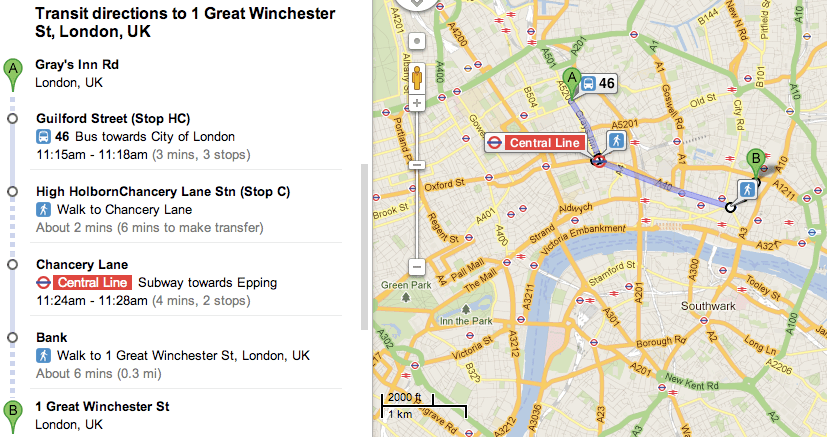
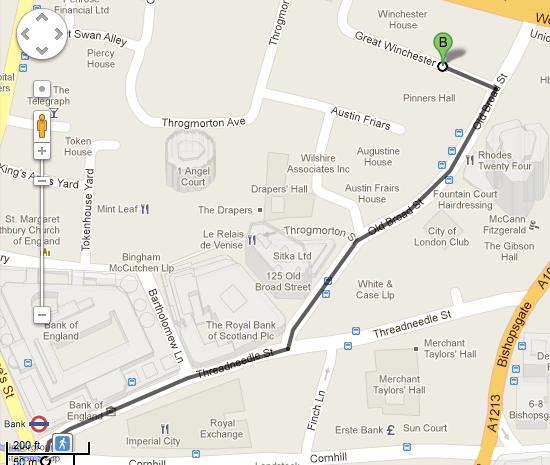
Finding Deutsche Bank is not easy. London’s financial downtown is a maze. There are small alleys and intricate paths. I took the tube from Chancery station to Bank street and  got lost looking for 1 Great Winchester Street. A fellow tourist had a detailed map and she pointed me in the right direction.

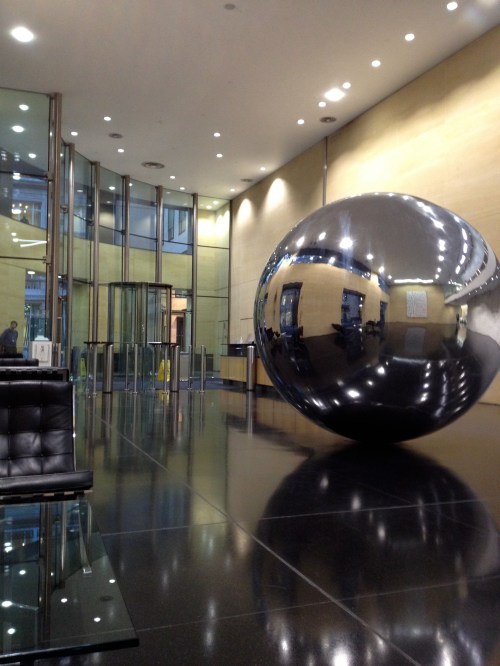
As you walk into Deutsche Bank, there is a big metallic ball in the lobby. I took a few photos before being instructed by security that no photographs in the building are allowed. As I moved toward the elevators, I saw other art installations throughout the lobby.

Deutsche Bank is well known for its art collections. Upon my arrival at the appointed floor, I was handed several brochures about these holdings. There is a special curatorial floor, with actual curators. Some of the art work is depicted on the security badge itself, as you can see in the above image.

One of the administrative assistants, while waiting for my meeting, gave me a detailed description of the methods used for putting together the art pieces on display at the floor of my appointment.

It was not a simple description. The language she used, the flow of narration, and the multiple art pieces she used as examples, indicated a thorough training in what she was talking about. She was dressed in a uniform.
I enjoyed our meeting. We had met the year before in Norway at the Oslo Energy Forum. He walked through various different aspects of what he is involved in, capital expenditures, commodity sales, pre-project development, financing. Because of the frontier element of my work, pre-project development and capital expenditures interested me greatly.

The meeting was about 45 minutes or so, and after gathering my reading materials, I suggested that I would get back to him to find out if we could follow up on a period where I could spend time in the Bank.
I also had a chance to catch up with Ben M. from JP Morgan. We also met last year at the Norwegian Oslo Energy Forum.  He invited me over to lunch with him and a colleague. I was able to take a few shots of the viewshed outside our luncheon window. I also captured a few images of the preparation of our lunch.


We discussed a number of issues, surrounding arctic frontier development. Ben mentioned that he had visited the offshore Snøvit liquefied natural gas installation in Barents Sea of Norway, and from there headed over to Svolvær. We also touched briefly on the topic of energy consultants and the requirement they have in providing information in a simplistic manner for government leaders to make decisions.

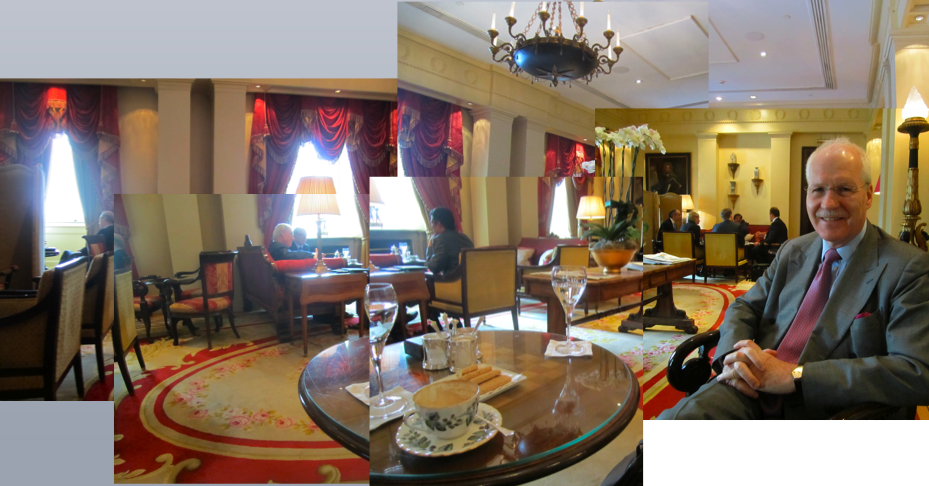
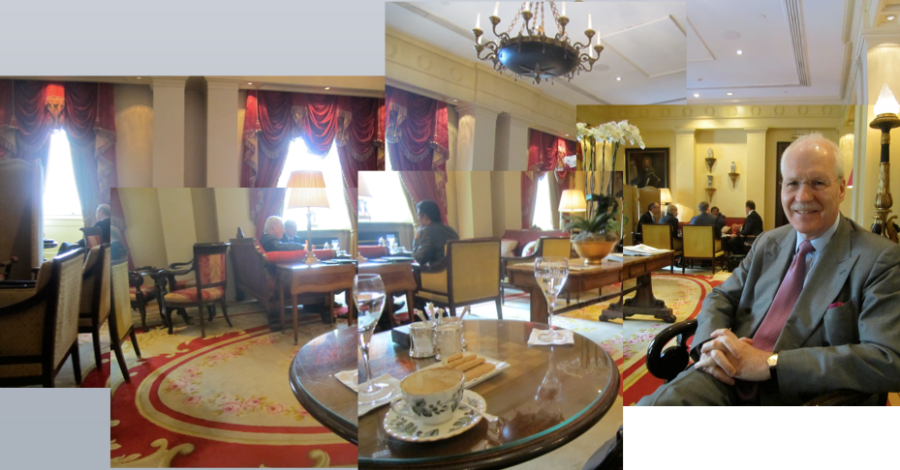
I met with Francis G. at the Lanesborough Hotel at Hyde Park Corner near Buckingham Palace. Speaking with Francis was one of the best conversations I have had on this project. We began with a quick overview of the oil and gas situation globally, comparing it to renewables, which he invests in, but does not believe — given the enormous demands for hydrocarbons and the amount of energy they release — will be valued in the near or far future. I agreed with him on the issue of the btu output consumed by Americans is enormous, and we both provided our own stockpile quotes of incredulous power availability by comparison to earlier times, with me giving my usual quote from Vaclav Smil.
We then went on to my project proper. Francis was one of the most perceptive interlocutors I have come across. His terminology and framework were nearly identical to Bruno Latour’s description of how to follow science in society. In the latter case, the issue is enrollment and convincing others wherein artefacts become facts and therefore natural. Similarly, Francis suggested that a leader has to convince a variety of industry to get on board, and that one must weigh the facts which is a process of looking at data–to-information-to-knowledge and how these three categories move frequently back and forth (facts to artefacts).

In so doing, I reached a deep level discussion on what I was doing. For this Francis suggested that one of the deliverables for industry could be, and on this point he was very interested, in developing a model of how decisions occur or how leaders make decisions or leadership qualities in particular. How they weigh certain decisions.

We drank water (me sparkling his flat) and the meeting lasted about 1.5 hours.


1/18: Chilly and rainy. Sitting in Euston station having a coffee, not much different from how I begin the day anywhere else in the world. The only difference of course, is that I battled through the crowds this morning from Emma’s flat through the tube to downtown.

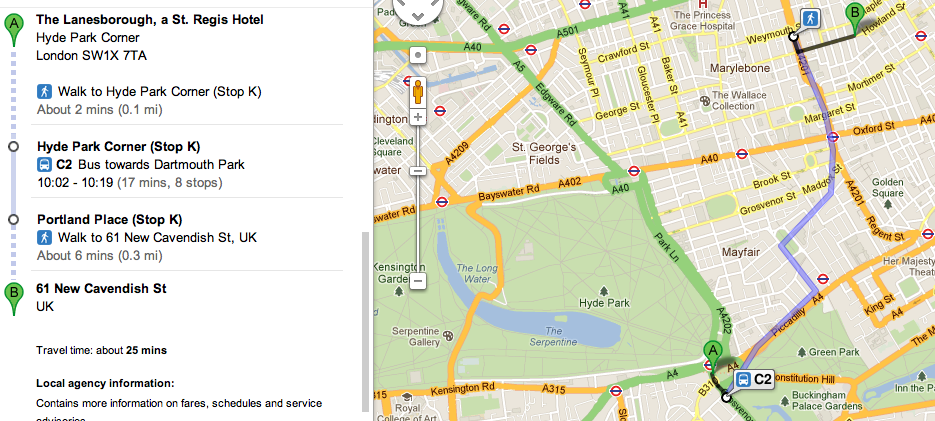
Today, I am headed to IIED, and then around 2PM going over to meet Francis G.. Afterward heading over to Energy Institute. From IIED to The Lanesborough at Hyde Park Corner:


From the Lanes Borough to the Energy Institute, 61 New Cavendish:

Londoners are gregarious. Yesterday while having a coffee I had the chance to chat with Sofie Howarth, who is writing a book about community outreach and who after hearing about my work, suggested I contact her brother who works in energy financing, straight away giving me his email address. Back at IIED, we worked till about 7:30PM and headed back to a pub for steak and ale, afterward catching a margarita in a local bar near Emma’s where it’s open mic night every evening.

1/17: My first day in London, spending the afternoon at IIED (International Institute for Environment and Development). Gosh, how can I explain everything, what a different planet from Berkeley. I picked up one their brochures and must have read it three times and even then did not quite understand everything. So sophisticated!

The folks here are polite and considerate. I have a little desk space, and my mate opposite me is Abbi B., with an MA from London School of Economics and works on value chains. In fact, I just spent the last 20 minutes talking in a confusing fashion, exited and rapidly, about my reaction to her recently written policy brief titled, Under what conditions are value changes effective tools for pro-poor development?

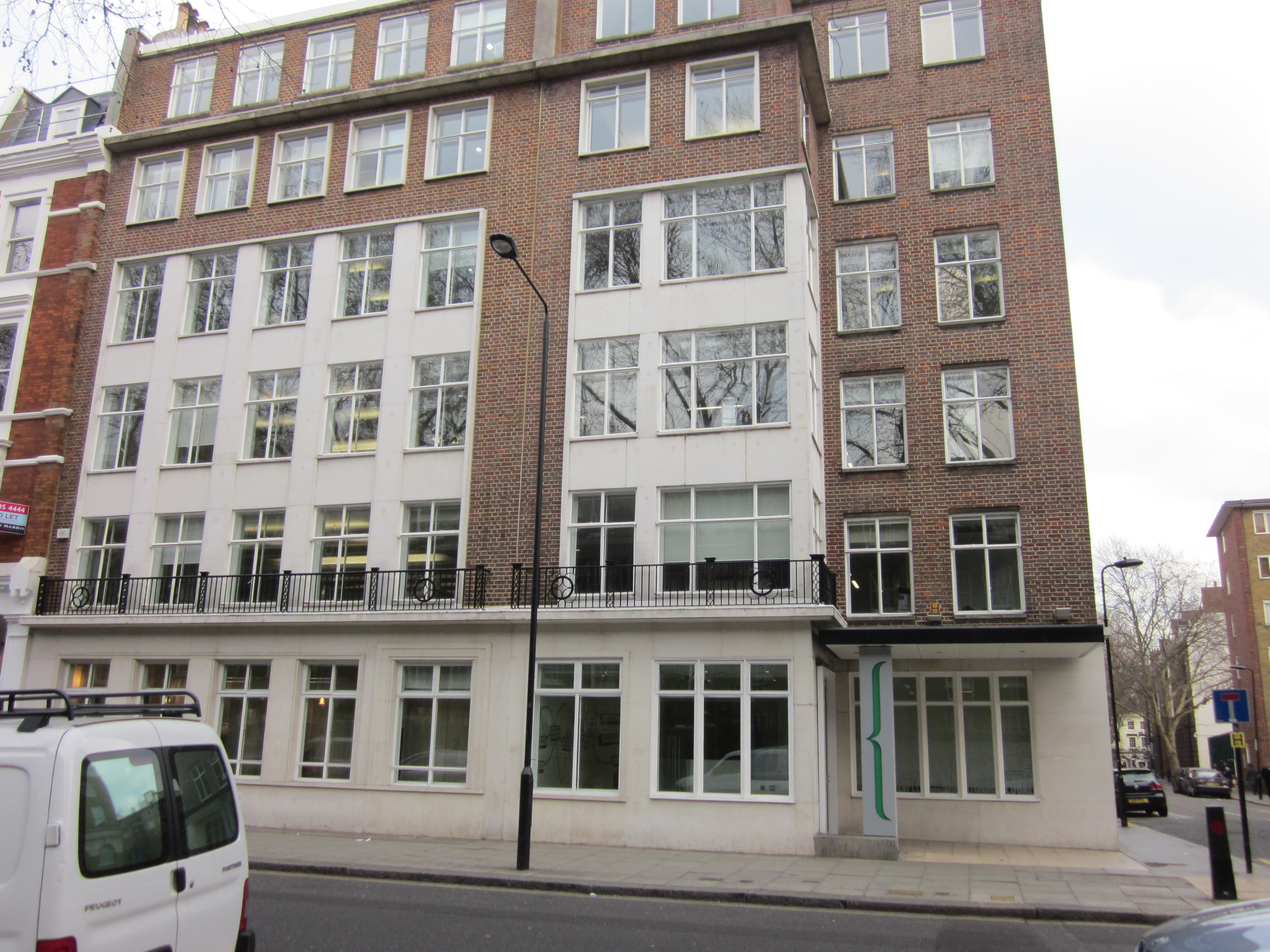
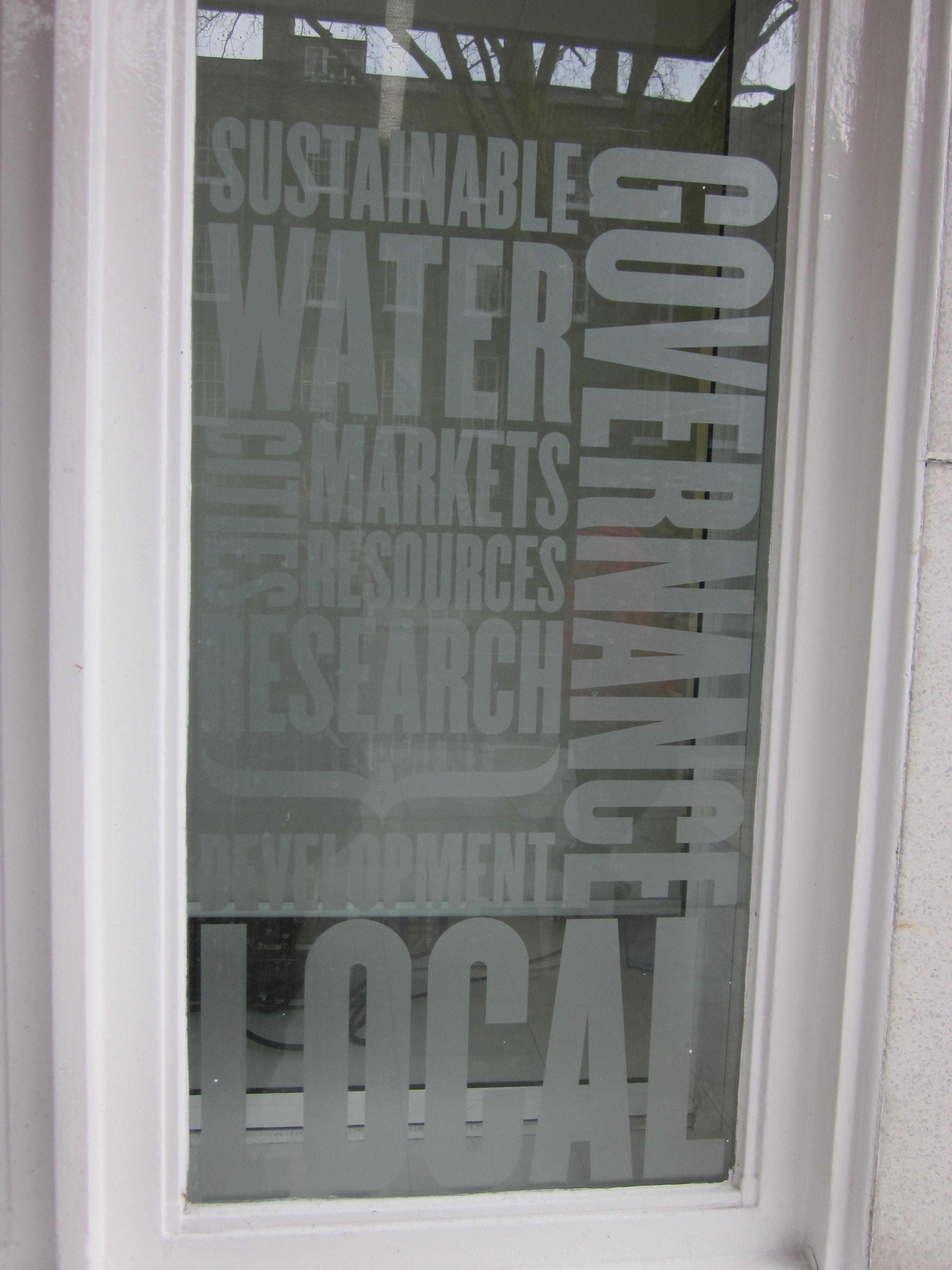
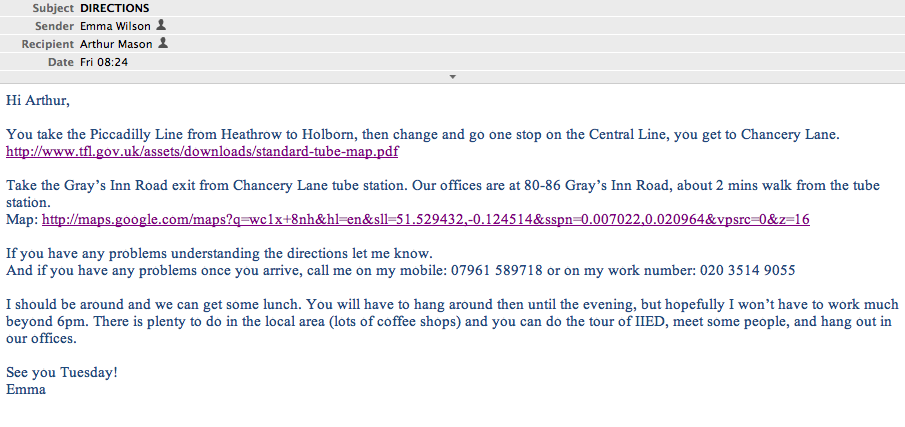
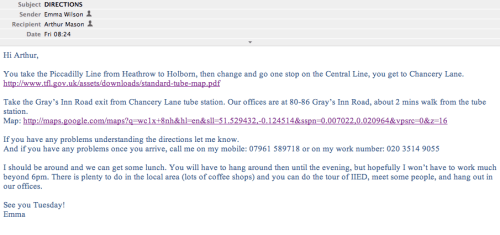
I was so enthusiastic, but perhaps it was the caffeine from the double-triple shot latte I ordered to keep me awake, since it is about 7AM west coast time, having just got off the plane several hours before, trotting through London’s tube from Heathrow airport over to Chancery St., to IIED’s beautifully renovated 5 story building, where down the street there are lovely luncheons, and coffee shops.

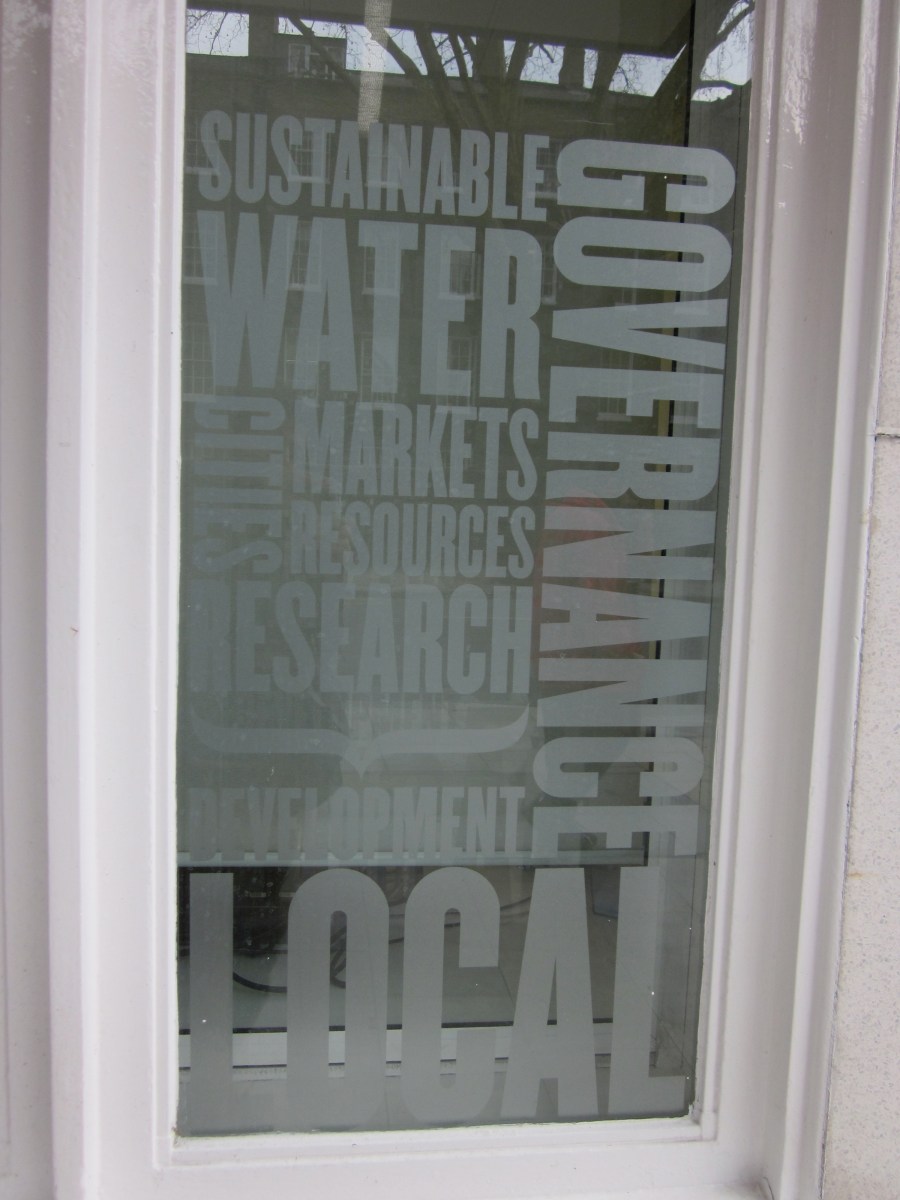
Emma W., senior member of the IIED’s sustainable Markets Group, is a friend whose work I admire very much. A few things caught my attention immediately — there are no private offices on the floors, and one result is that everyone whispers when they speak to each other, privacy is created by low talking, and at the same time, I must say, I am VERY much interested in what people are saying in low tones, so much so, that I even went so far as to comment to one of the researchers about her use of the phrase “I will put that on my top priority” — we had a good laugh (although, not a loud one) over my comment that in the good ole US of A, the very use of that phrase means the exact opposite.

I should say, however, when I arrived at lunch time in the cafe downstairs, there was quite bustle with folks laughing and talking, exchanging ideas, I immediately felt at home.



Emma and I have had some engaging discussions about the production of knowledge, and on more than one occasion, especially this morning while taking the bus through downtown London, she pointed out how dismissive I can be when talking about non-academic work to which we had a good laugh. But it was instructive as I began to think about some of the fault lines in our discussion and mentioned to her, perhaps the difference between IIED and my work or what I call academic work — is the difference between reproduction of discourse and novelty. I consider that what I produce is novelty as my marketable product whereas knowledge houses like IIED produce standardized productions, within definite niche settings. That was my argument.

And this brought us to the main critique I had, especially of universities, that most of these houses are more interested in name recognition than they are in producing great ideas. To this Emma was in agreement, all the so-called formats, type fonts, the policy briefings and broadcasts of promotions, all of the mature practices in place for producing, distributing, assembling — all oriented toward the effort of increasing one’s value in terms of name recognition.

Anyway, the conversation came about because last night — we were putting together a talk for the Arctic Frontiers presentation in Tromsø.
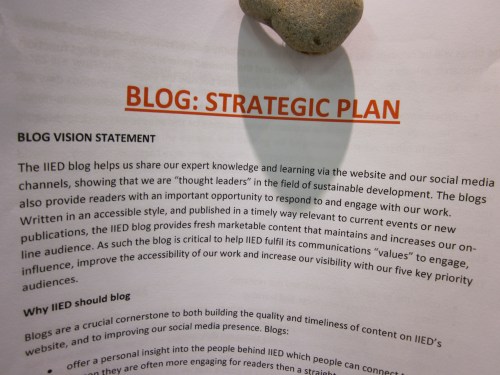
The talk, primarily Emma’s project, is about the difference between the desire to promote a concept of dialogue, and actual experiences she could think of where there was true dialogue (not many). We then went after a definition of dialogue, used by most folks, based on Habermasian distinctions of consensus building. On this, the assumption that academics take issue with Jürgen Habermas — is that much like the definition of liberal economics, dialogue assumes that everyone in the room is a so-called enlightened reasoned subject.

From there we began thinking about various categories of engagement that restrict dialogue, that are available to oil and gas engagement with northern communities. The argument we took up was essentially that in liberal states, there is the requirement to make demands from the liberal state, and it has nothing to do with dialogue, but that claims making requires making demands. We back tracked to include James Clifford‘s use of creating new interests along new axes of common purpose — essentially speaking last night and this morning on variations of enlightened reason claims making.


1/16: On the plane to london — read J. Godzimirsky’s pipelines and identities, current European debate on energy security, Shtokman and negp case (2006), looking at the Barents Region developments to consider them in larger geo-political relief about EU trends toward Russia. There’s quite a bit here on the so-called need for Russia to have western expertise in developing the high north or off shore and LNG deposits. I began wondering about typologies of required expertise in the literature, on shore (no); off-shore, LNG (yes).
Read V. Socor’s gazprom and the prospects of a gas cartel and Europe’s energy security, written about 3 years ago. What a difference 3 years makes. He suggests we build pipelines to Central Asia and make friendly with Iran in order to curb Russia’s thirst for power. Skimmed through book chapters for my edited volume with M. Watts  – Looks good!

Reading Indra Overland’s piece on gas cartels, practically had a nervous breakdown trying to think about what to write for a book chapter due February, when it struck me that the title of my proposed piece  — cartel consciousness and horizontal integration in energy industry — could easily be about the rise of a natural gas cartel as discussed by various practitioners these days. Could be.


1/11: Turning my attention now to what is at hand:

  • Working with Emma W. Senior Researcher at IIED, on a keynote presentation for Arctic Frontiers in Norway. We went through several drafts and it’s still up in the air. Will work with her when I arrive.
  • Francis Robert G., runs G. Consulting suggests we meet in the drawing room of the Lanesborough hotel, on Hyde Park Corner on Wednesday, January, 18 at 15:30. We met at Oslo Energy Forum. His world is populated by CEOs of oil and gas companies, who serve with him on various advisory panels that oversee global investment in natural resource development. One such group is Barclays Natural Resource Investment or BNRI, which has committed nearly $2 billion in 18 projects. Mr. G. is also a Chairperson for the Board of Directors of Petroleum Geo-Services, a Norwegian concern that focuses on data acquisition, analysis and interpretation. On their website, they state: “We help oil companies to find oil and gas reserves offshore worldwide”. PGS provides a MultiClient Library defined by 400,000 square kilometers of “high quality worldwide” three-dimensional seismic data.
  • Ben M. at JP Morgan Office located on 10 Aldermanbury on Thursday, January, 19 at 12:00. The message I received stated “Ben would like to invite you to lunch at our office on that day”. Another fellow from Oslo Energy Forum. A few images on this building can be found from John Elkington, who writes in London on global capitalism and sustainability. Ben is Managing Director, Head of EMEA Oil and Gas. The Acronym stands for Europe, Middle East, and Africa. Quite a region. He was quoted most recently by Financial Times journalist, Anousha Sakoui, on the topic of Atlantic off-shore development in Africa: “Given the global reserve replacement pressures on the oil majors, Africa is a region where they can deploy differentiated exploration and project management capability,” says Ben M., head of Europe, Middle East and Africa oil and gas at JPMorgan in London. “The sheer scale of the exploration opportunity in Africa makes it compelling for resource-hungry oil majors. Positions in Brazil transformed the equity story of those companies who saw the potential first. Companies are looking to replicate this now in east and west Africa.”
  • Thursday, 3PM, arranged to meet with organizers, Katie Crabb, at Energy Institute, to see how they do what they do.
  • Terry McAllister, The Guardian, Thursday Evening, January 19th, for a beer.
  • Michael H., Head of Energy for EMEA at Deutsche Bank, Winchester House, 1 Great Winchester Street, on 11 AM Friday January 20. In Oslo earlier this year, I met with Edward C., Chairman, Global Corporate Finance. He directed me to Michael.
  • Brad C., Chairman and Production Director at ExxonMobil, who I met last year at the Olso Energy Forum forwarded my email to  Robert Lanyon, Public and Government Affairs Manager , and waiting to hear back. Sent Rober a bunch of materials. But no response.
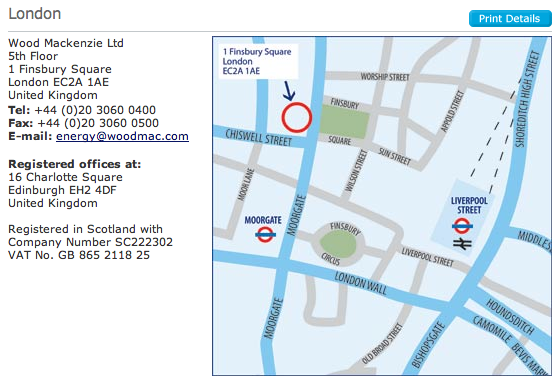
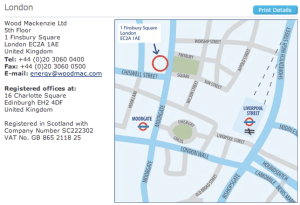
  • I want to stop by Wood Mackenzie Global Consultants to check out, at least that building. Here’s the address from their website: 
Oslo Secrets –

black empiricism


→ Montreal

American Anthropological Association (AAA) Meeting, Montreal, November 16-20, 2011.
Legacies and Landmarks in the Culture of Energy (ed., Strauss, Rupp & Love).

Several years ago, I can no longer remember, I presented a paper on a panel with Tom Love, who was running an energy panel at the AAA. Some years later, he contacted me suggesting he was putting together an edited volume on energy with Stephanie Rupp and Sarah Strauss. In 2010, we all were on a panel they organized, and then again, in 2011. My paper was titled Cartel Consciousness and Horizontal Integration in Energy Industry. 

In Montreal, I had met up with Joseph Campbell (U. Arizona) at a supper club. We went through our respective projects on natural gas.

There was, in Montreal, a retirement party of Nelson Graburn (UC Berkeley) in an art gallery. The place was packed to the gills with many of Nelson’s former students, including myself.

James Igoe (Dartmouth) organized a small get together with folks involved in energy and the environment, including Rick Wilk (Indiana U). I had a chance to meet later with Jim. He has written one of the best anthropology books I have ever read, and I teach it my course on environmental modernity.

After our own panel, and the Igoe panel, as well as the Graburn party, which seemed to all take place on the same day, the editors of the book invited several of us to dinner at a traditional french restaurant in Montreal. There, Stephanie told me some of the most hilarious stories I had ever heard about her life, including delivering her second baby in a New York taxi cab on the way to the hospital, and having to remind the emergency medical staff who came out to take the baby, that she was still attached by the umbilical cord.

The hotel was not far from the conference. Another swank location that I appreciated. Folks met at the bar most nights, and gossiped about the latest news in the anthropological world.


10/23: James Igoe, Dartmouth U. anthropologist contacted us about meeting up with a group of like-minded folks. Well, that sounds good. The workshop is taking place Friday and will serve as an opportunity to exchange ideas, “valuable and gratifying in and of itself as much as for what it may produce”. There is a retirement party for Nelson Graburn in an art gallery.

Enroute to 4(S)

4(S) Meeting, Cleveland, November 2-5, 2011.
Energy: Place, Politics and Justice (Phadke and Mulvaney)
My paper: Sites of Regulatory Power in Flux


11/5: evening — Arriving at SFO airport and receiving a call from Biliana Stremska demanding that transportation on the BART would lead directly to Balboa Station — a short walk from the Croation Cultural Center in South San Francisco, where this evening Bulgarian musician, Theodosii Spassov would be performing.


Hesitation. A long flight, having to walk through rain, arriving hungry, foolish looking, carrying bags.

In addition to the celebrated Bulgarian musician and the star quality of Theodosii Spassov, there was local singer, known for her vocals on film Avatar, the beautiful and talented, Radka Varimezova.


11/4: Hotel room television in Cleveland.


5PM: Drinks with Dustin Mulvaney, David Hess + others. David wrote the Science Technology Studies primer Science Studies. We chatted on the topic of Pierre Bourdieu‘s Habitus.

Candis Callison, now at UBC in Vancouver, working on the Arctic and climate change, has walked in.  She expresses an interest in mushrooms, to which Dustin broke out his IPad to show photos of all variety of mushrooms in the Santa Cruz mountains. Hugh Gustafson was with us until around 2AM.

3PM: Remote Presence, Present Futures. Princeton University’s Janet Vertesi is giving on ethnography of space scientists, and the coordinating activity on Saturn and on Earth by space projects. Janet uses the term fleeting alignment (difficult to reproduce, difficult to pin down), to describe the multiple overlapping infrastructures (knowledge, practice) that create moments of distinction bringing together different spaces of coordination (space-craft-time) that permit local activity of action at a distance. Lucy Suchman from Lancaster University is now talking — applying Walter Benjamin‘s insight about modern industry’s heavy impact on the body, increased repetition of actions, etc. cites Karen Kaplan‘s piece on visual targeting which appeared in the very cool journal titled Vectors.


MIT’s Zira Mirmalek is summing up the panel, suggesting the work was oriented toward compressing distant practices, actors and knowledges and in some cases the work of compression takes place in such compelling ways, that offer new forms of the mundane. Sensory insulation? or Censory insulation. Remote presence allows persons to inhabit far away places that place humans in jeopardy.


11/03: Chit-chat.

A Plenary with Gabriel Hecht and Hugh Gustafson talking about Fukushima. Gabriel gave a fabulous talk on the divide between exceptionalism and banalism that continually defines nuclear power. Accidents such as the Fukushima reactor need to be understood under the so-called normal conditions of the nuclear industry.


11/2: Hotel life.

Taxi Ride.
At the airport gate and checking out a plaque on tennis star Rosie Casals, the Women’s singles for 11 consecutive years ranked #1. When who should be sitting there but UC Berkeley’s Dr. Mary Sunderland, also going to Cleveland for the 4S, and fiddling with her presentation. She mentions to me at this moment, that on this very plane is Chris Jones, Dustin Mulvaney and Alister Iles, to name a few Science Technology conference goers.

CSTM&S

UC Berkeley’s Center for Science, Technology, Medicine, and Society (CSTMS).

Recently, David Winickoff spoke on Geo-Engineering. Cooling down the earth by controlling the sky — a type of science spear-headed by David Keith, previously of University of Calgary and my former sponsor of the Canada-US Fulbright when I was there some years ago. David K. is ultra smart and ultra famous, and now resides at Harvard University.

It was yesterday, at David’s talk, through an introduction from Chris Jones, that I met Ozzie Zehner, a Visiting Scholar at UC Berkeley with a newly minted book coming on the shelves about the pitfalls of green energy — in your book store this May 2012.

His book, titled Green Illusions, by all the looks of things, will be popular. Look for Ozzie on television soon, or NPR if you listen to the radio. We all got a chance to catch up over coffee. After our little chat, about all those et ceteras and so ons, we headed over to CSTMS’s launch of the undergraduate component, titled, Science of Society’s Course Thread.

The thread launch included food.


Dustin Mulvaney


10/14: Friday, I had a chance to catch up with Dustin Mulvaney for coffee.

We both were heading over to the Environmental Politics workshop to discuss Matt Hubert‘s chapter on neoliberalism and the 1970s in the wake of the oil crisis. The workshop consists of about 20 persons sitting around a table. Matt introduced his piece, which everyone had read before hand. Then we discussed the work while Matt remained silent.

Chris Jones was there, who is working on energy transportation at the middle of the 19th century, so I had a chance to introduce him to Dustin.
Department. of Geography’s Michael Watts turned up, providing a few comments, as did Nancy Peluso. The evening before, I tagged along with Matt and members of the Department of Geography, Nathan Sayre, and Richard Walker, for dinner at Gather, a Berkeley locale, for steak and margaritas. I had a chance to talk with PhD student Teo Ballve about his work in Latin America on drug cartels and territorial governance.

10/07: I met with Dustin for coffee to discuss among other things his interest in carrying out a GHG Inventory/Life Cycle Analysis of Exxon-Mobil’s Shale Gas production.

He suggests that natural gas produced from hydraulic fracturing operations produces methane emissions that make the Greenhouse Gas (GHG) intensity of natural gas higher than coal. There is also significant uncertainty around the GHG intensity of Tar Sands extraction and Synthetic Fuel production. So what he aims to do is to conduct a peer-reviewed life cycle assessment of hydraulic fracturing operations (in collaboration with Exxon-Mobil).

The other major resource impact from hydraulic fracturing operations is water. Water footprinting includes more than water quantities consumed and quality of wastewater, but also factors such as geographic content of water extraction. Here, he proposes to evaluate the water footprints of hydraulic fracturing and tar sands operations in the context of the geographic areas of water impacts. For hydraulic fracturing, he would contextualize the water footprint in areas of high and low controversy (comparing Pennsylvania operations to those in New York). For tar sands he would evaluate water impacts at sites of extraction and along potentially vulnerable water supplies.

3/31: I met up with Dustin Mulvaney, post-doc at Berkeley, who received his PhD at UC Santa Cruz. Dustin works on solar energy and has been traveling around lately looking at various ways government, through the Department of Energy, lavishly funds speculative deals in solar electricity. In particular, he is concerned with the environmental aspects of desert clearing when installing solar power. Such activity begins when a company files an environmental impact report with government. The report demonstrates what will happen to nature when constructing and operating solar power installations. Often, these reports are called Life Cycle Analysis (LCA) documents. These LCAs are supposed to describe the entire impact of a technology on the environment, from its initial assembly, operation, all the way to when the product is dismantled.

What Dustin has been discovering in his research, however, is that the metrics for determining LCAs, that is, the actual methods used for identifying impacts in these reports, actually do not include many of the ways in which a technology impacts the environment. He mentions for example, that the desert turns out to be an environment that sequesters carbon, and that clearing the desert would release more carbon into the atmosphere. Well, this feature is glossed over in the environmental impact report. In the end, he points out that metrics used to create these increasingly popular LCA reports, are quite political, and often conceal many aspects of how solar power impacts the life cycle.

Our conversation began with a walk over to the north side of Berkeley campus to the Thai restaurant on Euclid, next to a coffee bar that we were eyeing. We settled in, ordering the same thing, which happens a lot with me, actually, as if I am interested in tasting what the other person feels about their food. Dustin had some fascinating things to reveal about solar power industry, government give-a-ways, land give-a-ways, and fabulous taxpaying dollars being spent all under the name of innovation and cleantech. One Israeli company, BrightSource Energy, for example, has managed to obtain nearly 2 billion dollars from the US government, for which the company has used to fund military contractors to build gearboxes, and traditional engineering firms (Bechtel) to construct tubes– not necessarily companies on the innovative edge.

After finishing off plates of rice, green beans, and tofu, we skipped out to the coffee shop and ordered mochas. Sitting on the street, we began our conversation again. Dustin knows a lot of people in his field who are working at multiple scales — not only knowledge and information in Washington, D.C. (at the high level of creating abstract laws), but also what is happening in the field offices of, say, the Bureau Land Management in New Mexico, who map and lease out land. In a sense, he is examining the entire commodity chain of solar power.

We have both been fascinated by the concept of clean in phrases like clean coal, cleantech, or what ever to which clean can be attached. But what does clean actually mean in these contexts? It refers of course, to energy technologies that release less carbon, and thus reduce chances of climate change. But is clean coal actually clean? Will mountain tops no longer be destroyed? Will streams no longer be polluted by the word clean in clean coal? In a word, no.

Actually, Dustin had a come up with a phrase to capture this mode of thinking, which he calls — The Reductionist Epistemology of Carbon.