Feeds:
Posts
Comments


We arrived in Arkhangelsk some time during the summer of 2010 in the midst of a WWII victory celebration.  Our entire visit was focused on connecting with friends at the newly established Northern (Arctic) Federal University or NArFU. Our exploratory research included the goal of setting up networks of with Russian universities so that we could pursue long term research on Arctic energy development in the Barents Sea area.


Marina S. was our contact, and in fact, I bumped into her again not too long ago in Tromsø, at the Arctic Frontiers Conference this past January 2012, nearly 18 months after I first met her and initially discussed plans for a follow up project. It was then, in January, that she introduced me to Elana Kudryashova, Rector of NArFu. During fall 2011, when I began drafting the new request for research funds, Marina and I had several long conversations about what kind of support letter I could obtain from NArFU to include with the main grant proposal. In the end, she bifurcated the workshop and research aims from the capacity building and networking.

It is just incredible to me how much effort we put into reaching out to folks, then following up and asking them to write elaborate letters of support. Here is the letter that we received from NArFU, and we are grateful to them for putting this together.

Arkhangelsk is a one-hour, 40-minute flight from Moscow’s Sheremetyevo Airport. Traveling through Moscow on that particular day was tough. In addition to the hot weather, our driver was terribly late, and I practically had a melt down over the possibility of not arriving on time, since we had very specific arrangements to meet with representatives of the university.


That is Alex K., enjoying the ride out of the tarmac.

Upon arrival, we could not help mingling among the throng of revelers, as we made our way past the closed off streets to our hotel, Pur-Navolok, located on the embankment of the Northern Dvina river.

Upon reflection, there was not really that much for us to do. We had a few meetings with university representatives and a tour of the university grounds. In sum, the meetings took the better part of one-half day. But we arrived the afternoon prior and gave ourselves a half day after the meeting before returning to Moscow.

With the down time and worsening weather, we made our way through the city, noticing with what high admiration town dwellers revere the statue of Vladimir Ilyich Lenin, who stands at the middle square starring down the tallest building in the city.


From the center, we passed into the side streets and small fairs where local painters have developed a particular fascination for their skyscraper.


I am a big fan of ice in my soda pop, not a standard issue service provision in restaurants. After being discouraged by having only one or two cubes, I began to request as much ice as they could bring out, and it came in bowls.

The story behind the Arctic city of Arkhangelsk is well told. Its founding dates to the 1500s, established on order of Ivan the Terrible to be a commercial port. It is increasingly referred to as the Gateway to the Arctic, hence, one of the reasons why we wanted to check in. As Russian arctic oil and gas development begins in earnest, it will be from this Gateway.

One of the activities that I do during down time, and especially when it rains, is to dart into a movie theater. Hanging out in a restaurant, as in the case of the below photograph is another activity. Here, we visited the Argentinean Del Fuego located on the city’s promenade.


Nevertheless, on this particular occasion, we decided to travel to the nearby and well-preserved wooden architectured city, Maliye Karely, now a Museum about 25 minutes drive from the center of town. It is an open-air city of wooden mansions, churches, windmills and barns and built between 16th and 20th centuries.


As a footnote and of course, with due respect, while returning from our walk, Alex led us down the wrong path, thinking it was a short cut. We arrived at the doorstep of some unhappy shack. But we were able to retrace our steps.

From there, returning to Moscow was easy.

The Blue Carpet


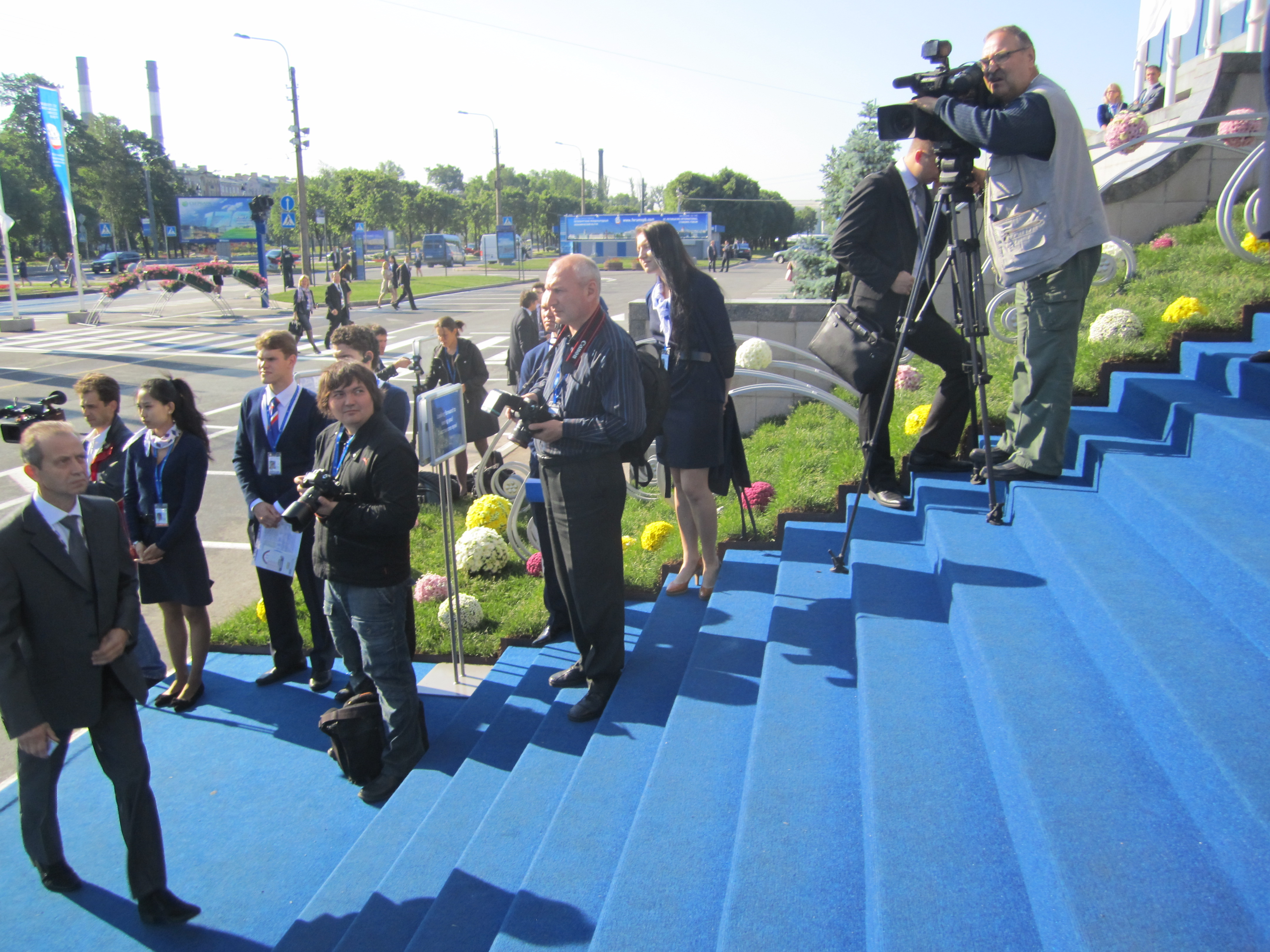
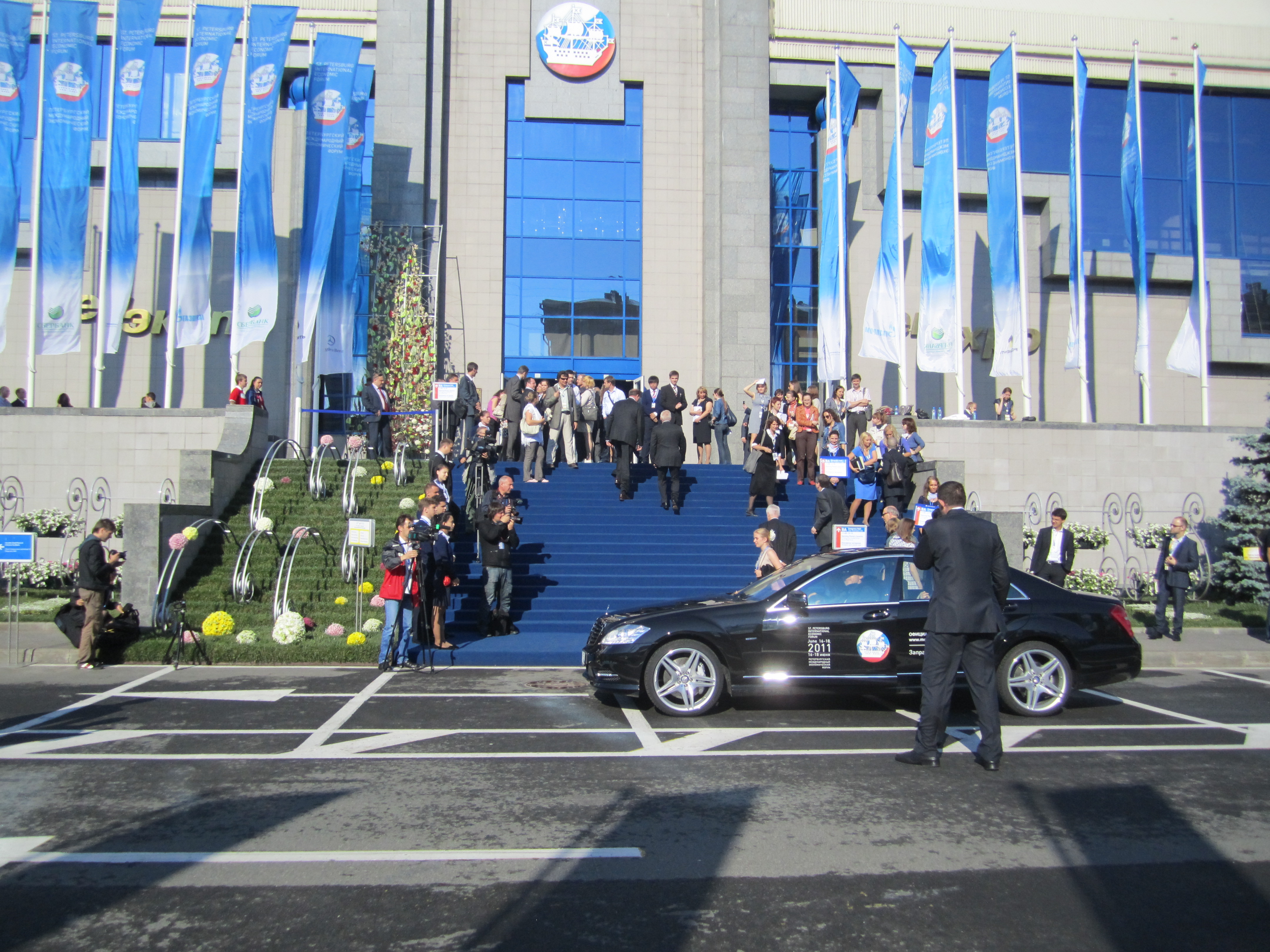
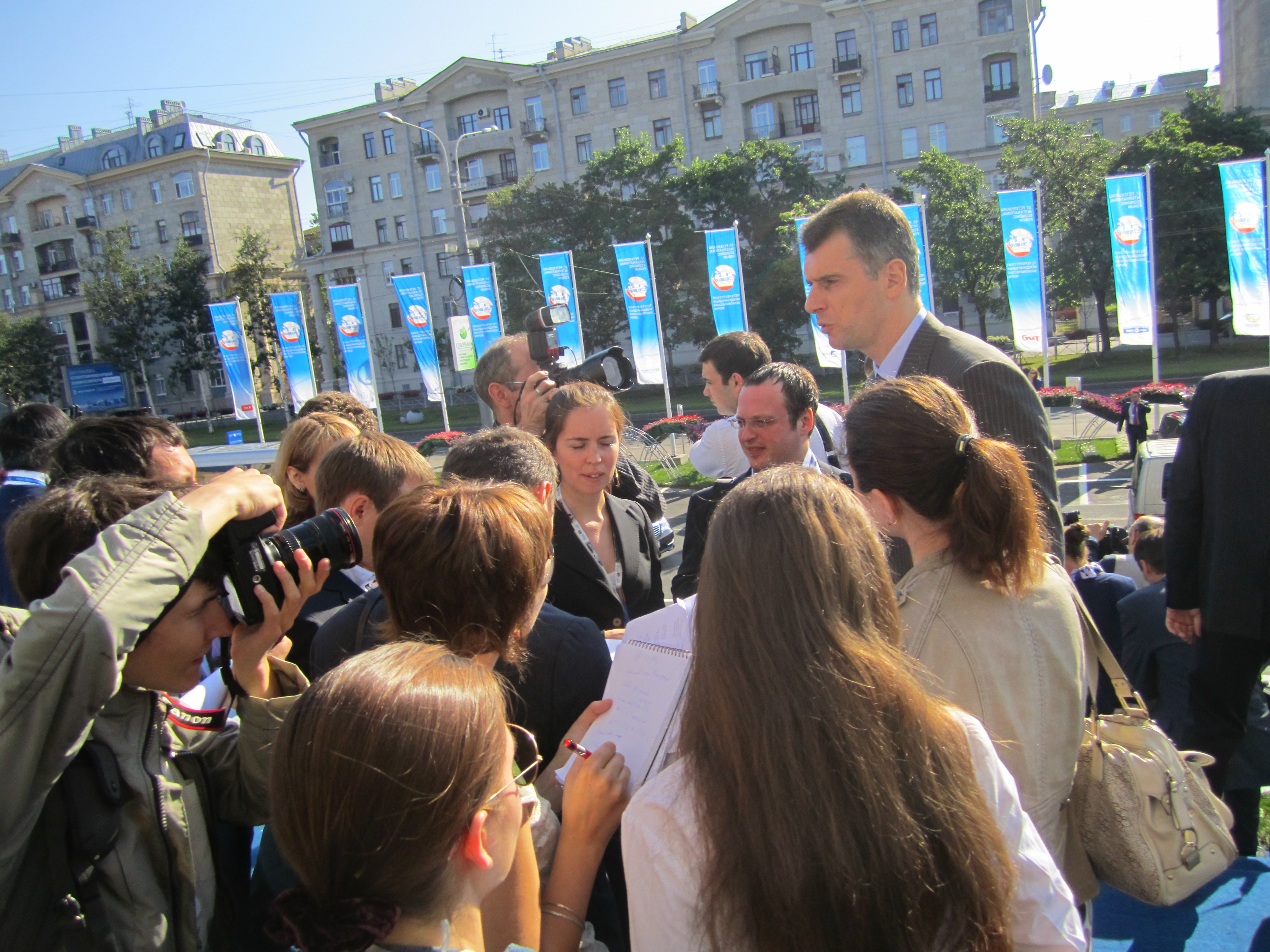
The Blue Carpet at this year’s St. Petersburg International Economic Forum (“Russia’s Davos”) framed the Entrance Steps for a variety of glamorous performances. Business men, photographers, journalists, conference personnel, an anthropologist, politicians, within a moments pass through this space igniting a sensory experience and thus, a sensible experience.

The steps set a colored fabric (blue carpet) — to an entrance of a conference — placing on display a fleeting phenomena of images that portray Russian political and economic power — ostentatious self-representation, fashion and elites.


Global Positioning

The Factory of the Sensible …

Quite some time ago now, Dick Olver, London-based head of global production for British Petroleum (BP), flew to Anchorage, Alaska to promote construction of an Alaska natural gas pipeline to deliver Arctic gas from Alaska’s North Slope of Alaska to markets in mid-continent. After his address, the Anchorage Daily News published a photograph of Olver. The man appears seated at a glass table with his hands reaching forward in a cupped-like manner. He grasps at an imaginary globe. The article headline is, “Global Positioning: North Slope Natural Gas Plays into BP’s Worldwide Plans.”

The last part of the headline — “plays into BP’s worldwide plans” — rhymes with the colloquial expression “plays into one’s hands.” It is a play on words stating that development of Alaska energy reserves is at the manipulative whim of BP.


World in the Palm

The photograph is striking. On the one hand, there is a clear image of Olver’s face and upper body attired in jacket and tie. Olver casts an excited grimacing smile. But in a curious display of editing, the full bottom-half of the photograph depicts the mirror image of Olver as he appears on the glass table, upside down. His head appears in Janus-faced expression and blurred by the reflection. Directly at the center of the photograph are four hands. Two of the hands belong to Olver, while the other two hands are those that appear reflected on the table. In a perversion of appearances, Olver has four hands and twenty fingers.

A glass half-filled with water or depending on perspective, half-empty, stands near Olver’s wrist, beside his gold cufflinks. The mirrored reflection from the table gives the water glass the appearance of an hour-glass. The water appears like the sand of time half-poured out. The news article begins by reminding Alaskans about Olver’s last appearance in Alaska the year before. Then, he was fighting for BP’s takeover of ARCO (Atlantic Richfield Company). The merger deal would have placed 70 percent of Alaska oil production under the control of one company.
Images of energy industry speak volumes. But it was at this same time, when the entire energy industry was uncertain with how to deal with uncertainty and risk — price volatility, wars, financial meltdowns.
Cambridge Energy Research Associates or CERA, a leading global energy consulting firm, took the opportunity to deal with these crises by framing their CERAWEEK conference through the visuals of a key symbol — the Chess Game.


One Move at a Time

In fact, not only the energy industry was concerned. Everyone required a new symbol — the same symbol — to deal with the times. Thus, the image of the chess game — this Very image — became a symbol circulating more widely across society. I found the image when I returned to San Francisco, in an advertisement for a symposium for Bay Area managers to learn the challenges of leadership in uncertainty.


Returning from the CERA Week conference in Houston, Texas, and I found this credit card application in my mail.


The two identical images are different. The CERA Week image focuses on strategic energy challenges for a changed world. But you can see in the background of the CERA image — there is clearly, an image of the globe.


Reproducible Images For Risk Management

The emphasis on the chess board, the vulnerable one-move wonder signified by the King, as well as the globe was apparent in other sites at the conference, including on one side of an internet smart card available to CERA conference participants.


The other side of this card has more. Here, the transparent globe has moved from the background to become the central attraction and is resting delicately in the hands of a child. In this image, the globe and strategic energy choices about the world’s future — are imagined as belonging to a next generation of leaders, presumably living in Asia, where strong economic growth is linked to increased energy capture, particularly in China. All of this — symbolized through the physiognomy of a child’s eyes…


A transparent globe cradled in the hands — through which to envision the future — taps also into the symbolism of the crystal ball, the fortune teller and practices of anticipatory knowledge, found during this period in advertisements on global communications.


The idea of hands propping up a transparent globe, returns us to Dick Olver — with his reference to Global Positioning. In this instance, strategic moves and foresight are linked to corporate power– that energy companies like BP literally have the world in the palm of their hands.


Worlds in the Palms of Hands


Contrast the above images to that used to symbolize the nation-state’s relationship to global modernity. In this image, the concept of Government emphasizes a lack of transparency — that is, lacking foresight, as seen in this figure of old Uncle Sam. Notice the different hand positioning, no longer in the supportive position, but resting on top of the world, invoking the Dead Hand of Regulation.

There is no mystery here, just aesthetics of the sense-making. Images from the factory of the sensible.

Energy consultants, like those at Cambridge Energy, always argue for global expansion in the industry and that natural gas energy flows through liquefied Natural Gas transport or LNG are suitable. Most natural gas travels by pipe. But LNG is always on the cusp of transforming from a niche regional business into a global industry. Global Gas Development is the watch word.

In short, natural gas can become a globally traded commodity. The U.S. market would become dependent upon these global energy flows. Thus, in these conversations, future U.S. dependence on global reserves of gas energy characterizes an entirely different world society than U.S. reliance on foreign sources of oil. Such things like natural gas imports, creating new economic value, and future global security, are all brought closer together through the reorganization of natural gas market knowledge, under the banner of reaching for the frontiers.

The symbol of this global gas modernity is found in a multi-faceted globe.

Shell Game


A Day in the Life of an Energy Consultant:
A Study in Productive Calm


Energy journalists are key players in Arctic natural gas development. We began noticing the influence of journalists when observing the Alaska Governors. Members of the Governor’s cabinet were highly concerned with the reporting of news events.

In fact, within the Alaska Governor Tony Knowles administration (where we began our paparazzi ethnography) we noticed a few journalists highly placed within the administration. They were word-crafters and public spokespersons for the Governor. Persons like David Ramseur, whose career began as an Alaska journalist, but in the final years of the Knowles administration, he became Chief-of-Staff. David recently is serving as Chief-of-Staff for Alaska U.S. Senator Mark Begich. Ramseur kept his cards close to his breast. He often wrote policy speeches for the Governor and kept an eye on daily press releases that we turned out for the Alaska media.

Journalist, L. Persily as Federal Coordinator

Another journalist who flittered between political appointments and freelancing for the Anchorage Daily News is Larry Persily. Larry is a master wordsmith. Under Knowles, he was Deputy Commissioner of Revenue and coined the term now famously delivered by the Governor, “My Way is the Highway” — which was in response to a policy favoring the Alaska-Canada Highway as the best route for an Alaska natural gas pipeline (should it ever be built).


Larry was hired also by Alaska Governor Sarah Palin in order so that he would not work as a journalist. We met up with Larry in Washington, D.C. recently, to see his new digs, as reflected in this photograph above. He is the Congressionally appointed Federal Coordinator on the Alaska Natural Gas Pipeline Project.

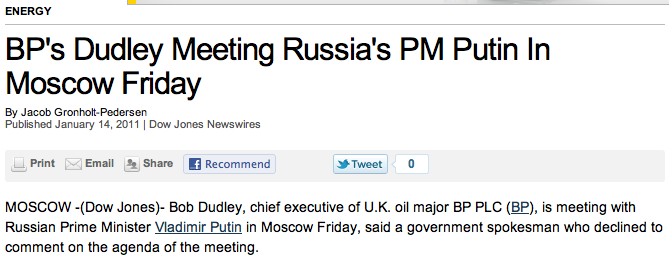
Moving on, in Moscow, we were lucky to meet with the quiet, humble, and high-in-demand journalist for The Wall Street JournalJacob Grønholt-Pedersen. Jacob is from Copenhagen. He speaks perfect English, Russian, and Danish. We initially saw Jacob’s writings when he was reporting on the Barents Sea Shtokman natural gas project. We contacted him by email. Here is an image from an internet search of his name.


We met Jacob for lunch on the pedestrian-only Kamergersky Pereulok – a sidestreet and popular hangout in Moscow. In fact, the street abuts the Cambridge Energy Consulting office where we met energy consultant Vitaly Yermakov. Here is a photo of Alex standing next to the Cambridge Energy bronze plaque.


Here is an example of headline by Jacob:


Energy Journalists on the Timing of Events

  • The issue of expertise surrounding development of the Barents Sea Shtokman natural gas field is reported upon in the press differently depending on the any one event, meeting or issue taking place. For ecological organizations, it is a chance to inquire into how potential industrial wastes and hazards will be handled. For representatives of Shtokman Development AG (the energy partnership) it is an opportunity to promote how information produced by environmental consultants will be made available. For trade organizations (builders, tenders) in Norway, they consider anxiously how they will be involved in the project.
  • Main tag line: “Russia’s priority project, the massive Shtokman offshore field in the Barents Sea north of Murmansk—a joint project with France’s Total S.A. and Norway’s StatoilHydro”.
  • In this article, Jacob demonstrates his access to expert analysts in the field. He quotes Vitaly Yermakov — Director of Moscow branch of Cambridge Energy; an “analyst” (unnamed source) from UniCredit and Ron Smith — Chief Strategist at Moscow-based Alfa Bank.
  • This main issue discussed concerns when the project will move forward at all. And we find printed here various statements by independent consultants or finance organizations who presumably are located somewhere in Moscow and whose comments are specifically limited to timing. Everyone wants to know about the timing of events. These statements on timing (2013, 2015, 2025, never) encapsulate an entirety of expectations surrounding regulatory and economic conditions.
  • If you google Moscow Cambridge Energy director, Vitaly Yermakov, his name appears in relation to Cambridge Energy Director in the Washington D.C. office, Matthew J. Sagers, who is author of an academic reaction paper to Milov et. al (2006), (the latter article appearing in the syllabus of Yale anthropologist Doug Rogers on energy in Russia). In addition to working with Yermakov, Sagers also cites in his bibliography an article collaboration with Russian gas economist Valeriy Kryukov, who we had dinner with in Oslo along with Oxford Energy Institute’s Jonathan Stern, at the Petromaks Workshop sponsored by the Norwegian Research Council — the same group who sponsored the Norwegian-Russian Arctic Gas Workshop in Murmansk, titled Petrosam (see below). Both Stern and Kryukov have been publishing for decades on Russian gas developments, together with Arild Moe of Norway’s Fridtjof Nansen Institute (see the post on Moe and Stern below).
  • In the article we refer to, Sager responds to the “nature of Russia’s official energy policy” (“ad hoc” rather than “systemic”). He comments primarily on whether Milov et. al are correct in their empirical assessments of oil exports, pricing developments, price deregulation, gas supply, export flows.
  • Essentially — what we draw attention to here is that there are various levels of detail entrenched in different spaces (academic journals, dinners, workshops), that bubble up to the surface through the work of journalists and often times in the form of statements about the timing of events.
  • The social function of the work of Pedersen, is to write stories in the form of news articles that serve as a hieroglyph, a consecrated form of expert interaction, a condensation of information flow, whose depth is flattened out by publication in the press, but that retains its hold as a source of knowledge because of its lineage, as represented by the various actors cited in text. We suppose the apt metaphor would be a tip of the ice berg. Articles by Pedersen, are like the tip of an ice berg — whose actual dimensions of depth — everyone in the know can recognize by its appearance on the surface of things.
In the event we are awarded our beloved National Science Foundation proposal, we plan to follow up with Jacob in the nearest future….

Mythos Gallery


Dancing.

Biliana Stremska — Berkeley artist, painter, architect, folk-dancer. We attended the opening of the Mythos Gallery‘s showing of her work along with other artists of the west coast. In addition to Biliana’s watercolors, which include energy themes, such as solar panels on homes in Sofia, Bulgaria — Portland’s Dane Wilson had several pieces concerning the light emitted from street lamps.

Capturing my attention was the inclusion of public lighting and renewables as suitable subjects, not only in the paintings, but also in the titles of the works themselves. One piece of Biliana is titled House with Solar Panels, while Dane had a few paintings with lamps, one titled Night Light.

Berkeley local Horst Bansner and Dane, darn near unnerved me with their chatter. Crammed into that little gallery, they badgered me on what I do (pipes, energy, paparazzi) and how could it possibly be anthropology, given that anthropologists focus on non-literate cultures, thought to be pre-modern.

It is a good question that soon had me admitting that I am a fall-guy for spaces of non-literacy. The fleeting phenomena rarely speaks with text.


In social spaces of interaction — in a language captured through face-to-face encounters — are where I find the verbatims and accents of emotional attachment.

I arrived ill-equipped. All I had was an I-Phone camera with a dying battery.

But I squeezed in a photo of what food the gallery curator put on display, what kinds of utensils, napkins, glasses, beverages, and whatnots.


A reading of Norbert Elias‘ History of Manners, suggests our relationship to the display of food is a dominant in how we define our sense of delicacy. Elias points out that table utensils, beginning in court society of 16th century, begin to shrink, actually get smaller, especially with the introduction of the fork. Beasts, once displayed on tables, disappear — even the carving of meat vanishes.


No Fork! and Eating with a Knife!

Unprepared Meat brought to the Table

Good visual examples of Elias’ narrative may be seen in the swashbuckling movies of Errol Flynn, especially The Adventures of Robin Hood, which I found on the web and cut and pasted here.

Elias points to a change over the past several hundred years from an instinct for interpersonal violence to an instinct for self-restraint. Interpersonal violence was part of a world in which there was interpersonal everything. In medieval times, body movements were unnoticeably shared. Masters, servants, children, all slept in one room. People ate with their hands out of the one-shared bowl, drank out of one shared glass, defecated in their commons.

“Back Then” — Interpersonal Violence was entirely Pleasurable

Bringing swords to dinner and fighting at the table is no longer acceptable

Thus, a shift from medieval society, where interpersonal violence is pleasurable—vendettas, feuds, revenge, duels — to modern society where violence is pathological — enables populations to sleep soundly as government drops bombs on civilian populations elsewhere.

In medieval court society, there arose an idea about court and specifically, courtesy, which drew attention to the idea of bodily shame and delicacy.

The very idea of Courtesy arrives at Court Society

The very Idea of courtly shame led to material practices that today we call manners. Over the centuries, increasing forms of self-control and restraint — of compulsions arising directly from threat of weapons and physical force gradually diminish while at the same time, giving rise to other forms of dependency — a police force—leading to affects in the form of self control.


Modern Courtesy requires Interpersonal Delicacy and Manners.

Politeness requires the Bomb

Hotel Moscow

I read a fabulously sentimental article in The New York Times about celebrated pianist, Harvey Van Cliburn’s return to Moscow as Honorary Juror to the International Tchaikovsky Competition, which he won in 1958 during the Cold War, at a time when then Premier of the Soviet Union, Nikita Khrushchev, was exploring the idea of peaceful coexistence with the United States. The article describes the outpouring of love still felt for Van Cliburn by Russians. Sitting in a coffee shop, reading the article, rubbing my eyes now filled with emotion, I suddenly had a Eureka Moment and breathed aloud, “Wait a spot – I know that place!”

Hotel Moscow

Right there, in that exact location, where Van Cliburn is posing for international photographers — I happened to have taken a photo of Alexandra Karamanova, my fellow photographist and travelry specialist on the first ever Paparazzi Ethnographic Tour last year of Russia — Moscow.

The View

Admittedly, Alex is no Van Cliburn. What I mean is that I do not think, in fact, that she even plays the piano. Nevertheless, the opportunity allows us to think about and reflect upon for a moment, just what Van Cliburn actually saw when standing on that parapet, having his photo taken by the international press. Just what were the material surroundings determining his consciousness as he smiled for the camera?

Let us take a tour!

First of all, Van Cliburn had to get up to the roof-top, and at 76 years old, he probably did not take the stairs. That means, he took the elevator. In which case, if he does not suffer from vertigo, he would have noticed the atrium he was passing through, and the cleanliness of the windows.

The Elevator Scene

He may have been accompanied by a few select paparazzi taking photos of his reaction to this Moscow hotspot, in the way Alex has staged this photo, in anticipation of such a moment, when we would notice someone in the news having their photo taken in this building.

Van Cliburn probably went up there for lunch, choosing a seat near where the photo was taken, and perusing through the menu in a nonchalant manner, just as Alex has done so here in this image — in a staged effort of anticipation about what future stars could be doing in this very location. Van Cliburn cuts a trim figure, so he probably doesn’t eat much. Probably, he has a sweet tooth, and ordered ice cream. It is actually quite warm in Moscow these days, so a little frozen confection soothes the nerves.

The Menu

Actually. Did I mention that this is the location of the Ritz-Carlton Hotel, on Tverskaya Street 3-5, situated just 150 meters from Red Square, with “panoramic views from its rooftop across to the Kremlin, which is 400 meters away”?

In addition to international stars like Van Cliburn, the Ritz-Carlton is also a watering hole for observing the “Celebrity Lifestyles of the Carbon Rich and Not-So-Famous” (and, of course, their self-appointed paparazzi ethnographers!).

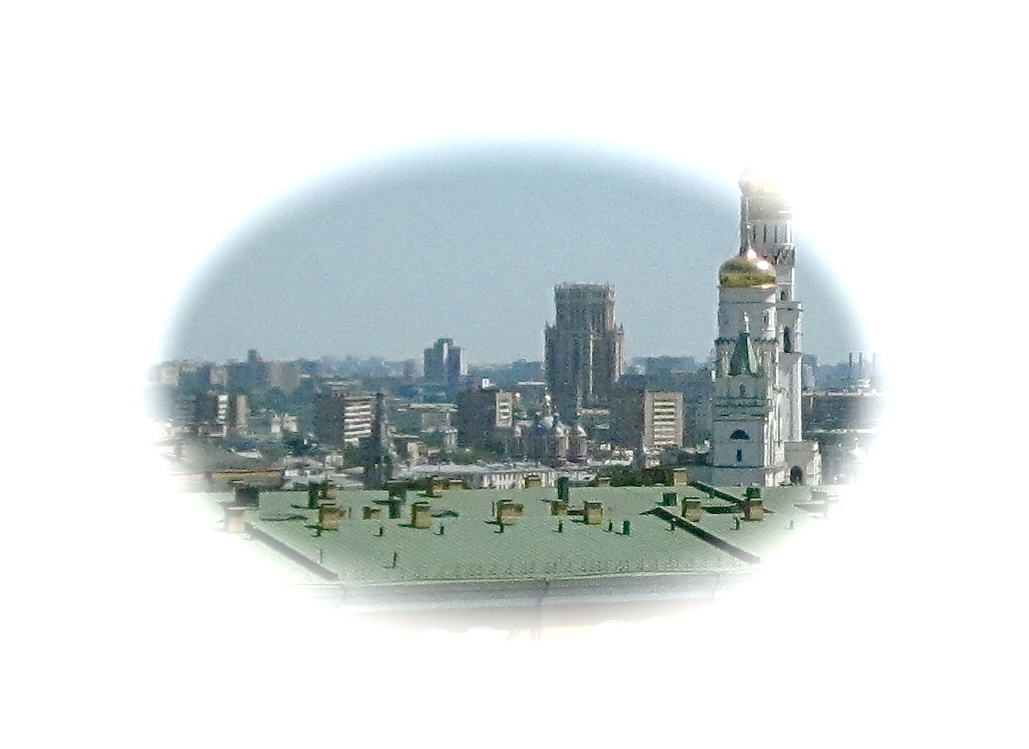
Well. Now you know the location. So you can do your own google search of images for the rest of the story. But I should mention, in final note, that from this particular location, in addition to the Kremlin, you can spot the Headquarters of various oil and gas companies in Moscow, including the Trade Tower in which we visited then President Bengt Hansen of Statoil, Moscow.

Statoil Boardroom, Moscow