Feeds:
Posts
Comments

Posts Tagged ‘Berkeley’

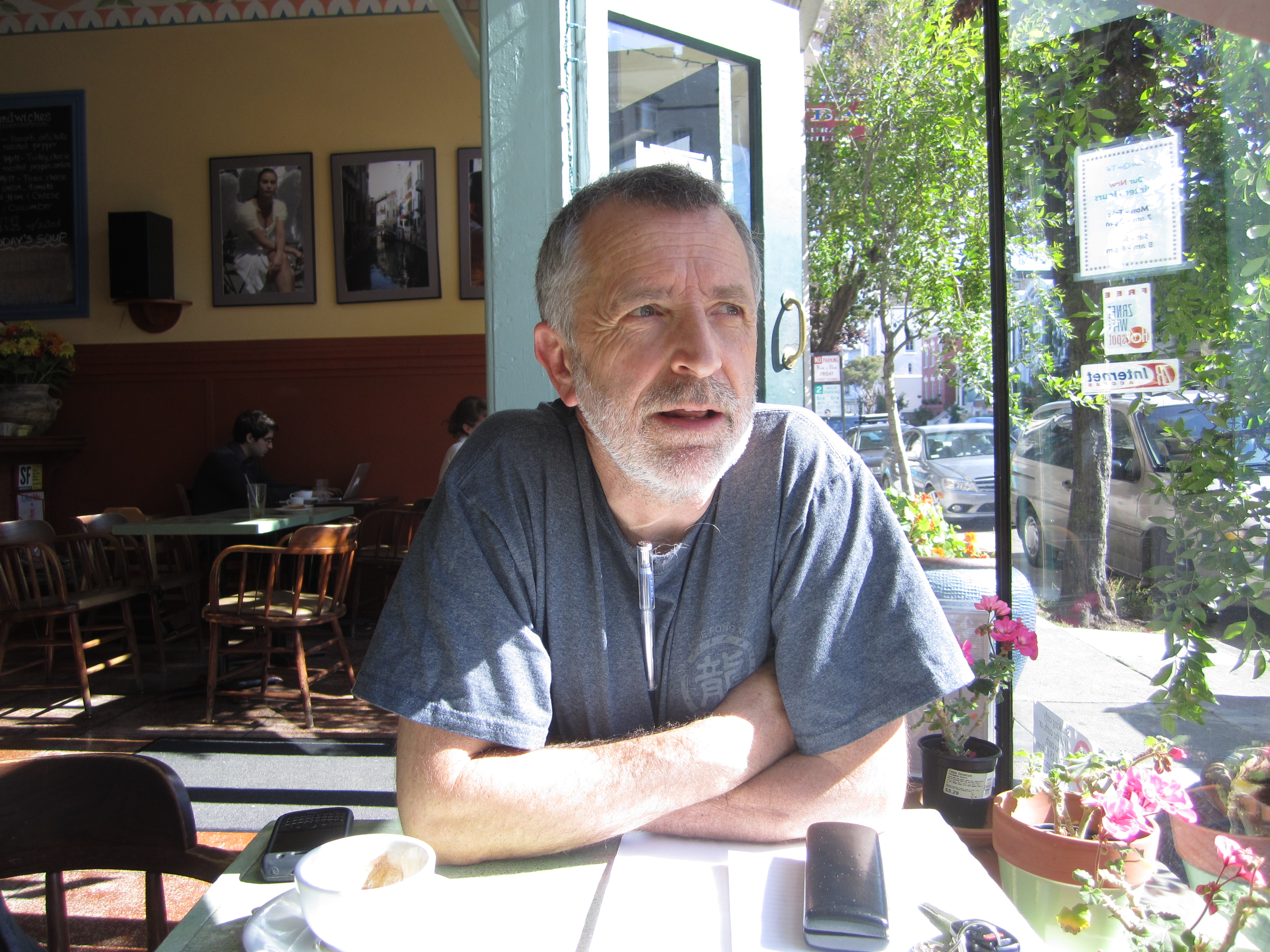
Nelson G.

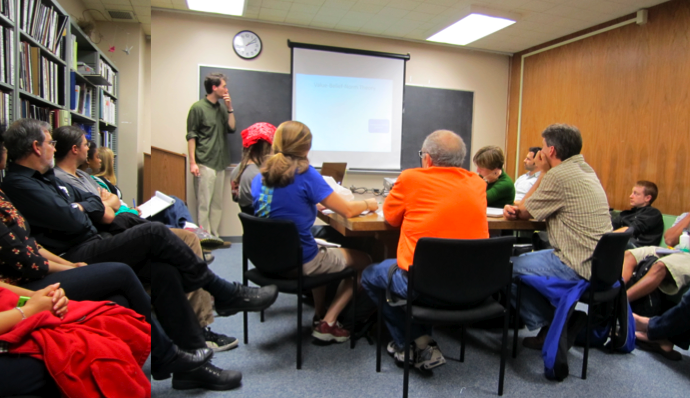
4/28 9AM: I caught up with my PhD advisor, Nelson Graburn, UC Berkeley’s Chair of the Canadian Studies Department and Professor Emeritus in the Department of Anthropology, who organized a conference for this weekend, titled Aboriginal Self-Governance in Canada, taking place in the Gifford Room, Kroeber Hall.

The event kicked off last night at 6PM sharp, with a duck dinner and familiar faces including Amanda Giles and Alexis Bunten, the latter, a Bristol Bay Alaska Native and Ph.D. in Anthropology.

Alexis just completed a superb article in the recent issue of Journal of Marxism and Interdisciplinary Inquiry, titled, A Call for Attention to Indigenous Capitalisms. She even cites my work, which is kind.

Over dinner, Alexis and I discovered that we had developed different views over what Alaska Native Corporations are going to get as a take-away from their re-election efforts on behalf of US Senator Lisa Murkowski (R). As everyone up in Alaska knows, Native corporations funded a write-in campaign for Murkowski after she lost the primary.

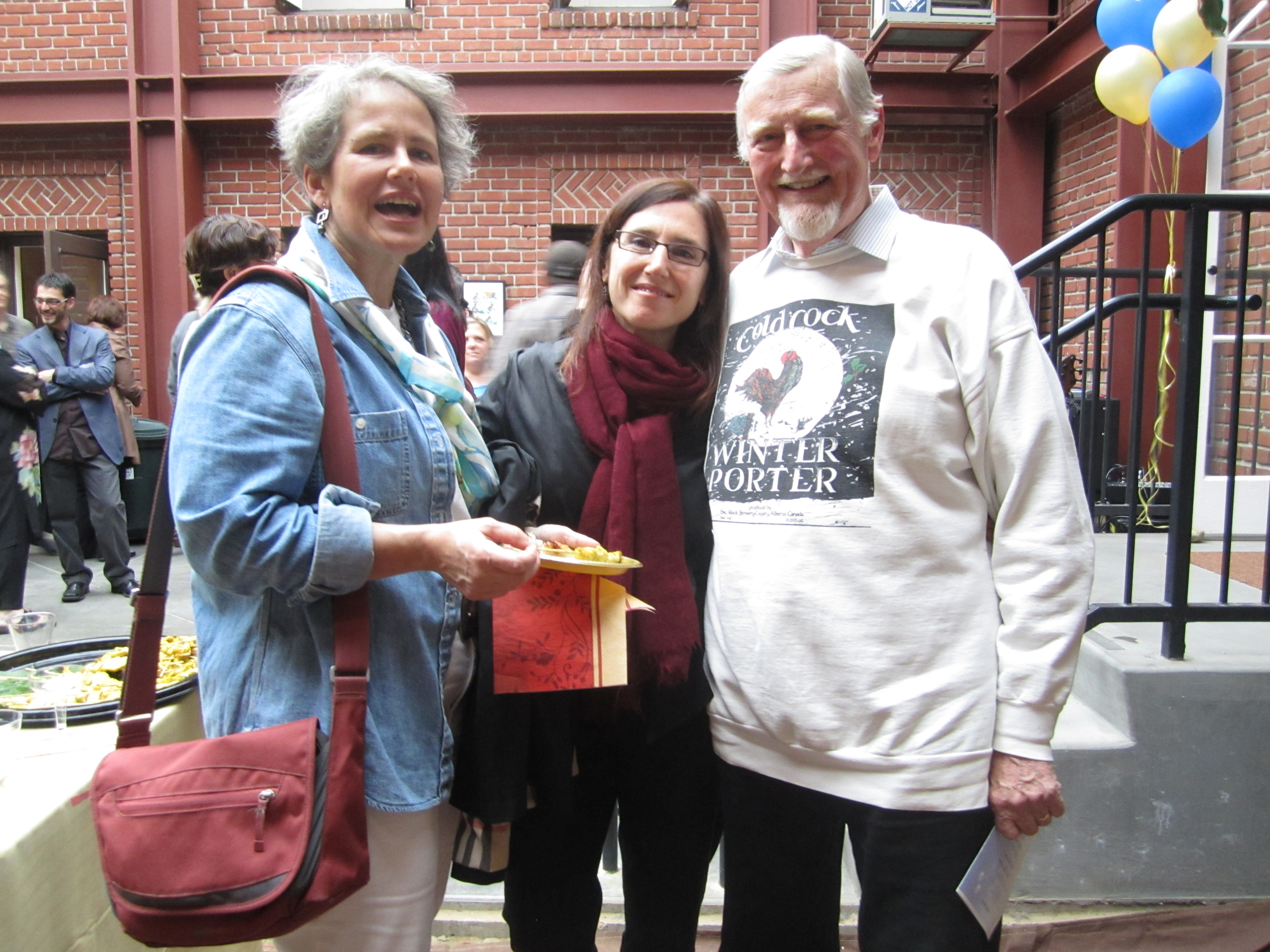
Alexis and I were able to to get reacquainted with Alaska heavies, Yup’ik leader Roy Huhndorf and his daughter, Dr. Shari Huhndorf, the latter now a UC Berkeley professor in the Department of Ethnic Studies, seen in the photo on the right.

At some point in the evening Nelson Graburn took to the bullypit providing an overview of the conference as well as reminding us all that government funds for research are an important part of keeping academic activities moving forward, and that we all need to take special note of who supports such funding when we vote in the next election.


I am going to refer to Nelson here and with all respect, as Daddy Cool, in memory of Boney M.‘s lead singer Bobby Farrell, that twist-master who every one adored from the 1980’s songs Rasputin and Daddy Cool.

In fact, the connection between the two men could not be more close —  both have lust for life and have a way of stirring excitement among those enviables who are lucky enough to grace their presence. Here is a poster for the day’s events, and shot of Bobby.


Curiously. I had not thought about Boney M. for ages until, one late evening, last summer in Akureyri, Iceland, while hanging out with Hjördís Guðmundsdottir, from the Akureyri Institute, at her house party, she broke out the Boney M. records. We started out earlier that evening as a group of revelers in a pub purchasing beer buckets. Here are a few photos:

Returning to Berkeley, Michele Hale, Arizona State U, Center for Indian Studies, is now talking, in the last session of the day about Navajo governance and self-determination during the 1970s, how that has led to what she calls devolution, an increase of active participation by the Navajo over what was previously federal control. This has lead to a large Navajo bureaucracy of 6000 employees with plenty levels of administration, now looking for reform because of ineffective services to communities.

And here, she refers to even greater devolution, from the central Navajo government to the even more local, whatever that is– and so I am waiting with bated breath on what the local-local looks like. This is because of lapses in ethics by leaders involved at higher levels. The phrase in play is Local Empowerment, (allows chapters to put the self in self-government), emphasizing participatory governance and citizen decision making.

Here they are, M. Hale, R. Huhndorf, A. Bunten, S. Hunhdorf:
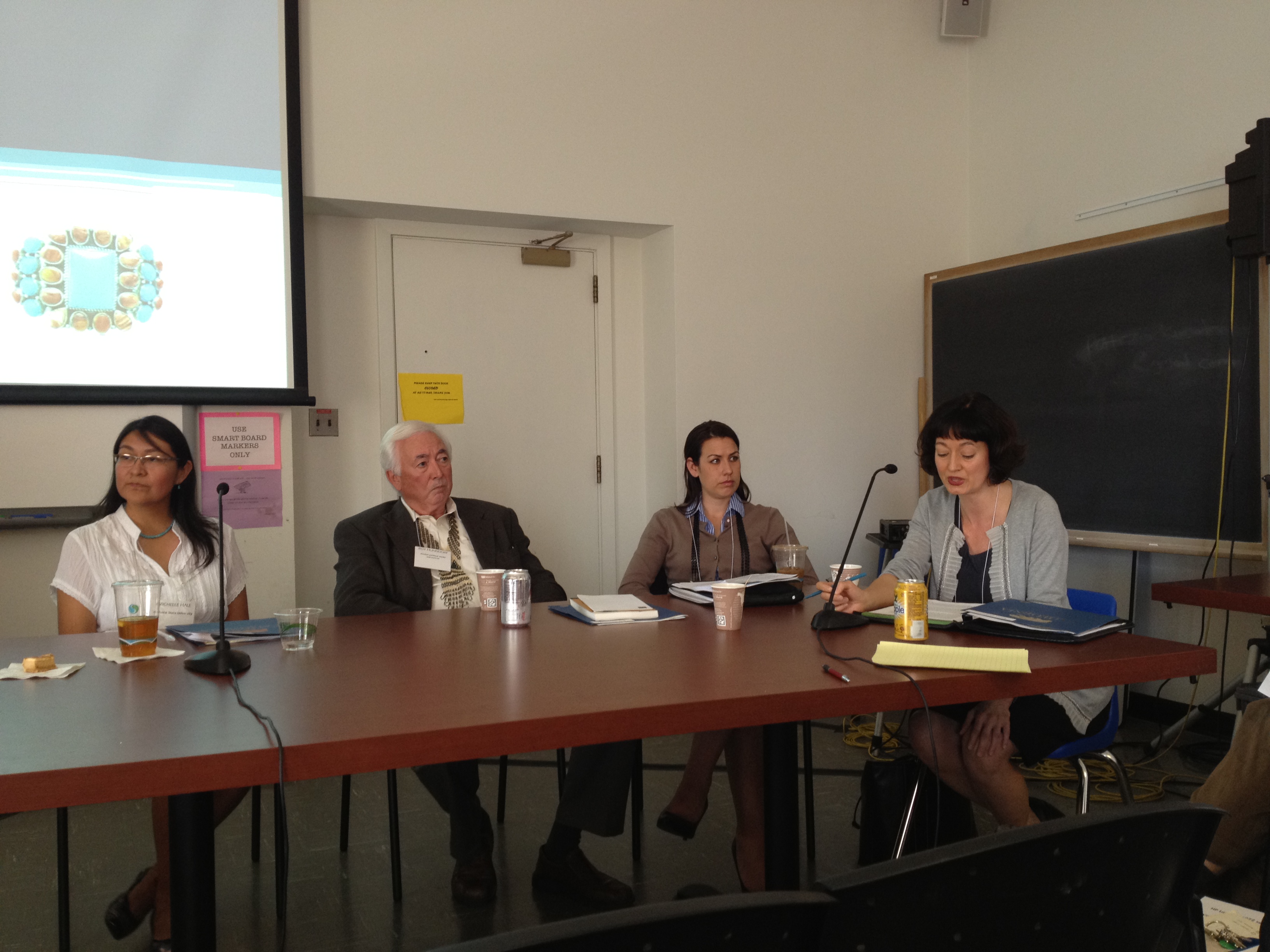
Roy Huhndorf is now up talking about Alaska Native governance after the Alaska Statehood, when Alaska Federation of Natives was set up to counter land transfers by the federal government to the state, when at that moment, oil was discovered at Prudhoe Bay, which opened up aboriginal title rights and halted the development of pipeline construction, which then led oil companies to lobby Congress to establish the Alaska Native Land Claims Settlement Act of 1971.

Alexis Bunten opens now talking about comparative legal frameworks on indigenous governance and so on.

It was good to check in with the folks from my old stomping ground, Kroeber Hall. We will see them again next time!

Read Full Post »

4/26: Energy Event #34


Read Full Post »

Wednesdays at ERG…

Wednesdays at the Energy and Resources Group (ERG), UC Berkeley, start early. At 8AM, we attend Climate Lab, taking place in the Neville G.W. Cook Room, and organized by PhD Candidate, Stacy Jackson. These weekly meetings provide opportunities for in-house discussions about climate change.

The talks are casual and range from the technical to the anthropological. As an anthropologist at ERG, you can find yourself at the nexus of always conducting research and ethnography simultaneously.

The technical here refers to economic projections and computer modeling that seek to establish the evidence so that we can collectively begin to emancipate the earth from laboring under the conditions of capital.

Everyone is concerned with greenhouse gas emissions, lowering the carbon footprint, behavioral change, moving toward lower carbon lifestyles. There is no question that the earth is warming, it is just a matter of whether the evidence can bring about certain political, technical and social ends.


On one such a Wednesday, I presented Empathy for the Graph, to discuss how time horizons that ERGies work with, become available through complicated non-representational images (graphs, charts, equations). These images remain a valid depiction of events, but are often ungraspable to most persons outside the confines of Neville G.W. Cook Room itself. Though in fact, there is some evidence, that various groups across the United States are becoming increasingly comfortable with non-representational images, and intensifying, in fact, a sense of unease among those for whom such images still remain standards of their inability to comprehend.


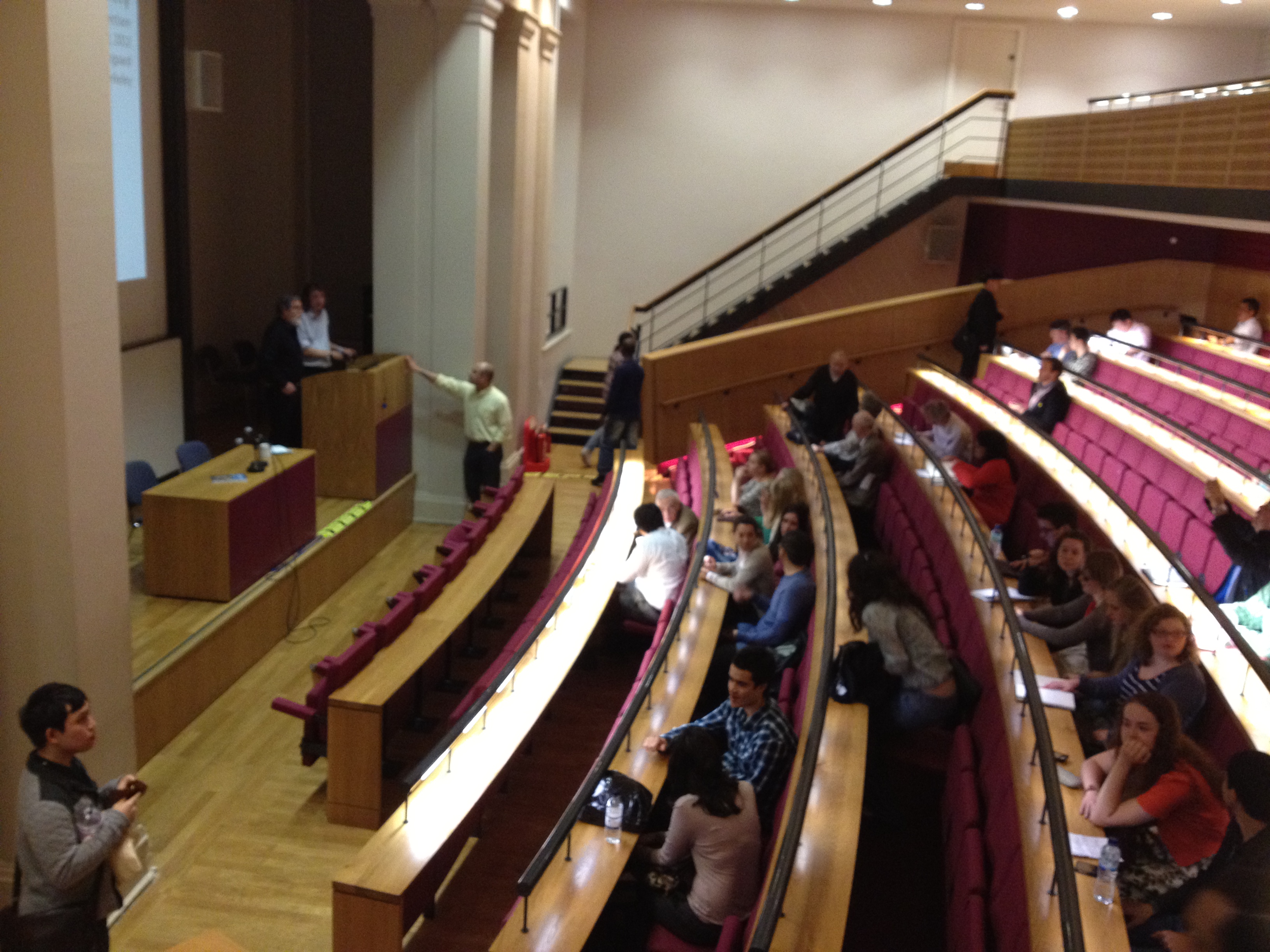
Well to continue. After Climate Lab, which takes place from 8AM to 9AM, everyone goes back to what they were doing. There is typically another talk at noon. A few folks from the Goldman School of Public Policy announce a seminar lecture, so we head over there, as we did recently, to hear from Jan-Erik Petersen, seen here, talking from the position of the European Environmental Agency about science and policy making for the environment in Europe.

But whatever the talk, we all typically return again at 1:30PM back into the same room where Emeritus Gene Rochlin presides over the PhD Seminar. Gene is a nuclear physicist with a political science background and leader in Science and Technology Studies.

By the way, ERG’s Dick Norgaard has a new edited volume, The Oxford Handbook of Climate Change and Society (2011) which he co-edited with John Dryzek and David Schlosberg. It is fabulous and expensive, still in hardback, but your library probably has a copy.

Dick presented recently in the lunch time seminar, and then, as if by chance, I was able to see an encore performance of that talk, much improved, in London at King’s College.
Certainly, I have presented at the lunch time talk as well, also in preparation for different venues. As such, the Neville Room is a laboratory for the constitution and staging of performative knowledge elsewhere.


Finally, at 4:10 PM (because Berkeley time is 10 minutes after the hour), we head over to the Colloquium.

This is a mix of PhD Candidates, Visiting Researchers, UC Berkeley faculty, presenting anything they happen to be working on these days.

“Wednesdays at ERG…”

Read Full Post »

CSTM&S

UC Berkeley’s Center for Science, Technology, Medicine, and Society (CSTMS).

Recently, David Winickoff spoke on Geo-Engineering. Cooling down the earth by controlling the sky — a type of science spear-headed by David Keith, previously of University of Calgary and my former sponsor of the Canada-US Fulbright when I was there some years ago. David K. is ultra smart and ultra famous, and now resides at Harvard University.

It was yesterday, at David’s talk, through an introduction from Chris Jones, that I met Ozzie Zehner, a Visiting Scholar at UC Berkeley with a newly minted book coming on the shelves about the pitfalls of green energy — in your book store this May 2012.

His book, titled Green Illusions, by all the looks of things, will be popular. Look for Ozzie on television soon, or NPR if you listen to the radio. We all got a chance to catch up over coffee. After our little chat, about all those et ceteras and so ons, we headed over to CSTMS’s launch of the undergraduate component, titled, Science of Society’s Course Thread.

The thread launch included food.


Read Full Post »

Dustin Mulvaney


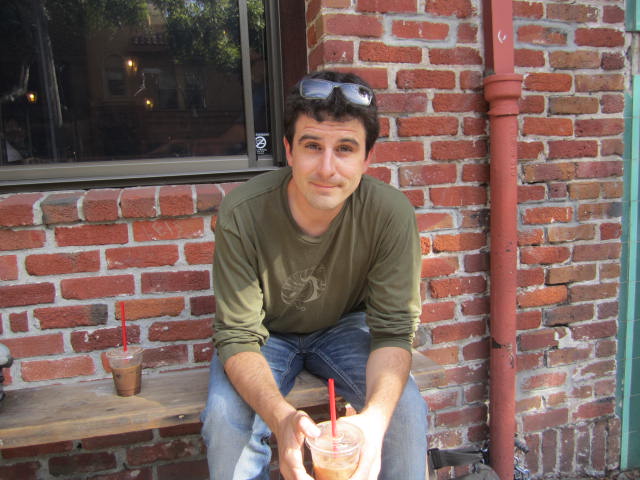
10/14: Friday, I had a chance to catch up with Dustin Mulvaney for coffee.

We both were heading over to the Environmental Politics workshop to discuss Matt Hubert‘s chapter on neoliberalism and the 1970s in the wake of the oil crisis. The workshop consists of about 20 persons sitting around a table. Matt introduced his piece, which everyone had read before hand. Then we discussed the work while Matt remained silent.

Chris Jones was there, who is working on energy transportation at the middle of the 19th century, so I had a chance to introduce him to Dustin.
Department. of Geography’s Michael Watts turned up, providing a few comments, as did Nancy Peluso. The evening before, I tagged along with Matt and members of the Department of Geography, Nathan Sayre, and Richard Walker, for dinner at Gather, a Berkeley locale, for steak and margaritas. I had a chance to talk with PhD student Teo Ballve about his work in Latin America on drug cartels and territorial governance.

10/07: I met with Dustin for coffee to discuss among other things his interest in carrying out a GHG Inventory/Life Cycle Analysis of Exxon-Mobil’s Shale Gas production.

He suggests that natural gas produced from hydraulic fracturing operations produces methane emissions that make the Greenhouse Gas (GHG) intensity of natural gas higher than coal. There is also significant uncertainty around the GHG intensity of Tar Sands extraction and Synthetic Fuel production. So what he aims to do is to conduct a peer-reviewed life cycle assessment of hydraulic fracturing operations (in collaboration with Exxon-Mobil).

The other major resource impact from hydraulic fracturing operations is water. Water footprinting includes more than water quantities consumed and quality of wastewater, but also factors such as geographic content of water extraction. Here, he proposes to evaluate the water footprints of hydraulic fracturing and tar sands operations in the context of the geographic areas of water impacts. For hydraulic fracturing, he would contextualize the water footprint in areas of high and low controversy (comparing Pennsylvania operations to those in New York). For tar sands he would evaluate water impacts at sites of extraction and along potentially vulnerable water supplies.

3/31: I met up with Dustin Mulvaney, post-doc at Berkeley, who received his PhD at UC Santa Cruz. Dustin works on solar energy and has been traveling around lately looking at various ways government, through the Department of Energy, lavishly funds speculative deals in solar electricity. In particular, he is concerned with the environmental aspects of desert clearing when installing solar power. Such activity begins when a company files an environmental impact report with government. The report demonstrates what will happen to nature when constructing and operating solar power installations. Often, these reports are called Life Cycle Analysis (LCA) documents. These LCAs are supposed to describe the entire impact of a technology on the environment, from its initial assembly, operation, all the way to when the product is dismantled.

What Dustin has been discovering in his research, however, is that the metrics for determining LCAs, that is, the actual methods used for identifying impacts in these reports, actually do not include many of the ways in which a technology impacts the environment. He mentions for example, that the desert turns out to be an environment that sequesters carbon, and that clearing the desert would release more carbon into the atmosphere. Well, this feature is glossed over in the environmental impact report. In the end, he points out that metrics used to create these increasingly popular LCA reports, are quite political, and often conceal many aspects of how solar power impacts the life cycle.

Our conversation began with a walk over to the north side of Berkeley campus to the Thai restaurant on Euclid, next to a coffee bar that we were eyeing. We settled in, ordering the same thing, which happens a lot with me, actually, as if I am interested in tasting what the other person feels about their food. Dustin had some fascinating things to reveal about solar power industry, government give-a-ways, land give-a-ways, and fabulous taxpaying dollars being spent all under the name of innovation and cleantech. One Israeli company, BrightSource Energy, for example, has managed to obtain nearly 2 billion dollars from the US government, for which the company has used to fund military contractors to build gearboxes, and traditional engineering firms (Bechtel) to construct tubes– not necessarily companies on the innovative edge.

After finishing off plates of rice, green beans, and tofu, we skipped out to the coffee shop and ordered mochas. Sitting on the street, we began our conversation again. Dustin knows a lot of people in his field who are working at multiple scales — not only knowledge and information in Washington, D.C. (at the high level of creating abstract laws), but also what is happening in the field offices of, say, the Bureau Land Management in New Mexico, who map and lease out land. In a sense, he is examining the entire commodity chain of solar power.

We have both been fascinated by the concept of clean in phrases like clean coal, cleantech, or what ever to which clean can be attached. But what does clean actually mean in these contexts? It refers of course, to energy technologies that release less carbon, and thus reduce chances of climate change. But is clean coal actually clean? Will mountain tops no longer be destroyed? Will streams no longer be polluted by the word clean in clean coal? In a word, no.

Actually, Dustin had a come up with a phrase to capture this mode of thinking, which he calls — The Reductionist Epistemology of Carbon.

Read Full Post »


Dancing.

Biliana Stremska — Berkeley artist, painter, architect, folk-dancer. We attended the opening of the Mythos Gallery‘s showing of her work along with other artists of the west coast. In addition to Biliana’s watercolors, which include energy themes, such as solar panels on homes in Sofia, Bulgaria — Portland’s Dane Wilson had several pieces concerning the light emitted from street lamps.

Capturing my attention was the inclusion of public lighting and renewables as suitable subjects, not only in the paintings, but also in the titles of the works themselves. One piece of Biliana is titled House with Solar Panels, while Dane had a few paintings with lamps, one titled Night Light.

Berkeley local Horst Bansner and Dane, darn near unnerved me with their chatter. Crammed into that little gallery, they badgered me on what I do (pipes, energy, paparazzi) and how could it possibly be anthropology, given that anthropologists focus on non-literate cultures, thought to be pre-modern.

It is a good question that soon had me admitting that I am a fall-guy for spaces of non-literacy. The fleeting phenomena rarely speaks with text.


In social spaces of interaction — in a language captured through face-to-face encounters — are where I find the verbatims and accents of emotional attachment.

I arrived ill-equipped. All I had was an I-Phone camera with a dying battery.

But I squeezed in a photo of what food the gallery curator put on display, what kinds of utensils, napkins, glasses, beverages, and whatnots.


A reading of Norbert Elias‘ History of Manners, suggests our relationship to the display of food is a dominant in how we define our sense of delicacy. Elias points out that table utensils, beginning in court society of 16th century, begin to shrink, actually get smaller, especially with the introduction of the fork. Beasts, once displayed on tables, disappear — even the carving of meat vanishes.


No Fork! and Eating with a Knife!

Unprepared Meat brought to the Table

Good visual examples of Elias’ narrative may be seen in the swashbuckling movies of Errol Flynn, especially The Adventures of Robin Hood, which I found on the web and cut and pasted here.

Elias points to a change over the past several hundred years from an instinct for interpersonal violence to an instinct for self-restraint. Interpersonal violence was part of a world in which there was interpersonal everything. In medieval times, body movements were unnoticeably shared. Masters, servants, children, all slept in one room. People ate with their hands out of the one-shared bowl, drank out of one shared glass, defecated in their commons.

“Back Then” — Interpersonal Violence was entirely Pleasurable

Bringing swords to dinner and fighting at the table is no longer acceptable

Thus, a shift from medieval society, where interpersonal violence is pleasurable—vendettas, feuds, revenge, duels — to modern society where violence is pathological — enables populations to sleep soundly as government drops bombs on civilian populations elsewhere.

In medieval court society, there arose an idea about court and specifically, courtesy, which drew attention to the idea of bodily shame and delicacy.

The very idea of Courtesy arrives at Court Society

The very Idea of courtly shame led to material practices that today we call manners. Over the centuries, increasing forms of self-control and restraint — of compulsions arising directly from threat of weapons and physical force gradually diminish while at the same time, giving rise to other forms of dependency — a police force—leading to affects in the form of self control.


Modern Courtesy requires Interpersonal Delicacy and Manners.

Politeness requires the Bomb

Read Full Post »

Paparazzi Ethnographer (that’s me!) bringing you the latest news of the not-so-famous, and today is no exception. Brought to you directly from the retirement party of UC Berkeley anthropologist Nelson Graburn is evidence of what can only be described as an academic celebrity pile-up.

But before we even go there, we need to introduce our latest discovery, the talented and stunningly straight forward jazz singer, Abby Diamond and her act, The Diamond Jim’sVoilà!

Abby Diamond, Jazz Singer extraordinaire

The Diamond Jim’s

Guitarist Mark Coulter

“What a set of pipes,” is all that could be heard by anyone who dared to whisper aloud about Abbey’s vocals when the band started up.

Okay, let’s get back to business. Nelson Graburn, world renown arctic anthropologist, Inuit arts, inventor of the phrase fourth world (referring to indigenous modernity) and creator with his bear hands of an anthropology of tourism — is retiring. After 48 years, he’s decided to call it a day.

entering the mosh

Dr. Conkey

Dr. Habu

Let’s take a look at who came out to see the master off.

Uh-huh.

Oh my Lord, is that who I think it is? Meg Conkey, archaeologist extraordinaire (another one!) and Junko Habu, who actually worked in the Arctic for a bit, if I recall — no wait, she’s famous for Pacific Rim archaeology of Japan, on sabbatical last year, but back to the trenches.

Dr. Laura Nader and Nelson Graburn

Drs. Ferme, Pandolfo & Graburn

Laura Nader and Nelson Graburn, wow, two anthropological heavies in the same room and friends after all these years. Mariane Ferme of Sierra Leone ethnography fame, and Stephania Pandolfo. And all these folks have written books, multiple books.

Good grief. Science, what a Life!

Tomeko Wyrick

Kathy and Cecily Graburn

Tomeko Wyrick, btw, worked the room splendidly. She’s in charge of the Archaeological facility, or at the very least making sure things run smoothly, and she was in fabulous form. There they are! Kathy Graburn and the Song Bird, Cecily Graburn. Oh, pardon me, the Opera Singer. The first time I saw Cecily sing, I thought to myself, shhh, let’s listen – and then Boom! Her voice was so strong it practically shook the rafters apart. Cecily also plays and teaches violin.

Phew! That about does it for now. Congratulations Nelson!

Read Full Post »

« Newer Posts - Older Posts »