Feeds:
Posts
Comments

Posts Tagged ‘Berkeley’

Tonight, we caught a free screening of the Swedish version (with English subtitles) of the movie, The Girl Who Kicked the Hornet’s Nest, the film adaptation of the third novel in Stieg Larsson‘s Millenium Series. The trilogy includes the bestselling novel, The Girl with the Dragon Tattoo.
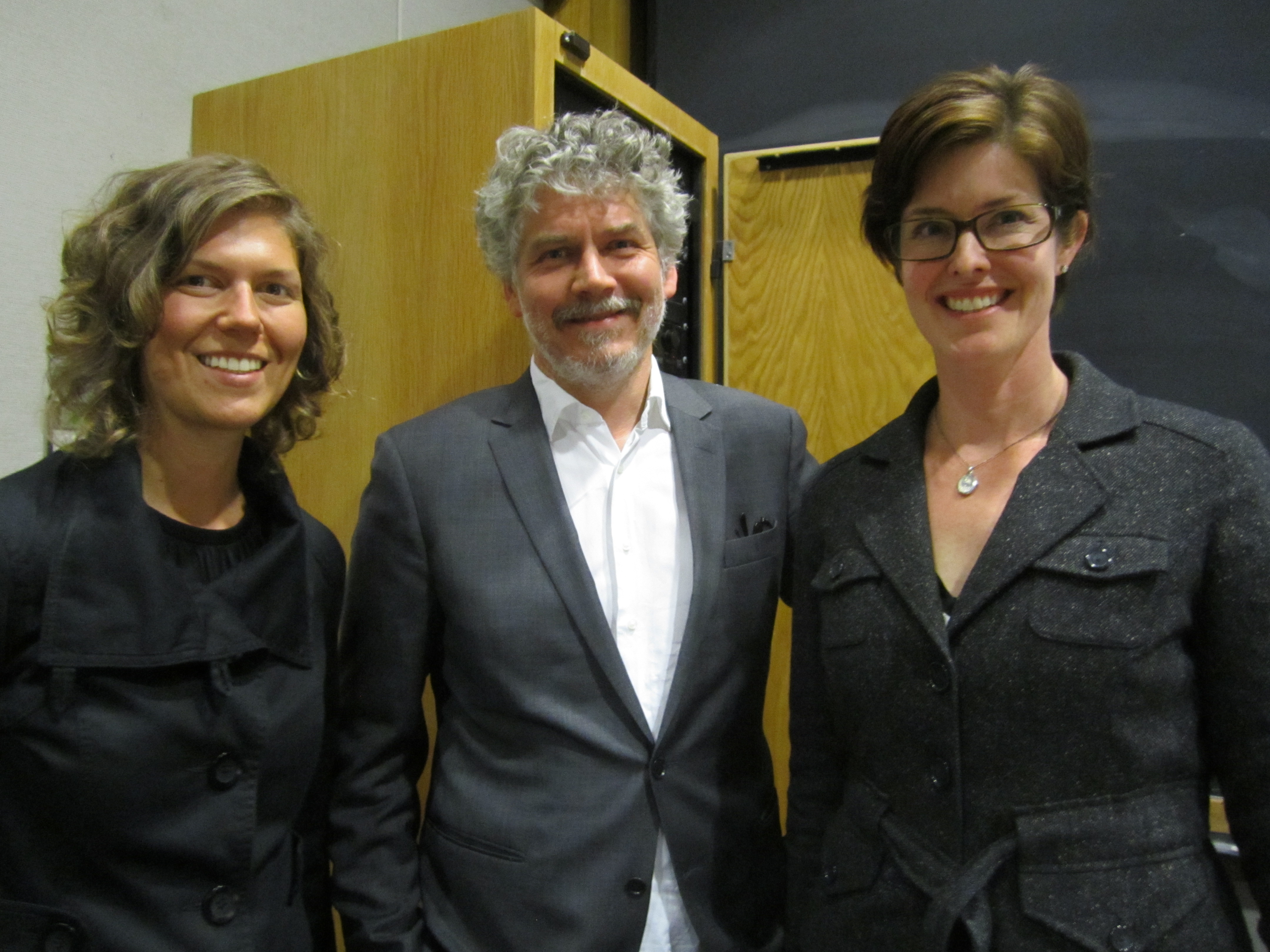
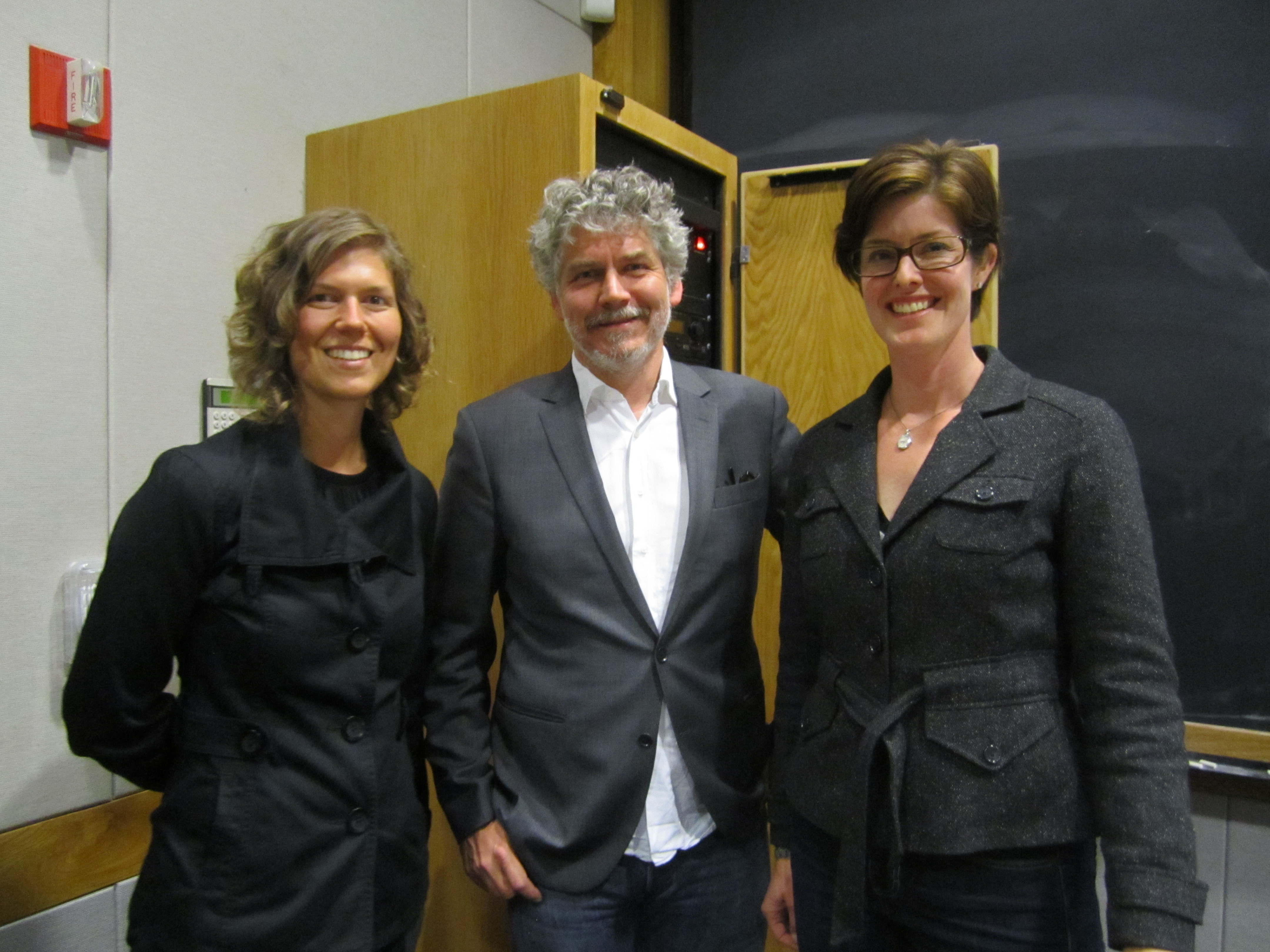
Swedish film Director – Daniel Alfredson flanked by UC Berkeley’s Laura Horak (L) and Amanda Doxtater (R)

The feature film was followed up with a question and answer period with filmmaker, the Swedish director Daniel Alfredson. The program was organized ably by Amanada Doxtater of UC Berkeley’s Scandanavian Department and Laura Horak of UC Berkeley’s Film Studies Department.

Did I just say the word “ably”? In fact, Amanda and Laura were fabulous! As you can see from the photograph — as hosts, they shone with every bit of the star quality as their guest. And the hall was packed to the gills.

Everyone enjoyed the film, even though for many it was not the first viewing. I had already seen the film previously, but I wanted to catch it once more — to get into the mood of the evening prior to when the director would be commenting on his work.

There is an interesting story here for those of you who are not familiar with the book trilogy or the movie sequels. Apparently, the Swedish production that created the three movies also created a parallel television series which was shown in Europe. Both the movie and television versions have some overlap but are separate films.

Film directed by Oplev

Directed by Alfredson

Directed by Alfredson

Also, what I did not know, is that Daniel Alfredson directed the two sequel films (The Girl Who Played With Fire and The Girl Who Kicked the Hornet’s Nest).

Niels Arden Oplev, directed the first of the trilogy The Girl with the Dragon Tattoo.

To the enjoyment of everyone attending, Daniel Alfredson was articulate, charming, charismatic, well-dressed — and all without compromising an edgy artistic glow. He patiently and thoughtfully answered all the questions we posed to him  – over the period of one hour! Of course, I couldn’t hold back and asked him three questions, so star struck as I was about the artist and especially the artistic process.
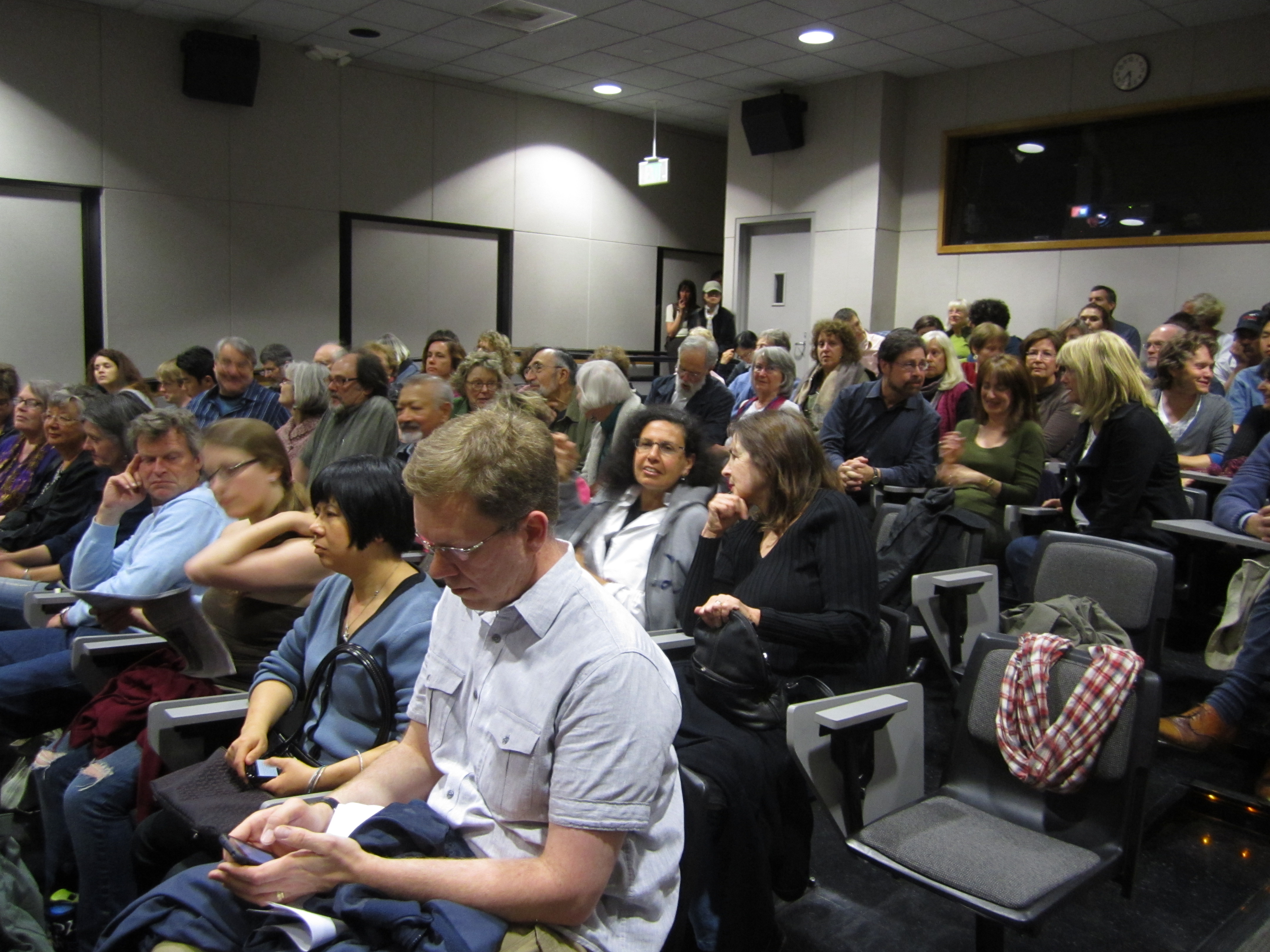
The hungry crowd

Did he feel any pressure stepping into a sequel film project? No, in fact, he pointed out that the sequel production was already underway before the first film even opened in the theaters. So the sense of expectation typically associated with a sequel was absent. What did he think about Daniel Craig playing the role of Michael Nyqvist in the American version of the film?

That was my question.

On this point, Daniel was gracious to a fault, expressing only support over the upcoming attraction.

A question about the musical score set him to pause and we could all see that here was a topic in which he had struggled over to get just right, since much of the last film deals with facial expressions without dialogue.
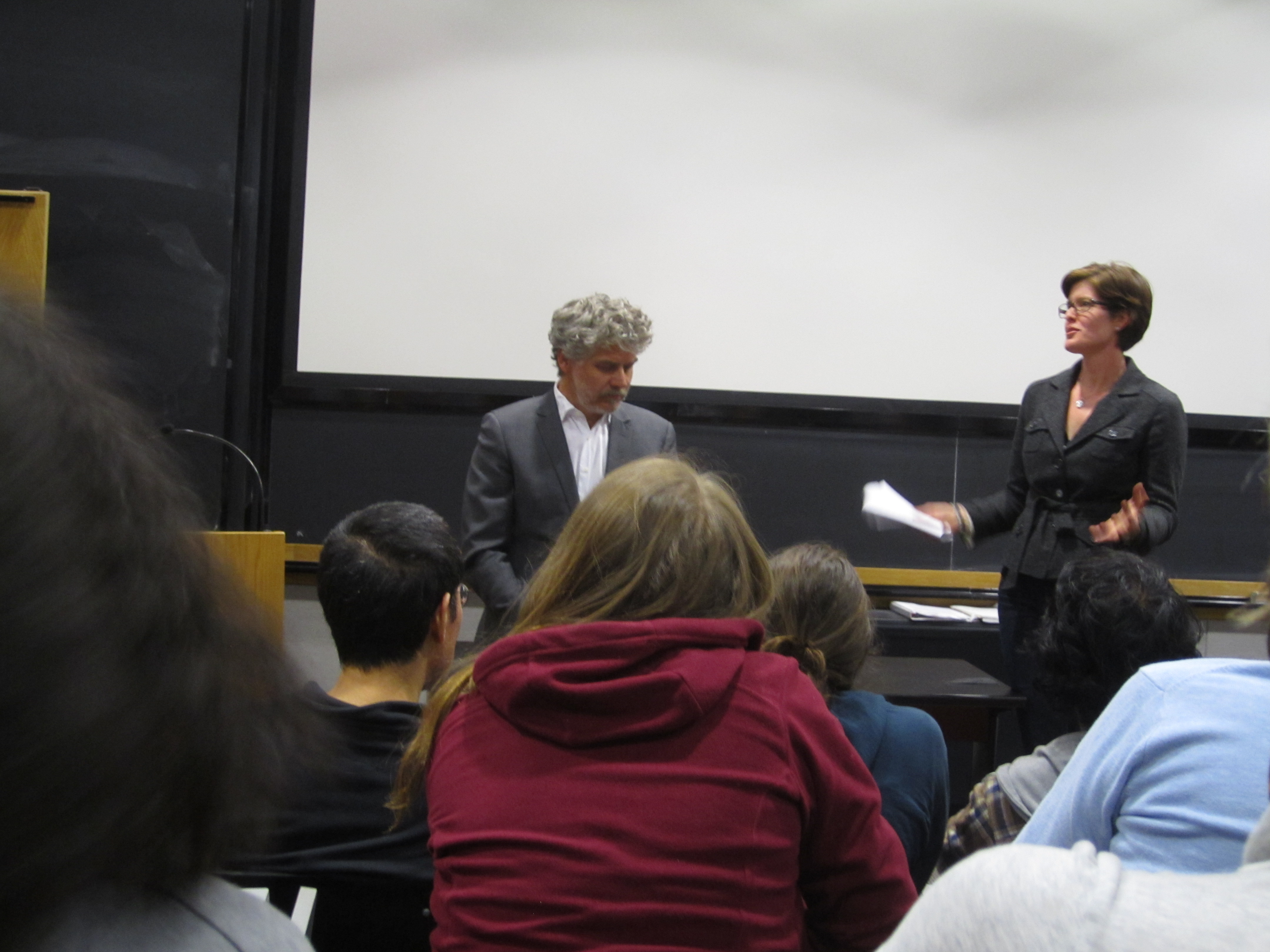
Question about musical score
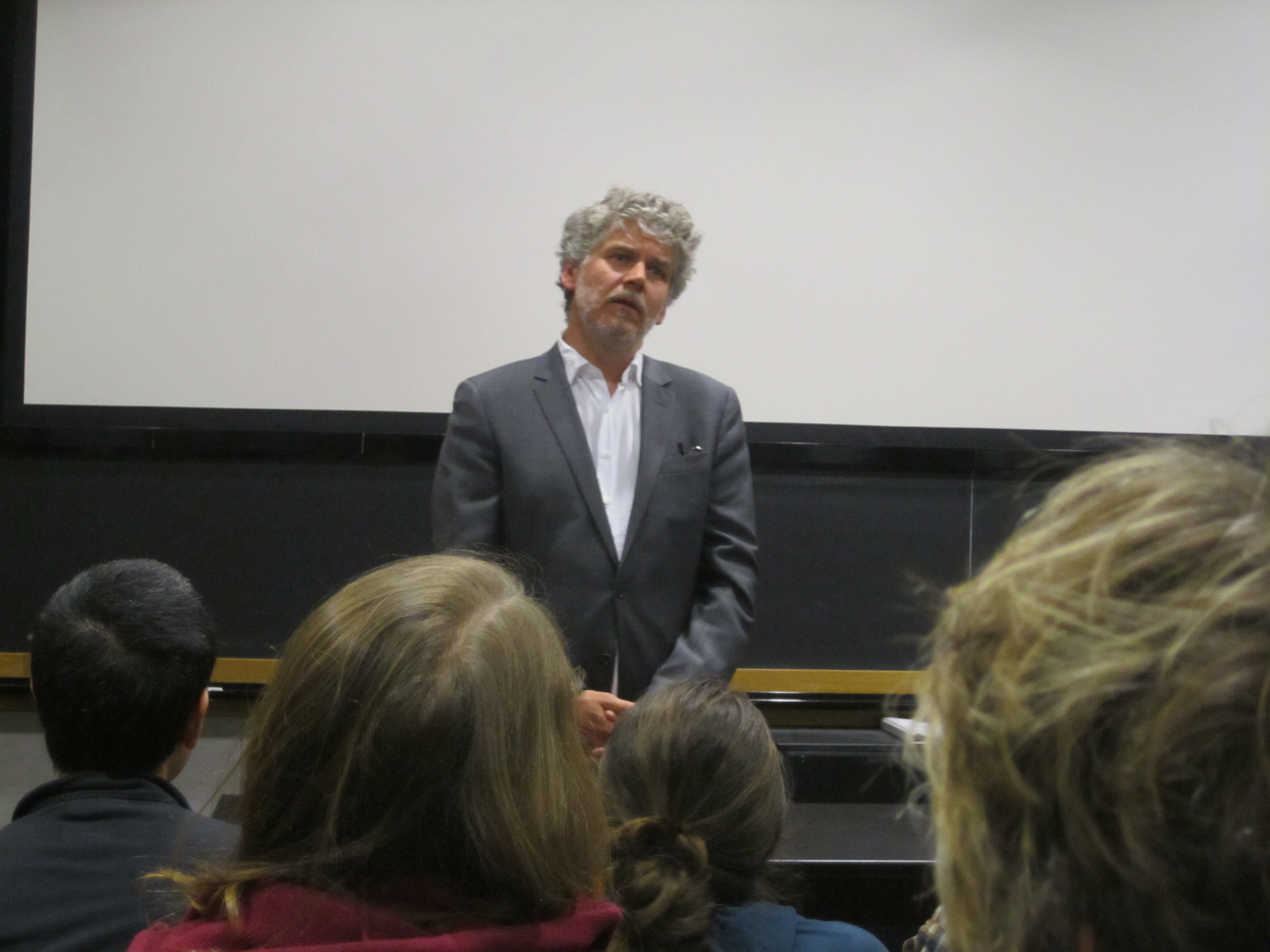
Question about Daniel Craig

I usually work alone, writing. So I wanted to know: what is it like to film on a set, organizing all those actors, what’s going on in your head??!!

His answer came as a surprise:

eh, not really a big deal. He suggested that filming is a military excersize, in which organization and timing are key, and where the action sequences are about


technique while the emotional sequences are about capturing silences, mood of expression and keeping the tension.

By the way, since I work in Norway, Denmark, Sweden, Finland and Iceland, AND, since I’ve always been interested in carrying out an anthropology of film direction — yes, you guessed it


— I couldn’t stop myself and had to ask him outright, whether I could contact him for a follow-up discussion about conducting an anthropology of Scandanavian movie production.


And what do you think Daniel’s reply was?
The Glamorous Trio
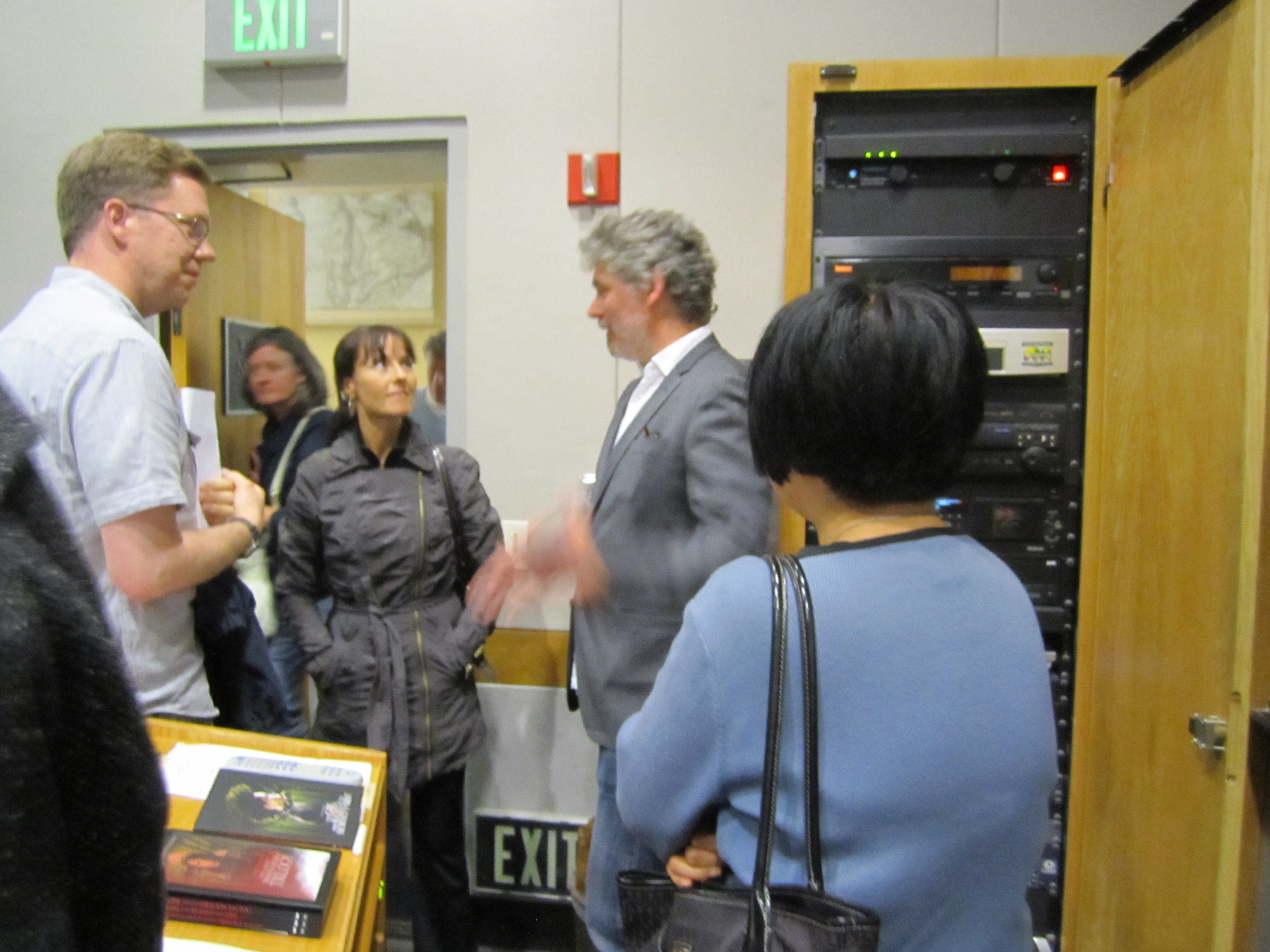
Meeting the man in the man


Well, let’s just say that we’ll catch you on the set of the next Daniel Alfredson movie production, as


StudioPolar expands its paparazzi ethnography to bring you all in the latest aesthetics of the not-so-famous.

Read Full Post »

Dirk Brantle

Met with German philosopher Dirk Brantl, visiting here from the University of Tubingen. We met last week at the ERG picnic, when I asked him to discuss his research on 17th century author of Leviathan, Thomas Hobbs, for which Dirk has completed a doctoral dissertation and is in the process of writing a book on the topic.

Dirk had fascinating insights about Hobbs. One of the things Dirk pointed out is that, while graduating from Oxford, Hobbs never became a university professor. Instead, he was tutor to certain large families in England. Much of the material he based his writings upon was available to him in the libraries of these estates. And of course, Dirk walked through the logics of Hobbs’ critique of Aristotelian philosophy of virtuousness, suggesting that man by nature can only act according to his interests, and to be virtuous requires a strong sovereign force.

Dirk and I then discussed the possibility of meeting for a coffee and he requested that I send him something I was recently working on – which I was happy to do. I emailed my recent paper on Corporeality of Consultant Expertise, the talk I gave this past Wednesday previously.

Here’s a sense of the conversation I had with Dirk, because I wrote a few points down:

  • My book is essentially about the fleeting phenomena surrounding how agendas are set through expertise. Here what I am referring to is not political institutions or history of the industry, but instead, the all facets (through ethnography) of what happens when consultants engage with politicians. And this is captured from handshakes to the kinds of images used to influence politicians about decision-making.
  • In an earlier post, for example, and in the corporeality piece, I refer to a Heidegger-ean distinction of tradition versus modernity – primarily through the way humanness is represented on things- such as leather and wood that were close to our bodies and which we utilized over a long period of time, versus its absence on modern products, such as computers, car door handles, which do not carry a trace of the human heart and are disposed of readily. And in this case, my argument was that things that carry a Human Trace, are not necessarily carrying them in a deliberative manner. There is no virtue in leaving a human trace of the human hand on a wooden door post that has been opened for umpteen years. But the fact is, that once that door post, now 2 decades old, is encumbered with the trackings of the human hand, this non-agentive object takes on agency, because it represents the accumulation of time, subjected to it, of course, without intention. And in this manner, I refer to the hands of experts, which are like putty, because they never do any manual labor, but when shaken, demonstrate and take on agentive quality. That is, when you shake their hands, you are confronting a particular type of humanness, characterized by a certain corporeality in relation to a specific type of labor.
  • Take another example, in my book, government is not interested in economic training, but in how to channel the complexity of facts into the kinds of simplicity that can form the basis of political decision making. And through this we can see the intersection of scientific facts, interests of government interests of experts. Take for example, the importance that graphics play in demonstrating what the future of what shall be. This is an important point. When I first started working in energy politics, I used to see graphic designs that I could not understand. Nevertheless, much like a business awning with Chinese lettering, I could acknowledge meaning without registering understanding. And this distance between registration and legibility created a tension between what I did know and what I wanted to discover. This was particularly the case in certain graphics that depicted natural gas formations in the United States, which at first, I did not quite understand. But here again, in these images, which I was just coming to know, there were only a handful of ways of reading the message. I could acknowledge that the United States was being referred to, and that there were some “blue bubbles” that I could not yet register their meaning (they were supply areas). So what I could say is that in this image there was already a pre-judgment of things before I was even told by the consultants what the images meant. That is, the uncertainties themselves are bounded.
  • Another issue we talked about, from the importance of examining the fleeting phenomena of decision making, was that in such instances, you can actually examine how decisions are made, instead of simply state that institutions make decisions. And for this, one needs to recognize that the bodies I am examining are not subject to institutions of knowledge, but instead, are representatives of these institutions. They speak on behalf. In this sense, my informants represent two faces of sovereign body, in that they had properties by which institutions can take form. They were totally replaceable, because it was their position that remained, and yet, because they stood in those positions, they in effect, made decisions.
  • Again, one of the problems of my piece was moving from the historical to the empirical, which I never wanted to do. Capturing fleeting phenonena was always about the actual ritual context of the moment, despite whether or not, certain forms could be historicized. And so here, the idea was to understand, in a complex setting – how fleeting moments register events.
  • “Knowledge-Events”. In my corporeal piece, I refer to Eureka Moments. These are moments of inspiration in which what occurs is an idea that can change the reality of the world. In my conversation with the philosopher Dirk Brantl, he pointed out that in my work I refer to Eureka Moments as a type of Knowledge-Event Product created by experts for their clients. Dirk suggested that my use of the word product limited the possibility of the claim behind a Eureka moment (knowledge-event). So for example, once you share a Eureka moment, the question then arises, what is your responsibility to carry out the project? Are you at liberty to discard your pathway? Or with are you obligated to set an agenda? Would I need to remind you that we had that moment if you moved away from the agenda set by that Eureka Moment. In essence, How do Eureka moments create sociality and responsibility.

The Eureka moments I refer to are not the eureka of Archimedes but characterized by sociality.

Read Full Post »

Chris Hecker

One of the things that I like about Berkeley, and by extension, the Bay Area, is that people are so clever. And I notice this especially in those instances when I attend a presentation by someone speaking on problems at the intersection of gameplay, aesthetics, and technology.

I didn’t realize that gameplay designers (and want to be designers) are some of the most creative speakers and thinkers today. They really have enormous capacities of energy and more importantly inspiration, to throw into their work.

Chris Hecker demonstrating Spy Party

Ask yourself the question, for example: On what topic do you throw hundreds of hours of your free labor without regard for the time of day, but simply because you’re possessed with the sense of play that comes from your inspiration on a project?

The answer for a lot of folks in the Bay Area is game design.

Tonight I attended a talk by Chris Hecker who does not consider game design as a shoot’em up plot driven model. Instead, he really wants to understanding games as a working art form, that crosses into craft.

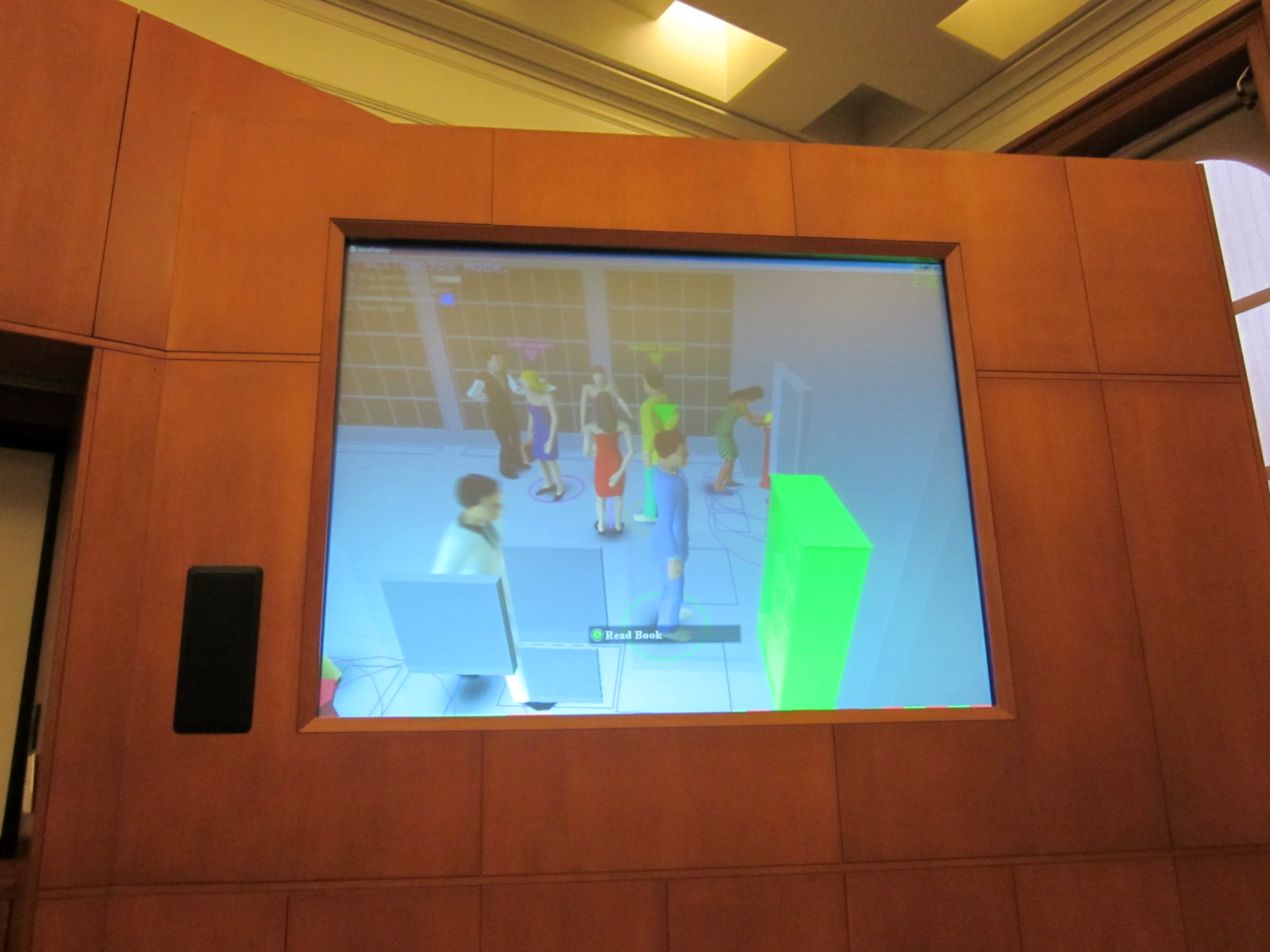
Speaking like an committed advocate, he introduced us to his working game design called SpyParty, where the focus is on interactivity, subtle human behavior and deception.

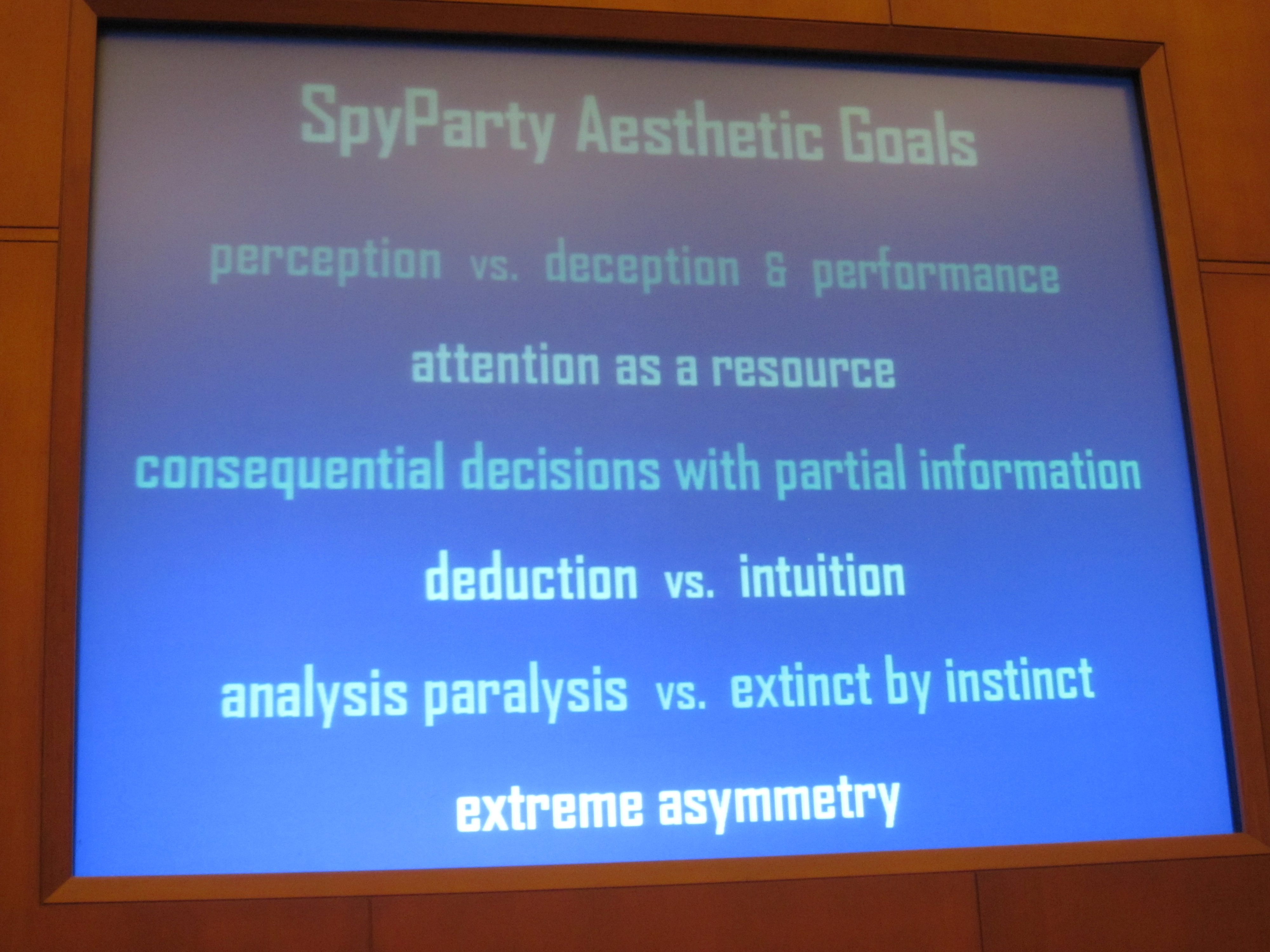
There were a number of themes he spoke to which were fabulous, including questions he asks about his games, but also his work more generally, such as, how do you spend your time, how much attention do you give, how connected are you? And these are great questions to ask, especially concerning the aesthetics of ethnographic sites, for example, when I consider the emotional involvement of my own informants.

Spy Party in motion

Aesthetic Goals

How ARE my informants in the energy industry different from game designers like, for example, Mr. Hecker?

Here’s a guy for whom art and entertainment in games, film, comics, are totally meaningful and where attention is a resource. Speaking of which, during his talk he made quite a few references to comics and film, comparing gaming at this point in history, to where film was in about 1910.


He lamented that comics never rose above superhero fictions, even though attempts by certain artists brought attention to comics as an art form, the industry and productivity as a whole, remained pretty much on the same level.

For film, he was more flattering, referring to the industry as much more vibrant in its ability to provide society with a rich aesthetic treatment of ourselves and imagination — but, there were turning points, early on, for example, Citizen Kane or Birth of a Nation.

Read the directions before playing


In that sense, he wonders what the future of games will be– whether it will get stuck in a trench of money making mass produced pulp, or rise above to become the 21st century’s aesthetic landscape of imagination.

Read Full Post »


Recently, I caught up with Energy Czar, Daniel Kammen — a Hero for our time.


Can you imagine?! He’s been invited to the 2012 Oslo Energy Forum as main speaker, along with Bob Dudley, current head of British Petroleum (who we have yet to catch up with), Helge Lund, CEO of Statoil (who we just met there a few months back), and Lee Raymond, Former CEO, Exxon Mobil, etc. and so on.

“Under no uncertain terms,” I informed the Energy Czar — while raising my forefinger skyward, “can you attend the Oslo Energy Forum 2012 without bringing me along.”

Good Grief! That’s StudioPolar‘s backyard!


Well, we’ll see. At $15K an entry ticket, to go once in my lifetime should be enough. And I should thank here the US Federal Government for thinking so highly of me to scoot me over there several months ago. But to go again. Now that would be the true test of the Paparazzi Ethnographic master.


Back to the Czar.

First, we chuckled over East Bay Express naming Dan Kammen Most Influential Cal Berkeley Energy Czar for handling the $8 billion portfolio for World Bank Group’s Energy Strategy

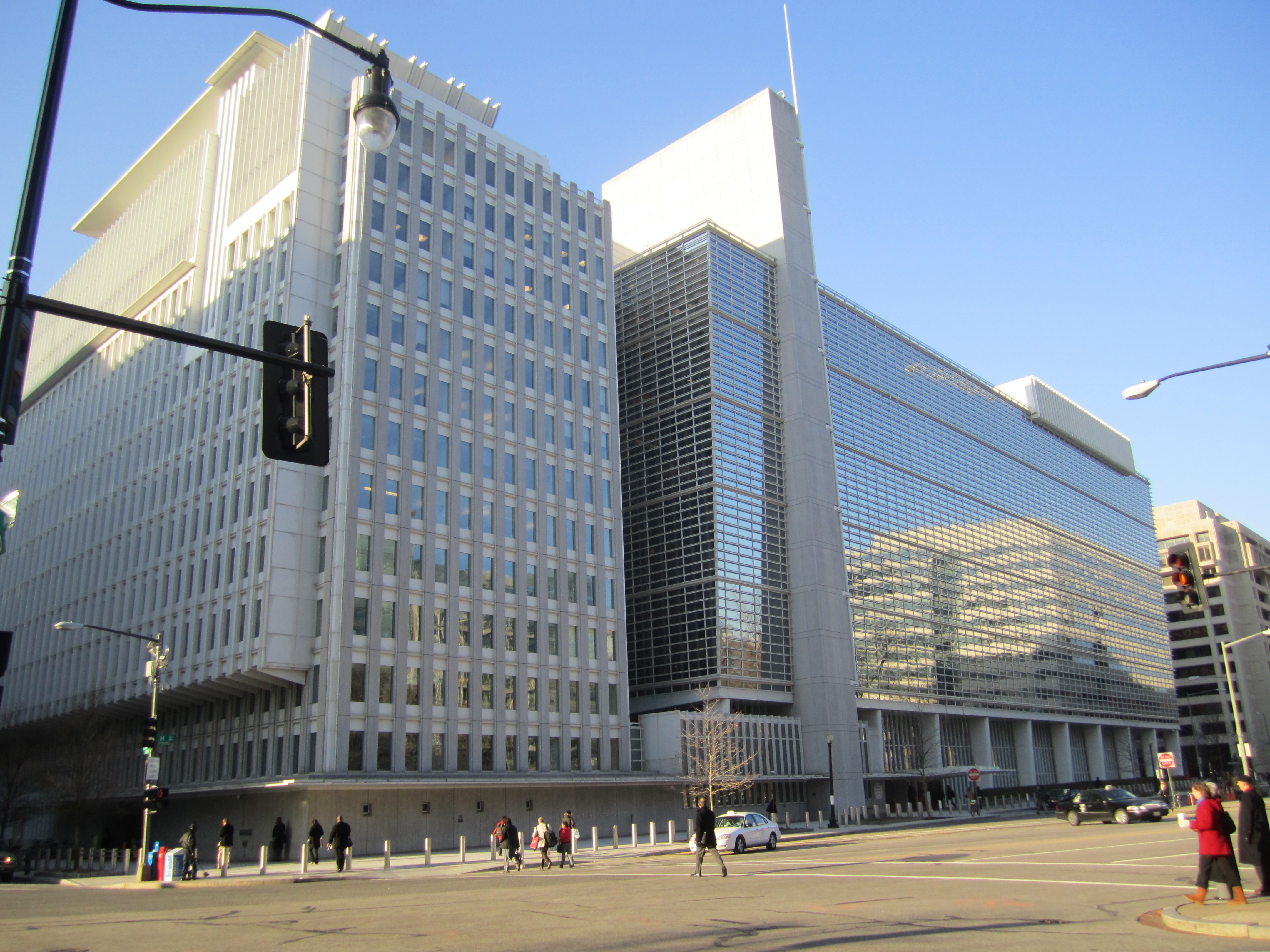
As a matter of fact, I checked in on Dan at the World Bank Group (WBG) in Washington, D.C., recently — to provide evidence that Dan was doing just that —  handling the WBG Energy Strategy.


The World Bank Group building is impressive and located in the heart of Washington, D.C.


I managed to get through security with only a raised brow.

Just as I got my feet wet, we were called back out again, for an early lunch with Paul Isbell, Senior Associate at Center for Strategic and International Studies


Paul is a gracious host.


Paul is entertaining at the table as well.

We ordered wine with the meal.


Ordering such a fancy meal — I got to use fancy silverware — a fork with three prongs, a knife without a serrated edge and a little dent and a spoon with a dent…

World Bank Group is a big castle. There is everything! Dining, Customer Service Center where you get your United Nation’s passport, Health Clinic for travel vaccinations, Mail Department, Graphics Shop, Latte Dispensers, Library, Dry Cleaners, Restaurants, Employee Banking. There is artwork everywhere, and the atrium must be a couple hundred feet high, similar to a cathedral.


It was an interesting experience for a guy like me, coming all the way from a small town called Berkeley. I almost felt like I was hanging out with the big boys. Hey, Wait a New York minute! That’s what we do here!


I attended meetings with a lot of VIPs.


After several days, I realized I could just live there, literally, inside the WBG. Without coming out.

I would not get bored. I could be like a house cat. Roaming, purring, sleeping. Eat late brunches with Dan, visit the Customer Service Center for services, and have plenty of lattes in the atrium. That’s where all the business takes place by the way, right there, sitting and chatting over who’s next in line for big power plant.


Oops! Silly me. I almost got so carried away the WBG lifestyle, that I nearly forgot the tag line of the main story:

WBG declined to allow the Energy Czar to participate in assessment of clean energy alternatives in Kosovo…and to Dan’s credit, the story was splashed all over the news: e.g.,
Battle over Ugly Coal

I guess that’s what makes Dan Kammen the Energy Czar. He’s more than just a fat cat purring in the WBG.

Read Full Post »


Epiloguewe broke up at about 8:30 PM after a fairly long day of activities that I am still a little unclear about, though to most of the technical people in the room, things are rather clear. One thing I can opine, putting my own sociological spin on things, is that Carbon Utilization will be a much more innovative entrepreneurially driven sector than Carbon Capture and Sequestration (CCS). Capturing and herding carbon for umpteen hundreds of years is  a different kind of activity than utilization, with all its imperatives to make a profit.

4PM: policy break out group: now we are gathered in a different room with a different set of folks, talking openly about the policy issues associated with Carbon Utilization. And we’re talking about (1) the appropriate role of government; (2) the relationship to carbon taxes and credits; (3) education and communication to the public; (4)  What is plan B? (given that we’ve done nothing to deal with carbon over the past 20 years, and we will not seem to be doing anything, what is our alternatives); (5) Transforming CO2 from a cost to a business and technological opportunity; (6) energy security and societal implications (political problems) — as Graciela Chichilnisky stated–and who consulted for the Pentagon– that the U.S. military identifies climate change as a major risk center; (7) energy security; (8) funding by government agencies, potential coordination; (9) energy policy and interrelations.

(1) role for government: well, we’re sort of stuck discussing what the role of government should be… Typically, in energy, government regulates by industry, while in environment, government regulates across industry, so the question of I have is: what is the “object” of CO2 for government… Actually,  so we agreed that the role of govt. should be to explore a menu of ideas for carbon management; (2) education…? government should educate itself of the risks for addressing climate change and the increasing uncertainty in energy security, given the problems in the middle east…


3PMah, okay, so I participated in the “electrochemical frontiers” break out group, and I cannot really say that I understood too much, it was quite technical, but as a workshop process, we were supposed to come up with some goals and here they are, for what it is worth: (1) a CO2 Utilization Community should be created (it is fragmented at present) to lobby policy and funding organizations; (2) Add-on contact manufacturing could reduce threshold for adopting of new technology; (3) be complementary to CCS; (4) find research on long-term performance of catalyst including regeneration; (5) novel scale-up technology; (6) improve volumetric efficiency and throughput; (7) develop suitable analytical techniques; (8) develop common economics/performance matrix; (9) create a pipeline of engineers and scientists through outreach.

In the end, we “voted” to select a few to bring to the main conference. And it turned out that creating a Utilization Community got the most votes. So, here, the point was that there were several types of technology for utilization that were competing against each other, and this particular group — which included a few venture capitalists, a few scientists from Chevron and DVN and well, I was in there– felt that it would be a good idea for these folks to identify themselves as a community for government and scholarly funding…

lunchI am starved! all this conversation over “microfluidic reactor for CO2 conversion”, and utilization via “Direct Heterogeneous Electrochemical Reduction” — which I know nothing about, and can barely identify as English, and even looking at all these slides that have all these graphs, and lines going in crazy directions, and “artificial trees”, and such topics, is stressing my pea-brain, and reinvigorating the corporeal aspects of my body, mainly my tummy — that I am hungry!

Let’s look at what’s available to eat:

lunch buffet

lunch plate

noon: Green Cement’s Brent Constanz from Stanford talking about placing carbon in cement. Good grief, it is possible to put all kinds of wastes in cement– and have it sequestered there forever. You can get about 1600 pounds of CO2 in a yard of concrete. And figuring the whole world is cementing over everything, there’s quite a possibility there for some interesting possibilities. Here’s a pretty good graspable article on his work.

China, China, China. Here it is again. We had it last week in Oslo, and now here in Berkeley. China and India, the fact is, a new cement plant once a week, a new coal fired electricity plant once a week. “No matter how you model it, if we go as hard as possible toward renewable, we’ll get to 49% coal fired electricity in 20 years from 50% now”…. Well, that settles it. StudioPolar is going to start a new project in China.

10:30 AM: Clean Coal! Sequoia Capital’s Hogarth is actually talking about how cheap electricity is to produce from coal in the Powder Basin (Utah), and how it makes sense for carbon sequestration. Good grief, this is such a crazy issue! I have to point out that in Norway last week at the Oslo Energy Forum, there was a practical meltdown over Clean Coal, and how the public relation campaigns has taken the natural out of natural gas. Graciela Chichilnisky opined that if we are serious about moving beyond coal we have to cut the government subsidies which ranges in the billions of dollars.

the future as coal

Notice for example, that in this slide on the left, that coal with carbon capture and sequestion (“Coal w/CCS”) is already depicted as the late-bridge beyond natural gas. Moving toward Clean Coal to displace natural gas. Can you imagine!!

10:00 AM: Much of the discussion over the past hour has been on scaling and economics. Scaling up to manage the huge volumes of CO2, taking it and turning it into something useful, from the lab to industrial scale, and the money that no one’s making on it so far. Uncertainties at the industrial scale surround project permitting, project capital, educating the communities, and so, the speakers are interested in getting these parts of the problem in place, practically before even coming up with the idea itself for making CO2 useful… because “once you get to industrial scale, you need to role these things out immediately” — and, it is often “easier to do this outside the United States”….

Graciela Chichilnisky from Columbia University is speaking right at this minute. She is a famous scientist who represented the United States as author of the IPCC report that garnered a Nobel Prize with Al Gore. What an amazing personal website she has. The “externality of Carbon Dioxide can be redressed through the profit motive” — making money from from externalities. Useful ideas to deal with CO2, rather than put it back in the ground.

Berend Smit, from Lawrence Berkeley National Labs, however, now speaking about how we should realize that we’re dealing with an Enormous amount of material, the CO2 that we produce is in total abundance. By looking at sheer volumes, he suggests underground may be the only way, as far as sheer volumes. Five years ago, no one worked on CO2, but now it’s cool.

Financier Warren Hogarth, another big gun from Sequoia Capital with an impressive website. Looking for companies that have a valuable economic technology today.

9 AM: This morning, I’m attending the UC Berkeley, Haas Business School workshop on carbon dioxide utilization, discussions on how to capture and re-agentize carbon dioxide. Andrew Isaac, who runs a business exchange with Norwegian companies DNV (Det Norske Veritas) and Statoil, is the facilitator. A few of the folks that I met last week in Oslo are here representing the same companies. DNV is sponsoring the event.

I will be updating what is presented here, in not too technical terms, because this is a unique type of workshop and the only one of its kind in the United States so far. As with always, We have our placards, name tags, complimentary breakfast with yogurt and coffee, and of course the power point projector that feeds us information.

Read Full Post »

Joe Kantenbacher

11/10: I met for coffee today with Joe Kantenbacher, whose seminar lecture I had the good fortune of attending last week. Joe ably provided data on how scholars have talked about the topic of behavior modification, as it relates to energy and climate change. The presentation was provocative indeed. Joe began by pointing out that if climate change is anthropogenic (human induced), then, instead of looking for financial or technical solutions to green house gas emission reductions, we should orient ourselves toward identifying a climate policy that can shape the aggregate set of human activities to reduce our carbon footprint. After all, as Joe points out, last year, residential households in the United States were responsible for producing thirty-nine percent of the nation’s green house gas (GHG) inducing carbon dioxide.

Joe Kantenbacher

Joe’s presentation was a trial run for a paper he plans to deliver in a few weeks at the Behavior, Energy and Climate Change (BECC) conference taking place in Sacramento, California. According to the their website (link here), BECC is focused on understanding the nature of individual behavior in order to accelerate our transition to an energy-efficient and low carbon economy. One aspect of the conference — whose attendance anticipates policy makers, social scientists and media —  is to “achieve viable solutions” for reducing greenhouse gas emissions by efforts as design, effectiveness of policies, and individual actions.

With these preoccupations, Joe decided to cull from bodies of scientific literature the kinds of stimuli or technique that researchers had concluded would result in behavior modification. If this last sentence sounds a little complicated, well, it is, in part, because the topic is a little complicated. But the point was so interesting, that I began to think about it in discursive and historical perspective. And before I go there, I want to provide a little more description about Joe’s presentation which captured my interest, while fully acknowledging that I cannot unpack his full intellectual vision.

At the beginning of his talk, Joe casually reminded us of the various models used in different academic fields for interpreting behavior modification – such as prices (economics), culture (anthropology), and normative values (sociology). Second, he pointed out that each of these fields identifies society as the appropriate scale for examining behavior modification (I add a footnote of dissent on this point as anthropology has abandoned society altogether in favor of the subject and rationalities that govern the individual). Third, while society may be the scale for investigating behavior among different disciplines, each approach suggests a specific rate-of-change. Economists, for example, believe change can occur overnight (e.g., triggered by a spike in prices) while sociologists believe that rates of change follow longer patterns of structural shift, such as, for example, from feudalism-to-capitalism, or from modernism-to-post-modernism.

I enjoyed the review. It was a reminder of the need to keep a sharp look out for what we are calling: scale of object, temporality of dynamics, and form of registering events.

Well, here is where Joe’s talk became even more curious. After culling through the record of 1970s-1980s science literature, and pulling articles that crossed over topics of behavior, energy and climate change, he then created a visual networking image to elucidate the spatial relations of different disciplinary authors who were publishing topics akin to each other.

VOSviewer program

At first, upon seeing the image, I must admit that I thought his discussion had shifted toward the epidemiological. But as he explained to us, he was using VOSviewer, a program that can help you construct maps based on network data using a clustering technique. Toward the end of his talk, which I don’t quite recall, my visual attraction so distracted by the VOSviewer image, Joe suggested that researchers had and could identify a variety of forms, by which modification of behavior takes place, and these forms include: public commitment, invoking norms, tailored information, feedback, modeling, goal setting, and a few others. Some of these techniques for influencing behavior could be considered antecedent (before-hand), such as goal-setting, while other could be considered consequential, or what might be called carrot-and-stick (e.g., rewards, feedback).

I think Joe is on to something, in that he has identified a suite of practices, aimed toward governing the body, around the issue of energy and climate change. The lecture struck me profoundly because of the possibility of a history of future unintended consequences that may derive from the inception of a certain idea-force:

Climate change is a scientific fact. But what will it mean to us, that it is now a social fact? Stated differently, in addition to an empirically changing world that we register by science-based instrumentation, what does it mean for us, as a group of persons, to call attention to ourselves as responsible and capable of changing the global climate? What possibly can it mean, to begin living under an idea-force  — a regime of life, in which we identify ourselves, collectively, as the Sun King?

Read Full Post »

Karlene Roberts


Catastrophic Events and High-Reliability Systems

11/9: One of our emerging projects at StudioPolar plans to explore the reliability of electricity grids in the Arctic. We can not help but notice that across the Arctic, from Fairbanks, Alaska, to Nuuk, Greenland, everyone lives in homes that are heated solely by electricity. No one knows the names or biographies of the technicians who run the local power plants and upon whose lives these communities depend. Even so, community members appear confident in the reliability of these ghost machines, so much so, that few residents consider back-up plans for an emergency situation (God forbid), in the case that power-stations shut down.

Karlene Roberts

We find two things remarkable about this condition: (1) someone, or some group of persons, working in the government housing and planning office decided one day, that there was enough reliability in electricity systems to approve building homes, in areas where temperatures range from 32 to -40 degrees fahrenheit for months on end, without any traditional mode of back-up heating, such as fuel-oil or wood stoves, and; (2) these really are reliable systems, and technicians in arctic communities do get up every morning and produce electricity, despite the fact that these regions are often talked about as high-risk for many occupations and lifestyles.

We also wonder, as an aside, and this is something we must resolve, why these technicians are not celebrated, and emerge as political and economic leaders of these communities, given the crucial role they perform in these societies. We became particularly aware of this in Nuuk, Greenland, where politicians garner quite a bit of local celebrity, including the premiums of vanity that are associated with their rule.

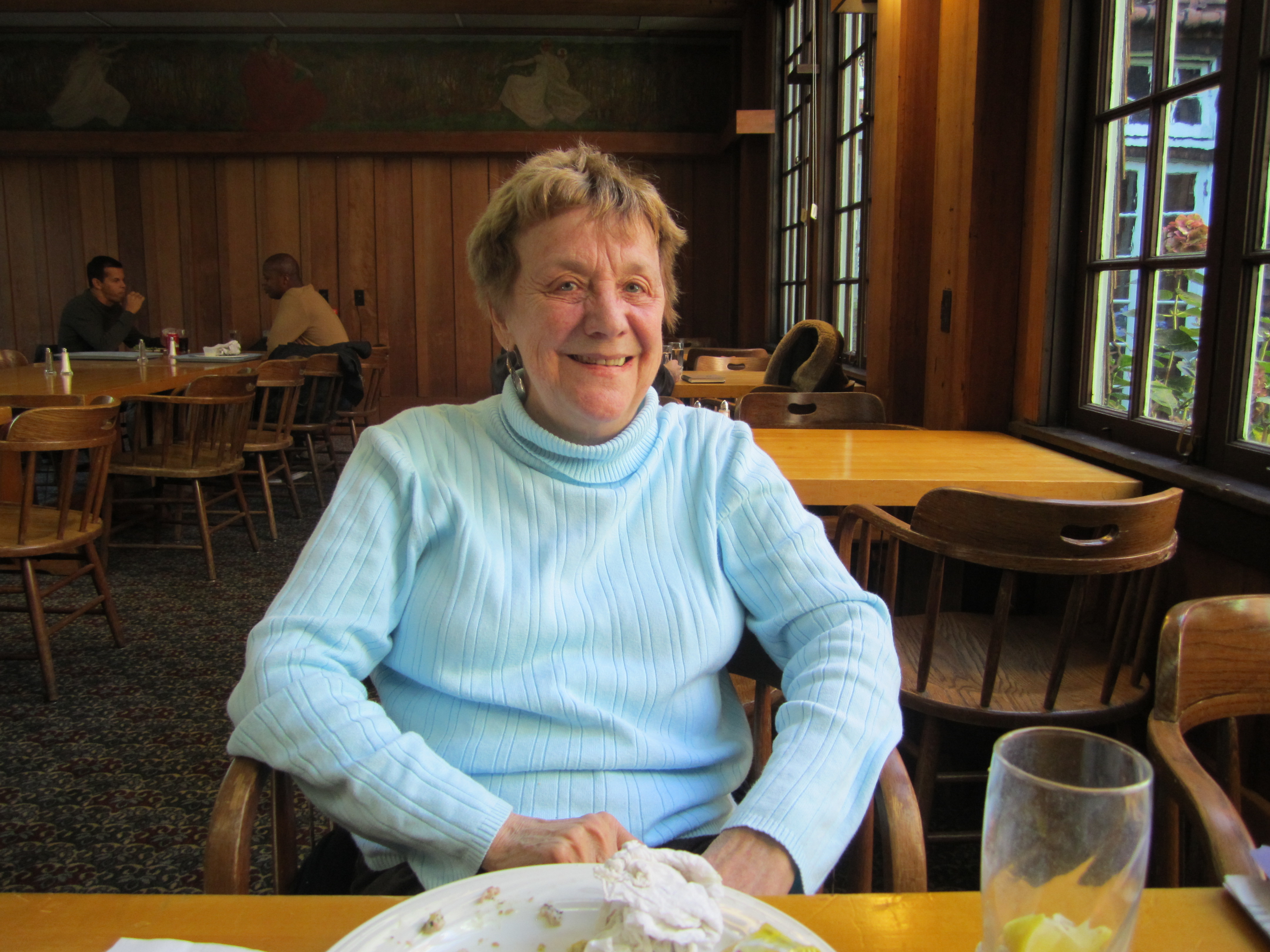
With these issues in mind, I was grateful to lunch today at the faculty club with Karlene Roberts, whose research over the past several decades concerns the evolution of large-scale technologies with high levels of operating reliability performance that are crucial to political legitimacy. Karlene received her PhD in Psychology from UC Berkeley, and after working at Stanford, became the first woman ever appointed to the Hass School of Business here at UC Berkeley. In fact, she has been a frequent collaborator with ERG’s Gene Rochlin and Todd LaPorte, a political scientist also at UC Berkeley.

There are so many research fields Karelene is working in at the moment, and which overlap with our own interests at StudioPolar, that the conversation was dizzying. Just to mention a few: she is actively engaged in UC Berkeley’s Center for Catastrophic Risk Management with which we plan to participate; also, she is working with members of Statoil, the Norwegian oil company, through their collaboration with UC Berkeley’s Center for Executive Education, and which is titled the Statoil Project Executive Program, or, in Statoil language, according to the company website, Project Academy. We plan to follow up on all of these links and will report back in updates on our NSF EAGER research.

Read Full Post »

« Newer Posts