Feeds:
Posts
Comments

Posts Tagged ‘Houston’

Houston CENHS @ rice

1cup

2top

Rice U visitation with D. Boyer and friends…


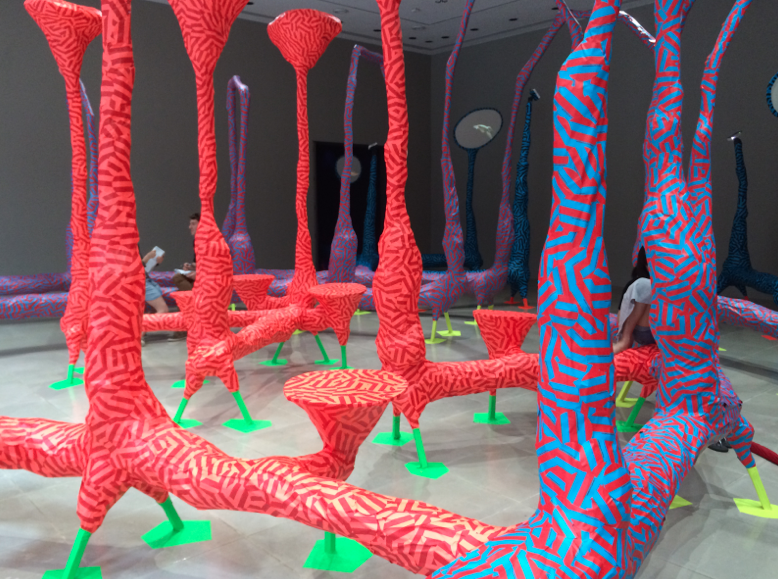
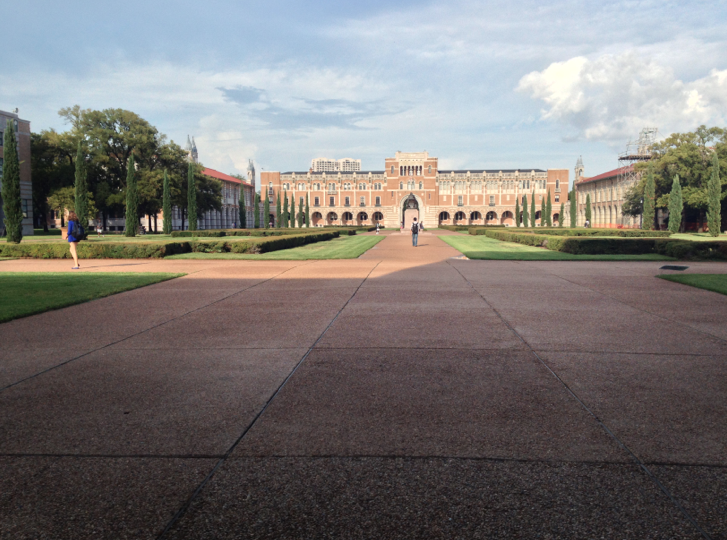
2/26: Visiting Rice University in Houston, now sitting in the quadrangle cafe, situated smack-dab in the middle of campus – and near points of interest, between Baker Institute and Department of Anthropology.

With floor-to-ceiling windows, the cafe is a latte drinker’s goldfish bowl.

Checking the internet while capturing glimpses of long distance perspectives across campus. There is something to say, also, about the sprawling oak trees at the university (4000 by one estimate?).

Within the Engineering Quad, there is a trinity of sculptures by Michael Heizer, collectively titled 45 Degrees, 90 Degrees, 180 Degrees.


3floor

4lunch


Well, no say!
HeizerMichael Heizer sculptures at Rice, more recently of Levitated Mass, Los Angeles fame, where we entertained separate visitation not so long ago at the County Museum.


firstboyscomputerteam


2/25: A trip to Houston’s Rice University with Dominic Boyer and friends, visiting CENHS (Center for Energy and Environmental Research in the Humanities).

Did I mention the wonderful discussion we had yesterday, with Heather Stern, talking shop about the next solicitation soon to be announced through Belmont Forum G8 Multinational Program, a follow up grant  to the National Science Foundation, ArcSEES (Arctic Science, Engineering and Sustainability for Education)? As a team, we are gearing up for the proposal due this July.

Well, no matter.

Just to say, I ennobled myself to a deep sigh of relief during our chat, going so far as to announce,  “I got all that I wanted off my chest” – to which Heather responded “like a therapy session”, causing us to share a collective titter.


there

Read Full Post »

EnR Houston


Rice University, 16-20 September


A visit with Dominic Boyer & Friends, Department of Anthropology
Rice University
, Houston


Houston


+ Brown Baggy.


plane


Epilogue…

What a great trip! Dominic set up a number of inspiringly productive engagements, including a brown bag presentation where I presented my initial thoughts on the European trip, a combination of techniques for locating what I call the Sweet Spot of Modernity (empathy for the graph, corporeality of expertise, science as salon culture), developed in part by my recollection of James Faubion‘s manuscript Modern Greek Lessons, who was in attendance, by the way, during my talk and even came up afterward exchanging a warm greeting.

Cymene Howe, faculty member, posed the first question concerning how deep or, rather, how extensive could I frame staging of verification, a perfect question because it links epistemological frames of reference to authenticity through performativity. My response was a bit inchoate, in part, and this was true to how I addressed all the questions, because faculty and students immediately located the weak links in my argument, or rather, the intriguing left-unsaid areas, which require further development. I was grateful for the feedback.


library


Later that same day, I had a chance to circle back with Cymene, Dominic, and EugeniaNiaGeorges, Chair, Department of Anthropology, when they invited me to dinner at Pondicheri, a South Asian restaurant where I ordered a lamb burger with salad. I really wanted to order the lamb burger and with Nia’s prodding, went ahead with gusto. It was delicious. Finally, in addition to the meetings I mention below, there were a handful of superb chats with Rice Department of Anthropology graduate students, whose names and projects I will leave unmentioned out of respect for the openly liminal space we enjoyed when just brainstorming over method. It was method that I most enjoyed discussing with them, so many cool projects in so many different areas, Iran, Haiti, Brazil, China.


upstairs


Hyper-Objectivity and Issues of Scale

s9/19: I had the uncanny good fortune of meeting up with Derek Woods, CENHS Pre-doctoral Fellow, at the Brochstein Pavillion at 11AM. We discussed his recent interest in terraforming fantasies combined with technical prediction and the biosphere — resulting in a dispersal (emptying out) of agency — when shifted up to scale.


1345Interesting indeed. The Anthropocene.

Terraform the world that we want – extending the privilege of the liberal subject of the economist, toward shaping the world that we enjoy. A customization logic of autonomy. What resource level dimensions we might imagine, including placticity – making food out of waste and, well, turning matter into anything. The alchemist’s return or as Derek would have it, a “Rumpelstiltskin logic” — Life as surplus (Melinda Cooper) overcomes a world of Limits to Growth.


6

Global Gas Development

9/18: I had a good talk with Ken Medlock III, newly appointed Director, Rice Center for Energy Studies at Baker Institute. Ken knows oodles on global gas developments as he replaces previous energy guru Amy Jaffe, the latter having moved to UC Davis.


image of lights After exchanging a few notes on background experience, I was able to pose a few questions concerning the relationship of frontier developments to shale gas as well as global formations in America, Europe, and Asia, the primary self-enclosed markets.


Ken graciously allowed me to photograph him for my upcoming energy guru photo album post (coming soon here on PaparazziEthnography) — to include my notable meet-and-greets with Cambridge Energy‘s Daniel Yergin taken during Russia’s St.Petersburg Economic Forum; Oxford Energy Institute‘s Jonathan Stern while attending Norway’s Oslo Energy Forum, Skolkovo Energy Center‘s Tatiana Mitrova when participating at the Moscow Russian Gas Petroleum Congress; Fridtijof Nansen Institute’s Arild Moe at the Norwegian Research Council Sponsored PETROSAMS meeting; and, Aleksanteri Institute‘s Markku Kivinen in Helsinki.  Ken We strategically posed the photograph to include the hanging portrait of a gas flaring map or perhaps it was the world-at-night photo (upper left). I took a second photo but flinched and managed only to captured an image of Ken’s shoes (lower right), which I include at any rate.


shoes
“Majors sold out Permian basin – mature areas, and wanted the capital projects in the Arctic.”


The above is a quote that says it all. Essentially, the Major oil companies turned out their mature supply areas in favor of developing elephant fields with high capital costs, and in the intervening time that it took to ramp up the plans for developing North American Arctic and/or LNG imports through the regulatory process, natural gas prices collapsed on shale development by the independents (who had stepped in to clean up the so-called declining regions left behind the majors), catalyzing a shift by the majors back to the traditional supply areas.

floorfloor alsolocal foods
9/17: Lunch today with Matthew Schneider-Mayerson, CENHS Post-Doctoral Fellow at the Local Foods Restaurant on Dunstan in Rice village. Great place, though I must say that, by the time of my arrival, having walked there through the humidity, I was completely wet with perspiration.


heels and heatpavement We had a good discussion, just getting to know where each of us is headed.

Also, interestingly, Matt’s book is coming out soon on U Chicago Press, on the theme of Peak Oil, from what I gather, having looked at it from the perspective of the folks who consider petroleums a finite resource, and act accordingly based on a set of emotions directly linked to limits associated with everyday use of oil. Fascinating subject.
Rice

Read Full Post »

Schlumberger

Screen Shot 2013-03-31 at 6.51.58 AM Screen Shot 2013-03-31 at 6.52.29 AMI had the opportunity on Friday of visiting the testing facility of Schlumberger, located 45 minutes from downtown Houston. Schlumberger is one of the most prominent contractors in the global oil and gas business producing everything from strategic knowledge to explosive devices for opening up rock and thus getting oil to flow.

Bob Jetson (pseudonym), above, took me on a tour of various types of products the company produces for subsea oil well drilling and capture. He was polite enough to humor me in my image making. While wearing a helmet, Bob appears with a Matrix-like hole in the back of his head, as if used by the company to download reality forming knowledge.

The Schlumberger facility has a strict policy of NO PHOTOGRAPHS. The images in this post were taken with permission of my tour guides.

Upon arrival, the entrance to Schlumberger appears like many corporate techno-parks, a combined artificiality and enlightened setting, man-made ponds and foliage transplanted to the area from elsewhere. In fact, the landscape along the drive to the facility is quite stark, just flat land with various prairie grasses.


The land was obtained some time ago, and far away from the center of Houston so that explosive testing could take place. “There is a rumor”, my guide person explained, that the Schlumberger family initially used the property for “goose hunting”, but that just rumor. The present facility and its environs began to expand to its present size beginning in the 1980s.

Any casual observer to the facility will be impressed immediately by two features. First, safety reminders surrounding every available space, on the walls, on the floors, there are reminders for workers to wear their Personal Protective Equipment or PPE. These reminders took the form of posters promoting awareness to fingers, different colored floors to highlight the boundary of PPE gear. Every door mat was custom designed to promote awareness. Here are just a few of the many images I encountered in my trip.
The second thing that is impressive is the kind of work they carry out. I was amazed. It was a real eye opener to see the specifics of how oil and gas is taken out of the ground.

We covered well preparation, the ability to drill thousands of feet into ground, and then, to “service” the hole from a variety of capacities that the equipment is capable of doing not only inside the hole, but the ability to communicate to operators above, what actually is happening. We went over the explosive testing, which opens up the rock for oil and gas to flow into the pipe, and directional drilling, the capacity to direct the drill laterally — the details of this ability are quite extraordinary when explained in person.

Schlumberger has a fabulous website as well, where anyone can look up oil and gas terms.

Check it out.

Finally, what was amazing to me, was the amount of materials and expert labor required to produce the high level of specifications involved in producing these materials. There were special steel mills that produce metals solely for Schlumberger, and special contractors identified and verified as meeting the specifications of a Schlumberger supplier.

In short, the company appeared to me as a civics lesson in how our society operates. I even mentioned that such knowledge should be taught in grade school –in the same manner as lessons about government or mathematics, so reliant we have become on the work of this vast company.

Screen Shot 2013-03-27 at 12.06.15 AM

Screen Shot 2013-03-27 at 12.06.00 AM

Read Full Post »

Θ Houston — TSW12


That was a great week. I would have liked to comment more on all the activities as they were taking place. I captured below a partial representation of all the great work we went through together.
In attendance this week were a lot of important folks from both sides of the Atlantic, Ambassadors, Ministers, Consular Generals, Arctic Chairs, the whole yard.

One of my favorite moments was heading up to an evening reception at the top of the Houston Hilton Hotel. We were waiting in the lobby when, as it turned out, one of the elevators was kaput. Hotel staff directed us to take the freight elevator.

Inside the elevator, packed to the gills so as to give the feeling we were in close quarters, Norwegian Minister of Health, Gahr Støre, was shaking everyone’s hands — that is, shaking the hands of those who knew of his importance in Norway. Minister Støre is expected to soon stand for the position of Prime Minister.

Minister Støre is charismatic, lean, handsome, tall, well dressed, articulate, sharply intelligent according to policy experts, with polished gestures, and a winning smile.

As serendipity would have it —  I happened to have entered the freight elevator with American professor, John Tallis, (pseudonym) with whom I had a few beers just previously at the bar. Completely ignorant of Gahr Støre‘s identity, John was oblivious to the cultural moment taking place as we all headed vertically up to the rooftop terrace. From the casual look of things, the professor could not have interpreted the intensity of meaning associated with the ritual goings on now circling Minister Støre — all lined up and squeezed as we were into an inelegant freight elevator, yet in close proximity with a “political star”. The Minister was well aware of his star power in the midst of others, but when confronting both of us, the Americans, he provided a simple nod of his head, to acknowledge our ignorance of who he was.

I was, of course, caught up both in the star power moment — and the simultaneous recognition of the possibility of me being interpreted as a foreigner (we were two Americans in a Houston Hilton hotel).

I could not help myself, wanting to “shake the hand” of the power holder. I promptly introduced myself to the Minister, indicating that we had met the previous year, when he was Minister of Foreign Affairs, while attending the Oslo Energy Forum (OSE) in Holmenkollen on the outskirts of Oslo. He asked whether I had been back to the OSE, and I responded in the negative. On this point, our connection ended. But then, as if from a deep desire to maintain a lingering connection to the man, only to have a little more of his stardust cloud blow in my direction, I added having just met, several weeks before in Olso, with Johan Nic Vold, Managing Director of OSE.

This triggered an brief eureka moment regarding my existence, along with continued conversation as Minister Støre made his way to greet others with whom he is on politically intimate terms.

What a ride! Here is an image of Minister Støre from the Oslo Energy Forum, not too long previous to the Houston meeting:


11/15:Morning Day Four of TransAtlantic Science Week
Okay, now I am very far behind in my updates on what has happened throughout yesterday and in the evening. Nevertheless.

I am now attending the session: Fulbright Arctic Chairs and Beyond. I was able to meet Timothy Moore, from the Embassy of the United States in Norway and have a helpful chat about goings on in the Scandinavian political world. There was Petter Naess, who runs the Fulbright Office in Oslo, and up now at the podium is Pal Sørgaard, Deputy Director General, Norwegian Ministry of Education and Research. And even Paul Wassman is here, from Fram Centre, Tromsø.


11/14: Morning Day Three of TransAtlantic Science Week
Okay. I have to provide a wrap up for yesterday, but before we get to that, we are at the beginning of Day Three which begins with a Workshop on Petroleum Technology. But before that, I should mention briefly that this morning’s participants were mingling over (starbucks) coffee and chatting, and I had a chance to re-introduce myself to Kari (last name), with whom I traveled to Russia, along with workshop participants for the Teriberka workshop. And what do you know, Kari mentioned that there is a June workshop in Arkhangelsk (yay!).

Siri Helle Friedemann, Director Department of Petroleum, Research Council Norway is the chair for this daylong workshop. I met Siri as one of my first informants in Norway, but more about that later. For now, Siri is up on stage talking about RCN’r role as advisor to government, in networking and dissemination, and international cooperation. Wow. There is a Petromaks 2, a 10 year program supporting research, workshops.

Ove Flataker, Director General of Norwegian Ministry of Petroleum and Energy, gives a similar (same) talk as on the pre-conference day, see below.

Now up is theme, Drilling and Deepwater Technology. Satish Nagarajaiah Rice professor. Energy initiative on campus, is chair of this session. Okay, here we go.

IRIS. Center for Research Innovation, International Research Institute of Stavanger (IRIS), Sigmund Stokka, Research Director, 230 people, working on energy, marine environment and social science. Center for research based innovation. Describing a variety of partners, locations and test facilities, and numbers of MA and PhD students.

Very technical discussion.

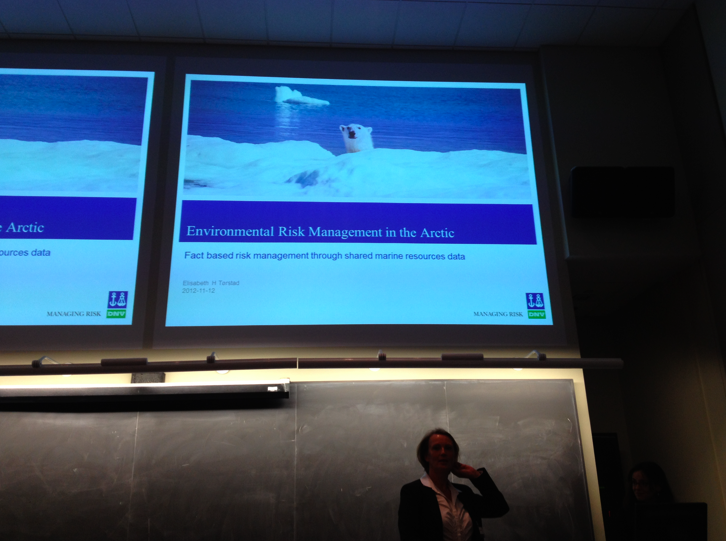
Elisabeth Tørstad VP DNV is up now taking about the kinds of risks involved in developing oil and gas.  Several categories. Wow, a lot of information. External risks, Internal risks. (major overruns, major delays) — keeping an eye on risk picture and on barriers. Initial risk assessment and create “barriers” — e.g., a contract that has terminated or transferred. A company may be put up as responsible and then falls. Decisions are made on the basis of barriers that are set up and they are not.

One of the questions that comes up is “drift” — small changes that slide a project into disaster. Monitoring drift is important. A barrier is degrading.


11/13: Afternoon Day Two of TransAtlantic Science Week
A panel on Think Tanks.
I always like to get in early, to get the lay of the land, and with 15 minutes to go on a topic that I am keenly interested in, a panel titled, Special Session: Think Tank Collaborations, I have already settled in. Look, there is another photographer besides myself, but with much more elaborate equipment for taking images.

Okay. we are underway.

Ambassador Edward Djerejian, Baker Institute Founding Director making opening comments: Talking about how private funding create opportunities that university institutions do not have. A distinction between university-based versus non-university based think tanks. There are, in fact, 1776 think tanks in the United States, there are 230 major think tanks.

Another thing to consider, is whether they are partisan and non-partisan. Baker Institute is non-partisan despite the Republican bias of James Baker himself. A final distinction, based on foreign policy and internal policy.

Thinking about collaborations. One the biggest challenges is translating ideas into viable policy programs that can influence government and academia. Baker has had enormous influence and had some failures. Presented their ideas to Obama on tax reform, which was not accepted, but ideas on G.W. were taken.

Emphasizes how only folks “inside” government decide.

Now, here we have Wegger Strømmen, Norway’s Ambassador in the United States, talking about think tanks. They actually created a report for the Norwegian government about think tanks and collaborations with them. The Peterson Institute for Economic Studies, is a firm the Norwegian government is very interested. International Institute for Strategic Studies in London was a location Strømmen spent time at.

Wow. This is interesting. Strømmen states that in America, “you have to look quickly for political affiliation and connections to industry“.

Peter Hartfel (?) professor economics at Rice U. and affiliated with Baker Institute. There is a deliberate attempt here to encourage collaborations with academia. The folks at Baker joint supervise graduate students, a very good example of how a vision of collaboration between university and think tanks work well.

Okay, energy security. An important part of the work is natural gas in global markets and geopolitical issues. Joint program on with Stanford and developed a World Gas Trade Model, which they have involved Harvard recently. Looking at long-term contracts to “market-based” price. Baker has worked with Institute for Energy Economics in Japan. A number of subscribers, “some of our best research topics come from industry”.

Edward Djerejian: No matter who finances the research, it is created without bias.

Okay, up next, Kristian Berke Harpviken, Director of Peace Research Institute Oslo (PRIO).

Best practice of policy is based on sound academic research. Talking about the make up of PRIO now.

They publish no less than four peer-review “long standing” journals, highly ranked in international relations, that create a revenue. Twelve propositions for a good think tank. Into four groupings (1) People (2) Money (3) Outputs (4) Impact.

Now here, the conversation surrounds around actually making money off the journal, and Ambassador Djerejian would like to know “how can you make money?” — to which Harpviken replies in some detail how money is created, through primarily bundling and library distribution.

Baker Institute does not produce a journal and every time they go to consider it, it appears too daunting.
A point about “images” and how they are interpreted differently by experts versus lay folks, bringing to mind my distinction in Empathy for the Graph.

Now up. Dean Eric Schwartz. Two elements relevant to the present conversation: (1) Integration of service, scholarship, and training; (2) Science, Technology and Environmental Policy (STEP) as a critical component for enhancing public discussion. Emphasizing policy literate scientists, and science literate policy makers.

Up now is Jon Pedersen, Head of Research, FAFO Institute of Applied International Studies.


11/13: Lunch Day Two of TransAtlantic Science Week
We have all gone to a group lunch being held in the prestigious Baker Institute. I have not been here previously, but of course, I am familiar with its top notch reputation.

At lunch, we heard again from Subra Suresh, Director of the National Science Foundation. The lunch is delicious and the surroundings prestigious. There were so many folks who wanted to attend the luncheon, the organizers created an overflow room where the good director could be seen on a screen.

Here below area few images of the luncheon in the Baker Institute itself:

And here below, is an image of the overflow room, where folks could lunch as watch on the screen the happenings taking place a building away.


11/13: Morning Day Two of TransAtlantic Science Week

Okay, we are just getting started here. I always like to arrive early to see the setting, get a seat up front, and take a few photographs of the environment in which folks will be giving talks. Sometimes when the auditorium fills in, it becomes difficult to start taking photographs around the room.

Okay. All of the big whigs have stepped into the auditorium and are taking their seats in a reserved section near the podium. Wegger Strømmen, Norway’s Ambassador to the United States has just introduced Neal Lane, Senior Fellow in Science and Technology Policy, who is now introducing David Leebron, President, Rice University.

Neal Lane. Begins with a comment about the cool weather, and the new art work on campus, now giving directions to and discussions about the Tyrell Sky Space. In general, Dr. Lane refers to the importance of  technology in energy development and promoting science, but also, relationships between our two countries and populations who share an entrepreneurial spirit.

Wegger takes the stage again to introduce Kristin Halvorsen, Norwegian Minister of Education and Research. Halvorsen is now up talking about innovation and higher education, new knowledge by research communities and its practical use. Managing the contradictions between petroleum wealth and climate change concerns, requires close cooperation with international research centers to achieve political goals. I should note that Ms. Halvorsen is wearing a very smart Navy blue pea coat-like dress over a skirt with white brocade.

Up now is Dr. Subra Suresh, Director of National Science Foundation (NSF). Summarizing thesis of the origin of the NSF. Innovation is necessary for the strength of the nation, and comes from research in science and engineering which should be carried out in the university and funded by NSF. First year’s budget in 1950 (?) was $200k and now it is $7 billion. NSF funded early research for the mathematics which ultimately became GPS and Google.

“Innovation comes in different ways: we put a man on the moon before we put wheels on a suitcase”. Seventy percent of all Nobel Prize winners have come from early NSF research. Actually, Subra is a superb speaker.

Okay well, Subra is a hard act to follow, but some one has to follow him. And up now is Arvid Hallen, Director General, Research Council of Norway. Arvid has some interesting slides, graphs that show performances of Norwegian science via publication indexes.

Above are a great set of slides indicating research centers. This is something that I am interested in, of course, for looking at the linkages of energy production and research innovation.


BREAK

Okay, now we have Ambassador Edward Djerejian, Founding Director of James Baker Institute for Public Policy, Rice University, whose presentation title is Geopolitics of Oil and Gas. Strait of Hormuz. Transportation of oil — can be easily shut down, if only temporarily, spooking the energy industry with a spike of prices. Promises that the Western Hemisphere will be come “energy secure” within the next decade, and thus the geopolitical map will change. Second “Arab awakening” — a “tectonic shift” in the political landscape — the “true end” of the colonial era.

What is necessary is “political and economic reforms in our bilateral relationships”.

Great question: How do think tanks learn? How do they see themselves as doing things better? Do they learn from each other, do they collaborate with each other? How do they work with each other, is this meeting one way they learn from each other?


11/12: Day One of TransAtlantic Science Week
Wrap up for the day: After the last session, conference attendees made their way to the Consular General’s residence in Houston.

Perhaps one of the most remarkably casual instances of this trip is the number of informants that I know based on my research of the Norwegian energy knowledge industry. This list includes Siri Helle Friedemann, of Research Council Norway (RCN), with whom I met when I first began my project in 2010, and at that time attended her RCN funded Norwegian-Russian energy workshop in Murmansk and Teriberka, Russia. I also bumped into Petter Naess, who heads up the US Norway Fulbright Foundation, in Oslo, and with whom I met at the orientation meeting in August.

Crazily, as it would seem, I also bumped into Ole østein Aspholm, Senior Principal Consultant, Det Norske Veritas (DNV), who attended my talk at DNV last month in Høvit, at the corporate offices outside of Oslo. These folks are in addition to those mentioned below.

Most of the evening was spent in the backyard patio, around a Texas shaped pool, where we dined on indian food buffet style. Consular General Jostein Mykletun provided a warm reception over a microphone to everyone, stressing the theme of the conference, to bridge partnerships between Norway and the United States across academia, government, and industry.

The typical manner of entering a consular’s home is to line up and greet first his wife (sonia) and then the consular general, of course, with a handshake and brief introduction. This occasion was no exception. Among the party I had arrived with, a group of recent PhD’s or nearly there, Katherine Hedegaard was engaged in rock science, and we spoke together at length about our respective projects, she speaking about the problems of oil recovery in North Sea chalk basins which collapse inexplicably and I about my recent National Science Foundation proposal, that I am writing at this moment, attempting to put together a revision that makes sense.


Panel: Sharing Environmental Data Across Boundaries in the Arctic Part II: Now up. Jon Staerkebye, Senior Vice President, Kongsberg Oil and Gas Technologies. Showing movies that depict the advance communication strategies for envisioning environmental monitoring on the sea floor.

Okay, now speaking is Dr. Larry Hinzman, Director of Arctic Research Center, U. Fairbanks, talking about the best of international partnerships for understanding the Arctic.

International sea ice prediction network. Ice-ocean model run by ACCESS working group to provide guidance on how to target observations.

Streaming thoughts in my head: I woke up today deciding to chance it that most folks would be wearing a suit without a tie. I was correct. Now where on earth did I learn that? It was in Holmenkollen, at the Oslo Energy Forum (OSE), when Johan Nic Vold, managing director for the Norwegian Energy Foundation, organizer of the OSE, instructed participants on the first day, in a collective manner, that wearing a tie is limited only for dinner gatherings.


Coffee break: I just bumped into DNV’s Elisabeth Tørstad (Exec. VP and Chief Operating Officer, Division Americas and Sub-Saharan Africa), who joked that she sees me everywhere — to which I responded that I request her travel itinerary from DNV. We laughed. I first met Ms. Tørstad at the Berkeley CO2 sequestration meeting, where we exchanged stories about the Oslo Energy Forum. Then, some months later, we bumped into each other in Tromsø, at the Arctic Frontiers conference this past January.


Sharing Environmental Data Across Boundaries in the Arctic Part I: Jarle Aarbakke, Rector, U. Tromsø. former Chair of Norwegian Government appointed High North/Arctic Committee.

Wow. This turns out to be an interesting panel. Climate “regime shifts” in Marine environments. I barely got my tail over here, thinking the meeting room was close by, but turns out a 10 minute walk, so I missed some of Dr. Hepsø’s (Statoil anthropologist) opening. But Dr. Aarbakke is stirring things up already by jumping directly into Norwegian-Russian data sharing on climate change, marine environments in the Barents Sea area, which requires cooperation by all Arctic countries. “Key Message”.

A “next generation” environmental monitoring system. That it is harder to find financing for data management. Sharing requires (a) recognition of ownership (its traceability) (b) standardized and readable formats (c) known data sources (d) known quality of data.

I wish he would go into more detail about these points, traceability of ownership, for example, seems to be a curious rabbit role to chase down.

End of presentation, stressing the need for the Arctic Council to step in to create a major presence in data sharing. Of course, during Q and A, I made my few comments, always interested in having my voice circulate around the room, though not even sure what I referred to, just enjoying the fleetingness of exchange (yay).

Okay. Up now is Dr. Robert Detrick, NOAA Office of Oceanic and Atmospheric Research. Again, partnerships with industry, government, academia, to create expertise on data sharing. This is interesting: Observation network should include Operational Forecasting and Anticipation of changes in Ecosystem Structure. Point out the combination of technologies, traditional (ships, drifters) and emerging (unmanned aerial systems, cable observatories).

Data management. Tremendous volumes. NOAA has MOA’s with ConocoP, Statoil, and (?) on environmental data sharing partnerships.

Now up is Svenn Ferry Utengen, VP Statoil Research Development Innovation. “As my son told me, I am a ‘Fairly Good Representation of the Fossil Industry'”.

Using the best available technology requires sharing, in this particular field. Actually, that is a good question, what types of knowledge require sharing (e.g., arctic technology and development, including environmental) and what kinds of knowledge are proprietary (e.g., intellectual property).

Okay, now concrete technologies. Svenn puts up a slide that defines five areas where uncertainty surrounds how to move forward with technological developments. His activities refer to in house expertise  on, well, just a whole number of issues, including oil spill response technology, Arctic drilling units, Seismic technologies — I will post a few slides in a moment.

David Womak, IBM, Director, Worldwide Chemicals and Petroleum, began his career with Exxon, BA, MBA holder. paper titled, Bridging Partnerships. “Smarter Responsibility” — successfully, safely, productively. A series of partners who come together to explore “collaborative development activities”, things IMB thinks are going to impact the industry “going forward”.

Market research on chief ideas on the minds of global companies. Amazing. He distinguishes between global companies and petroleum companies. Cycle time, is 7 years for an engineer to become productive straight out of college, and looking to reduce it to 3 years. Environmental issues number one.

Wow. Oil and gas acknowledging the nature of complexity it needs to solve and will be outsourcing problem solving. Several threads if you will toward moving to solving data issues, environmental/sustainable issues.


Lunch: Tuna sandwich with potato chips. I learned that Vidar Hepsø, anthropologist at Statoil will be delivering a talk on Arctic energy at 2PM. Also, Amy Jaffe has since moved from Rice University to UC Davis to become Ex Dir. of Energy and Sustainability, and replaced by Kenneth Medlock, who I plan to look for tomorrow morning after the plenary taking place at the Baker Institute.

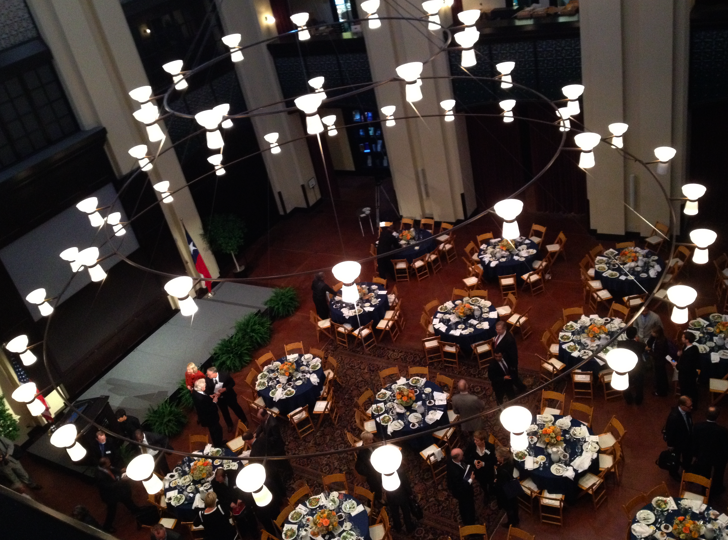
I am a push over for colored lights. I love dazzling colors. Whether used to depict complex capillary formations in oil deposits or as spot lights for jazzing up science posters, or even just mosaics on ceilings and pharaonic design patterns for architectural motif, the sight catches me my tracks.


Up next, a session on sharing environmental data across boundaries in the Arctic.

Ove Flataker

10AM: Just settling in and immediately began chatting with Ove Flataker, “Ekspedisjonnsjef” (Director General) of Norwegian Ministry of Petroleum and Energy, who just up, gave us a well rounded story about the history and future of Norwegian petroleum, respectfully referring to American titans of oil and gas development for establishing the industry in Norway beginning late 1960s.

I always like images that depict the Arctic, from different perspectives and highlighting resources in different ways.

Here are two such images that Ove employed in his talk:

“The best way of collaborating is physically, to meet each other”, says Prof. Arne Graue, Chairman of the Executive Board Petroleum Research, Norway, mentioning the value of networking. 

Oops, we just heard from Dr. Graue that the dinner at the Consular’s residence tonight is restricted by invitation only, so hold on to your tickets everyone! Here is an image of the invite:


PhD student from NTNU, Trondheim, Elena Parmiggiani, just gave a great talk on environmental knowledge management. Good grief, some folks have great projects. I am in the midst of revising a proposal for research funding on quite a similar topic, and found her talk inspiring.

One aspect that caught my attention is how knowledge is gathered — referring to (1) what is “new” versus what is “traditional” knowledge (2) what is local represented versus standardized knowledge and (3) what is top-down versus bottom up (e.g., folksonomies) knowledge.


11/11: I blew into Houston this afternoon to attend the Norwegian-Texas TransAtlantic Science Week via invitation of Dr. Jostein Mykletun, Norwegian Consular General to the United States, and former Ambassador of the High North.

This is a view of Houston from inside the taxi.

Some of you may remember that just over one year ago I had the opportunity to present a key note discussion of my research in Houston at the Arctic Oil and Gas Workshop.

At that event I got to mingle with folks in the technical part of Arctic oil and gas industry. It was at this workshop also that I first met Jostein, if I may take such liberties to refer to him by his first name.

I should mention that it was then also, at a reception at the Consular General’s home, that Sonia Mykletun invited me to apply for the Fulbright Research Chair position. This was an especially generous gesture. In fact, my visit here this week includes extending a warm thanks for support as I was awarded US-Norway Fulbright this year.
It is just about dinner time and I will head over to the Hilton now to see what other pre-conference activities are taking place.

Read Full Post »

8/10: US-Norway Fulbright Orientation….

Where Does One Begin?


Perhaps with Fulbright maven, Ragnhild Sohlberg, Ph.D., of former Norsk Hydro management and Rand specialist to whom, alongside Sonia Mykletun (see bottom), can be attributed the recently established Arctic Research Chair position?

With newly minted Fulbrighters musing on Art and Love in the Oslo Fulbright Office?


We back up and return to our visit at Nobel Institute?


To our roof-top reception following our Award Ceremony?


With where Prez B. Obama received his Nobel Peace Prize?


To imagine ourselves at Norwegian Ministry of Foreign Affairs?


After introductions to begin a series of discussions about life in Norway?
Chatting, down the steps, onward toward ceremony and reception?


Let’s walk alongside past the King’s Royal gardens?


To begin under the celebrated chandeliers?


The paparazzi search beams, yes, for stars of my left and my right?


With the gendered children’s spam (pâté for the sensitive)?


There indeed are so many places to begin, as if to say, how can any one paparazzi ethnographer capture all the fleetings of such ritualized settings?


8/9: Entering into the Fulbright reception:


6/23/2012: I was awarded the US-Norway Fulbright Research Chair 2012-2013 at University of Tromsø (yay!). Reading my previous blog, see below, seems like a long time ago that I began the application. And it was! One year ago. I want register here and now that I plan to attend the Fulbright Orientation upcoming in August and to capture that event in paparazzi ethnographic style… 🙂

I recounted the entire saga of the award application to Svetlana L., with whom I had several wonderful conversations in April at Cambridge U. while attending the BASEES conference. Afterward, we met up in London over drinks at the Lanesborough where I poured out the entire story. She confessed to me that my tale was indeed, interesting. Here is Svetlana chatting on Hyde Corner:

To provide one example, I received news of the Fulbright award while in a hotel room in Jinan, China. I was visiting folks at the Department of Anthropology at Shandong U., with the generous offer to take the position as Associate Professor. For several days, I wandered around Jinan wondering how in world I would fit into that city scape, with all its unique food items, such as sea slugs, rose petals, and lettuce, as shown in the image below, taken at a high-end delicacy restaurant.


On the third day of my visit, returning to the hotel from a preview of the apartment that the university offered me as part of the hiring package and after walking out of the shower — a blast furnace of a water faucet, thank the lord — I noticed a new email in my inbox, from the Fulbright Foundation in Washington DC.

It was an eye spot. I paused for a few moments before reading the word: “congratulations”. And I plan to provide some updates right here, especially as I get news of the orientation.


6/23/2011: Last month, in Houston, I had dinner at the residence of Sonia Mykletun, recently Executive Director of the US-Norway Fulbright Program. Toward the end of the evening, she graciously invited me to apply for the newly created US-Norway Fulbright Arctic Chair, launched during her tenure. Sonia’s husband is the Royal Norwegian Consul General, Dr. Jostein Mykletun.

Both Jostein and I attended the Arctic Oil and Gas North America Conference that week where we were invited as keynote speakers.

Jostein presented the Norwegian Government’s High North Strategy, since he was Foreign Ministry Ambassador for the High North.

I decided to take Sonia up on her offer to apply for the Arctic Chair and have created here a post to document the process of putting together the Fulbright proposal.

What I find interesting, in fact, are all the threads that come together to make an application happen. In advance of my discussion with Sonia, I had discussed this opportunity with anthropologist Sidsel Saugestad of University of Tromsø (UiT). Initially, I was short listed for assistant professor in her department, though the job went to David Anderson, formerly of U. Aberdeen.

Some months followed and Sidsel and I chatted in SFO at the Anthropological Meetings about my spending time in Norway. And now, we are coordinating on the application.

Nezune Menka and the Band

The artist community of Svolvær in mid-winter

Another connection at UiT is Dr. Paul Wassmann of the Marine Biology Department who also has joined the Fulbright application effort on my behalf.

Not too long ago, Paul invited me along with early career scholars to Svolvær, Norway, in winter, on a cruise ship traveling the Norwegian inside passage from Tromsø, so that we could talk shop on oil and gas development in the Arctic. The conversations were intense. To cool off, we were provided with our own entertainment, in the form of a salsa band flown in from Barcelona, Spain.

That was an amazing voyage and Svolvær is so beautiful, especially in winter. In fact, there were artists in residence and we attended gallery showings. One of my favorite set of paintings was from Maud Brood, who, a bit of a recluse, became quite animated when talking about her work.

Hill Side by Maud Brood

Anthropologist Carly Dokis

pausing to catch a breath

During that trip I came to know quite well anthropologist Carly Dokis, who is wonderfully witty.

We spent all our time just hashing out ideas, intellectualizing our emotional lives, recounting our individual experiences through the language of anthropological texts. It is impossible not to do so when you have spent so much of your life sitting around reading. Having an interlocutor of that caliber, like Carly, made the trip.

Najune

heading south

But I should not forget the wonderfully clever anthropologist Najune Menka, also in attendance and who originates from Alaska. Najune works at the intersection of science, environmental politics and identity.

What is funny, Carly was living in Calgary, Alberta, where I was also living at the time, having been awarded the US-Canada Fulbright Scholar, North American Research Chair, at the University of Calgary.

The project I am proposing to carry out now extends my research into energy analysts in Norway. For this, many persons I have met so far as part of the US National Science Foundation research, including Arild Moe, Kaare Hauge, Elana Wilson Rowe, will be part of the project.

I have just completed what is nearly a first draft, and I am quite excited about it, and perhaps for this reason, I decided to create this post.

Read Full Post »

The Following

Mr. G.


Mr. G. in Houston, USA


Mr. G. in Moscow, Russia


Mr. G. in St. Petersburg, Russia


Mr. G. back in Houston, USA


Read Full Post »


Epilogue

Back in Berkeley, attending to my routine, beginning my day in a cafe with a latte and veggie bagel sandwich. In the midst of my now productive calm – I want to comment on the casual, friendly and emotional exchanges that are often silenced in my write-ups.

latte-bagel-blog

All this traveling, reading, speaking, exchanging of ideas — it is emotion expressed in highly charged conversations among experts.

There is no better person to write about on the topic of emotional exchanges than Dr. Walter Kuehnlein. Walter, if I may be so informal, was the official chair of the conference. He also has some brilliant stories about developing the Kashagan oil field in Kazakhstan along the Caspian Sea, where he is lead expert advisor on sea ice conditions for the 160 billion dollar oil production project.

Walter and I became friends after we arrived back from the reception taking place at the Norwegian Consulate General’s home on Tuesday evening. We made a good impression that evening. Both of us were invited to return to the hotel via the comforts of a big black SUV escorted by two staff of the Consulate General. Upon entering the hotel, Walter and I bee-lined for the bar and began having a few Crown Royals before moving on to a Laphroaig single malt, in homage to Walter’s investments in the Scottish distillery.

Well, from there, we began to spar over a variety of moral and specifically philosophical standpoints about our personal commitments to purity versus practicality of aims. And this discussion raged on for several days, ending with a hug in the elevator as we departed for our separate destinations. In my opinion, Walter protests too much about the importance of being practical. In his opinion, I am rather naive about a commitment to the ideal. Both of us, in our own way, make compromises we must live with. Walter is perhaps more self-burdened with those compromises and far more wealthy and successful than I am. For my part, I am more self-righteous and selective about which compromises I will even admit to myself that I am making, and of course, sitting here in a breakfast cafe wondering over my fate as a visiting prof. Meanwhile, Walter is back in Hamburg, probably brunching with an aide to Kazakhstan president Nursultan Nazarbayev.

I should mention, as an aside, that Walter tells great stories about the written agreements between oil companies and the government of Kazakhstan. For example, the companies were contractually bound to have certain developments in place by certain times. An off-shore rig, which was being put together in Louisiana, but not yet completed – had to be moved to the Caspian Sea to make a deadline, and with the remaining parts flown in from the U.S. on an order of one million dollars per flight — requiring 800 flights. Can you imagine? A one million dollar airline ticket? And to be involved in such massively expensive projects.

Here’s a list of persons with whom I shared a meaningful exchange during the past week on consultancy and arctic energy development (in alphabetical order) along with their links to internet websites of firms they represent (note to self):


Yannick Benedek Technic
Troy Brown and Jimmy MaingotDrillTec
Cameron BodnarGovernment of Newfoundland and Labrador
Clare Edwards Kavik-Axys
Jim Kendall — Bureau of Ocean Energy Management- Dept. of Interior
Steven KopitsDouglas Westwood
Walter KuehnleinSea2ice
Gary IsaksenExxonMobil
Daniel LangesEmbassy of France
Consul General, Dr. Jostein and Sonia MykletunNorwegian Consul General
Gene PaviaUMIAQ
Wylie SpicerMcInnes Cooper
Eirik Torsvoll and Per Windingstad LarsenRoyal Norwegian Consulate General

It is dry just to list names. But I need to get in the habit of doing so. And I should note from this list some of the international origins of participants. On the last day, Yannick Benedek (from France), along with Troy Brown (from Germany) and Jimmy Maingot (Trinidad) as well as Walter Kuehnlein (Hamburg) all joined together at the bar to discuss massive energy projects, Shtokman, Kashagan, and the relationships between French and German companies and Russian intel gathering. Troy has great stories of his Moscow office, concerning intel gathering.

The clean-up crew

From there, Walter and I met up with Steve and Sue Woolley (Spain) to have drinks along with Wylie Spicer (Canada) and Jim Kendell (Washington, D.C.). Again, Wylie gave an excellent talk on regulatory issues. He really was the consummate emotionally distanced lawyer– a lawyer’s lawyer, while Jim was always quite concerned, nervous in fact, with how his federal government would view his activities — and would not accept that we buy him a round of drinks, even for a glass of merlot. Emotions run wild among the professionals. But clearly yoked to the utility and restraint of their particular status and position.

Day Four — Friday and wrap up

Great few presentations on LNG and risk management. List of to do items on this conference:

  • Names and websites and where they intersect on arctic research;
  • Post slides from talks;
  • Comparison of this conference to others that I’ve attended over the past year. Clearly, smaller gatherings are excellent to form closer bonds with industry personnel involved in projects.
Back to Berkeley


Day Three — Thursday

conference organizers and…

That is Steve and Sue Woolley, conference organizers celebrating after a successfully organized energy conference. They live in Spain, and manage everything out of IBC Energy in London. We all gathered in the bar after the thank yous and et ceteras. What did we talk about? I don’t even remember. It was hours ago already.

Here, I should like to thank Mark Nuttall for recommending to Sue that I present a talk. Mark was kind enough to send me his slides from last year, and that helped in thinking through my presentation.

To do list and notes to self:

  • International attendance: at one point in our discussion at the bar, I realized I was speaking to participants from Spain, Germany, Trinidad, Australia, France, Japan and Singapore
  • There was feedback on the Shtokman project with a few folks having competed on the initial requests early on
  • Interesting stories from the Woolleys on conference management.

Dr. Walter Kuehnlein — The Master

DaytimeTechnical Day –ice conditions, off-shore pipeline development, electrical heat tracing, pipe-in-pipe, safe line system, etc. These technical presentations are above my head.


Day Two –Wednesday

Wrap up ideas: I first traveled to the Arctic years ago. Back then, I imagined that I had caught a glimmer of the last frontier experience. I was awestruck by the midnight sun resting along the horizon. While I could not kick salmon out of streams (as historically noted), I could still throw a line-and-hook in the water and snag a Chinook in the gills without much bother. I was captivated by rural life of Alaskans, and spent quality time with Alana and Jerry Tousignaunt, who I’d met while volunteering as an archaeologist near Road’s End, in Chiniak, on Kodiak Island, Alaska.

Alana and Jerry lived in a camper with a plywood lean-to expansion. They had no running water, an outhouse and fired up a sauna once a week to bathe. Jerry taught me how to hunt, using 20-odd seven rifle and I used to sleep soundly on the plywood floor of their lean-to — wrapped in a few blankets. Up until that time, I had spent much of my life in the urban centers of New York and San Francisco and in upper-middle class neighborhoods of the San Francisco Bay Area, my first experiences of Alaska were a reprieve from the obligatory expectations of upward mobility, consumption. I cherished the experience.

inside light

Now, I have another type of arctic experience, one that does not take place under the midnight sun but instead, under florescent lights inside office buildings and hotel lounges. Men are accustomed to wearing suits and ties, while women wear skirts and high heels. No one speaks about fishing or hunting, and everyone is totally focused on maps, charts, designs, graphics – of how the Arctic can be managed. It is, nevertheless, an arctic experience.


Noon: Quite frankly, I did not expect to get the positive reaction I ended up receiving. I thought my first presentation to industry would flop. I’m inclined to interpret success here not necessarily based on my coherence and brilliance, but as an example of a real and longstanding need for managing relationships between industry and northern communities. The problems of arctic development are not technical, but social and of course, technical by social means.

Folks were intrigued by my argument getting different groups on one plane, managing the challenges of dealing with different stakeholders through social technologies that provide a continuous flow of information by a third party not-for-fee-service. I even was able to announce that we’re working on a Global Gas Center at Berkeley. I provided an advertisement, just like the other experts. Panelists of the following discussion titled future of oil & gas exploration in the Arctic, constantly referred to my talk and my ego inflated proportionately.

The Chief

I have decided to keep track of select persons who came up to me expressing interest in resolving issues through the type of discussion I provided. Both James Kendall, Regional Director of Alaska OCS Region, and Gary Isaksen, of ExxonMobil Exploration, expressed frustrations on how to manage and deliver a consistent message to community members in Alaska, and would be open to participating in brainstorming sessions for a Global Gas Center. Gene Pavia, of Umiaq (Ukpeagvik Inupiat Corporation) demonstrated a deep understanding of community frustrations with industry, ranging from fly-by community stops, where CEOs only come to villages for a few hours, to being inundated with details that are unmanageable. Gene expressed interest also in thinking through how to create stability and predictability on northern projects.

I was asked publicly by Cameron Bodnar, of the government of Newfoundland, whether Environmental Impact Assessment (EIA) reports provide the similar kind of proposal I refer to in my talk. I replied flatly in the negative. I reminded the audience that nuclear was not developed by market demand, rural electrification was not developed on market demand. Both were government sponsored mega projects.  Moreover, EIA reports are market mechanisms, where decisions to build are already completed based on market decisions, and where public discussion is back-ended. Thus, all these issues need to be front-ended.

10:00am: Just completed my presentation. Phew. That was, uh, well, I’ll find out during break—Steven Kopits patted me saying it was excellent, and Dr. K. made some warm comments as I left the podium, so hopefully I was worth my passage. Norwegian Consulate Jostein Mykletun is up now talking about High North issues. Norway is increasing presence, R&D and $$ up in the High North. Norway is open to more stakeholder involvement in the Arctic Council.

Three key elements in Norway Strategy: climate change, strategic operations, relations with Russia. Arctic sea ice and climate is changing at alarming rate. Jostein invited Senators McCain and Clinton up to Spitsbergen. “Arctic offers front row seats in the global theater of climate change”. The government has established a Center for Ice Climate and Ecosystem at the Polar Center in Tromsø and investing in research facilities in Svalbard. Border crossings- 140k between Russia and Norway in the arctic, when only a few years ago, there was 3000 crossing- they are developing a border passport when you live near the area.

8:30am: Presenting my first talk to the oil and gas industry in Houston, representing myself as an expert, just like the people that I usually study. Sue Woolley starting the meeting, “keep your badges on and watch your valuables – also plenty of time for mingling”. Sue is the organizer of the conference.

Dr. Walter Kuehnlien, managing director of Sea2Ice Ltd. takes over, begins his comments by stating, “so many distinguished experts here” – I’m actually sitting up at the front facing the audience — typing on my computer while this whole thing is ongoing. And I’m going to give my talk here in about 20 minutes.  This might be weird. Talking about social technologies in the middle of a Houston oil and gas industry audience. I’m a little nervous. Not panicked. But just wanting it to go back to my hotel room and watch tv. I always do this. Present some idea that is unproven and uncertain. Could be embarrassing. We’ll see.

Okay, back to Dr. Kuehnlien, he’s talking about the increases in demand of oil and gas, problems with nuclear power, etc. He has a vision about optimizing development. Mainly technical.

Next presentation. Steven Kopits. I am after Steven. Ugh. Steven just got up to the podium. Looks confident. “Good morning everybody” – talking about macro issues. Begins with an advertisement for his firm, Douglas Westwood is a consulting firm – leads with market research, oil services and technologies, banks, etc. Begins his talk with Oil demand issues. China demand is up, everything is up, even better than government projections. Oil demand continued. Oil demand continued. Macro.

I have about 10 more minutes and then I’m up. Nervous. Did I mention I had a few whiskies at the bar last night while arguing with Dr. Kuhenlien over the importance of Polish film director Roman Polanski? This morning, I shook Dr. K’s hand with trepidation, and then we both burst out laughing. I was so passionate about my ideals and fate of creative projects. Ugh. A few more minutes. Ouch, Kopits is done.

Okay, Dr. K. just introduced me, here I go. Ahhhh!

7:30am: Went through a dress rehearsal of my presentation this morning in my room. Walking through the lobby en route to give up my power point presentation at the conference. Noticing all the bulls starting their day in suit and ties — walking matter and happy to be one of them. And in the middle of my measured confidence I was stopped dead in my tracks by a song coming over the airwaves. What was it? That haunting melody? And then I recalled. It was Yo La Tengo‘s Can’t Forget (Available here on YouTube) — I practically fell off my rails. I used to listen to Yo La Tengo’s tracks years ago in Japan while visiting Miruna Stanica, now a professor of English somewhere on the East Coast. I could just sit in the lobby and keep the tune on rewind, sipping a coffee and drift away:
Day One —

The Meal

Reception: The Norwegians are so gracious! Especially in Houston! I was so lucky. I got to meet with Royal Norwegian Consulate General, Jostein Mykletun, Ph.D. and his gracious wife Sonia Mykletun, who has been running the Fulbright Scholarship for Norway for a couple years now. Who else was there at the reception. Well, everybody?

The fabulous Sonia Mykletun

We had so many opportunities to say hello to each other. And on top of that, we even had time to do a pow wow on carbon sequestration, the future, coal, natural gas , and everything you can think of that has energy in its title. And even the Arctic. — Green Coal. That was the ironic insight we came up with. No longer Clean Coal but Green Coal. Imagine!

There is no better activity I can think of than that of an ethnographer paparazzi of the not-so-famous, and in this case, of the so many talented professionals working on oil and gas in the Arctic.

The King and Queen of Norway, standing behind Eirik Torsvoll and Per Larsen, staff to the Consulate General

pow wow

en route to reception: I showered and left the hotel room for a glance around before heading off to the reception at the Norwegian Consulate. What did I witness? Higher end furnishings and a mall. Stores with food, steel wracks, clothing, people, starbucks, escalators, elevators, marble floors, brass railing, glass walls, air conditioning. Excitement. Fatigue. Restlessness. I remember such events from Arizona. The higher end mall always appears to me as an image of a feudal order. All the various non-mobility positions in place. The concierge is overheard attempting to manage hotel guests who are demanding that they be placed in executive suites. The candy store salesperson flatly refuses to be photographed by a tourist because of company policy. Arriving as I did from Elmwood in Berkeley, an intimate street with small worn-in shops, I had some difficulty adjusting my sight to the present surrounding.

hallways, beds, linens

coffee cups, cocktails, credit cards

air conditioning, gummy bears

2PM: I arrived into Houston and checked into the Westin Oaks Hotel at the Galleria. I forgot how tony this place is.

This is my first gig as an expert presenter to the oil and gas industry, so I’m going to document the entire affair…. I realized, upon arrival, that this venue was the previous location for the Cambridge Energy Week Executive conference, before they headed to the new Hilton, which I covered when I attended that affair last March.

Okay, let’s start with a simple equation: How much does a 1/2 hour presentation by an fledgling expert (me) actually cost an organization? Well, RT airfare ($326), three nights at the hotel ($299 x 3), RT cab fare to the Oakland airport from Berkeley ($85), RT cab fare to Houston airport ($100, but I opted for the shuttle so its $50). Of course, there is a taxi to the reception this evening at the Norwegian Consulate in Houston, and then a few meals but I don’t eat much. So in the end, the cost to hear me babble is about $1358 in expenses. But we should add that I’m going to be observing the event and collecting data, and that under typical conditions, I would be required to pay for the entrance fee ($2698). Thus, the final tally comes to $4056.


I am going to take a shower, and start taking some photographs of the hotel. I will post those later this afternoon before I head to the reception, and then by late night, I’ll have the talking heads posted as well.

Read Full Post »

« Newer Posts - Older Posts »