Feeds:
Posts
Comments

boatridewalkclass

6-14 August


Co-organized by Prof. Sergei Medvedev, University Higher School of Economics, Moscow & Head of Education programme, Tapani Kaakkuriniemi,  Aleksanteri Institute, U Helsinki


The Politics of Nature:
States, Borders, and Limits of Modernity

The Seventh International Summer School in Lapland

Kilpisjärvi, Finland, 6-14 August


class shot
Escapes from Modernity website.

Programme

Röyksopp-Poor Leno 😉 !!


Student Presentations…

8/12final day, Presentations: Well. Here we are, the moment we have all been waiting for. The final morning with presentations by the various student participants divided into groups (ta-dah!):
groupFirst up on our list we have the project, Scandinavia and Japan, brought to us by Vika (Victoria) Shtykova, Nikita Vasilenko, Oleg Sergeev, Sonia Solomonova, “The nature of a certain place”.

first groupNikita and Oleg narrate conceptions of Scandinavia and Japan as emerging toward the Modernity form–an originary state of nature continuing to draw on mythology of the ancients founded upon the natural world.

Unlike the Viking explorers, Japanese isolation from the continent, creates a self-enclosed self-sufficient system, yet, both spaces raise the principle of the natural world to the level of the state.

Up next on our list comes forward the group, Education Escape, with Seva Ioffe, Marina Fadeva, Dasha (Daria). Marina begins with an imaginary tale of a monster threatening school children and requesting as an answer from the audience as to how to respond, which they then present as a metaphor of education, the institutional construction of self-identity with so-called choices, following with “a play in two acts”.

The first emphasizing the intolerance of acceptance of difference, and second, the transfer of information versus the subjection of personhood to the construction of knowledge, using farce as harmless critique, while still getting the point across.
group two

Okay, here comes another group talking about, Climate Change, Alla Hanninen, Igor Efremov, Saana Porthén, mentioning of course, possible litany impacts associated with anthropogenic land- and atmosphere-scapes.

Traditional land use and infrastructure changes, health standards, affecting the local population – essentially, that climate change carries the “sign” (in the Saussurean sense) of change and could not be registered without it.

climate change

Now, stepping up to the plate is, Beyond Borders, with Nastya Vologodskaya, Natasha Iakovleva, Nastya Lukovenko, and Tatiana.

Lines that define modern space: economy + emotions; The realm of Nature – animal world; The use of borders for the sake of changing social norms; Space as luxury. The concept of [European] “North” as one integrated “unit” versus southern borders.

The team members carried out interviews with 20 persons nearby the biological station, who reacted to the idea of borders, expressing themselves as without borders but as kinds of citizens of the North. Norwegians come to shop in Finland, weekend. Who says the Northern folks are not very talkative, in fact, quite sociable. There is a sense of fluidity among travelers. Density of population influences the perception of space.

bordersThe North as main character (over other conceptions of space); no such notion as citizen of the South [just the undeveloped South, ed.]; Lapland is not an economic union – population belongs to Land and to Nature; Borders not visible (fences, frontiers); We are seeking to break Modernity by means of Modernity (imposed social order not natural for animals). The role of electronic communication in creating an imaginary space.

groupingUp now, Corporations, performative language in one act play with Masha (Maria) Nabat, Roosa Rytkönen, Dima Terechenko, Ivan Chernyavski (with props – Tapani as Judge, Arthur as environmental activist, Natasha, Edward, & Azamat as village dwellers).

Dima (lawyer) and Masha (Governor) versus Roosa (lawyer) and Ivan (biologist). Both sides make their case based on traditional tropes of development versus environmental sustainability and land use.  A number of witnesses arise, creating a comico-dramatic affect.jury
Finally, Our Escape, poetic discourse, beautifully done with Edward Epstein, Azamat Ulbashev, Paulina Vrublevskaya, Nastya (Anastasia) Falcon, Gritten Naams. Escape from flows, “expression of feelings makes you sensible…individual doesn’t need more than their hands, minds, a greatest escape… listen to your heart, trust yourself, follow your imagination…” “now we can see, escape is a journey to human nature … it never ends, but every time it brings us closer to ourselves….” – limiting talk, watching movies, different examples of escapes, different possibility of escape. “Do you agree with this kind of escape”, but other kind of escapes come to mind.

Oeuvre [“movie”]:

Azamat generously agreed to allow this posting of the final group’s film sequence as part of their representation of self-escape and exploration, a kind of tongue-in-cheek yet sentimentalist oeuvre, effective as it is.


What more is there to say?

Sergei provided a few final words on the eve of the end of the 7th summer year in the Escapes of Modernity. Eloquent as ever, to paraphrase: A distinct group, determination to discuss, acceptance is a powerful filter, making a decision to come to the North, and of course today’s presentations.

The Meaning of art is to be drawn to a challenge, to decode real art over a lifetime [echoes of V. Shklovsky, ed.].

We had a brief moment to identify a few individuals personally, for their special contribution… for their Inquisitive Spirit (Dima), Escapist Mood (Gritten), The Performer (Azamat), Philosophy and Life (Oleg), Sense of Wonder (Roosa), Engine of the Community (Seva), and Sauna Fairy (Masha).


Sauna swim

ходит- бродит баню топит…

saunaswimswimearthboard

movie

image

Paparazzi.Ethnography@berkeley.edu


Editor’s Corner: notes from the peanut gallery

If asked to offer my own opinion, “my two-cents, for what it’s worth”–as they say, well, quite frankly, it would include a sentence on the absolutely amazing hikes over the past days. Below are two perspectives looking both ways from different sides of the lake:
one way

Look this way…

other way

Look that way….


8/12, mid-morning session: Okay. Well, we have since re-coffee’d up, and now sitting in to listen to Tapani‘s discussion on energy and ecological thought in Finland.

Well, Finland, as it turns out, is a major producer of paper, pulp, and metals, 7th largest paper/pulp producer, raising the energy per capita to quite high levels.

Norms and Forms: Moving toward discussion of the EU framework: Environmental Impact Assessment Procedures. National legislation(s). Nature Conservation Act, 1995 in Finland, has a variety of descriptive themes that outline the “natural” state, including, but not limited to… “conservation of natural habitats”; “landscape conservation”; protection of animal species”; and with each designation, there are specific directives, such as “Procedure concerning notifications on the flying squirrel…”boat
Natalidriversea
All of this to say, that the regulatory framework is so increasingly complex in relationship to construction, that an entire expertise of mediation is required to navigate the various economic, political, regulatory development required to achieve progress. Development is a highly delicate act these days.color


foot8/12, day seven, morning session: We just finished breakfast, typically coffee, some form of warm cereal with jam, two types of both sliced cheese and meats are available, sometimes cut slices of orange.

Sergei M. is now up, speaking to us this morning about Deep Ecology: Reclaiming Time and Space. Club of Rome’s Limits to Growth, the crucial moment of Western reflexivity, and the dichotomy of environmentalism and ecology.

In the case of the former, consumption and capitalism continue as a central theme, but under considerations of sustainability, while in the case of the latter, the subject of humanism is decentered, and durations outside so-called civilized time become the focus of attention (10,000 years of humanism, 1,000,000 of shark-ism).

settingEcotopias, the rise of risk society (U. Beck) and popularization of one-dimensional man (H. Marcuse) leading to traditional conceptions of the West and the Rest in new forms, a strategy by EuroAmericans to raise the threshold of what constitutes the maturity of modernity in the eyes of “develop-man” (development).  Dystopias in the form of eco-fascism.

Social construction of nature, positioning nature as an artefact that can be codified, recreated, mimicked, parked (walled-off) as a zone of indistinction, set apart and inscribed through scientific practice and technical instruments.

treesBarry Commoner, The Closing Circle,…: (1) Systemic connection, on ecosphere for all living organisms and what affects one, affects all; (2) Everything must go somewhere, there is no “waste” in the eco-system, a closed system where transferrals into or out of the system are self enclosed (first law of thermodynamics); (3) Nature knows best, as a reminder that human technology is likely to be detrimental to the system; (4) No such thing as free lunch, and exploiting nature will convert resources from useful to useless (second law of thermodynamics).

hikingwalkingArne Naess: Deep Ecology: (1) well-being of life (prioritizing bios over zoë, biological life over political life) (2) richness and diversity are values (multiculturalism); (3) rights of man do not include reducing richness and diversity — except, ahem, for so-called “vital needs” (dry cleaning for Wall Street bankers, whale hunting for Inuit North); (4) appreciating life quality over increasingly higher standards of living.hikingwalkingbordershikingshoes feet

…flourishing.

Fair enough: discussions in West, however hypocritical they may be, do take place, and critical consciousness does have a space in academia, politics, the economy.

The biological age, bringing life into the world continues to remain a form of goodness, versus a restriction on population. The “population bomb” and fascism associated with discussions surrounding relentless expansion and or limitations of growth of populations.

Environmental Spatiality: Borders, Landscapes, Maps (modernity as constriction of space); Space of places vs. Space of Flows (postmodern dissolution).

Human experience and meaning are still local — Heiddegerian theme of habitus where human action comes into focus: The walking pathpath


Small-scale government, direct democracy and citizen participation, small-scale production, self-sufficiency and austerity. Saying “no” to development, an affluent (or political) choice.

Environmental Temporality– forms of time: clock time (chronological sequencing, human discipline); timeless time (instantaneity, random discontinuity, the global casino); glacial time (Lash and Urry) of ecology (nuclear waste timelines)

Ecology as a way of reclaiming time and space — Re-essentializing human experience.


Movie night!

film

Как я провёл этим летом

How I Ended this Summer


I sat in on the movie this evening, having missed a few other nights’ showings.

The Plot:
movieIn the Arctic, a meteorologist and young assistant take sensitive radiation and weather readings, collecting data at specific times of day transmitted to meteorologists at another station via regular radio calls, engaged in tedious work but taken quite seriously by the senior meteorologist who follows a strict routine, while his young assistant slacks off around the ramshackle arctic station.

A radio call sends word that the meteorologist’s wife and young son are involved in a horrible accident, the young slacker avoids relaying the news, until life between the two men reaches a boiling point.
telling
We enjoyed the movie. Sergei provided commentary at the beginning. Afterward, he led us in a general discussion on the meanings of the film, which we all appreciated.

Hmmm.
walking
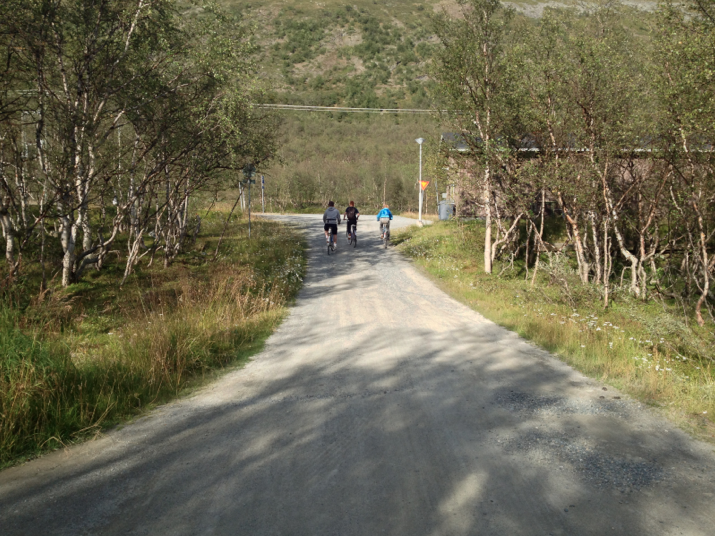
Earlier, a few of us on foot and others on bicycles traveled the distance to the KMarket, at the center of town, some 45 minute walk from the biological station. We picked up a few items for the film.

Popcorn, a New World cuisine was my choice for the evening.

Masha kept me entertained the entire walk home, with her specific observations on the American way of life, gathered while she lived in New York attending graduate school. One the way, we managed to catch site of reindeer which often wander around the area.
deer

Yesterday, I neglected to write about our absolutely fantastic hike, beginning on the Swedish side of the lake arriving there by local ferry, and then walking to the Norwegian border, where Tapani provided us with a lecture regarding 1000 years of political history in the Nordic north.

From there, having had lunch, we trekked upward and around the lake, to the base of the fjell which we had previously hiked several days prior. In all, it was about a four hour hike, perhaps more, through some of the most beautiful country I have seen ever.

Well, in fact, I should note as an aside, that today in front of everyone, I was able to provide a short digression on some of my own research–benefiting, of course, by the tracks laid down from earlier presentations by Tapani and Sergei, both of whom deftly introduced topics on, well, the themes are there to read below.
hillside


 Presenting the graph:

yet more graphsmore graphsgraph8/9 day three, afternoon session: Surprise visit by Antero Järvinen— offering a lecture titled, Cautionary notes on long term trends in northern nature — established scientist working here at Kilpisjärvi Biological Station, U Helsinki, for over 30 years. Fabulous images demonstrating skepticism of anthropogenic change to climate.

Views from
Kilpisjärvi Biological Station:

The Kilpisjärvi Biological Station, Scientific Research Station belonging to U Helsinki, est. 1964 provides long series observations of High North flora and fauna. Here is the view looking out.

gardengarden
garden


8/9 day three, mid-morning session:

Coffee!

Here at the biological station, thankfully, while without the milk foam, there is plenty of coffee available (yay!).

Tapani Kaakkuriniemi continues on the topic of Nationalism: representations (scientific and popular) aimed toward securing (reasserting) an independent stance. Finland’s national independence day in December versus Sweden’s national day in June, which, because of differences of weather, intensifies a particular understanding of the self, nation-hood, belonging. Here, Tapani recalls the work of Johann Gottfried von Herder (1744–1803), German philosopher of the initial cultural form, Will Kymlicka (Canadian political philosopher) on multiculturalism, and other popular practioners of the modern form, Jürgen Habermas, Jean-Marc Ferry, measuring egalitarian justice of the multicultural alongside considerations of political stability.


computer8/9 day three, morning session: Tapani begins this morning with a few reminders about tomorrow’s boat trip and hike, also a few announcements about further possible day trips to Norwegian border, and finally, now we begin with Tapani’s lecture on the nation-state:

State sovereignty— three elements of an organized political entity occupying a 1) definite territory, 2) population, 3) government.

Manifestations include the symbolic form of the flag, marked borders. Member status in United Nations continues with South Sudan, Montenegro, Switzerland, Serbia joining after the turn of the 21st century.

Basic assumption is that sovereignty stands outside the law, no higher authority than the sovereign, and thus, and equivalence of status among states (Peace of Westphalia, 1648 — emergence of absolutist states as final actors wherein the sovereign no longer signifies the King’s two bodies).
mountain Westphalian order…bound up with the persistence of non-capitalist property relations that lingered perhaps, lumbering toward the sovereign modern state. So, there are a variety of different sub-national and supra-national entities emerging which give rise to question the status of the Westphalian defined modern state. And this includes the concept of American tribes, status of Native-ness through government-to-government (often non-territorial) relations.
Tapanipresentationimage


duplicateduplicityThe Hill
8/8 day two, mid-morning session: Prof. Sergei Medvedev continues with a description of the world from 1450-1750, the march toward ecological risk society. Circa 1450, China was advanced, Islamic civilization in decline, Europe a backwater — then…

1) European ecological individuality wherein risk becomes more controlled (fewer natural disasters, regulated marriage, controlled fertility, colder winter linked to fewer diseases, advantageous position at the World Seas, good ports and waterways); 2) Food regimes (Rice versus Wheat), wherein rice requires a certain centralized authoritarian structure while wheat favors small “holders”; 3) High priority for order and peace in China versus European subject as agent of change; 4) Philosophy leadership in learning and morality versus wealth (using a knife to cut open a body, the anatomical theater).

rocksEuropean control over nature through the rise of the Modern State (violence, territory, nature); Judeo-Christian Tradition; Scientific Revolution (abstract and geometrized universe governed by fundamental principle of gravitation, Ferdinand Braudel); Early Capitalism and colonialism eventually transforming the world into an economic global system.

Medvedev’s “The Modern Trap” — Making the world friendlier, lighter, safer place, Pursuit of happiness and comfort, Avoiding risk and fighting death. Enslaving nature and man. Human freedom cannot be achieved without emancipating Nature. As opposed (or in relationship with) “more modernity” of geoengineering, where modernity is an unfinished product.

Here, I have to establish some lines of clarification. Prof. Medvedev’s argument is with what he problematizes as practices of intensification with the goals of perfection, creating similar attributes to U. Beck‘s Risk Society, entering a period in which the (over) production of bads poses threats to traditional structures of a wealth generating society.

setting8/8 day two, morning session: Sergei Medvedev begins this morning with a discussion of Maurits Cornelis Escher (1898-1972), analyzing prints for their philosophical perspective on the imagination of social and philosophical dimension (structural power[s] within the context of modernity, its institutions, language, and social form).

rocksMoving from Escher across various authors on the Modern condition, Max Weber, Franz Kafka, Jürgen Habermas, Michel Foucault and practices of surveillance. Oh, here we go, one of the students, Seyva, points out that institutions produce individuality, much like Foucault had pointed out in his many descriptions of genealogies of the present.

Emergence of Modernity, is there a time period? Early 20th century? Constitutions and rights of man? Reformation? Perhaps there are multiple modernities.

Holland as an example of modern space, as a highly constructed ordered “nature of space” (versus space of nature). Organized geometrical plots (power of geometric universal — a lego universe). The power of the cadastral map and with all the daily pursuits.

The cue: Soviet disciplining institution, knowing the rules of the cue (you don’t ask “who’s last in line?”), Vladimir Saroken, Russian postmodernist writer of The Line. Agitation after the first 30 minutes, and then transcendental by the time you arrive at the moment of consumption (“no joy”), for deficit commodities (toilet paper — wrapped in white like revolutionary sailors).

walkingNostalgia for the cue. Standing next to each other, communal experience, comunalnii kvartira (communal apartment).  Airline ticket lines. Western European/American etiquette versus Russian practice. The focus on property (bodies, time) — things that do not belong to the self (standing in line as an indication of non-ownership of time). The cue, whether we like them or not, serve a variety of different purposes (reading, time wasted, prayer, imposing and productive). The permanent reproduction of the communal body.

Modernity as a practice of filling all the blank spaces (Z. Bauman).

I want to mention, in passing, our hike yesterday evening to the summit of a nearby fjell. The walk itself was some 2 hours up the hill and 90 minutes back to the base. hilltopfriendsphotowalkinghappy

sadhiking


8/7 day one: 7th summer school at Kilpisjärvi, we are starting up this morning at 10AM, now listening to Sergei Medvedev, Higher School of Economics professor, European history and programme co-organizer, describing his initial experiences in the north as a formative desire to set up a school where students could meet and discuss the modern condition. Prof. Medvedev has a long career in various Western European and American academic institutions, and is quite involved in the Russian public sphere, publishing commentaries for the Russian Forbes magazine, radio and television in Moscow.

escape
Escaping the routine practices of the urban center, bringing students to a remote place near the Arctic circle, as much about education as it is isolation, northernness, remoteness, enhancing humanness. Lectures in the morning with interaction, lunch at noon, discussion of projects by students, a selection process to narrow down proposals and then movement toward creating finalized projects. An escape from networks for some time.

The organizersTapani Kaakkuriniemi (far left with S. Medvedev), Head of Education at Aleksanteri Institute, reminiscing on early life in the North. Temporalities of the North based on different attitudes than the march of progress associated with urban life. Sharing the experience associated with the land, climate, weather, the natural elements. Hiking during summers.

We have some preliminary discussions, including our sauna period, hiking areas, weather conditions, cycling, and the dangers of cycling in the north given the narrow roads and having to share the space with truck drivers, payment of accommodations and bus transportation (payable to Tapani). Tricky terrain in the area, so notifications of travel should be taken seriously.

First session: Art of Travel.
everyone Sergei M. — Travel as daily routine and ordinary, versus previous times, when travel was limited to merchants, traders, sea farers, taking travel for specific reasons, escaping debt, discovery, but not sentimentalism as it is today, as a journey of self discovery, as a reflective subject, that apart from reading can be accessed through traveling. Tourism, a standardized form, though its early development began as the “‘grand tour” for self development, necessary visits to Nice, the destination of young, wealthy, Englishmen. Tour emerges as part of cycling and sportsmanship and both, combined with the appropriation of space. Tour de France, cycling and covering the nation, “liquid modernity” (Z. Bauman), the idea of spread, expansion, exploration and appropriation of space, encircling space.

cordMass society–what was individual exploration, travel becomes mass tourism, the big resorts, sanatorium, standardizing bodily recreation and leisure, depositories of the human body, belonging to the state (as in Soviet Russia), requires states of rest, at resorts (Crimea), through jet travel (Boeing 747), economies of scale makes transAtlantic crossings a mass option, the secretary, the itineraries, discipline and practices, no longer imagining travel without the guidebook (lonely planet), confining to itinerary on the one hand, and enlightenment on the other. Stop using your own vision, but channeled through the guide book and losing the sense of personal discovery and exploration.

Textual and experiential. Do you first look at the image or at the textual description.

Tourist or Journeyman. The consumerist practice in addition to the guidebook includes the camera (and now Iphone, Ipad). People traveling for the purpose of taking photographs, standardizations and reproductions, proving their own reality (W. Wenders). Tourism as standard procedure overburdened through accessible practices, mediated through repetition (repeat visits, matrix of comfort). On the other hand, travel remains an encountering the other.
bus tourismfrom the window

Simon Infanger, Switzerland to KilpisJärvi by bicycle, project 5000. Traveling without a guidebook, and taking photographs, backpacking as a counterweight to tourism. Works in marketing, sports life, bicycling 13000 km/year. Project 5000: Cycling from Switzerland to Nordkap and back to Tromsø (5000km) within 28 days (+4 days off). Collecting money for Viva con Agua for drinking water in development countries. “Probably the most ambitious cycling tour ever from Switzerland to Nordkap”.

stationProject 5000: Press feedback (newspaper, television); Daily updates on tour (blog, social media); Presentations after the tour. A present form of travel mediated by technological advancements in clothing (weather gear enabling cycling during heavy rain); delivery of packages through coordination of internet and FedEx; bicycling equipment has radically changed to provide increasingly different and intensive performance.

Travel packaging delivery at destinations provided for specific weather conditions, differences between Germany and Finland, requirements differ. All of these requirements, traveling parcel to parcel, “a huge organization before you start, but when it works, it is super comfortable” [simplification by huge energy demands and organization, a striving for simplification] — streamlining the intensification of time-space compression, combined with “huge media feedback.”

desert“I have an Ipad and post photos and messages every day”. The length of the project, its speed, new, excitement, because it is only 28 days, versus something like 3 months which would become boring. “When I arrive back in Switzerland I will do presentations on the project to raise money and provide inspiration for others to try something new.”

mapAs part of preparation, a Youtube video of training was posted as well.

Inspiration: idea, that you can realize the idea, that you can focus, priorities, “if you can think about it you can do it…I fell in love with the North, and it took me three years to come back, the major goal, sometimes you have to do bad things to reach the goal, 50 hours a week sitting on a bicycle seat”. Doing things are needed to reach the goal, and not doing what everyone tells you to reach the goal, and the professionals responded, “You’re not a pro and this is very ambitious” — good to have concerns but good to be self confident and do the way you can do things.

25,000 followers on the blog, and comes up with an idea in Germany, providing an image of the roller coaster with his bike, to share on social media.

People living with the project through social media. The representation of endurance “arriving through muscle force and not car”.

in the busbusAfter Lunch: A short introduction to the Kilpisjärvi Biological Station , Scientific Research Station belonging to University of Helsinki established in 1964 by Prof. O. Kalela (who came to examine fluctuations in small fauna). The only part of Finland extending into the Scandinavian mountain ridge (Scandes). And plenty of flowers, mountain, high latitude flora. Between continental and oceanic climates, quite difficult to forecast. Mean annual temp. -2.3 c (+10.9c July/-13.6c January). Shortest growing season in Europe: 100 days (in southern Finland 180 days). The research station provides long series of observations on: fluctuations of small rodent densities over a 60 year period; population dynamics of passerines since 1957; changes in flora. Research activities include effects of global warming (ITEX project).

Eight permanent employees: director, station manager, department secretary, laboratory  mechanic, cook; 2 cleaning persons and janitor. Three part-timers: 2 cooks and research assistant. No permanent research positions.

cleanerSergei Medvedev: Introducing the program. Escapes from Modernity philosophy. All together 16-17 schools with hundreds of students (7th programme in Finland). Gathering people in remote places to discuss critical ideas, including in addition to Kilpisjärvi, Estonia, Tartu University sports station, gathering each February, Bavaria, in the Alps (media and information technologies), Catalonia (aspects of architecture and the modern city).

talkingEscaping from the big city, from modern society and hassles of daily life with the object of criticism being modernity. Modernity: something to which we all belong and yet seek to escape. The discliplinary institutions that restrain us and at the same time produce us. Reformation, Enlightenment, Industrialization/nationalism, 20th century (wars, mass, globalization). Key tenets of modernity (time) our measurment (no such thing as time in nature) — modern time, premodern cyclical time. In Lapland, time of the eternal now.

We saw a Norwegian movie yesterday on the way here, in the bus, entitled “North”, which presents the concept of time in the form of the low-hanging sun, the symbol of enduring time (not being afraid of death, reuniting with nature). Environmentalism as non-modern form of economic imagination.
fireheading top
Two-minute round of introductions of students:
Well, here, I am going to jot down the first names of students in attendance as each briefly describes their project idea. Afterward, there will be break out groups to decide which topic should be further explored. I have abbreviated the project ideas into key words:

Roosa, cult. anth., U Helsinki: maps, borders, naming.
Paulina, soc., Moscow: constituting North community.
Marina, hist., Moscow: legislation as source of identity.
Nastia, cult. anal., HSE: image of North in media.
Anastasia, media, HSE: information and social networks.
Natasha, law, HSE: recycling practices.
Vayna, law, HSE: legislation environmental protection.
Igor, demog., HSE: life expectancy indigenous.
Alla, lit., U Helsinki: climate change.
Sonia, lit., U Helsinki: Saami identity.
Mitya, polysci., HSE: cultural integration.
chickenAzamat, econ., HSE: recycling.
Edward, hist., HSE: crosscultural studies.
Tatiana, polysci., HSE: cultural heritage.
Sofie, for. affairs, HSE: interactive game.
Gritten, polysci., U Helsinki: new routines.
Nastia, econ., HSE: climate change.
Dimitri, econ., MGIMO: oil & gas companies.
Dasha, hist., HSE: animal rights.
Oleg, philos., HSE: mythology.
Masha, IRpolitics, NYU: economic equality.
Victoria,[], HSE: ecological politics.
Seyva, econ., HSE: education.
boat

meal
Regroup at 5:45

Six group titles:
New approaches to education as escapes from modernity
Beyond the borders
International corporations
Mythological influence in modern Scandinavia and Japan
Urban escapes
Climate change
rainbow


epilogues…

wingwindowswimming


8/1: Over lunch with Dana M. and Anna F., Aleksanteri third floor, I mentioned my recent field trip with Tapani K. to St. Petersburg, Russia, where, instead of heading to Gazprom for an Energy Intensive Seminar, our schedule changed and we walked through a Q and A at the Baltika Beer factory, owned by Danish beer giant, Carlsberg Group.

We all tittled over this choice of venue change, but the reality of the trip raised a series of research questions surrounding method.

I mentioned that our Gazprom visit was likely suspended because of proprietary concerns about sharing information, but during our visit to Baltika we acted like curious academics nonetheless, pestering the tour guide incessantly with questions about production chain.

Actually, I realized that Baltika representatives were indeed quite open to responding to all of our questions, without hesitation. Unlike the energy industry, the brewery guide offered the possibility that studying beer production in Russia could be a fruitful way to have access to (enough) data on global production processes.

In Houston, for example, visiting the oil service company, Schlumberger (see post below), the tour guide suggested the company had total control over production of metals required to assemble parts, and governing over standards ensured reliability of performance. In St. Petersburg, I asked whether Baltika governs over agricultural producers to standardize qualities and quantities of grains. We were told the beer company relies on local growers but could rely on grains shipped from Argentina or Brazil– no solid contracts.

The openness of the entire discussion suggested there are “unmarked” categories of discourse about industry in Russia, where researchers could have access to data than in “marked” industries, such as energy, where gaining access feeds into a kind of desire of — on the one hand of Russian industry’s need to sequester facts, and on the other, of western researchers’ focus on gathering those particularly unavailable facts.

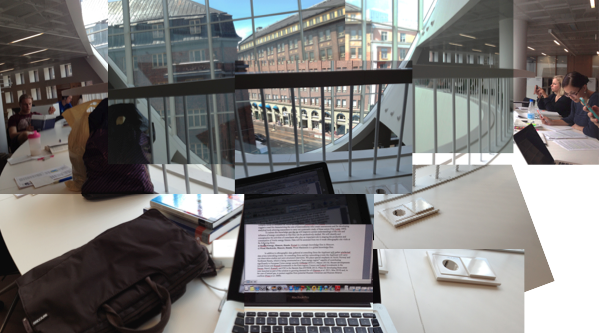
view from libraryHelsinki
street scene
window

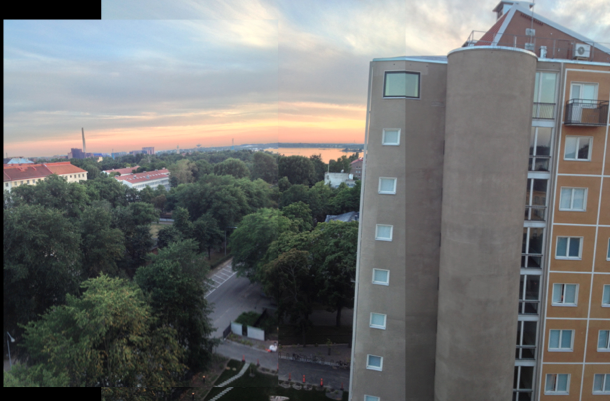
park at night
inland sea

Over lunch, we began discussing the possibility of carrying out interviews among practioners working in Russia, to determine which industries are more open to sharing information as research– energy more closed while with beer– well who knows, perhaps more open. Questions about transparency and access could provide a sense of what types of information could be available for qualitative researchers working with interview and ethnographic materials.

I thought at that moment, of how open the Norwegians are when talking about energy industry.

Two additional points of relevance:

First, researchers having written about access to Russian energy industry have in their personal possession some sense of how transparency is constructed. Also, how would a comparison of industry transparency between Norway and Russia appear. That is, in addition to selecting industry based on open exchange within Russia– also select an industry that as of yet has not developed the appropriate consciousness of having to sequester knowledge. Finally, how could a comparison of Norwegian/Russian practices over transparency take place.

In short, three types of comparison: (1) between “marked” (energy) and “unmarked” (beer) industry; (2) across Russian and Norway’s energy industry practioners looking at forms of sequestration and transparency; (3) among researchers of Russian energy industry, to determine what they — objectively, can point to as validation, in their claim to have deep access.
movie

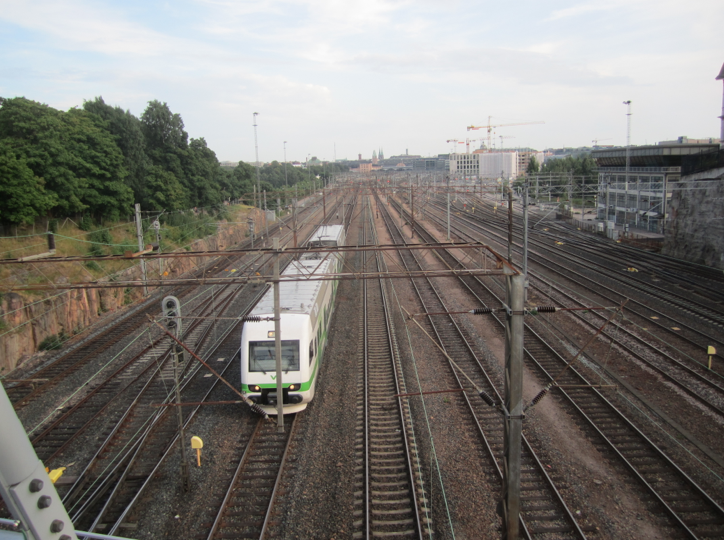
train

dancing

image

dancing

plug

coffee + Croi
train

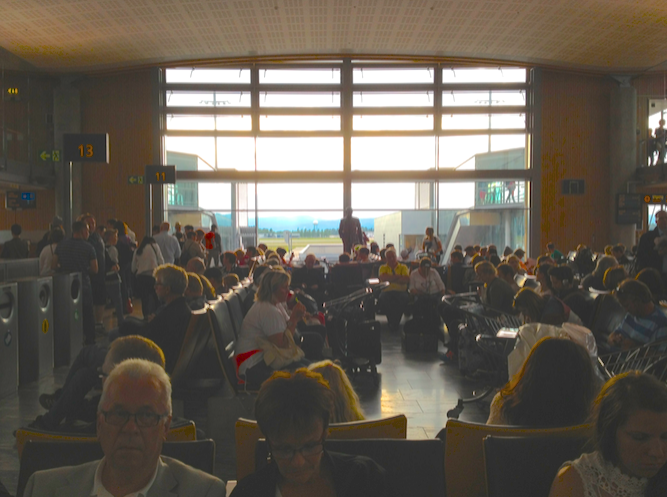
enroute Oslo

enroute7/3: Tristan Mermin flew into Oslo from the Bay Area and we spent the week traveling the town and the surrounds, discussing our respective work, its limitations and possibilities.

It was an opportunity to speak endlessly.

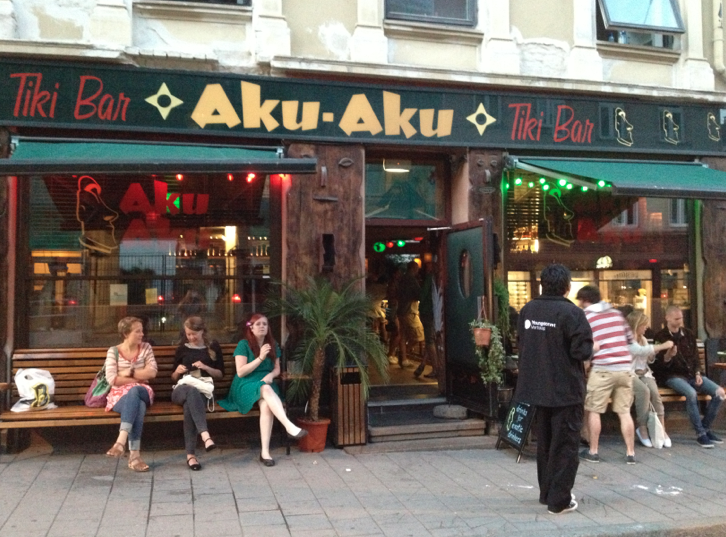
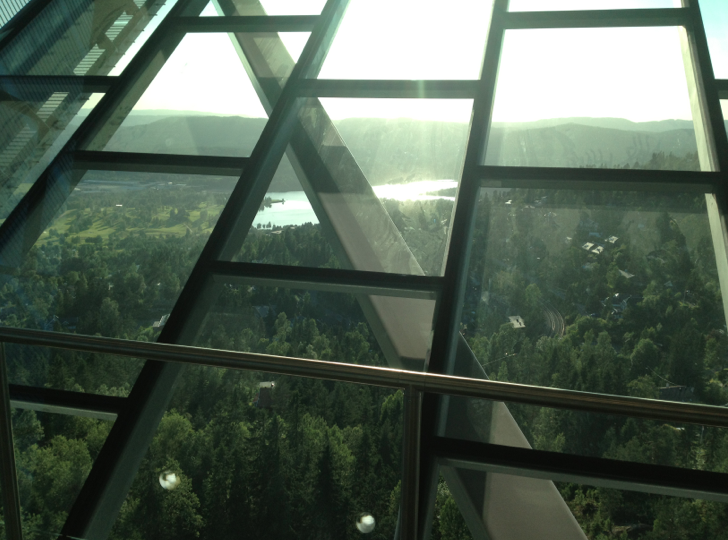
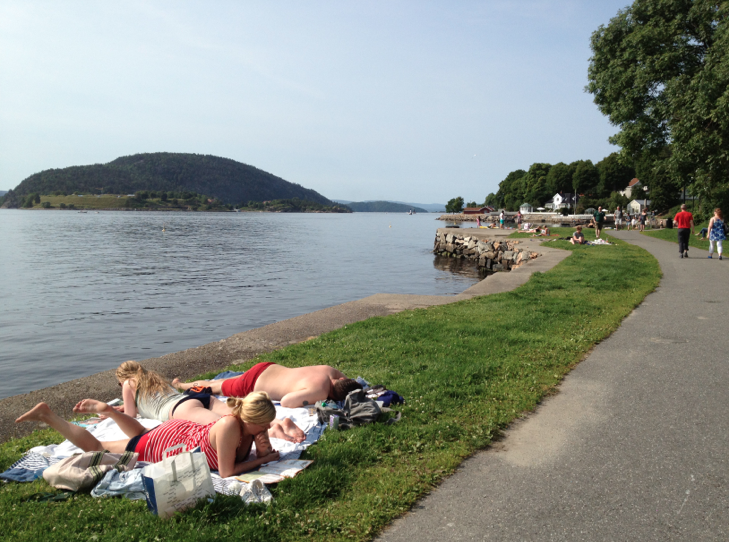
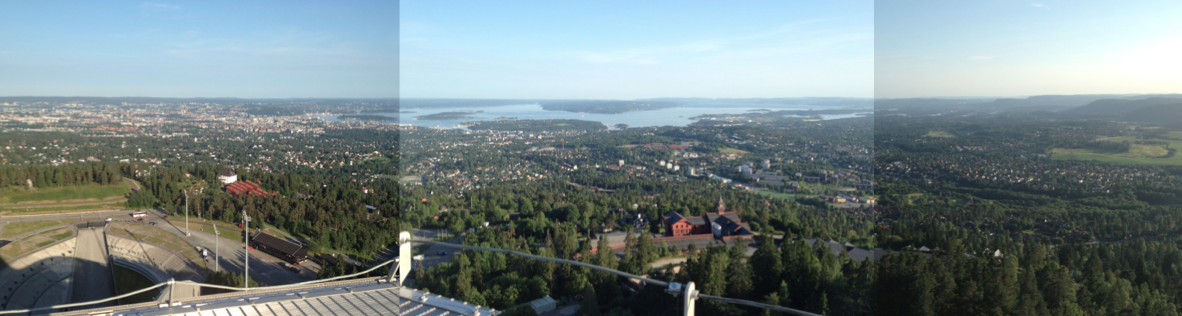
We did more. We played tennis near our flat in Majorstuen, checked out the view from the top of Holmenkollen‘s championship ski jump, went swimming at Drøbak (40 minute drive from town), rented a car to catch a party in Farsund (nearly ten-hour drive to southern-est Norway), strolled the weekend flea market two steps from our front door, attended an Oslo party for Norway’s Miss Universe, toured the Viking and Kon-Tiki Museums and Royal Palace — and of course, hit restaurants and bars – dinners at Kafe Oslo Litteraturhuset, Hotel Havana, Olivia Hegdehaugsvei, drinks at Aku-Aku Tiki bar, Andy’s sportspub and pianobar, Bjoerungs, snacking in Marmaris Pizza & Grill Grunerløkka, Åpent Bakeri in Majorstua, Kaffebrenneriet, a bowl of cherries from Vestkanttorget after our tennis match, and Mabou nightclub where I always wanted to visit. clubIn one discussion, I was reminded of my drafted manuscript titled Eureka Moment as Knowledge-Event Product, from which I read several paragraphs to Tristan, because of our interest in the role of commerce in the delivery of inspiration. We laughed aloud.

I had suggested a new type of advisory service titled the Eureka knowledge-event or EKE. Eureka knowledge-events (EKE) are delivered personally to clients in the form of an idea to create entrepreneurial thought for seizing opportunity. Responses to EKE are expressions of sudden awareness (wow, I’ve got it!).

diningbreakfastThe EKE, I suggested, connects forms of expectation associated with commercialized labor to experiences associated with a personal calling or vocation.

Upon its reading I pulled the manuscript for revision.

Within several days and during our stay, I received a manuscript request from Journal of Business Anthropology, to which I suggested the planned revised article.discosculptI also had a chance to describe my recent attendance at the St. Petersburg International Economic Forum (SPIEF), the Davos of Russia. Describing how I capture the back-stage scene, Tristan pointed out the gravitational-pull creating activities that typify the event, including the concentric circle security patterns that define the heightened sense of excitement during attendance.

Attending keynote speeches, Russian President Vladimir Putin and German Chancellor Angela Merkel, requires high security identification badges, without which, I noticed several slipping through the turnstile by walking alongside another attendee with the appropriate ID, a tactic for getting a closer look at the power holders.dinnerkontikiWe delved into recent activities of Tristan as owner of the brand Batiste Rum, an ultra-delicious, ultra-premium rum that he discovered during his travels throughout the Caribbean.

His stories of exploring the region, tasting, negotiating with different rum producers is fascinating, and I plan to invite myself to accompany him on a St. Barts Island adventure.vikingshipTristan reminded me also of the need for exercise and how all anxieties as toxins could be flushed through the system from just some running around, an life-balance reminder.

Did I mention how accomplished a tennis player Tristan has become, actually knocking me flat on my back with one of his first serves after I failed to dodge the ball. After the game, all things appeared to us even more cheery and clear.
cellarbalconWe spent considerable time talking of excellence and the importance of interrogating the epistemological core of one’s object to identify in full the points around which what governs survival emerges.

I could not help acting particularly intense, and referred to means-ends causality in the form of a quote by King Louis IX of France, cited in Norbert EliasCourt Society, “beware of hope, a bad guide,” which I carry with me at all times, as reminder of that science is politics by other means.
holmenKgardenWe went into depth on topics relating of charisma and reflexivity, of humility and of vanity projects and whether second acts can provide an authentic experience and of a shift from wealth creation to commodity flows, and of the importance of protecting cash flow over securing the stability of wealth coming under continued threat.

kon tikishotcourtWe referred to Oslo itself, as a town that reflects, in fact, a city-wide country club, with its public tennis courts and swimming pools, its Royal Palace, museums and gardens, with its street cars that directly take you past the city’s best restaurants and clubs, and the streets themselves, with domiciles that represent, in miniature, sections of various European cities.

It was perhaps Belvedere writ large and public –but with all the actual prices of participation reaching so far into the stratosphere so as to impose limits of entry for only those who can afford the city’s often outrageous cost of living.
clubracketsWe discussed the ecology of ignorance surrounding ethical practices perceived by others and whether or not it makes any difference to provide feedback upon projects in which others simply do not feel the same. I was reminded of my early work in Alaska on elites and land claims and how the work continues to stir debate long after I have moved on to more pressing questions about energy development and that what presses upon folks as the ethical may long after be forgotten by others whose actions represent casual markings within an arc of trajectory.
breakfastburgerschairWe discussed the lady in the forest.

We mentioned the power of denying helplessness by foregoing desire and rebuilding a life entirely without purpose within the overall structure of capitalism in which the peripheries are purposefully denied agency beyond their capacity to fuel the future through resources and labor.

pancakesfeet sangriaTristan pointed out the importance of “enjoyment” or “profit as you go” principle, to always recuperate the present within the strategic objective.

And here, I thought of Diogenes and the power of anecdote in corporeality of expertise, alongside all the stories in the news these days of workers in Europe living their entire lives through delayed gratification — only to wake up and realize that all their savings have vanished at the hands of  bankers who shored up their own assets by putting the accumulated labor of others on the roulette table.

The story reminded me of Henry Miller‘s mantra about the importance of pinning your last dollar to a calendar, to prove and provide a final date when destitution arrives, thereby, living fully and completely up until the last moment. moreplane tooplaneWe pointed to the notion of pattern recognition, especially in the context of iconography, for example, that on display at the Kon-Tiki museum, an image hangs on the wall of a photograph of a seated Kon-Tikier, wearing straw hat and strumming an acoustic guitar during their wild ride in the Ocean — suggesting some kind of leisure amidst the wild, and that this very same image, or a cropped version, holds a prominent place in the Aku-Aku Bar in Oslo, suggesting that to replicate (this) iconic form regards a marker of authenticity.

We spent time deliberating on the typology of markers that constrain and define any social field of trajectory.
coffeegardentikiIn connection, we discussed narrative structures and the importance placed on markers of distinction, the wholesale distraction that accompanies the blinding light associated with awards, research grants, peer-reviewed publications and the like, and the inability to reduce the complexity of the game, particularly in academia, to a logic of practice that could result in efficiencies by any other means than personal labor.

That was my argument, at any rate, even though what-that we had tested ideas about repackaging and kicking down the food chain research articles or the wholesale management of a career by the amount of money required during a budgeted year.
lakepolesWe mentioned the professionalization of professionals and of expertise, essentially — the bifurcation of intellectuals into those on the one hand that would come to represent a “standing reserve” and provide added value through quantitative values (numbers of publications) and, on the other hand, experts oriented toward research outcomes that would be qualitatively measured based upon the concept of an idea.
watertunneltop
We departed as friends.

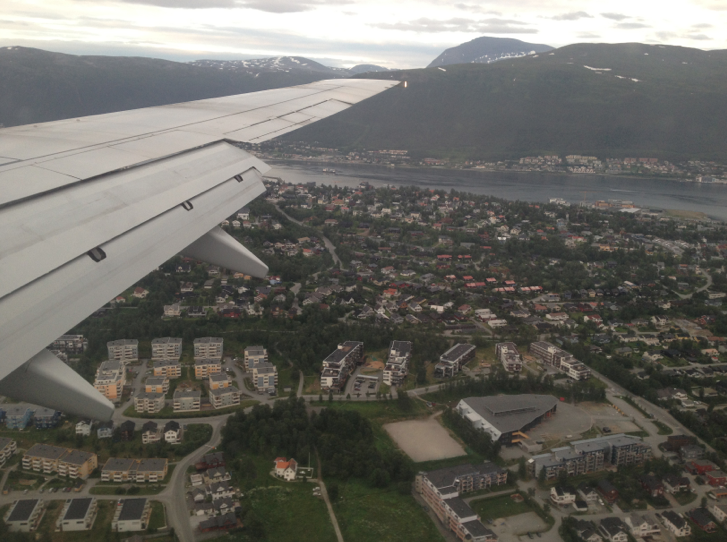
enroute Troms

lights


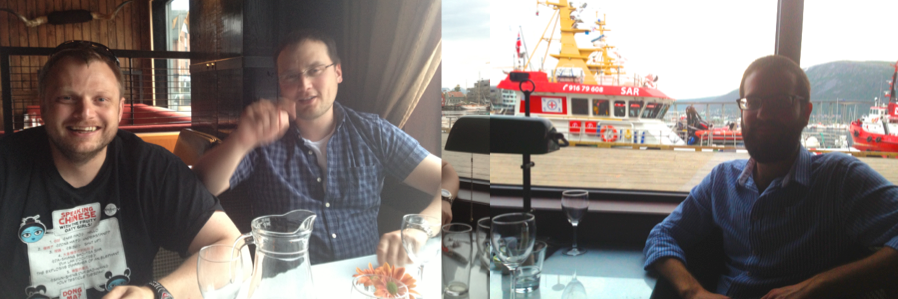
Tromsø, Steak, Anthropologists.

in housetroms

inside

Screen Shot 2013-07-03 at 12.28.22 PM

friends

Helsinki helsni machine6/30: Laundry in Helsinki, gave me a few hours to ponder Arkhangelsk, SPB, Moscow. Game changer — April, at the Arctic Council meeting, Stockholm, I suggested the trend in predictions over the past 15 years could not, or did not, anticipate game changing events, such as increases to oil and gas production through fracking techniques. As a consequence, was it then premature to discuss opening the Arctic to oil and gas development, and if so, how could everyone in the room consider the option as settled? The question took form during the Economists Summit, Oslo, March, when a more general statement emerged from the audience about the logic of opening the Arctic to oil and gas developments given the current condition of security of supply and insecurity of demand. wingBy the time I arrived at the St. Petersburg Economic Forum, June, the topic was global outlook on natural gas. At the International Energy Agency (IEA) Launch of the 2013 Medium Term Gas Market Report, Maria van der Hoeven, Executive Director, IEA, suggested that low natural gas prices in the United States, high prices in Europe, and stratospheric prices in Asia were symptomatic of the lack of a global gas network. Moreover, the mismatch left open opportunities for Russia to capture Asian prices by directing hypothetical Arctic natural gas pipeline projects toward China. Over supply in Europe from United States exports would dampen demand years to come. The question was reformulated as follows: Going back 15 years, we see reverse cycles of demand-supply security. FinnairIn the late 1990s, increasing demand and a flush of natural gas availability opened the possibility of a turn toward electricity power generation based on natural gas. By the early 2000s supply tightened while demand was peaking. Throughout the 2000s tightening supply destroyed demand along with other factors of volatility, until 2006 when supply begins to pick up, and by 2010 there is general acknowledgement of supply abundance during a period of weak market demand. These reversals of security affecting the fortunes of supply-demand relationships, did not deter IEA, alongside all other consultants, from making continued strong predictions. window dressingAccording to M. Hoeven, the question is best addressed in terms of asking what are the “game changers”. How would China’s economy move forward, how would supply increases take place in areas where hydrofracking technologies are still nascent. Finally, I posed the question to panel members at RPGC, Moscow, who were quick to point out that they do not, indeed, pose forecasts, but in fact, scenarios. Business “likes stability, stability of trends moving forward into the future”. But given past events, volatility and swings in the nature of global gas markets and its resilience toward globalization, could they mention game changers that would alter the scenario landscape. left side tooloo stair grass tile Hesl Helsini
Helsin
boats

Moscow Oil & Gas

moscowsushiphoto opinside

25-28 June 


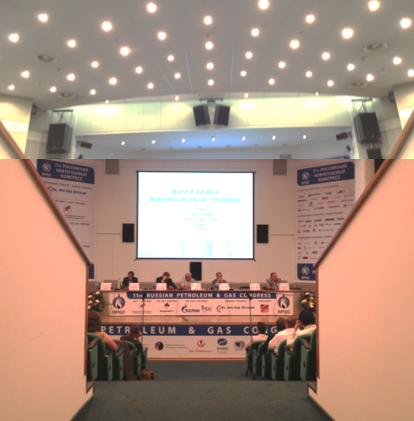
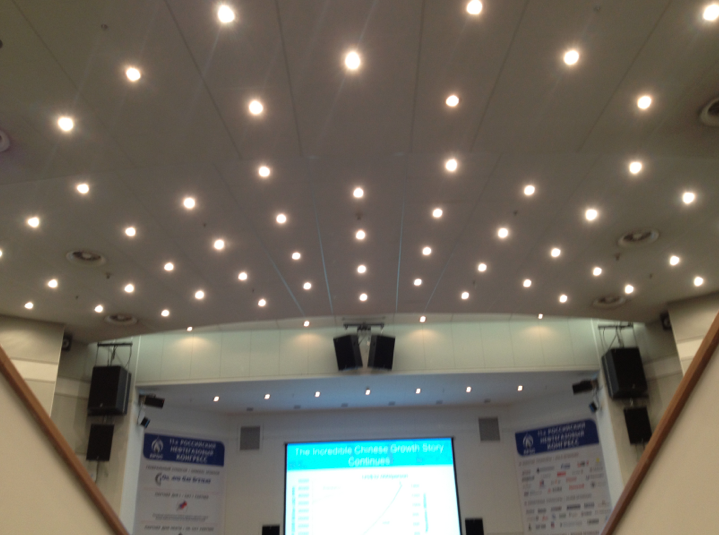
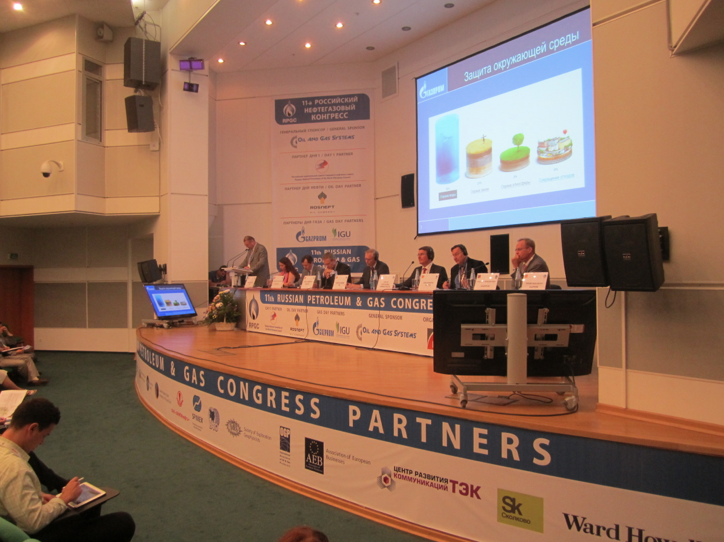
Russian Petroleum and Gas Congress
Moscow Centre

Congress website, Sponsored by Industry
Program in English.
Travel Information
Delegate check list


Epilogue:The feast

mealalso thereAttending the Congress is an iteration in the forward movement on understandings about Russian oil and gas.

On display are the particular feelings Russian academic and some industry and government have toward changes in markets and potential pipeline developments.
inviteFor example:

Despite recognition of immense importance of shale gas extraction in the United States upon Russian industry taking place at this meeting…


there
[including official denials of its importance, as witnessed by anyone attending Vladimir Putin‘s response to Daniel Yergin‘s question about changes to industry at the plenary of the St. Petersburg Economic Forum only days previously, when the Russian President announced there is no shale gas revolution in the US but in fact a short lived environmental disaster taking place]
bus arrivalcigar
— one main play is the rough-shod feelings expressed by Russian industry at the hands of their consumers, the Europeans, for whom they feel betrayed after having invested in building pipelines to the West.

That is to say, efforts associated with infrastructure so meticulously built up and managed by Russian personnel to deliver gas to Western Europe are ignored by consumer efforts to import global gas and renew attempts to create spot markets. For Americans, of course, this sentiment would fall on deaf ears, given the pipelines themselves are depreciated over a 20-year period after which, they simply become cash cows.
Screen Shot 2013-07-14 at 7.07.58 PM

Screen Shot 2013-07-14 at 7.07.43 PM
It is as if there is a certain nostalgia over infrastructure and what constitutes investment in Russian industry is the actual material placement and not its economic value.

At any rate — these are raw notes below taken as the days were long.
image


6/25 — Day Three:

Gas Day

Plenary Session


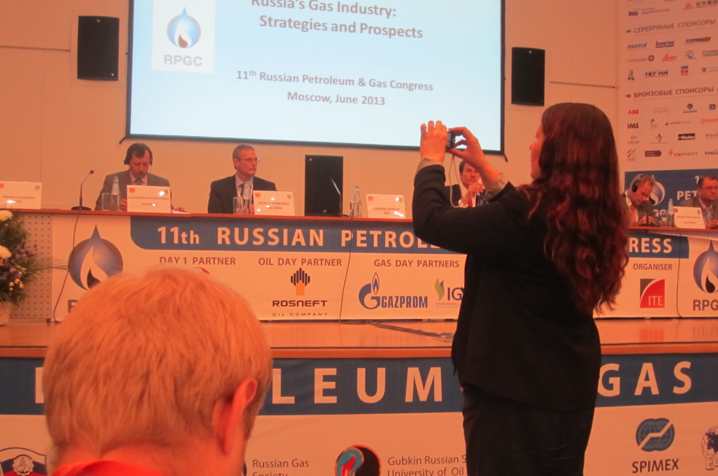
Russia’s Gas Industry: Strategies and Prospects The Russian Far East and Eastern Siberia as a New Gas Hub: Developing Production, Processing and Supply of Gas to the Asia-Pacific Region

photophoto opCo-chairs: Torstein Indrebø, Secretary General, IGU, and Alexey Mastepanov, Academician and Deputy Director, Institute of Oil and Gas Problems, Russian Academy of Sciences. Alexey provides introduction. Demographic change and in particular, scientific and technical progress have changed the gas growth agenda, to a shift toward surplus energy where consumer will select their own energy and provider and area of consumption.

Totally different criteria come into play. With the tightening competition of the consumer energy prices will fall. These processes are not alien to energy, even after the shale revolution in the United States. Technical changes do not remain the same. “Stone age did not end because we ran out of stones” — hydrocarbon age will not end because we run out of oil, but other advances toward a non-hydrocarbon era. Hopefully these issues will be discussed, to make us revisit these issues.

in townAnatoliy Arabskiy, Deputy Chief Engineer for Research, Technology and Ecology, Gazprom. Dobycha Yamburg, Innovation technologies in gas production and their influence on environmental protection. We have planned a number of environmental measures. Sustainable development. Describing technical changes to gas development that enhance environmental importance. Highly technical discussion about subsurface water movement.

Alexey responds: Mr. Arabskiy clearly demonstrated there is significant cost reductions in efficiency in gas technology.

lunchVladimir Pashkov, First Deputy Chairman of the Government of Irkutsk region. Development of the East Siberian petrochemical cluster. Improvement of efficiency of oil and gas recovery by new technologies. We are subsidizing economies of other countries through lack of efficiencies. Unfortunately, increase in prices are not directly linked to economic performance. We are introducing a number of measures to maximize development and revenues. The premise that significant oil and gas reserves exist heighten potential for production. Proper geologic conditions for accumulations, existing transportation systems, modern chemicals, human and scientific resources are in place in Irkutsk and other factors give optimism. We are developing an oil and gas cluster — a complex that would increase production. Developing Irkutsk gas for export purposes. Creating a wealth fund for investment technologies.

Dmitriy Sokolov, Researcher, Asia Pacific Energy Research Centre/APERC. Japan APEC energy demand and supply outlook 2013 by APERC: the role of natural gas in energy balance of APEC economies for the period till 2035. We do forecasting of energy to 2035 in Asia. A few words about APEC, examine energy sector in 21 companies, 60 percent of global energy demand in Asia. We develop research and cooperative programs for sustainable energy, fully financed by Japanese government. We do annual statistics, overview, demand and supply outlook (every four years), research support for cooperative programs. Programs: Oil and gas security exercise (GOSE) held in STPB, April 2013. and LNG Producer-Consumer conference held in Japan last year.

mealScenarios: Business as usual (“Assumes existing policy continues, including polices in process of implementation, legislation already approved”) Three alternative cases: High gas scenario; Alternative urban development scenario; Virtual clean car race.

Key results: reducing primary energy intensity by 2035 is feasible. Nuclear electricity production increases. Gas based generation rises by 10 percent in contrast to coal.

To support large scale natural gas from Russia: Education–policy makers cannot take action without the support of their stakeholders and constituents. A completely wide difference between Russian and Australia. Australia is totally open (2) Promote energy efficiency-provide information and set standards for buildings, appliances, and vehicles, eliminate wasteful fossil fuel subsidies provide financing for cost-justified EE investments, promote Energy service companies (3) Promote energy research.

goodiesAnatoliy Panferov, Deputy Chairman of the Committee for Environmental Management, Ministry for Development of the Russian Far East of the Russian Federation. Formation and development of the Far East petrochemical cluster.

Samuel Lussac, Analyst, Wood Mackenzie, Vladivostok-LNG: promoting development of East Siberian gas. Vladivostok program. Both Russia government and Gazprom want to develop huge gas resources in Far East and market them in Asia.

How to Monetize East Siberian Gas reserves: Looking to supply China and Far East. Different supply zones using different scenarios of transport (pipe, LNG). All deposits located away from infrastructure, specific gas itself requires refining terminal. 30 to 40 billion dollar pipelines. As a consequence high capital costs makes projects marginal. Take away: Chayanda project not economic. Vladivostok market is not large enough to develop these fields. Joint development of Chayanda and Kovykta may be economic, if gas went to China and Vladisvostok. Mineral tax terms provided by Russian government are relaxed to stimulate pipeline projects. Unlocking Siberian gas would be very capital intensive and partners should be welcomed. Also, government tax regimes would be welcomed. Gazprom would have to capture the market there and competitive against other

lunching also lunchingVyacheslav Kulagin, Head of the Global Energy Markets Centre, Energy Research Institute, Russian Academy of Sciences, Development prospects for the global gas market: new opportunities and risks. Share of gas will increase from 20 to 25 percent. All forecasts are bullish, but there is some question as to whether gas demand in Europe won’t be replaced by other non-Russian supplies. Important coincidence: this graph shows a share of Russian export is falling. In principle we hope that demand will grow that our deliveries will increase and that pipeline shipments will be supplemented by LNG but the competition is pretty tough. If we sum up the projects being built and contemplated for European export, we talk about doubling capacity. Just 5 years ago we expected major increase in exports to Europe. 200 bcm per annum is an positive assessment.

Nabucco project unlikely. Azerbaijan will not approve. America: the shift to natural gas as a transportation fuel. The issues of pricing is major.

Vladimir Timoshilov.

Vsevolod Cherepanov, Member of the Management Committee, Head of the Gas, Gas Condensate and Oil Production Department, Gazprom. Gas-condensate assets: current situation and prospects. No show.

Vladimir Kontorovich, Laboratory Chief, A.A. Trofimuk Institute of Petroleum Geology and Geophysics, Siberian Branch of the Russian Academy of Sciences. Strategy and prospects of Russian gas industry development. No show.


Plenary Session 2

Strategies to Strengthen a Leading Position in the Global Gas Market: Energy Diplomacy, Development of Transportation and Processing Projects, Marketing South Stream Pipeline – Europe’s Vital Project
Co-Chairs: Uwe Fip, Senior Vice President, Gas Supply East, E.ON Global Commodities SE, John Roberts, Energy Security Specialist, Platts

Torstein Indrebø, IGU. Main driver we see is air quality and public health, where the gas industry can provide competitive solutions. Huge differences in European, American, and Asian gas prices. Can disparities between oil and gas be continued. Finally, if we shall success in the gas industry and reach global age of gas, we need to create more trust for the gas industry, climate groups, students.

Sergey Balashov, Deputy Head of the International Business Department, Gazprom, Gazprom and sustainable development. Speaking ironically about environmental concerns, giving an example of the imagined protection of an imagined whale.

Valeriy Minlikayev, Gazprom. Specific reservoir details.

woodmacUwe Fip, Senior Vice President, Gas Supply East, E.ON. Global Commodities SE Security of supply and growth of new market segments for natural gas. Short term trading with gas structure. E. ON. has restructured. Reform of the malfunctioning carbon market in Europe is leading to power generation primarily led by coal and oil. New LNG and pipeline projects (from Russia) provide security. Ensuring that Gas supply in Europe is secure into the future. New applications for natural gas in Europe, transport sector, real boom is to be expected when LNG is used for long-haul trucks.

Oleg Aksyutin, Member of the Management Committee, Head of the Gas Transportation, Underground Storage and Utilization Department, Gazprom, Energy efficiency of Gazprom gas transport projects.

bigVitaliy Yermakov, Director, Russian and Caspian Energy, IHS Cambridge Energy Research Associates / IHS CERA, Changes in Russia’s LNG strategy and “Go East” gas policy. From the oil side, we will see major increase in LNG segment. It will be a resource to meet demand globally. Our team of economists at Goldman Sachs are saying that Asian countries are already outpacing Europe. By 2030 it will be growth of 7-8 percent. In 20 years Asia Pacific region, they will outpace Europe and America so dramatically, the west will not be able to catch up. “A new gas map of the world”.

New suppliers, with huge reserves. Traditional suppliers still here, won’t go away.

Shale gas put America at the top of the list. Turkmenistan will make an announcement soon which is huge. Traditional model suggested several major players with large reserves. In this tradition, huge pipelines would create supply to demand centers. But in the early 2000s with LNG, and now with new resources, are shifting this model.

In the US, everyone expected the States would become an importer, and created LNG terminals, and now, it is expected on being an exporter. The future is to what extent the US can be shifted to other parts of the world. Deepwater areas, huge reserves were discovered. From this perspective maintaining competitive costs. For Russia, the idea is to maintain competitive costs, or lower costs. We don’t expect major growth in the domestic market (Russia) so all expansion is largely for Asia.

Leonid Chugunov, Head of the Project Management Department, Gazprom “South Stream”: challenges and innovations. No show.

Ksenia Gladkova, Senior Adviser to the Secretary General, IGU Role of gas in global energy policies. I’m pleased to return to Moscow after presenting at the same conference. African members are displaying interest in joining us. Meeting in Azerbaijan, later this year in November.

more imagesJohn Roberts, last word — we had a strong stress on green house gas emissions, and ability of gas to mitigate issues. But we need to take a fresh look at the irony at the rise of CO2, that we live in an era of low coal prices and a lack of carbon prices that can mitigate. Four words: Supply is no problem. Security of supply is no problem and security of demand is the problem. Security of demand during G20 recently, took center stage, perfectly right, not because we’re here in Moscow, but because of the reciprocal nature of buying and selling. Politicization of security of supply and demand which impacts on long-term contracts, even though Norway was able to build the longest off-shore pipeline without any long term contracts, and it was the evident longterm supply that kept the market for that project moving forward.

“Politicization of Gas Corridors” — Role of government still important, I don’t know of any gas project that is not political. On the other hand, these political projects have to be commercial, you need two green lights. Just yesterday, in fact, there is not going to be a definable system (Nabucco) moving to Europe. Look around at Russia today, and you hear that phrase that Russia is an energy superpower, but you can also say the at the United States is an Energy Superpower, and the two are totally different species. They are the worlds two biggest developing hydrocarbon prospects.

questionsQ & A: Game changers? [no one mentions bubble bursting in China] Remember that it was individual producers that provided innovation in shale, and it is doubtful that CNC or Rosneft or Gazprom, as large organizations can provide the kind of innovation that would be required to create a game changer.


in front6/25 — Day Two:

Technical Session

Strategic Role of Drilling and Oilfield Services in the Development of Upstream Projects

Valeriy Bessel, Executive Vice President, NewTech Services; Professor, Gubkin Russian State University of Oil and Gas. The oil production paradox, or is it worth spending money on drilling. Main costs of vertical integrated companies is development costs. He notes there is more development activity in US than in Russia. “Drilling 5 times less, wellstock 5 times less, and well stock 3.5 times less, and yet we produce more than the United States. Maybe we do not need development drilling, or maybe the United States is wasting their time, because they don’t know where to to put it. My provocation speech, which I will answer at the end of the day”.

music in the hall“Music in the hall is sponsored by Spacik company”.

Konstantin Gribanov, Head of the Business Development Office, Rimera, Rimera’s Integrated approach to well service with guaranteed MTBF increases. Providing a service complex, with specially made metal technical products, leading to increased oil production and cost decreases.

earphonesGavin Graham, Executive Vice President, Integrated Energy Services, Petrofac, New options for old fields: the changing role of oilfield service companies in extending the life of mature fields. West Siberia and Arctic possibilities for new development.  2064 oil reservoirs discovered, 1097 in production within 10 years.

Andreas Rentzsch, Vice President Sales, Bentec, Bentec’s “New Generation” cluster slider. New development in cluster slider for the Russian Market.

city sceneAndrey Petrakov, Director of the Scientific EOR Centre, VNIIneft, Using associated gas to enhance oil recovery. 24 percent flared gas instead of reinjection volume of natural gas. We do not pay due attention to gas. We had a decree adopted assigning 95 percent for gas utilization. Flaring gas is ecologically detrimental (see graph for details). Economic consequences of flaring, up to $13 billion per year through flaring. Difficult to stimulate subsurface developers to take advantage of associated petroleum gas (APG). Economic efficiency is not obvious.

Valeriy Bessel returns to answer his question of why Russia bothers with oil development, given its inefficient comparison to the United States, and nevertheless increased capacity over US development. Well, “suggestion” — we have to drill or efficiently, but [?]


Plenary Session

Oil Exploration and Production in Russia: Trends and Prospects Oil and Gas Industry Innovation Development: Technological Instruments for Recovering Hard-to-Recover Reserves and EOR of Mature Fields

plenaryplenaryOleg Pertsovskiy, R&D Director of the Energy Efficient Technologies Cluster, Skolkovo Foundation sponsors the plenary —  first time participating in this conference, and starting the panel off. Viktor MartynovGubkin Russian State University of Oil and Gas, Introduces the panel.

another Gloom and doom over oil production in Russia. Our Ministry of Education, adopted governmental decree divided education into priority and non-priority. Where do you think oil and gas fell into? Non priority, even though 50 percent of industry of the country depends on this topic. First of all, it was a negative moral consequence for the industry, but even an economic decay, the difference of financing for this topic would be half lower. Also, it is impossible to train a theoretical person without practical training. I won’t dwell on it, but if you have a change, I would like to ask all of you, we have to speak up as oil men, oil and gas companies are writing letters to Ministry of Education, everyone is stating extreme things, such as Oil and Gas is not innovative or priority. So we’re going to discuss some technology issues, even though we won’t be able to develop the science. As [Joseph] Stalin said, “human resources are decisive for all”.

imageOil could even be considered a renewable source, when such fields like Remashkena, we produce more oil than appraised, that perhaps oil is not created at the same speed as we learned it, the problem is that there is no science on the topic and it needs to be explored, unless we miss another revolution — if we find out [for example] if field reservoir production is different that we understand [to allow oil to accumulate], just an example of the great discovery and changes that we are going to face. It is essential to understand our position, in order to have functions achieved special for this country, not just for oilers but for general public, every scholar and economist will see that every one job in the oil sector creates 12 jobs elsewhere.

Renat Muslimov, Board Member, Tatneft; Adviser to the President of the Republic of Tatarstan on the Development of Oil and Gas Fields. Russia needs to optimise oil recovery and maximise EOR. The status of oil industry as reproduction of reserves and oil recovery ratio. When we ignore everything, everything looks fine, but if we look at it scientifically we recognize some distinctions that we should not speculate and manipulate. Let’s do it as the Americans do it. No one will do without the oil syringe. Back in the Soviet time, the project was 580 million tons, but we have 640 million tons. We have to face the corruption. Easier to go along with payolla. The same with oil, we really have to proceed with the reality of demand. We are not reassuring reproduction. Couple of comments on Ramashka. The older systems seems to be much better than the latest system of realizing production. A complaint against the shift from technocratic authority over reproduction to bureaucratic and economic authority.

anotherDmitriy Kryanev, Academician, General director, VNIIneft. The current state and prospects of oil recovery from fields with hard-to-recover reserves. Begins with BPs annual 2011 chart of what is economic. Different methods for recovery (thermal, chemical) EOR methods. North Sea uses good recovery methods (CO2 sequestration). Shale gas in US is shifting to oil, because of drop in prices. Horizontal drilling and multi-scale fractioning. Data on US production of Shale, previous year 13 percent, maximum production 66 million tons by 2030. Average oil recovery in global, 30 percent, US 39 percent, Norwegian 50 percent. In Russia, official recovery rate is 38 percent.

SkOleg Pertsovskiy, R&D Director of the Energy Efficient Technologies Cluster, Skolkovo Foundation. The Skolkovo Foundation’s role in supporting innovative development of the oil and gas industry. Describing Skolkovo set up how and why. Mentioned today already that many conversations about resource reproduction as a priority sector. We cannot just switch from oil to something else, for example, internet technology. We have to make use the resource as best as possible, value added. If we look at different institutes, all oriented toward different projects. We are focused on moving from R&D to marketability. Talking now about the set up of Skolkovo. Over 1100 proposals were received, over 240 when through review, 40 projects received funding.

Alexander Sitnikov, Director of the Oil and Gas Field Development Department, GazpromNeft Scientific Research Centre. The main technological challenges of and potential for increasing the efficiency of oil field development. What are key challenges? Talking in very technical language. … Improving regulatory framework of Russian oil and gas industry.

Ilya Mandrik, Vice-President for Geological Exploration, LUKOIL. Developing innovative geological exploration technologies on Russian offshore fields. Talking about offshore Arctic, implementing technical and regulatory competence, building up.

Ilnur Shigapov, Manager for Development in Russia, TGT Oil and Gas Services. Complex oilfield research to optimise mature field development systems. Rather technical. The previous speaker suggested regulatory changes to enhance offshore developments, in the Arctic for example (which Bessel suggested that Russian industry in comparison to the US are, on offshore, in an infant stage of development). The slides are available on the left.

[Just as an aside, I had a fabulous conversation with a German Service Company provider, Larissa XXX, who described in some detail how tenders obtain contracts with oil companies, including the importance of networking and its relationships to quality]

moreDmitry Khlebnikov, Molten Group. Tools to support innovative development of the industry. Ranking a company based on a model for innovation. Usually, Russian companies rely on the innovation on foreign companies. Foreign companies typically rely only 25 percent on outside the shop technologies. Innovative strategies are not the same for every industry. Obviously we can’t do everything by ourselves, and we should not. But to understand who and how we should rely, a few categories, significance of the technology to our company, etc, and if we judge ourselves based on this model (slides) we can know what we need. Technological independence, if we think about it, if we purchase ready made technology, we take on long-term risks. We have technological dependency from companies. We have to create innovation. Different institutions, partnerships, universities can be involved, venture, Skolkovo, implementation of technology. Despite the fact, here are a few examples of good examples of partnership.

We need to communicate using our R&D initiatives:

shaleViktor Baldin, Chief Geoscientist, GEOSTRA Prospects of oil and gas presence in Gydan and the western part of Taymyr. Mainly technical, suggesting possible reservoirs. Reserves and assessment, preliminary assessment suggests this area has a tremendous amount to reserves.

Done with the list of speakers with just a few minutes before lunch, as originally discussed, let’s have a few questions or remarks. First question. Remark regarding the Gubkin University. You mentioned that a memorandum has to be signed. Let’s do that. Okay dear colleagues, the question was, why all the R & D organizations and oil companies do not communicate with each other?

We just view ourselves as competitors instead of cooperation, placing bids, we are not very well used to partnerships in the context of competition. As of today, major oil companies have 30 years of fundamental sciences and exchanges with universities. We do not put a long term forecast beyond a few years, and in comparison to Western companies R&D, they have 20 times more, and we have not adequately funded science. So there is not government policy and incentivizing R&D, yes, as to short term, but not long term. Maybe Skolkovo would like to comment.

Yes. Well, maybe the cooperation may not be at the extent we want yet, but there are a quite a number of companies that are getting together, and there is increasing cooperation, and finding some common ground, yes indeed we have such ground for cooperation. Question: To what extent is Skolkovo prone to cooperation? We try to do our best to be a catalyst for this approach, whether we have done it correct or not, we are not the sole initiators of this process, whether it remains a bureaucratic move (sponsored by ministry) or otherwise, we are starting it.

outside

food


6/25 — Day One:

Plenary Session One

Russia’s Oil and Gas Industry: Responsibly Energising a Growing World

title scenemainthereGetting Started: Chair, Pierce Riemer, General Director, World Petroleum Council/WPC, thanking everyone and reiterating his pleasure to attend. Vladimir Evtushenkov, Chairman, Russian National Committee of the World Petroleum Council / RNC WPC. Chairman of the Board, Systema, now stating that this is the only Russian oil and gas Congress of its kind, and that there are unique challenges, to assess prospects of business developments, to be discussed at all levels, and on behalf of the Russian government, “I would like to greet everyone involved to have successful Congress. Thank you for your kind attention”.

Kirill Molodtsov, Deputy Minister, Ministry of Energy of the Russian Federation. An honor and privilege to greet you here. If I ever tried to describe what is going on with one word in oil and gas, that word is “change”.

panelLast week in St. Petersburg, at the Economic Forum, President Vladimir Putin described these changes, and all those changes are visualized by us right now, what are we going to do, making an agenda, keep up — what forms those new trends. So this topic is worthwhile to discuss in the framework of the Congress, and we will talk about how the market of hydrocarbon marketing are being constructed, global bench marks, and as Lewis Caroll, stated in Alice and Wonderland, we have to run and lead the motion, and with the launch of Siberian sources, we have to lead the changes, shipping and pricing indexes, the global context, how to measure it, count it, how to proceed from transactions, OTCs, coal, crude oil, gas. Let’s get down to work.

talkerRenato Bertani, President, World Petroleum Council / WPC. First of all I would like to thank everyone, and be very brief about the importance of Russia in the oil industry and global context. A few facts, looking back 150 years, fossil fuels, account for 80 almost 90 percent of energy consumed by the world. Looking forward over the next 40 years, all projections are that oil and gas will be the main sources of development for sustainability, 60 to 70 percent of global needs. Certainly in this context Russia is the most important sources of hydrocarbons, in addition to conventional sources, IEA assessed unconventional oil, Russia has the largest potential, 75 billion barrels of additional unconventional oil. The message is the next year here in Moscow, the 21st Petroleum Congress, giving Russia its importance in the global context.

notesAndrey Tretyakov, Acting CEO, Rusgeology. How to create funding, actively discussing public private partnerships, putting together algorithms for development of new territories.

Ivan Grachev, Chairman, State Duma Committee of Energy — you are expecting from me the brief address. I express my sincere respect. Common knowledge that half of our budget comes from petroleum. A private story, we argued with professionals what would be the pricing scenario, and there was quite a panic in government, and they tried to push through Duma a crisis package, channeling the surplus of money to bank accounts in the West.

Conservative accounts to about $90 per barrel. I chose $100 per barrel, why was I correct? My desire was trying to understand realistic trends, and I was sure there was not going to be a second wave of crisis, and it is my perception that current crisis theories are virtual theories, and that real and virtual indices are determining global forecasts, but we are entering into a new stage, and that there is no reason to believe we will be entering into a second phase of crisis, and I am absolutely skeptical about renewables and am 100 percent sure that oil and gas will keep rising, by what margin will be arguable, but these fundamental baseline ideas.

full blownAllow me to make my judgement about markets. If we say that crises emerge at real and virtual worlds, there should be another financial bubble, and that the next global financial bubble will be shale gas and shale oil and gas. Absolutely utopia the idea that Germany will be self reliant on wind. If I come back to our Russian laws, our fundamental premise that oil and gas prices will grow, and that China will need huge amounts of net clean energy, these assumptions allow us that the huge costs of development of eastern fields are quite justified. Therefore, the Duma will make necessary changes to the law. One small detail, the existing system of predictions could hardly be said to be acceptable, the system needs a lot of changes based on fundamentals.

Valeriy Yazev, First Deputy Chairman, State Duma Committee of Natural Resources, Environmental Management and Ecology; President, Russian Gas Society, Natural gas and EU energy policy contradictions. 

more folksThank you Mr. chairman. Forecasts to 2025. It is difficult to predict oil and gas markets, lacking are geopolitical considerations and internal politics. But OECD decides to restrict sources from non-OECD countries, difficult to determine. Changes, new refineries in Saudi Arabia, golden age of gas turns into renaissance of coal, and Europe forgets carbon free economy and embraces coal-based power plants, working in conjunction with wind, impacting our realities, we fail to use completely our fields in traditional production areas and push into Arctic offshore and eastern Siberia, and bust our budget.

I don’t share Grachev’s assumption that we need to go into Arctic and bust our budgets, we have plenty of untapped oil and gas sources and non-conventional, a big impact on global environment, but fundamental strategies should be proved. Controversies in natural gas, energy dialogue. Early this year, there is a need to transform EU energy policy, and create modernization, and create new partnerships with Russia. In Europe, gas prices prove to be inefficient because of high costs, and that prices earlier to the crisis were better than now.

Renewables made a lot of progress by spending 100s of billions of Euros, and through subsidies, and imposing their regime on the markets. EU gives priority to renewable, but conventional which serves as reserves without subsidy is not reasonable in my opinion. European gas market is in ruins, and is the ideal storm. Before the 3rd energy package was approved in Brussels, I said “let’s stop arguing since it is approved, but let’s look where we are after 5 years [of high prices]”. But Russia makes long term investments for Europe for its long term benefit, and Europe turns around and does not want to repay this investment, and is responding to shale gas.

Our experts should be protected against such scenarios. What should be our interest in Europe, if it wants to impose spot prices, or competition?

global gasRussia does not create oil prices and has indirect impact on gas prices. Long term contracts are an inherent aspect of oil contracts, and follows an ideal model, but should be linked to some market pricing mechanisms. At the end of the day, economic factors and consumers will determine the situation. Russia needs to be flexible, the controversies, the pace of our economy, 3.3 percent or whatever, but even at 4 percent, we are falling behind, in balance of exchange. The capacity of our domestic market, does not increase, making our manufacturing less competitive, and purchasing power of households falling, we should decrease the energy intensity of our economy.

Fernando Valenzuela, Ambassador, Head of European Union Delegation to Russia EU-Russia energy relations. A great pleasure for me to participate in this conference. Pleased to share with you some views on oil and gas markets. Oil and gas are primary in the EU economy. Anticipate oil imports by 90 percent by 2030. Energy markets are changing rapidly, as already mentioned. The recent rise of LNG and Shale gas revolution in United States, continues to have impact on Global gas. Commenting on suggested changes toward natural gas transportation. Having LNG refueling every 400 meters. In order to retain this market share, gas has to be competitive. US coal exports to Europe has risen to its highest level in 17 years. Coal prices having fallen 19 percent. Gas electricity plants unable to compete with cheap coal are shutting down. Russia should reflect on this situation and be more sensitive to these changes. Russia’s economy needs reform, the energy sector, the economy requires rationalization and modernization. Moreover, increasing efficiency can open up more resources for export. The basic relationship between EU and Russia needs reliability, and Russia, while needs compensation for its production, also needs to become more competitive working within a sound equal framework.

concludeLeonid Bokhanovskiy, Secretary General, Gas Exporting Countries Forum/GECF. Natural gas developments in the context on the new energy mapGas Exporting Countries Forum (GECF). Members and Observers. US will be a lead exporter, Offshore Africa is up and coming. Climate change regulation is moving to promote gas. On the other hand, the falling demand in Europe for natural gas because of the financial crisis is affecting gas developments. Shale gas is creating new opportunities and cautions. Increasing exports are destabilizing traditional contracts (EU), there is some unfeasibility about the longterm politics of development in the United States. In Europe, UK, and Poland, shale gas is under review. Uncertainties surrounding ultimate availability and the environmental impacts of energy production. The GECF represents the highest level of activities and vision. Second meeting will be in July 1 in Moscow.

Vladimir Kornev, Executive Secretary of the 21st World Petroleum Congress; Director, Russian National Committee of the World Petroleum Council / RNC WPC, Russian National Committee of the World Petroleum Council: 55 years – results and prospectsTalking about the history of the WPC Council. From the very start, the Russian national committee was established by 14 legal entities. First and foremost, we represent the interests of our countries within the framework of the WPC, taking into account interests of other countries, realizing our activities promote the Russian oil and gas sector. Back in 1971, the Soviet Union hosted this conference (shows a video). Basically talking about the conference coming up and how anyone should participate. Let me remind you that we have a stand on the second floor, and we will celebrate the initiation of the congress with you.

detailsAlexey Kontorovich, Member of the Russian Academy of Sciences, Chief Scientific Officer, A.A. Trofimuk Institute of Petroleum Geology and Geophysics, Siberian Branch of the Russian Academy of Sciences, The first decades of the 21st century – Russia’s role in world energy markets.

Plenary Session Two

EXPERT DISCUSSION Strategic Alliances In the Global Oil and Gas Industry: Prospects and Challenges — The importance of strategic alliances for developing exploration and production projects and technology exchange International oil and gas projects with the involvement of Russian companies in Russia and abroad Transformation of the global hydrocarbon supply structure in the context of BRICS strengthening The role of international technology exchange in developing offshore fields

Moderator: Igor Vittel, Producer and Host, Observer TV Show, RBC TV, asking questions.

planeExperts:
 Genadiy Shmal, President, Union of Oil and Gas Producers of Russia, gets a souvenir for being good at what he does. Turkey is involved in major projects, and any unrest will have some effect and will impact regional situations. Moreover, Turkey often acts on both sides, gives support to projects, but laying out alternative projects.

Anatoliy Dmitrievskiy, Member of the Russian Academy of Sciences, Director, Institute of Oil and Gas Problems, Russian Academy of Sciences, talking about the massive changes in shale, Gazprom lost 15 percent of its shale gas sales in Europe. I made presentation in Europe some years ago, and asking why Russia is allaying its pipelines to Europe when Europe is producing gas on its own. And in 1997, we began to suggest that we should be pushing East, but we should have done it earlier, that we should be shipping gas to China, while European price remains low. We’re used to the fact that Europe needs gas and we have gas, but Europe is becoming a buyers market, what will be oil and gas prices for gas, it would not be indexed to oil because gas prices are falling. We have difficult negotiations all the time.

on stageIgor Vittel: We know for certain we are trading at a loss to us, as far as I understand. [Dmitrievskiy takes a phone call] Perhaps [VladimirPutin is calling you.

Tatyana Mitrova, Head of the Oil and Gas Department, Energy Research Institute, Russian Academy of Sciences. All prices are created privately, the terms and conditions remain confidential, that the market is somehow creating some kind of natural economic price. You cannot expect to have a monopoly over an expected price. Aggressive pushes by Iraq, shale in US and decline of oil prices.

Vittel — If we look at the driver of global demand, China, if we look at the horror of the bubble that was supposed to create decline in oil prices, which is now about to explode, and we will see a rapid decline in oil prices and the Russian government will suffer.

Mitrova — Our economy is sensitive to slight changes in oil markets and from perspectives. The costs in Russia are 2 to 3 times higher than are competitors.

taking micVittel — Now Shale revolution is a good thing for Europe, though it is bad for us, even though the European shale project failed in my opinion, the Japanese in depth drilling, to what extent, new technologies of production can reshape the energy market, while LNG intended for US from Qatar, and found its way to Europe, talking about Angola and Nigeria, certainly intended to cut off China from encroachment on resources.

Valeriy Bessel, Executive Vice President, NewTech Services; Professor, Gubkin Russian State University of Oil and Gas — There is not a single country in the world that does not suffer from a need for oil and gas, it is a buyer’s market, but shifts occur. All predictions, BP, about Shtokman gas should be going to United States, now US is exporting. Venezuela is 100 percent linked to United States through oil sales. I don’t understand why they are dividing there. Disintegration of Soviet Union, we actually disintegrated a very powerful country, and 2.6 dollars per barrel for Rosneft, back in the Soviet Union. Rosneft has partnership with ExxonMobil, and the Russian budget may not survive.

Vittel — You should be careful, we just had the president announce the transnational railroad [laughter]. [Pause] Chinese economy will have a rapid decline with implications. I fully agree with the bad implications of the disintegration of the superpower that we were.

herVitaliy Yermakov, Director, Russian and Caspian Energy, IHS Cambridge Energy Research Associates/IHS CERA. 
Over the past two weeks, I’ve been hearing the same thing. China will sooner or later will go into rapid decline. I am somewhat taken aback by this forecast, and we have decline of the economy what does that mean for us, if we compare with GDP in China. Of course China is ahead of everyone, in 20 years time, they will be so ahead, no one will catch up. The growth of the population, requires economic growth, providing energy resources. All the consultancy companies testified to the economy is reshifting from traditional centers of growth. But the slow down of growth does not necessarily mean that energy growth will decline. They have a traditional approach to the market. They supply from long distances, lengthy pipelines. Exporting LNGs, it becomes quite obvious, that possibly to have LNG floating facilities, as a global model.

numbersVittel — Everything is against us. Will the government recognize the problem and embark on some interesting decisions [will some decisions take place]. Irina?

Irina Esipova, General Director, Centre for Communication Development in the Energy Sector. Well, in St. Petersburg, Mr. Putin announced that we need some kind of one stop shop center of energy communication. But the Chinese tend to say that every Chinese citizen eats one brick stone within one year period. They are advancing technologically, and penetrate into the Russian European market. Of course we have to face this challenge with courage and if we speak about the influence of the reputation of this country, the ITC, it is all very complicated, the only company active abroad and positively perceived, is the Lukoil company.

Valeriy Yazev, First Deputy Chairman, State Duma Committee of Natural Resources, Environmental Management and Ecology; President, Russian Gas Society.

Break outpanel: Communication Forum

Influence of the Reputation of Russian Oil and Gas Companies on Russia’s Position in the World

[An unusual panel. Last week in SPB Economic Forum, there was discussion on “perception” of Russia boards of directors. In this panel, perception of Russian energy companies was the main topic, ed.]

Panel chair, Irina Esipova, General Director, Centre for Communication Development in the Energy Sector, begins with a “positive surprise”. We have Konstantine [?] who receives an award as best journalist, correspondent for energy world energy journalism. Now, modern technologies not often used in our oil and gas companies. Only Lukoil is trying to enlarge its reputation in different companies, and has its emphasis on self representation.

Speakers:
 Natalia Grib, Head of the Analytical Centre, Gazprom Energoholding, speaking of Russia’s position in the international oil and gas market. Recently I see an increase in content in the media. Several years ago, we did not have a panel on how to present ideas, sometimes people would communicate. I think this is a huge step forward. Peculiarities of information flows in different territories that reflect oil and gas market trends. I have been writing 15 years with more than 3000 articles. My presentation to enlarge your views, if the journalists are here, they would not use my information, because it is open. How can we interpret information. Already the 13th year that it is losing its position, has now only a 3rd in the world.

speakerPart of a huge global industry that influences Russian companies. These things are linked together but do not know how to use these tools from a PR point of view. I can recall yesterday, presenting forecasts up to 2025, only BP gives forecasts up to 2030, only in 5 years, there will be hardly anyone asks for the Lukoil forecast. In 2012 declined to 35%, BP experts say that coal is rising, energy of all developing on coal. The fundamentals of coal and gas is starting to rise into oil. Only 2 percent of renewables. If is for you to understand what we are living in and who we are working for.

Oil price was influenced by different factors. Sanctions against Iran, planned production declines in UK…. From speculative factors, so you as a company can influence the market, you can place news so that folks understand what is happening. US is trying to minimize imports, in Europe, there is slight decline, in China, you can see the increase of oil and gas imports.

imageIf we try to enlarge analyze basis, include shale, condensate, etc. Russia is in first place in terms of all liquids. So it all means things are based on representation. Same information represented in different markets have different outcomes. USA will always reiterate their market is always doing well and imports are declining. During the last 5 years, they declined light oil fractions, but increased heavy oils, the import structure is being changed, they usually show that import of light is being declined, but when I hear the Russia decline, that Russia does not have enough of gas, this forecast is not true. Gas generation in Europe is in decline in favor of solar and gas, but it was not forecast, a scenario, that all forecast would not be correct, so what is the difference between forecast and professional speculation. Natural gas prices highest in East. US, power plants are built for the cheapest source, natural gas, in Europe it is built for coal and LNG. Situation in Europe reflected on major oil and gas companies.

meetingLarisa Ruban, Director of the Dialogue Partnership East-West Centre, Energy Research Institution, Russian Academy of Science. Expert forecast for the energy sector of the Asia-Pacific Region and Russia’s place in this region. We performed an international surveys of professionals, decision makers, we asked from 16 countries in Eastern regions about consumption. China, India, both are big energy consumers and increasing. Experts provide their evaluation on demands of energy resources, and transportation and risks of conflicts and threats.

When we talk about image, in the Pacific basin region, ranking countries based on leadership possibilities. No production without stability and safety. Only 13 percent of experts believe there is the possibility of world conflict. And over 70 percent believe it is low possibility. Image of Russia—What is the role of Russia in the far east, 46 percent says we have lost the position, behind the economic development in the region, even though in the past it held a higher position. Russia is a middle range player. But is increasingly changing its position and can work in the Far East, though skeptical. Chinese experts say they are stressing cooperation and not unions. They feel that Russia is very strong in oil and gas production, and the attitude is better toward Russia than USA.

Russia wants to play a leading role in Asia, but without the power to do so. Last year just 11 percent of experts felt Russia was a global power.

speechYanina Dubeykovskaya, Co-Chairperson, Programme Director, “Communication on TOP” Communication Forum in Davos. Does energy need publicity? International experience. Came to Davos to organize energy. Of course we know that communication development is transparency and openness. The world is digitalized and outcomes of transparency cannot be predicted. The main measurement of efficiency of communication, and what influences our decisions. If our company is efficient and use of communication tools. First rule is competition. In China, internet is regulated by State and positioning of experts is totally different. Whether a company sees internet as a strategic tool, communication models based on b2b/b2c, private or publicity of the company and the first person in the company who is the main decision maker.

Systematic changes- even if we are not personally linked into internet digital, but more and more, the company’s image is influenced by the internet, communication is global and quick. If 10 years ago we needed to restrict information to a certain audience, today it is less and less our role, because it is impossible, we lose the reputational goals because it is impossible. From linear to cloud communication. If you do not have twitter, you will have a problem. Probably there can appear a person, the person starts influencing… local audiences.

computerInformation is changed to a social phenomena. Not a simple logical structure, we need to involve people so that they share your values, we don’t inform any more, but involving people. Packaging of the content, a story, with a plot, a hero takes place of the abstract company, and you know that a lot of companies give a public face. Presenting the image of the company. All this data is influencing the fund market and creating reputations and this is the companies evaluation. The question is whether the companies image can create a positive image in investment society, create credibility. In energy sphere it is less presented, whether it can be applied to the energy sphere. I am a transparency addict. Having worked in the energy sector, it can be up to your personal principle, but whether required by market. It is not everything that much to the energy sector, but even this conservative sphere, that energy companies use naming to transparency and this new challenges presented markets information policy. Should be quicker should be wider, and we are for anti-crisis communication. If we need to always talk minister of emergency and understand the tools. The whole of the reputation is not only the company. The concept of reputation that haven’t even thought about.  World energy brands. Internet channels. Lukoil, that is presented in digital channels. New trend of energy company, I could not find it. A few good on line channels, you tube, presentation of first persons in the company, Gazprom project that has 20 thousand viewers, a good thing about internet, it calculates statistics. We can see site traffic it is a good measurement of involvement.

Energy industry in general, is still very closed, when something happens, a crisis, there is a lot of unstructured information in media, and that is the specificity of the industry, if it is conservative, and should correspond to the changes of industry.

The image of the person should represent the main person of the company, they inform this or that about the company, the spokesperson places them into the spot light. And the person who has this function of the evangelist should have a talent of the digital auditorium.

Irina jumps in: Top managers do not represent the new understandings of the current situations. We provide a new forum to create a new set of understandings.

things tgubgsAlexey Fisun, Head of Reputation Research, United Minds International. The reputation capacity of Russian oil and gas companies – The topics of oil and gas are gendered, now I’m studying the male aspect of the corporate image, doing this now for several years. Analysis of expert opinion. I developed a system of reputational capital and present results related to energy industry. Why do you think Russian companies are interested in their reputations. In general. Crisis, catastrophe or if they have enough spare money. When the companies are going to place their assets on the public stock. Reputation when we need to attract investments. Different reputation than Dosteovesky or Pushkin. Reputation becomes material, and we need to assess the efficiency of PR services, or when PR is working really bad. We evaluate different industries – general assessment of industries, leading 20 companies? But are you from analytical sectors, when you have to deal with your reputation.

Index of reputation. Energy would be more than 5, the reputation of the business is not really high. Among this rather low evaluation, the energy complex, only gives way to high tech. (www.rep-capital.com).

What industries are more immune to crisis. Fuels are a little higher, (railways are more reliable than oil).

Answers of the experts

(1) bases of resources
 (2) connections with authorities. (3) Etc. look at slide (9) transparency of company…

spiderwebWhere in this list of the image of the company and reputation of the company. We are talking about what is related to reputation, everything is related to reputation. But nothing is related to reputation. Reputation in energetic company is not included. But what is a supplement for reputation for Oil Company – “Administrative Resources” no. 2 and no. 1 (being capable of stating factually what the company has in the ground).

We keep asking: financial factors. Business strategy, ethics of business, ethics of business (7th position). Corporate responsibility on the last place. There is a slide there that looks like a spider web. And this is about reputation. Connection of reputation of a company with shareholder expectation. General evaluation comes up to 42 percent.

Russian Company reputation. Somehow the scene in which they float is impacting the quality of fish itself. So the main importance and evaluation – gives us a tool to think about (www.united-minds.ru).

Screen Shot 2013-07-14 at 7.08.32 PMVladimir Bachishin, Professor, Slovak Law University; Partner, Bachishin & Tkach Consultancy, Slovakia. The perception of Russian oil and gas companies in the European media –Analyzing media space assessing Russian oil and gas companies. Content analysis. A lot of definitions. Talking about linking personalities to gas developments in different areas.

imagesFiodor Klimkin, Press Secretary, LUKOIL Overseas. The image potential of Russia’s oil and gas businesses abroad through the example of LUKOIL Overseas projects – key factors that can impact and implementation of image potential, Lukoil overseas, three factors, 1, implementation of mega projects, 2, social charity of company, 3, efforts of the company to promote the brand.

We’re the largest investors in Iraq. Invested 2 billion in Uzbekistan, and up to 7 billion more in gas projects.

Second factor. Social – we organized events, not so big, but targeted, equipped school with desks, computers, football stadiums,
Lukoil in Kazakhstan. Third efforts to promote the brand, ecology safeguarding. Investigated respondents after a lukoil video in British television.

anotherAlexander Goriunov, Press Secretary, Deputy Head of PR Division, Itera International Group (of companies). Conditions and factors for Russian oil and gas companies to build their reputation—we started working with Rosneft, and shareholders are considering selling our business. We have something to tell you after 20 hours of business. Originally we had corporate responsibility. Sports projects resolve issues in certain ways.

Bicycling—the main shareholder was always interested in bicycling. Was on the Russian Olympic team, and company was called Katiusha. Also elected to the bicycle sport. The president Putin called him and asked him to take care of the country’s bicycle sport. Initiative that is to promote bicycle sport values and abroad. In Europe it is very popular. It became kind of an initiative.

Katiusha is one of only two teams that does not take the name of the sponsor (all in Europe?) how we promote the team, and how we resolve the issues of informing society, visualization and branding, lost in translations and broadcasting, working with media and new papers. Media interested in bicycling in Europe more than in Russia, so they can use bicycling to promote its major issues. Facebook, twitter – all language is in two languages.

Hockey – great way to resolve our image issues in this country (Riga), we all know how much you invest defines how well you place. Most important thing for us is this sport type is international, we support international competitions, we create our image of international company.

Fisun – corporate and state responsibility, you showed a good example, when the president called the company to ask to do something.

yeahDenis Terekhov, Managing Partner, Social Networks Agency –Social networks and the charity sector as tools for corporate reputation building in the fuel and energy sector.

No one can distinguish coca cola from pepsi cola, you have to distinguish yourself. Are there still Nokia users in the audience? But tomorrow don’t bring clean water to poor people.

It is clear that social network these are sales. Citizens of the little towns, 20 percent discount. Social media. Why many men here wear ties. It is a matter of formality, [now it is] strange to not to have a site. Not to have a public company, a channel of communication. Social media. Monitoring, you are overhearing what is talked about you during the previous year. So we do surveys to see what is being said about a company. On internet, we can see a great deal of the population.

Lukoil president in a driving accident, and they should have developed a digital reaction to it. If you have at least one attack, on the internet you need to be ready. If there were before sometime to think, you have not time to think. The press are with you whenever you are, in the taxi, in the train, it is not understandable where journalist ends and where bloggers end. You should work on the same logics as the bloggers, when you have to deal with 20k bloggers you can influence with them in anyway, like you could have done before with journalists.

In any company you need to create a united point of entrance – one input and one output. If there is an article in some far away town,  a blog can be very important to a company.

somethingAndrey Purtov, Producer, HiBrand International Conferences; General Director, ArtGraphics.ru; Managing Partner, Plan & Business Business Development Agency; Coordinator and Teacher of Branding, British Higher School of Art & Design  The visual image and reputation of Russian oil and gas companies.

Kirill Melnikov, Special Correspondent, Kommersant Daily, 
The media – supporters or enemies in building the reputation of oil and gas companies?


plane6/24: Folks attending from different sectors — global gas development, Barents sea development — intersecting in one place. From previous Paparazzi Ethnographic blogs:

taking micTatyana Mitrova, Head of the Oil and Gas Department, Energy Research Institute, Russian Academy of Sciences; Vitaliy Yermakov, Director, Russian and Caspian Energy, IHS Cambridge Energy Research Associates / IHS CERA; Thor Christian Andvik, Project Director Barents Region, INTSOK/Norwegian Oil and Gas Partners.
tunnel

arrivingforumstage

20-22 June 


St. Petersburg International Economic Forum

Forum website, sponsored by FSU
Saint Petersburg, Russia


more of it Putin

Epilogue: I had the opportunity to reflect on the International Forum while strolling the Neva river bank and with Julia Smirnova, marine geologist (aka Miss Polar Lows).

As I explained to Julia, the forum reflects a gathering of glad-handing big shots whose lives are out of touch with everyone else wandering the city streets. But it is also a specific occasion for a collective of events.space At the SPB International Forum, new participants are enrolled into frameworks of understanding, truths emerge even as disagreement and distrust remain.

Attention to certain individuals (career, attitudes) intensifies.

There is continual display of fleeting phenomena (modes of talking, attire), over which various actors converge and publicly declared their interests. It is a public relations moment for different interests.

streets

In short, the Forum represents (and reproduces) a formula of need, that reflects the nature and degree of interdependences that hold together various persons and groups — forming, in this case, Russian economy – interdependencies that always require the so-called owners (State), de facto owners (oligarchs), investors (businessmen), and so forth.
neva At the time, during our conversation, four possibilities emerged from my own thought about the experience: (1) The Mirror of Media Democracy; (2) The Space of Governance through Reflection; (3) Hard [Business] Truths; (4) An Event of Our Time.


photo opshots


more of the same

Day Three

6/22: Enhancing Russian Corporate Governance Standards.
This panel was well attended. I sat in the front row next to capital investor Drew Gruff, who has been in and out of Russia for some 20 years. The meeting focused on the problems of recruiting high quality directors for company boards with participants giving a range of suggestions, including implementing American standards that ensure honesty, integrity, and personal liability. Olga Dergunova, Deputy Minister of Economic Development, Head of the Federal Agency for State Property Management of the Russian Federation, was the moderator and began the discussion soliciting new proposals for changes to the Corporate Governance/ Behavior Code.

innovationpanel

Dmitry Pankin. On the backdrop of the financial crisis, a lot of information about how management should develop, renumeration has become key, a central topic in discussion of amendments to corporate behavior code.

rtDefinition of independent directors, what are criteria of independence of board members, what percentage of shares can be owned by an independent director to be recognized as such. Another issue is disclosure requirements, how does a company disclose information (to shareholders), alternatives include companies not providing sensitive information that may be deemed as damaging the company, we are still collecting comments. Question by Andrei Bugrov, Deputy Chairman of the Board of Directors, Non Officer, Member of the Management Board, Interros Holding Company. “What part of what you said applies to state owned companies?”

photoingOlga speaks, Corporate Behavior Code, which will be replaced by Corporate Governance Code, will provide more detailed language for business ethics. But how is the current level of governance appreciated by international community?

David Gray, Managing Partner, PwC Russia. The new code is a good step in the right direction, but there is still this perception that Russia is still a place where normal standards are absent, but Russia has made a lot of progress in the past few years, especially in the quality of directors. We have a board survey every year, and a key issue is the quality of candidates in the board. Lack of depth in corporate Russia, especially human capital, technical or financial persons, improvements around the quality of directors is a very practical step.

chessOlga: Quality of corporate directors is important. Andrew Bugrov: One of the realizations emerged from financial crisis, the importance of independence is exercised, but at the expense of expertise, extremely difficult to enroll qualified directors in the boardroom.

Ronald Freeman, Independent Director, Member of the Audit Committee of the Board of Directors, Severstal. If I can add, I am always surprised how self-critical Russians can be. The best Russian corporations have closed the gap between what is written in the code and behavior. How have they done that? The best Russian companies, they want to hear, they demand a diversity of viewpoints, and I’ve seen them change their minds in the course of board meetings. On the other hand, Board of directors have to be prepared, they need to come in ready to do the job right, extremely demanding, preparing. We need to talk more about government of government.

chessingOlga: Quality directors, the ability to get ready and analyze the outcomes on a regular basis, is the second major factor of a quality board. Where is that incubator that can put out directors, not just for Sberbank, but for the 2500 other companies that require independent directors? What is the essence of approach for putting together a quality group?

Dimitry Peskov responds, we do an open procedure, there is an option to file an offer or bid, we look at the competencies of the person, if we can track that down, you can offer tasks for those people, and can identify their clearest manifestations of competency, we more or less understand the competence of an industry and can therefore model a board of directors, whether be charged with making a certain decision, making a foresight, and based on that, persons from all walks of life can be selected, and then we need to balance them in terms of ethical qualities.

Andrei: Is there not a corporate universal exam [referring to Olga to ask how does the state select their board of directors]?

Olga: We have as the state, 2014, independent directors, and we saw that there is corruption in that certain individuals want to work somewhere, and also expertise in one area does not always translate into pragmatic competence. So we came up with a basic set of requirements, certificates of education, chartered experts, and comparing all those requirements, and looking for financial and economic experience within the requirements of a company, but government requires a more universal approach to the selection process, and requires having a system put in place, of codes and laws of professional conduct. Alexander, what advice would you give to corporations to satisfy investors?
folksAlexander Afanasiev, indeed, we are interested in directors, the project to develop the new code of corporate governance is of interest to us, because we are pragmatic beneficiaries of the process, openeness and transparancy of markets provides access to funding. You have to convince shareholders, lenders, government officials, corporate governance plays an important role. According to my personal experience, perception, how you think about the market, lags very much behind in Russian markets, a legacy from the Soviet saying, that the office is stronger than the industry, but we have made advancements quickly, obtaining and protecting assets is not a formula for openness.

Now it is different, owner is separate from management, and owner, shareholders and managers. Here the concentration of capital is high and securing the rights of minority sharelholders is high. Good corporate governance pays back. There is a certain premium for corporate governance.

foodingOlga, continuing on the thesis of listing, information about the company, performance, transparency, not only increasing opportunity to take loans at lower rates, and here my question is to Albert, the NYSE is stringent about reports, and the sanctions when they are found invalid, and what would you recommend.

Albert Ganyushin, Head of International Listings, NYSE Euronext. Both in US and Europe there are very strict standards. In Russia, a European approached based on OECD is more widespread. The US described: a set of rules is quite narrow, but you have to ensure 100 percent compliance, why is this system good? because it raises the corporate governance to a minimum capital level, which creates a mark below that you cannot operate, as a result, the US is the most developed in the world, why was it done?

Strict compliance with minimum standards, provide valid reporting, and there are no other approaches in the American market, what does that mean in Russian market, I think there should be strict compliance. The head of a company should sign a paper and state he will not lie.

lightsAnd if a company is ready to do that then the company is ready to operate. Since Russia prioritizes building an affective capital market, the process could be accelerated, and the process takes some time, but could focus on a minimum standard. If you own the company you can make your own rules, but if you want to attract investors at a low price, then the minimum set of standards could help. One more thing, companies in Moscow and NYSE, we advocate that we work together and there shouldn’t be any problem following these problems and that helps promote corporate culture.

photo opQ: Andrei Bugrov, what are the most common mistakes? A: Usually, companies choose too many indicators, which is useless, and make people aware of indicators, and that they have to work within a framework, when the system starts operating, the main thing is not to go mad, because the system starts providing so much information, and it takes a lot of time and effort, and so has to avoid erroneous decisions, however, nothing more successful has been invented yet.

yeahFreeman, adding, good board acts like a good string quartet, board effectiveness, you know what it is when you see it. Directors can be dismissed on an annual basis and retained collectively. Andrei, reaffirming that Freeman’s comments are important.

Michael Kleinemeier, President, SAP in Middle and Eastern Europe, Maksim Krasnyih, Director for Russia and CIS, Intel Capital, Andrei Volkov, Rector, Moscow School of Management Skolkvovo

Russia’s Green Agenda: A Sustainable Approach to Drive Russian Productivity and Competitiveness. Speaking now is Sergei Yefimovich Donskoy, Minister of Natural Resources, speaking of Russia’s adoption of a state plan for green initiatives, “Arctic zone development” — a road map for environmental regulation, focusing on mitigation of previous environmental impacts, recycling and modernization of industry.

headsLaw on technological regulation and incentives, less red tape, use of electronic data bases, oversight performance of regulation, for environmental concerns. Safe handling of wastes is another important issue, requiring decisive measures or Russia will become a “big dump site”, establishing a new industry for treating solid waste, requiring changes in legislation, adoption no later than spring 2014. Also within our green policies, protection of Baikal lake and surrounding areas. Key areas of the nation, environmental impacts, every year a billion tons of waste, hundreds of thousands of hectares, putting in place a list of priorities for 45 regions, allocation 120 billion rubles, total investments in environmental sector will increase to double current rate, seeking to clarify areas for efficiency of investments

insideAndrei Elinson, Deputy Chief Executive Officer, Basic Element, Chairman of the Board, Basel Aero. Our own 70 person working team has been evaluating current legislation, continues with a legacy with command and control. An average permit in the current system require 1-1.5 years, whatever enterprise, you need to fill out hundreds of documents. Issues like “damage” does not have a precise definition, with more than 1500 regulating documents, describing various relations of various bodies in the country. Competitiveness should be a main driver in greening the environment and many companies are moving toward environmental awareness as part of their development models.

Sergei Donskoy, Minister of Natural Resources, apologizes for being emotional, but reasserts that environmental legislation requires attention. Isaac Sheps, President, Baltika Breweries, Senior Vice President, Eastern Europe, Carlsberg Group. 40 percent of waste revolves around packaging, so we have been looking to recycle and reuse for new packaging, the brewery way of sustainability. Clusters of sustainable industry around our brewery, establishing glass and can factories near the brewery to save on transportation costs in recycling.

Alexander Chuvaev, Executive Vice President, Fortum Corporation, Russian Division, pointing out the modern capacities of electricity generation in Sweden, and increasing reliance on natural gas.

Natalia Khanjenkova, Managing Director, European Bank (EBRD) Russia. 240 billion Euros to bring Russia up to environmental standards equivalent to Europe. Russia consumes energy 2 or 3 times more than other countries.

facialEvgeny Schwartz, Director of Conservation Policy, WWF Russia. Global economy is indeed globalized. Environmental sensitivity in Russia is especially visible in Russian forestry, industry is very supportive of environmentalists, why it is important to treat Russia as a global basis, positioned between environmentalist Europe and not so environmentally sensitive China, consumers on one hand and producers on the other hand, China is beginning to demand sustainable timber products to meet European Union legislation surrounding environmental protection involved in production for imports.

sceneOil and Gas, and Mining, needs work, the worst industry is the financial segment. The bill currently being reviewed and discussed (environmental legislation) — categorizes projects, assessment of environmental impacts, should protect small and medium business interests.

James Rosenfield, the right path for Russia is that one unique for Russia, looking at a global scale, start with the point made by everyone here, of energy efficiency, the 5th fuel at CERA, efficiency, Second, great energy technology contributions and enthusiasms for that, Skolkovo start up village, privileged to present on renewable, and sat through 50 start up businesses on renewables, and amazing to see what Russian technology has to offer the rest of the world, and that prime minister Medvedev attended, and that leadership has to start at the top, so having Donsky here is important.

more of itGreat rebirth of renewable energy wave, 1970s, response to oil shock, small scale, but today, massive worldwide build up of modern supply chains, creating massive electricity generation all around renewables, while in emerging markets it is 15 percent of green energy, one trillion dollars in past 3 years invested in green energy, meeting climate concerns but also growing energy demand, and that response to fears of peak demand, but also more recently a reversal in green energy because of financial meltdown and shale gale has a powerful mindset on the concept of scarcity, growing awareness of hydrocarbon abundance, and the “green spread”, the costs associated with renewables, is widening, originally had thought to decrease, and there is a reconsideration of renewable energy. On the supply side, an over supply of renewables, solar and wind have twice the capacity to meet demand, and we’re seeing consolidation in industry, with prices dropping for solar, and also a change in attitudes in Silicon Valley toward greentech, as folks settle in to longterm advances.

red room60 countries are invested in renewable portfolios, and emerging markets are more interested, however, “economic competitiveness” is continually driving the discussion around renewable and environmental developments, and this is having an effect in Western Europe, with Germany industrial community requesting a relax from high cost decisions surrounding supply. 10 percent of global capacity by 2025.

stuffMy big recommendations, besides the cornerstone of efficiency. Focus on remote off grid sectors, Vladivostok versus Moscow, second, rationalize structure, you have heat and no power, third, solid waste problem, use technologies for energy generation; next leverage your low cost gas resource, a myriad gas enabling technologies, finally, leverage your competitive advantage in science and technology  in R and D, material sciences, bio sciences. The green story will take some time to unfold in Russia, but when it happens it will take place very quickly. With patience and time you will see a different energy future in Russia.

subwayKeynote Speeches


Russian President Vladimir Putin and German Chancellor Angela Merkel

Vladimir Putin, responding to comments, including in the New York Times today, that Russia continues to not be the best environment for foreign investment. In the key note, Putin responds to these concerns, by stating he/Russia is committed to protecting the rights of minority investors, create tax incentives for citizens to invest in capital markets, modernize financial regulation, curb offshore financial instruments (offshoring of world economy).

main hallHere, Putin mentioned a number of energy infrastructure projects, including LNG terminals and increased movements of oil and gas to China and Asia. Accessible bank credit especially for SME’s, giving banks opportunities to lower costs from removing regulatory accounting procedures. Creating a better more reliable business climate.

insideOur investment image and internal perception, depends upon our (government) actions to improve business climate “de-penalize” commercial disputes, at the judicial level, municipal and state bodies, unite supreme court and arbitration court of Russia, intend on asking parliament and judiciary, to establish a “business ombudsman” with certain powers for defending the interests of the business community in relation to government, including suspending acts taken by municipal authorities, giving class action suits [?].

Yet another government proposal, to declare amnesty for certain individuals who have committed serious offense of the state, money counterfeiter, Draft amnesty, has been read by the business community. According to this draft amnesty, crimes related to entrepreneurial activity, economic amnesty not only restores justice, but a chance to reorganize a space for entrepreneurial institutions, respecting entrepreneurs and law.

Human capital. Health care and education, social changes in economy… abstract figures of industrial growth should not be our ultimate goal.

st. petersAngela Merkel is up now, talking about globalization, how it can and should be shaped. Working toward the G20 coming up, and emphasizing global free trade, accept competition from all over the world. European Union, Free trade region established between EU and USA, drawing down barriers to trade. Russia also wants to establish ties, to EU, USA, Pacific region. Germany wishes to support Russia’s efforts to diversity its economy, trade increasing between the two countries, especially in the energy sector, the energy mix will depend for a very long time on natural gas, of tremendous importance, Nord Stream, a forward looking project for energy transportation, a “truly European project” — Gazprom, Rostneft, we are also having German companies in the exploitation (upstream) here in Russia, standing ready to cooperate very closely.

Looking for transparent rules in business development, and here Germany can be a good partner, of tremendous importance, in the long run, we can only be prosperous if the entire of EU is prosperous, Russia always stood by our side, making a commitment to the Euro, and we have shown in the Eurozone, that politically, we have committed ourselves to the Euro, though trust from investors had eroded during the financial crisis, whether countries could repay their debt.

signManagement of economies, sound fiscal policy will loom large at the G20 meeting. Competitiveness, each country will need to prevail in competition, structural reform, respond to sound fiscal policy, that each country requires to reclaim competitiveness. Lending is a big deal in SMEs, and set up a particular lending institution sponsored by the government. Economic coordination, research and development, unit labor costs, cannot be great disparity within the EU zone.

Arguably, the high unemployment rate among young people, is the most pressing issue in Europe. Greater need for coordinated labor market.

Zhang Gaoli, Vice Premier, People’s Republic of China. Allow me to congratulate you on the successful opening of the forum and stimulating global economic growth. There are certain positive changes given uncertainty. We do not have enough drive behind global economic growth. Undertake steps to support open environments (business), international trade based on free and rational exchange.

Q & A. Economic Summit. Serious reaction to US Federal reserve board policy.

manPutin — what Russia should do is covered in my remarks. Adjustment is needed as some point, esp. with continued liquidity in the market, and it is not right to expect the world to follow America’s ongoing series of fiscal cliffs, including reducing debt burden by the Fed, which Obama did respond to at the G8.

Merkel, responding to policies good for Germany not necessarily good for Europe, making a brief comment, referring to the previous comment about Bernake, that high liquidity was the cause of the past financial crisis, but the reaction shows that we are not back at full balance. But actions of the Fed should not be creating such global fluxes, but just points out how global changes are dependent upon global banks. Secondly, the big deficits suggest that sovereign bonds are nothing to invest in.

Question: Potential exports of natural gas from the United States, projected flat demand for gas in Europe and high prices for natural gas in Asia, suggests that  Arctic oil and gas for export to Asia make sense, but requires technology and investment. In the Barents Sea, a number of Norwegian and Russian workshops suggests that Russia is not open enough to foreign investment  and partnerships in the Arctic development sector, can you comment?

peopleDaniel Yergin Question: how do you see developments in oil and gas and what is Russian strategy for handling new developments.

Putin: I do not see any cardinal change. US shale gas affecting economy today, but fundamentally we have not seen big changes. And that shale gas is creating more problems that fundamentally changing the price. I do not serious change, but cardinal changes in technology would be best, we should assume that cheap energy will not be available and new technology.


talkingstarry bar

Day Two

6/21: Day two. Energy Club Summit: Reshaping Global Oil Markets. Moderator, Dr. Daniel Yergin. I have yet to obtain tickets to attend this meeting. Only special invitation is allowed. I view it on one of the screens, or in this case, on front page of the SPIEF which has a live stream of this event.

Already one hour late in getting started and any later, it will overlap with the main event of the day, which is a key note by Vladimir Putin. I met Yergin yesterday. We spoke briefly about what I am up to. Years ago, I worked with the Alaska governors, Tony Knowles and Frank Murkowski. We engaged with CERA. On a few occasions, I lunched with Knowles and Yergin.


escalatorThe Economics of Managing Major Catastrophes. Moderator, Margareta Wahlström, Special Representative of the UN Secretary General for Disaster Risk Reduction.

Context, Economic impact on industry of catastrophes, obviously, taking this panel from the private sector perspective. Costing enormous values economically, socially, politically — with aspirations for economic growth, that creates catastrophic future risk, disaster risk accumulation in East Asia and economic growth curve, who pays, how do we manage increasing global context and abilities to build resilience.

crowdBusiness is lending toward higher risk regions, how do they think about risk, do they calculate them into their investment decision making, what are their instruments, what is the collaboration between the public and private, where is the leadership coming from, what are shared values.

Vladimir Puchkov, Minister of the Russian Federation of Civil Defense, Emergencies and Elimination of Consequences of Natural Disasters. Infrastructure bigger, new branches of economy, bringing IT to most remote places. External factors are different, climate changes, emerges of new risks and threats, earthquakes, tornadoes, etc. requires taking under many factors.

We are taking all necessary measures to minimize risk. Putin has approved strategy on G20, for security, NGOs also very involved. In order to implement this strategy, state system on prevention, unified system of 83 regions of Russia, involves early detection of threats that may emerge. We have build a modern regulatory base just three years ago, and today more than 3000 enterprises in FSU have been required to decrease risk. Step by step we are reducing the number of non-liscensed activities. For example, if a CEO takes on certain obligations on he files [?].

leavingSochi Olympics, for example, many different security professionals were involved during different stages, construction, etc., safety and security. Establishing the reserve systems (reserve fund) operating in the area risk reduction, providing necessary help for certain regions, and money subsidies to populations, entitling folks to 10k rubles and up to 100k rubles for property loss.

more of thisReimbursements cover immediate needs in the wake of disasters. Educating populace about disaster mitigation (threats, natural disaster relief). International cooperation for forecasting disasters and risk management issues, shaping new models that effectively allow us to manage societies, we need to be able to invest in protection of critical infrastructure, but finding a balance, draw a border line, that we are safe but that our businesses have resources, that they operate in a safe environment, but that they operate indeed. And Russia operates within a variety of multinational networks. Forecasting and prevention is key, putting together powerful international tools that allow us to enable improve our decision making process.

Margareta sums up, “Thank you Minister, economic models, public awareness, financial instruments, government capacity to provide safe environments, business response.” Safety should be an industrial requirement.

tea timeGill Grady, Senior Vice President, Corporate Business Development, GSE Systems. Minister set up my discussion quite well, what private industry can be doing. If we think about disasters, things we can control, things we cannot control.

Let’s talk about Human Performance, design of plants, whether regulation we have developed is meeting its intended purpose. Introduce regulation and improve safety, what assumptions are we making. If we develop new operating procedures will they be perfect, no.

Where do humans get experience on new events, are worst case scenarios actually worst case, nuclear power industry, the methodology of probabilistic approach and likelihood of things going wrong and building our models around it.

Assumptions of Fukushima, 10 meter wall (14 meter tsunami), back up generators (affected by water), response time. Fukushima gives us an opportunity to make assumptions and new regulations. Where can technology help us, the use of technology and the importance of training operators, simulation based technology and the real risks — industrial, natural, disaster and intentional disaster. Accident assessment technologies.

folksDifferent industries handle risks differently. But we can take another step further. Not a big proponent of new regulation, incrementally changed without understanding the total affect. Russia’s capacity to take a look at the whole picture of risk based approach to analyzing the safety of their industries. Sometimes, we have more strict conditions over how someone drives a car versus a running a billion dollar chemical plant.

Question from the audience:  How do you register thresholds of intentional disaster? Isn’t running down our natural capital in the name of economic growth an intentional disaster?

handyValery Akimov, Head of the All-Russian Research Institute for Civil Defense and Emergency Situations of the Russian Emergencies Ministry, Doctor of Technical Sciences, Professor. Risks are growing at faster rates than GDPs, two-fold task, either to grow faster economically, or reduce risks, and reduce material casualties.

Outline several scientific problems. The ministry manages to allocate necessary funds for technology and science. Science cannot do any long term prediction of disasters, but there may be a time where we could predict, or predict with some accuracy, or theory of risk management.

pingClassic theories of probability has not worked out well, predicting that, for example, flooding in certain regions would not occur again, and within a few years of the prediction, flooding took place in those regions for which predictions were created. The volunteers movement is important, in the area of civil emergency response. Our cooperation with the customs, providing safety and security in regard to food production.

Reto Schnarwiler, Managing Director, Swiss Re. government and public authorities, there is a lot of knowledge available on historic events and scenarios, that we need to get a hold of and come up with a risk landscape, based on that transparency of various risks, we could come up with various consequences.

bottleFrancesc Pla Castelltort, Deputy to the Executive Secretary of the EUR-OPA Major Hazards Agreement, Council of Europe. We are in the domain of multi-stakeholders is essential, the link between the scientific work and operations, but other aspects and stakeholders much be taken on board. Risk and resilience is a full network, making decisions at the individual level. National platforms in charge of defining important planning. Creating a demand for creating resilience and safety.

Dr. Valery Sorokin, Professor, Gubkin Russian State University of Oil and Gas. Global Marine Protection Initiative. Highlights one small important area of much wider challenge of managing major catastrophes. Preventing, preparing for and dealing with accidents of offshore oil and gas developments. Global annual output is 1.4 billion tons, 1/3 total is offshore. In spite of the experience of 70 years offshore, we must say that accidents happen in offshore rigs, underwater pipelines, and there is no guarantee that it will not happen.

the girls girlsOffshore oil and gas production are frontier energy enterprises. Avoiding risk most of the time, but sometimes something will happen, the accident claimed 11 lives, Deep Horizon platform, flushed tons of oil into the gulf. In the aftermath of the accident, Medvedev suggested at Global Marine Protection Initiative, to deal with these activities. 2010, since then subsequent Summit had some discussions. Establish mechanisms for best practices within the framework of G20. Very top down initiative, but not what it would seem, 10s of stakeholders are participating in our exercises.

Next Panel: Mind the Long-Term Risk: New Standards to Unlock Private Sector Infrastructure Investment.

Star Bar


Day One

6/20- 4PM, Afternoon session: IEA (International Energy Agency) Report launching. Medium Market Report 2013.

mapsMaria van der Hoeven, IEA executive Director. First time every IEA launching a report in a partner country. Because gas markets and Russia go together, important to see, gas remains a fuel of contradictions, stubbornly resists globalization, even in regions affected by energy poverty, gas flaring persists. Gas will emerge as a transportation fuel, natural gas vehicles, will have a bigger impact in reducing oil demand than renewables combined.

photo opLaszlo Varro, Head, IEA Gas Coal and Power markets, about to speak. LNG exports from United States coming up. Sabine and a few other LNG terminals just coming. Persistent tightening of natural gas is a concern, consequences more widely, ongoing competitiveness of coal in Asia, with impacts on emissions.

writing As LNG emerges as export to Europe, creates recovery of supply and export to Europe by Russia, and increased investment in US infrastructure (gas).

China, holds large scale reserves, perhaps comparable to US, but proving difficult to recover, complex geography, water scarcity, regulatory impediments, population proximity. 2020 China will be dominated not by shale but other forms of gas (tight) and imports. Europe same story as China, but also public acceptance is also a big issue, and how important how public confidence is primary.

Spilling over of gas from United States more than development. Okay. Laszlo is up:

Global gas is still gold. However, that said, GG consumption will slow down, due to EU demand and ME/Africa supply. But. Uptick on gas soon. Round the world tour begins with US — continues to dominate non-conventional development. Better seismic, drilling and fracking, “mass manufacturing” methods in oil field services, strong financial boost from liquids. Wow. Commercial development of Gas would be greater than any outside US production.

graphicSecurity issues, depletion and domestic demand growth lead to tight LNG supply. Within the next 5 years, decline in gas from ME, which has positive impact on global demand. Very large investments in Australian LNG — biggest investment base, 150 billion dollars, 85 percent taken in by Asian countries, non-spot market.

“So, if I connect high productivity in the US with tightening global supply, that would mean increased US LNG export, soon turning US into number 3 global gas exporter (contingent on Japan contracts).”

China moving to handle emissions from coal, air quality is emerging as the key question and gas is the answer. New gas heating in 3.5 million homes, 7 million tons of industrial coal consumption replaced by gas. Chinese non-conventional gas developments can not keep up with demand. China’s import needs are growing immensely.

gazpromRussia still needs to develop infrastructure in harsh climate conditions in order to fulfill request exports in China. Japan, nuclear restoration stabilizes LNG demand and eliminates need for oil. Europe, Bah, never really recovers to the pre-financial crisis level. Shale gas in Europe are not going to make the kind of shale revolution akin to US.

gazNatural gas automobiles. Natural Gas in transport in United States and China. In US, readily available supply, in China, mainly because of air quality concerns. US next 5 years will be about building up infrastructure to deliver gas, rolling out LNG trucks, CNG buses and trucks, deliver 120 thousand barrels a day.

Prices. $4 mbtu in US, $10mbtu in Europe; $20 mbtu in Asia.

Possible game changer — if I have to think about it: methane hydrates in Japan.

Significant gas growth in Asia. Russian Pacific and Arctic, not cheap but the good news is that Australian projects are not cheap, and off-shore Africa is not cheap. But the question is will they be as profitable as pipeline projects. No.

Political volatility. How about demand volatility, presumes global integration of gas markets. In Europe in particular, would you expect the arrival of US energy supply in the markets, that national governments would impose gas consumption as part of climate change and lower prices?

Maria — we see a shift from natural gas to coal and there could be a shift to gas as a partner fuel to renewables.

Laszlo on China. They will shift to gas, just like London did to get off of coal in the 1950s. If you want to heat a million buildings in China, it cannot be done with nuclear, but only with coal or gas. This issue will drive gas demand even at reasonably high prices.iea


6/20, after lunchOvercoming Energy Sector Bottlenecks to Gain Supply Stability (in cooperation with Goldman Sachs). Geffrey Currie, Global Head of Commodities Research Goldman Sachs International.

Alexander Novak, Minister of Energy of the Russian Federation, talking about possibilities of stability of supply and infrastructure for nonconventional. Just on Monday altered the taxing law for stimulating (concessions for lower permeable horizons) unconventional oil (40 percent discounts) to ensure recovery of a few billion barrels of oil (recovery). We also agreed with Ministry of Finance, over differences of taxation, just issue additional rules and regulations, no additional commitment for separation for unconventional, sending a good signal to market for increasing recovery ratios.

audienceJean-Pascal Tricoir, President CEO Schneider Electric, we supply technology to oil and gas industries, we also develop technology for energy efficiencies (smart grids, smart cities) for energy consumption. Internet, connecting people to people, but the next 15 years will be about connecting machines to the internet and people to the environment [see below talk this morning which he gave the same]. Helping the automation of pipelines making them more secure and enabling faster trading. On the downstream, very often people consumer in peaks, and now developing technologies to optimize these peak periods.

J. Currie — Shale on global energy markets, far reaching on oil and gas, and coal markets. Gas is displacing the coal on US markets and we are about to overtake Russia on coal export. Why did this take place in the United States. They simply outspent the rest of the world. The largest scale. Fiscal regime, low and stable tax regimes attracted a lot more investment, but having a global impact of shale revolution. “Direct my next question to Dr. Daniel Yergin, how will shale gas develop further and bottlenecks”.

gasDaniel Yergin, world’s logistic system needs to adjust to two things, incredible demand and growth in production. Remember in 2008, we were saying US would run out of oil, and since then it has increased by 50 percent. In natural gas, it has gone up 26 percent over the past 6 years. How quickly will this go to the rest of the world? Given the oil and gas industry is global. First, all shales are not the same, requirements for ascertaining what is actually in the ground, and what developments of industry are available to extract the resource. Questions below and above ground, regulations versus technical capacity for recovery, misperceptions that stand in the way of development, and ownership. In the US, individuals opened up mineral rights which is a great incentive for ownership, a lot of that will depend on the fiscal regime, governments, and public, and what I see in this past year is recognition by the world of what is going on in the United States.

on lineCurrie asking Yergin again: how do you see the long-term price of oil. “Well, certainly as you say, there is a floor [price] under oil”. If you were looking at the build up of supply and low demand growth, but prices are sensitive to politics, paces of development, switching, peak demand on global basis — rather than say “price will be this or that”, need to look at the factors that will shape prices, absent political conflict,

Frontier supply. Question to Taner Yildiz, Minister of Energy and Natural Resources of the Republic of Turkey, Black Sea. What will governments need to do to attract invests, particularly in frontier. Now Taner is talking without a translator so no one in the room knows what he is saying.

Okay, now we hear what is going on. “We have very positive economic results, doubled energy consumption, second in Europe in energy consumption, positive in this sense and confidence in our future, located on the Euro-Asian portion of the continent, and looking to develop our relations with Azerbaijan, together with many projects. One focus on natural gas and oil, and what is important is pricing, political perspective,  globalized. Everything is being globalized and glad that we can talk about it.

Kurdistan Ah-Rani [?] [name?] talks about new pipelines [impossible to hear him, feedback in the ear speaker, and it is too low to hear what he is saying]. Questions about legality and rate of returns ensue in Baghdad, attempting to figure it out.

walkingCurrie — US, imbalanced, with production bottlenecked, Asia, totally tight right now because of Fukushima, demanding substantial levels of LNG and finally Europe, stable but over regulated. Question to Sergei Kirienko, General Director, State Atomic Energy Corporation, ROSATOM.

Kirienko. Go Nuclear. What does it mean for shale/

Wintershall.mmdcx [?]

Yergin, what’s going to happen in the next wave of nuclear technologies. “I’ll make a prediction that by 2030s natural gas will have take over oil and coal, and that means that shale gas is much more important, second issue is electricity storage, and third thing, efficiency”.


thinking
6/20 – morning sessions: First day of the SPB Economic Forum, sitting in an early panel on G20 discussions titled, Innovation and Development as Global Priorities. 5 billion people without internet. Digital inclusion as a basic necessity such as water and electricity.

images 3 images images 2Aysegul Ildeniz, Head of Intel META, talking about gender gap in emerging markets, 25 percent less usage by women and 45 percent less in sub-Saharan Africa. Examples from Turkey, Facebook and Twitter usage, directly voicing the social change they want in the country, expressing participation that would not otherwise be necessary. Public-private (“like most people in this room”) partnerships that make the difference.


Jean-Pascal Tricoire, President, Schneider Electric, new subgroup talking about energy. Impact of IT technology on energy sector. Lack of energy takes a big toll on anyone’s life. Seven billion persons, only 2 billion have access to energy. If you focus on electricity will be multiplied by 2 in the next ten years, investing more in the next 20 years since its design since the beginning of electricity. Huge challenge also around climate change.

Cities – 2 percent of population, 80 percent of energy consumption. If we do not design a new mode of living in the cities, we will be deadlocked.

sceneIf internet over the past 20 years was connecting people to people, the next 20 years will be about connecting people to their environment (buildings, factories, cities), connecting 100 times more machines than people. Distributed energy generation. Two tremendous energy transitions. Access to energy for all. Smart cities, connected communities, job creation.

Igor Drozdov moderator, Senior Vice President, Skolkovo Foundation introduces Fulvio Conti, CEO Enel Group. F. Conti- the world is dividing into two pieces, those with energy and those without. Looking to create energy that is cheaper, reliable and sustainable. Cheap: model for energy should be market-based, the guidance for any investment. Giving access to 1.4 billion requires 1 trillion dollars over the next 10 years. You can get some of that back from government but most will come from users. Subsidies are an issue in business, keeping the price too low or high is a non-market transfer. Any kind of subsidy should be up for discussion, requiring a balanced approach, using any kind of energy available.

chessWhatever you use, oil, nuclear, all has to be based on cost without subsidies. New technologies bring the best possibilities for energy development. Electricity is paramount in discussion on sustainability.

You need to have systems without impact. Guidance on market basis that will guide executives on emission reduction. Decarbonizing economy, market driven, polluter pays, or incentives for new technologies.

OMZ’s Vadim Makhov, energy balance, growth of energy consumption higher than growth of population. “I fully agree that look at wastes and improve energy efficiency”. After energy efficiency is renewables.

Renewables growing sector even in compounded aggregate growth rate was 30 percent. Last year was 3 billion. We still have a question of what the bridge fuel will be.

Competition between coal and natural gas. Despite clean coal technology, some years remain to develop commercialization of reliable production. Natural gas better, best compliment to renewables, reliable, available, and less carbon footprint. Other big companies, Rosneft, announcing more natural gas fueling stations. Something needs to be done shifting over to natural gas.

head onPatrick Kron, CEO Alstom. Re-stressing importance of electricity. Wants to diverge on some points: (1) major challenge providing electricity to planetary inhabitants. “I don’t think one energy is bad or good, coal, gas, renewables, should be decided nation by nation basis, what is available”. (2) We need to provide massive energy but deal with global warming, curb emissions (a) improve efficiency along the power chain, address electricity 40 percent efficiency, sequestration CO2, (b) clean technologies are critical for high job drivers and long term policies.

(1) Ask the question What is a clean technology? (2) Make sure we promote green technologies all over the world (3) CO2 pricing mechanism. “We are not in the charity business so pace yourselves on the IT discussion”.

Speaker from audience. “Business has a crucial role in social planning”.

Use of Biotechnologies. Speaker [?]. Crop productivity because of industrial biotechnology. Chickens are fed with enzymes and microbes. Every chicken eaten (practically). Energy sector. Laundry is no longer washed at high temperatures, but lower temperature, because of enzymes included in detergents, and these changes will accelerate. Use of biofuels in corn, in the US, 10 percent, US farmers (next to Canada) are the largest fuel producers in the United States, in participation with biotechnologies.

Regional and national plans, de-risking, market based approaches.

chessingViktor Vekselberg, President, Skolkovo Foundation, Task Force Chairman, with the last word, stating a number positive suggestions, hoping the task force will continue to cooperate and work together, including market motivating comments, “We should not support any form of protectionism, local support of promoting national economies will go nowhere”.

NEXT Panel: Delivering Growth Capital To Russia’s Entrepreneurs
. It is absolutely freezing inside this Conference hall. There are a lot of panels going on, but I want to sit this out and wait for this upcoming panel on Entrepreneurship in Russia. About 15 minutes wait and already, there are several cameras in the room, and the seats are filling up. 
Folks are really photo-op crazy here at the SPB economic forum, a veritable photo frenzy…

Here we go.

bankerSimon Nixon, Chief European Commentator, Wall Street Journal. Introducing Pekka Viljakainen, Chairman, All Capital. Speaking about his work, advisor at Skolkovo, raising capital for infrastructure projects. Giving a lecture about “smart money”. Biggest barrier for smaller companies — not corruption, regulation, politics, governmental issues — but lack of trust. When you speak to entrepreneurs in smaller cities, the question is “why do I need your money, are your going to take my company” — Russia is about personal friends, without trust, no investment should be made here. Every single investor, everyone knows, the weak point, is the minority investor, “short version, is if you have less than 50 percent, you will be screwed”.

“If I want to triple my money within 5-10 years, Russia’s SME and Internet market is extremely attractive.”

roomTurning now to Sir Suma Chakrabarti, President, Bank for Reconstruction and Development. Biggest killer for new entrepreneurs is concentration of economic power in three sectors: (1) energy industry; (2) geography (within certain locations); (3) State still owns too much.

Needs repeating, with concentration of power, you have vested interests. Red tape and bureaucratic hurdles are a big problem. In our marketing of Russia to foreign investors, old investors, easy to do — quite easy to do repeat business. But new investors, very difficult. The more Russia is interlinked with global economy, the more entrepreneurship will be standardized, for example, especially in management skills area. “Foreign investors don’t like the top down approach”. SME’s (small and medium enterprises) are doing well.

Now up is Sergei Borisov, VP for Small Business Development, Sberbank. We have a lot of problems on SME. We have 6000 entrepreneurs every year, and looking for solutions, and I would agree with the lack of trust issue, but we also have a lack of knowledge and skills. Business plans are not fulfilled, payments fall behind, delivering access to capital and lack of loans. 30 percent were saying they were lacking loans, getting better, 22 percent these days. Interest rate is 19.5 percent. Thinking about how to decrease this rate.

the manNow up, Mark Haefele, Global Head of Investment, Chief Investment Office of Wealth Management UBS. Going to give a background on where UBS is, and then what he does, his view on SME lending globally. Been in Russia since 1997 as global wealth manager, bring billions of dollars to Russia and provide lending in the national structure.

Russia has done a lot to bring attention to this SME issue (including this panel) — and SME is difficult globally. UK is ranked no. 1 by World Bank for SME, but still, low by comparison with what money is available. Germany to Spain there is 2 percent difference. So SME is a problem that extends well beyond Russia.
Conti
Andre Sharonov, Deputy Mayor for Economic Policy Moscow. The task of decentralizations should be done by market not by government. We have typically attempted to involve everyone but that does not work well, and the government should be not replacing independent institutions and the market mechanisms. However, I would agree with the banks’ problems with spreading money around the SMEs. Very often, the entrepreneurs themselves and the government that follows suit, say that all problems fall down to lack of capital. But in fact, a non-competent experience or actions, very often, entrepreneurs mostly need the mentorship and knowledge.

Specific tools used by Moscow used to stimulate SMEs — (1) Subsidies, when there are special people or market instruments, we are a compliment, but that we should lose our money only in the last instance. Everywhere where governmental money is spent, it should be married with private money. Track records of Moscow investment fund, takes certain risks if a company goes on default. And our task is to deliver the leverage; Micro financing support. Also, measures that reduce the need for financing. We cannot cover all SMEs and we find that innovative entrepreneurs. Finally, we continue to support business innovations.

imagePekka with final note on SME. Do not look for money from the bank. Will not happen. Get the money from private investors. The business angels. Make that money fly faster. The Banks will not help.

Why is the interest so high? Is is structural?

airlinePekka speaking again on another topic, the success of building new economics is how much private money is channelled to private companies. How easy or difficult to start a business. We did it through Skolkovo services within 42 days. We have a company, book keeping, bank account. More than in Finland or Australia, but it is not that bad. The answer for money is regional.

Chakrabarti: Business environment survey in Russia, website, which can tell you where to start a business. Second, things are getting easier. Mark H., you don’t have to listen to Mr. Bulldozer (P. Viljakainen) for very long to realize how to go about things. The best thing I can say about attracting capital is speak to the issues of investors concern.

Sergei Borisov, The main problem is the Dutch Disease, where the oil and gas contracts and cash are inflating things.


Personal Attendance

screen6/15: A brief behind-the-scenes look at the “personal web office”.

Much of the information and access codes to move through the site is event-confidential. I have altered the screen shots by darkening out sensitive data. I want to provide availability to the aesthetics of SPIEF participation back-stage. The SPIEF website itself provides ample information about participants, programs — just about everything to imagine about the goings, with the exception of personal attendance.

There are a number of advance practices for obtaining an invitation. I will focus briefly on what takes place after having obtained via email an invitation.

image
personal Here are two images that give you a sense of how to manage one’s identity on the SPIEF website.

The first includes the personal codes (blackened out) for entering your personal web page

The second image, the data page,requires uploading your personal image.

personal tagaccredit There is a badge presented at various accreditation booths in the city, usually at high-end hotels.

The accreditation process takes about 10 minutes. The SPIEF allows accreditation to take place directly upon arrival at the airport.

Here are some photographs from previous years that I attended, at the airport.
arrivalairportacreditationsign There are quite a few billboards at the airport that advertise the SPIEF event.

Throughout the city, a tourist would see numerous billboard advertisements concerning the SPIEF.

English is ubiquitous in relation to the SPIEF. The emphasis on English language at the SPIEF gives the impression of not having left London or one of the Nordic cities, where English is fluently spoken.
arrivingsigns